Lessons from Tony Spring
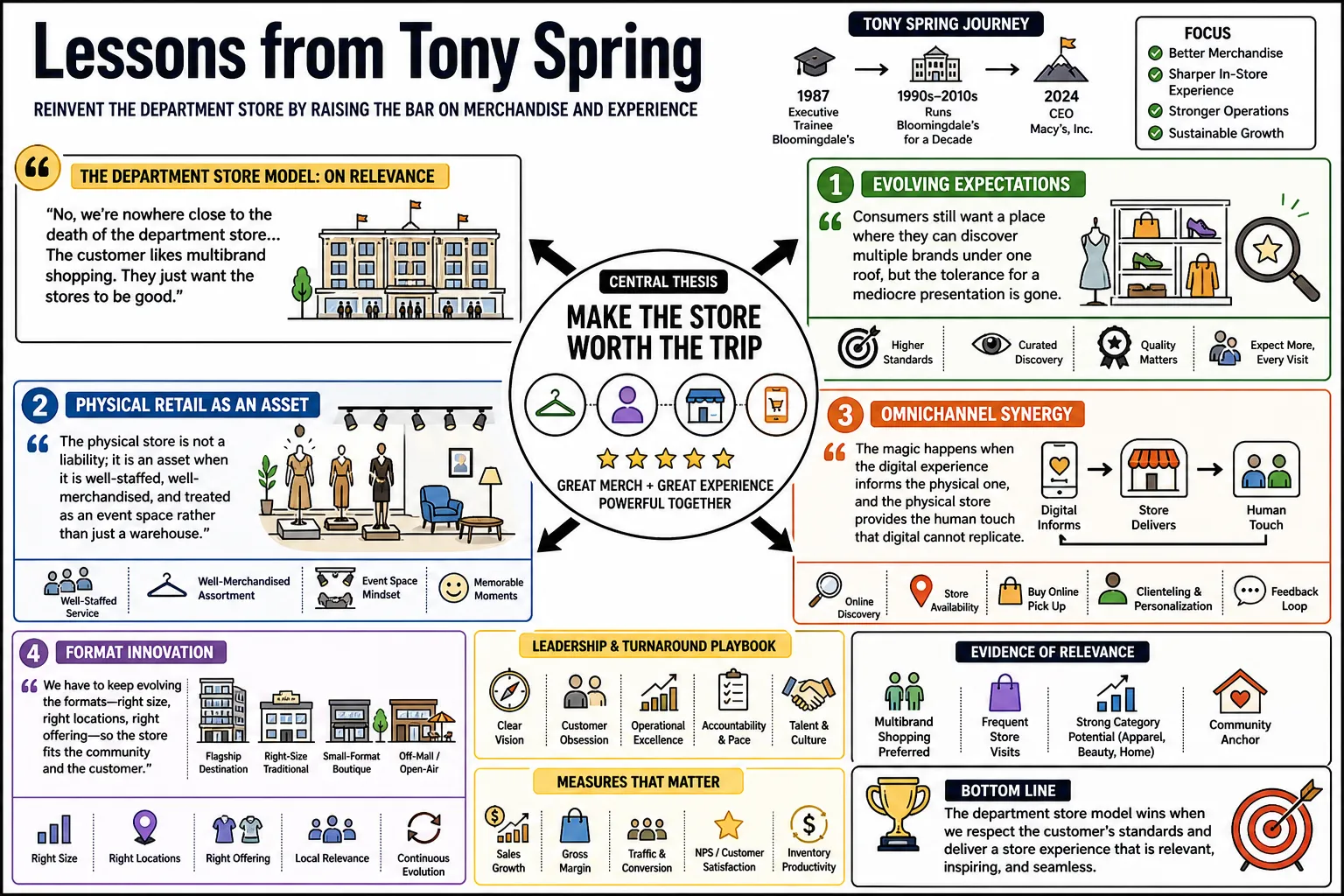
Tony Spring started as an executive trainee at Bloomingdale’s in 1987, eventually running the brand for a decade before taking over as CEO of Macy’s, Inc. in 2024. He has defended the traditional department store by focusing on better merchandise and a sharper in-store experience. This profile collects his thoughts on retail operations, leadership, and corporate turnarounds.
Part 1: The Department Store Model
- On the Model's Relevance: "No, we're nowhere close to the death of the department store... The customer likes multibrand shopping. They just want the stores to be good." — Source: [Semafor]
- On Evolving Expectations: "Consumers still want a place where they can discover multiple brands under one roof, but the tolerance for a mediocre presentation is gone." — Source: [Bloomberg]
- On Physical Retail: "The physical store is not a liability; it is an asset when it is well-staffed, well-merchandised, and treated as an event space rather than just a warehouse." — Source: [WWD]
- On Omnichannel Synergy: "The magic happens when the digital experience informs the physical one, and the physical store provides the human touch that digital cannot replicate." — Source: [CNBC]
- On Format Innovation: "We have to be willing to rethink the square footage. A successful department store today doesn't have to be the exact same size or shape as it was twenty years ago." — Source: [Retail Dive]
- On Brand Discovery: "A great multi-brand retailer acts as an editor for the consumer, cutting through the noise to present what is actually relevant right now." — Source: [The Wall Street Journal]
- On Community Hubs: "Our best stores serve as community centers where people come to buy a specific item, spend time, meet friends, and find inspiration." — Source: [Fast Company]
- On Convenience vs. Experience: "You cannot out-convenience the internet. You have to out-experience it, which means focusing heavily on visual merchandising and human interaction." — Source: [Fortune]
- On Retail Resilience: "Retail has always been a dynamic industry. The department stores that survive are the ones that treat their legacy as a foundation, not a constraint." — Source: [NRF]
Part 2: The "Bold New Chapter" Strategy
- On Strategic Necessity: "A turnaround requires honesty about what is working and what isn't. Closing underperforming stores is difficult but necessary to invest in the locations that can actually grow." — Source: [Bloomberg]
- On Complete Transformation: "I'm a big believer that you need strategy, you need culture, you need leadership, and you need execution. We're now at the point where those four elements are coming together." — Source: [Macy's, Inc.]
- On Resource Allocation: "You cannot starve your best assets to save the weakest ones. We are putting our capital where it will generate the highest return for the customer experience." — Source: [CNBC]
- On Small-Format Stores: "Moving away from the mall into strip centers with smaller, more curated footprints allows us to meet customers closer to where they live and work." — Source: [The Wall Street Journal]
- On Upgrading the Fleet: "The top 50 Macy's stores show what the brand is capable of. The goal is to bring that level of staffing, visual appeal, and product quality to the rest of the go-forward fleet." — Source: [WWD]
- On Pacing Change: "You have to move with urgency, but you cannot break the core operations while trying to fix the future. It is a balancing act." — Source: [Retail Dive]
- On Investor Scrutiny: "When you are a public company in transition, you have to block out the noise and focus on the metrics that actually drive the business: traffic, conversion, and customer satisfaction." — Source: [Bloomberg TV]
- On Modernizing Supply Chain: "A bold chapter is about what the customer sees on the floor and the invisible plumbing, like inventory management and logistics, that ensures the right product is actually there." — Source: [Supply Chain Dive]
- On Defining Success: "Success isn't merely a better margin this quarter; it is stabilizing the business so that it can reliably grow for the next decade." — Source: [Business Insider]
- On Execution Culture: "The best strategy on paper means nothing if the team on the ground doesn't understand it or doesn't have the tools to execute it." — Source: [Fast Company]
Part 3: Customer Experience & Listening
- On Reading Feedback: "I read every customer note that I receive. Listening to feedback is one of the most important ways we can improve and grow our business." — Source: [Business Insider]
- On Human Interaction: "Kindness, graciousness, and genuine care for customers cost absolutely nothing to provide, yet they are the most powerful drivers of loyalty." — Source: [Fast Company]
- On the Omnichannel Shopper: "The customer doesn't think in terms of online or in-store. They just think of the brand. Our job is to remove the friction between those touchpoints." — Source: [NRF]
- On Personalization: "Data should be used to make the customer feel recognized. It is the difference between a helpful recommendation and an intrusive one." — Source: [Vogue Business]
- On Resolving Complaints: "A complaint is a gift. It is a customer taking the time to tell you exactly how you failed and giving you a chance to fix it before they leave forever." — Source: [Forbes]
- On Store Environments: "Lighting, aisle width, and fitting rooms are customer experience issues that directly impact how people perceive the merchandise." — Source: [WWD]
- On Frontline Colleagues: "The associate on the floor is the brand. If they are disengaged, the customer is disengaged. We have to invest in their training and well-being." — Source: [Retail Dive]
- On Surprise and Delight: "Retail should be entertaining. If there isn't a moment of discovery or delight during a visit, we haven't done our jobs." — Source: [The Wall Street Journal]
- On Frictionless Returns: "How you handle a return often dictates whether that person will ever buy from you again. Make it easy, and you earn their trust." — Source: [Bloomberg]
- On Earning the Visit: "People don't have to come to the mall anymore. We have to give them a compelling reason to get in their cars and walk through our doors." — Source: [CNBC]
Part 4: Leadership & Talent Development
- On Career Longevity: "Staying at one company for decades isn't about being static; it is about finding new challenges and reinventing yourself within the organization." — Source: [WWD]
- On Executive Training: "Programs that rotate young talent through different departments are necessary. You cannot lead a retail company if you don't understand how the buying, planning, and stores connect." — Source: [Business of Fashion]
- On Decisive Leadership: "In periods of transition, you have to be more decisive and communicative. You can't rely on consensus for every move, but you must explain the 'why' behind the actions." — Source: [Fast Company]
- On Promoting from Within: "Institutional memory is incredibly valuable. When you promote internally, you elevate people who already understand the nuances of your culture." — Source: [Forbes]
- On Mentorship: "I wouldn't be where I am without mentors who told me the hard truths. As a leader, you owe it to your team to give them honest, actionable feedback." — Source: [NRF]
- On Embracing Failure: "If a new brand or concept doesn't work, we mark it down, clear it out, and learn from it. You have to create an environment where buyers aren't afraid to take calculated risks." — Source: [The Wall Street Journal]
- On Listening to the Frontline: "The people who interact with the customer every day usually know what's wrong with the business before the executives do." — Source: [Retail Dive]
- On Diverse Perspectives: "A merchant team needs to reflect the customer base. You make better buying decisions when you have diverse voices in the room challenging each other." — Source: [Vogue Business]
- On Leading Through Change: "Change fatigue is real. You have to celebrate the small wins along the way to keep the organization energized for the long haul." — Source: [Bloomberg]
Part 5: The Bloomingdale's Legacy
- On Brand Identity: "Bloomingdale's has always been about the intersection of fashion, entertainment, and pop culture. It is a distinctly New York energy that we translate to the rest of the country." — Source: [WWD]
- On Curating Luxury: "Accessible luxury is about making high-end fashion feel approachable without losing the aspiration." — Source: [Business of Fashion]
- On Visual Merchandising: "The windows at 59th Street are storytelling, rather than mere displays. That level of theatricality is what separates a great store from a transactional one." — Source: [The New York Times]
- On Vendor Relationships: "We treat our brand partners as true partners. We share data, we plan together, and we build shops that respect their aesthetic while fitting into our environment." — Source: [Vogue Business]
- On the Outlet Business: "The outlet shouldn't be a dumping ground; it has to be a thoughtfully merchandised extension of the brand for a more value-conscious customer." — Source: [Retail Dive]
- On Experiential Retail: "From in-store restaurants to pop-up shops, we always try to give the customer a reason to linger. Dwell time directly correlates to basket size." — Source: [Fast Company]
- On Adapting to Trends: "Fashion moves fast. If your buying cycle is too rigid, you miss the moment. We built a culture at Bloomingdale's that allowed us to chase trends aggressively." — Source: [WWD]
- On Maintaining Prestige: "You have to be careful with promotions. If everything is always on sale, you train the customer to wait, and you slowly erode the brand's perceived value." — Source: [The Wall Street Journal]
- On Global Appeal: "Even though it is an American brand, Bloomingdale's has a global resonance. International tourists seek it out because it represents a specific kind of curated lifestyle." — Source: [Bloomberg]
Part 6: Merchandising & Brand Curation
- On Inventory Discipline: "Buying too much of a mediocre product is the easiest way to hurt the bottom line. Inventory discipline is the foundation of profitable retail." — Source: [CNBC]
- On Private Brands: "A private label must offer more than a cheaper alternative to a national brand. It needs to have its own identity, quality, and reason for being." — Source: [Semafor]
- On Editing the Assortment: "More choice isn't always better choice. Sometimes the best service we can provide is removing the clutter and presenting a clear, edited point of view." — Source: [Retail Dive]
- On Emerging Designers: "Department stores have a responsibility to incubate new talent. It keeps our floors fresh and gives emerging designers the scale they need to survive." — Source: [Vogue Business]
- On Data in Merchandising: "Analytics will tell you what sold yesterday, but it takes merchant intuition to know what will sell tomorrow. You need both." — Source: [Business of Fashion]
- On Cross-Merchandising: "Customers don't shop in silos. If someone is buying a dress for an event, they need the shoes, the bag, and the cosmetics. The store layout should facilitate that journey." — Source: [WWD]
- On Seasonal Transitions: "Retail is about creating a sense of urgency. The floor needs to look completely different in October than it did in August." — Source: [The Wall Street Journal]
- On Quality Standards: "You can never compromise on fit and fabric. If a garment doesn't feel right, the customer will return it, and you've lost both the sale and their confidence." — Source: [Forbes]
- On Direct-to-Consumer Brands: "DTC brands eventually need physical distribution to scale. We offer them a highly trafficked platform to reach customers who want to touch and feel the product." — Source: [Bloomberg]
Part 7: Luxury Retail & Bluemercury
- On the Beauty Market: "Beauty is a highly resilient category. It is an accessible luxury that customers prioritize even when they are pulling back on larger apparel purchases." — Source: [CNBC]
- On Bluemercury's Growth: "Bluemercury operates with a neighborhood feel but offers premium products and expert advice. Expanding that fleet is a core part of our luxury strategy." — Source: [WWD]
- On Luxury Demographics: "Luxury appeals to more than an older demographic. The younger consumer is highly engaged with luxury brands, particularly in footwear, handbags, and skincare." — Source: [Business of Fashion]
- On Clienteling: "In luxury, the relationship between the associate and the client is everything. A good stylist manages a wardrobe instead of simply selling an item." — Source: [The New York Times]
- On Experiential Beauty: "Customers want to try things. Services like mini-facials and expert consultations turn a beauty purchase from a transaction into an experience." — Source: [Retail Dive]
- On the Aspirational Shopper: "There is a broad segment of consumers who mix high and low. They might buy a luxury handbag and pair it with a private-brand sweater. We have to serve that entire spectrum." — Source: [The Wall Street Journal]
- On Brand Exclusivity: "Offering brands or specific items that the customer can't find anywhere else gives them a definitive reason to shop with us instead of our competitors." — Source: [Vogue Business]
- On Store Design in Luxury: "The environment has to match the product. You cannot sell a two-thousand-dollar bag in a store that looks tired." — Source: [Bloomberg]
- On the True Definition of Luxury: "True luxury involves exceptional craftsmanship, limited availability, and impeccable service." — Source: [Forbes]
Part 8: Navigating Market Volatility
- On Consumer Spending Shifts: "The consumer is resilient but selective. They will spend when the value proposition is clear, but they won't settle for mediocrity." — Source: [CNBC]
- On Economic Headwinds: "We don't control the macroeconomic environment. We control our inventory, our expenses, and our customer service. You have to focus on what you can manage." — Source: [Bloomberg]
- On Promotional Pressures: "When the market gets promotional, you have to protect your margins. Sometimes it is better to walk away from unprofitable sales than to engage in a race to the bottom." — Source: [The Wall Street Journal]
- On Agility: "The ability to pivot quickly, whether that means canceling orders or reallocating labor, protects the business during volatile times." — Source: [Fast Company]
- On Historical Perspective: "Retail has survived recessions, pandemics, and the rise of e-commerce. The core human desire to shop and discover remains constant; only the methods change." — Source: [NRF]
- On Managing Stakeholders: "During tough times, transparency is your best asset. You have to be honest with your vendors, your employees, and your shareholders about the realities of the business." — Source: [Business Insider]
- On Supply Chain Disruptions: "A flexible supply chain is a competitive advantage. Diversifying your sourcing protects you when one region of the world experiences disruption." — Source: [Supply Chain Dive]
- On Holiday Shopping Trends: "The holiday season is shifting earlier, but the customer still waits for the final days to finish their list. You have to be ready to execute flawlessly in late December." — Source: [NBC News]
- On Post-Pandemic Retail: "The pandemic reminded people of the value of physical connection. We are seeing a return to stores because people missed the social aspect of shopping." — Source: [Retail Dive]
- On Long-Term Vision: "You cannot manage a legacy brand by only looking at the next quarter. You have to make decisions that ensure the company will still be relevant fifty years from now." — Source: [Semafor]