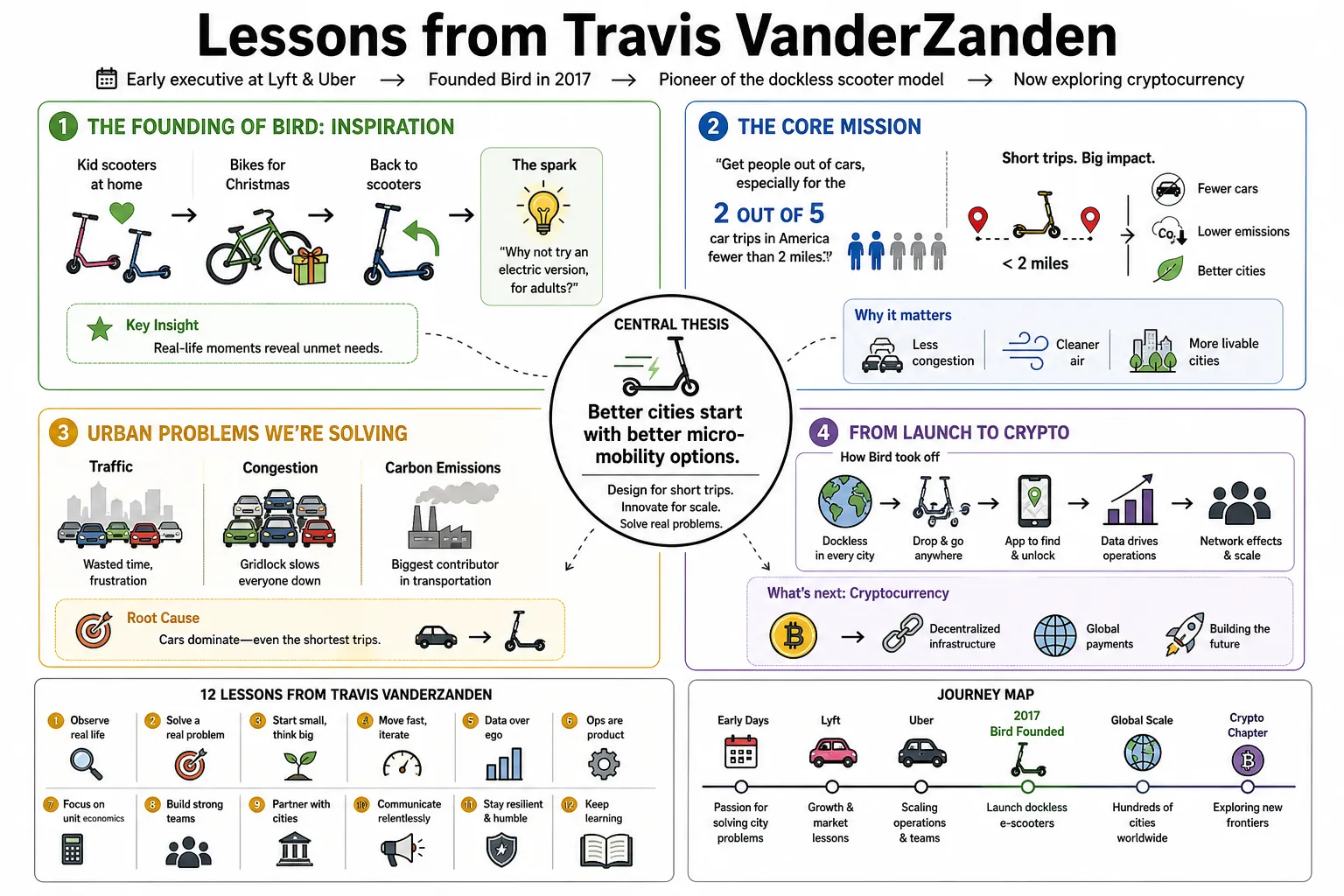
Lessons from Travis VanderZanden
Travis VanderZanden helped scale Lyft and Uber as an early executive before founding Bird in 2017. He popularized the dockless model, dropping electric scooters onto city streets to replace short car trips. This profile collects his views on scaling startups, urban infrastructure challenges, and his recent move into cryptocurrency.
Part 1: The Founding of Bird
- On the Inspiration: "My daughters had kid scooters, but the obvious choice in short-range electric vehicles for adults was a bike... I bought my daughters new bikes for Christmas and spent the afternoon teaching them to ride without training wheels. They had a great time—but the next day, they wanted to go back to their scooters. That made me think, 'Why not try an electric version, for adults?'" — Source: Sequoia Capital
- On the Core Mission: "We started Bird with the goal of getting people out of cars, especially for the two out of every five car trips in America that are fewer than two miles long." — Source: Bird Blog
- On Urban Problems: "Before Bird, I created Cherry... But at the end of the day, the biggest problems in transportation are traffic, congestion and carbon emissions—and cars are the center of the ride-hailing universe. Bird is the opposite; our mission is to get people out of cars." — Source: Sequoia Capital
- On the Experience of the Ride: "You take an Uber, a Lyft, you're in the back seat, you're on your screen, you're not really enjoying your city... When we first started Bird, we realized that we were now experiencing our city for the first time in a whole different way." — Source: CNBC
- On Exploring the City: "You can stop at a park on your journey from point A to point B, whereas if you're in ride-sharing or driving a car, you're just going from point A to point B." — Source: CNBC
- On Complementing Public Transit: "We're not replacing public transportation. We're the first- and last-mile solution that makes public transportation more connective and accessible." — Source: Sequoia Capital
- On the Environmental Goal: "Our mission is very strong: It's to remove cars from the road, reduce traffic, reduce carbon emissions. Every city in the world could benefit from that." — Source: Inc.
- On the Urgency for Change: "Cities today are built around cars, but they aren't built to handle the volume of driving that happens. And that's made simply moving from one place to another one of the most dangerous things we do, environmentally and beyond. We're going to need a lot of different innovations to kick our addiction to cars." — Source: Sequoia Capital
- On Defining the Category: The decision to use an off-the-shelf electric scooter was not an obvious one at the time, but doing so effectively created a completely new category in urban transportation. — Source: Forbes
Part 2: Lessons from Uber and Lyft
- On Early Growth at Lyft: "Incredibly proud of the growth @lyft over the last 18 months! 1 to 65 cities, more drivers than fedex, over 10M rides. Great crew." — Source: GeekWire
- On PR Attacks: When facing a lawsuit from Lyft, he publicly defended himself by calling the PR attacks ridiculous and describing them as an "audacious attack on my reputation." — Source: Yahoo News
- On the Early Scale of Lyft: His tenure saw the company transition from operating in a single market to becoming a major player across 65 cities in just a year and a half. — Source: GeekWire
- On Uber's International Expansion: Moving to Uber, his initial mandate involved driving the company's aggressive expansion into international markets like Spain and Germany amid stiff regulatory pushback. — Source: Business Insider
- On Driver Supply: At Uber, the key to scaling the platform globally relied heavily on managing driver growth to ensure that passenger demand was consistently met with adequate supply. — Source: Business Insider
- On Optimizing Driver Experience: The focus shifted from merely acquiring drivers to deeply optimizing their overall experience on the platform across the globe. — Source: Business Insider
- On Executive Competition: Moving directly from the COO role at Lyft to a VP role at Uber underscored the intense, high-stakes competition for leadership talent during the height of the rideshare wars. — Source: Time
- On Operational Scaling: The rapid hyper-growth experienced at both companies laid the operational groundwork and scaling strategies he would later apply to the launch of his own company. — Source: Los Angeles Business Journal
- On the Ride-Hailing Model: Despite the success of ride-hailing, he realized that placing people in the back seats of cars did not solve the fundamental issues of urban traffic and congestion. — Source: CNBC
Part 3: The Cherry Experience and Passion
- On Identifying a Pain Point: A business model might address a genuine pain point, like the inconvenience of getting a car washed in a busy city, and look great on paper, but that alone is insufficient. — Source: Sequoia Capital
- On Passion vs. Pain Points: To successfully build a company, solving a market inefficiency is not enough; the founder must possess a deep, genuine passion for the mission. — Source: Sequoia Capital
- On Sustaining Energy: Building and scaling a company is a grueling, multi-year commitment, and without personal enthusiasm, it becomes nearly impossible to maintain the excitement needed to tackle daily challenges. — Source: Sequoia Capital
- On First-Time Founder Mistakes: First-time entrepreneurs frequently make the error of focusing exclusively on solving a problem without assessing their own motivation for the long-term journey. — Source: Sequoia Capital
- On the "Terrible Idea": Looking back on the car wash startup, he later candidly referred to the concept as "a terrible idea" and actively advised other entrepreneurs not to try it. — Source: Inc.
- On Acquihire Outcomes: The acquisition of the car wash business by Lyft ultimately served as an acqui-hire, transitioning him into a crucial operational role in the rideshare industry. — Source: Wikipedia
- On Overcoming Scaling Hurdles: When unexpected obstacles inevitably arise during the scaling process, it is a founder's enthusiasm for the underlying mission that fuels the team's resilience. — Source: Sequoia Capital
- On Long-Term Commitment: Founders must evaluate whether the problem they are solving is one they are willing to dedicate years of their life to, beyond just the initial launch phase. — Source: Inc.
- On Meaningful Impact: The transition from a car wash service to micromobility represented a shift from addressing a minor inconvenience to tackling a massive global issue. — Source: Sequoia Capital
Part 4: Infrastructure and City Planning
- On Autonomous Vehicles vs. Scooters: "I love the stuff Elon's doing, but you know the deeper I get into transportation, the more I realize all we really... we don't need autonomous vehicles right now, we don't need tunnels, all we really need is more bike lanes." — Source: CNBC
- On Short-Term Infrastructure: "In the short term, we would love to see the cities evolve into more bike-friendly and more scooter-friendly cities." — Source: CNBC
- On the "Chicken and Egg" Problem: "The cities have always wanted to create more bike lanes... but they've always been in this chicken-and-egg problem where if they take away a lane from traffic or parking, people would be angry. And they didn't think Americans would actually get out of cars and use the bike lanes. And so we're hoping with Bird... we're showing that Americans will get out of cars." — Source: CNBC
- On Dedicated Parking: "More bike lanes are a great start. I think now on the infrastructure side we really need to work with cities to get more dedicated parking." — Source: Bird Blog
- On Safety and Cars: "I like to say you wear a helmet to stay safe because cars are dangerous. And anytime you're operating anything around cars, you should really wear a helmet." — Source: CNBC
- On Urban Density: E-scooters are particularly effective in dense city cores where traditional public transit is either unavailable or inconvenient for short, point-to-point travel. — Source: Micromobility.io
- On Downtown Parking Corrals: The long-term success of dockless vehicles requires cities to actively integrate dedicated micromobility parking spaces directly into their downtown infrastructure. — Source: Bird Blog
- On the Impact of COVID-19: The pandemic accelerated a shift in urban transportation, as cities became much more willing to repurpose street space for active mobility to accommodate socially distanced travel. — Source: Bird Blog
- On the Hierarchy of Roads: The introduction of small electric vehicles forces cities to reconsider how street space is allocated between pedestrians, small vehicles, and full-sized automobiles. — Source: CNBC
Part 5: Founder Advice and Leadership
- On Treating Cities as Customers: Startups in the urban innovation space must recognize city governments as their most important stakeholders and customers from the very beginning. — Source: Sequoia Capital
- On Early Regulatory Friction: Launching without viewing cities as partners initially led to unnecessary friction and regulatory pushback, a lesson learned the hard way. — Source: Sequoia Capital
- On Collaboration over Disruption: Building a collaborative, cooperative relationship with local regulators is absolutely essential for the long-term viability of a transportation startup. — Source: Sequoia Capital
- On Resilience in Leadership: Setbacks, legal challenges, and intense market competition should be viewed as critical opportunities to pivot and refine strategy. — Source: Inc.
- On Learning from Other Founders: Aspiring entrepreneurs should actively study the stories of past founders, using resources like Phil Knight's Shoe Dog to understand the necessity of perseverance. — Source: Sequoia Capital
- On Managing Volatility: A strong, shared enthusiasm for the company's core mission is the only way a team can successfully navigate the extreme volatility of the modern startup ecosystem. — Source: Sequoia Capital
- On Team Motivation: Aligning a team around a massive, world-changing goal like reducing global carbon emissions is vastly more effective for motivation than purely financial targets. — Source: Inc.
- On Adapting to Change: A founder must remain flexible and willing to adjust the business model as new data regarding consumer behavior and regulatory requirements emerges. — Source: Sequoia Capital
- On Scaling Execution: Ideas matter, but the ability to execute aggressively and scale operations across multiple markets simultaneously is what separates successful companies from the rest. — Source: Los Angeles Business Journal
Part 6: The Evolution of Micromobility
- On the "iPhone Moment": "I don't think we've hit the iPhone moment yet in micromobility." — Source: Bird Blog
- On Hardware Maturity: Current e-scooters can be compared to early mobile phones like the Motorola Razr. They are functional and highly popular, but the industry is still waiting for a truly revolutionary hardware design. — Source: Bird Blog
- On Form Factor Agnosticism: Companies in the space must remain form factor agnostic, avoiding attachment to a single vehicle type in order to adapt to what users actually want. — Source: Bird Blog
- On Research and Development: Significant investment in research and development is necessary to discover the next major breakthrough in small vehicle transportation that can legitimately replace gas-powered cars. — Source: Bird Blog
- On Consumer Preferences: The ultimate goal is to provide a portfolio of vehicle options, recognizing that different users and different trips require different physical form factors. — Source: Micromobility.io
- On Hardware Durability: A major challenge for the early industry was operating with consumer-grade hardware; the transition to rugged, custom-built vehicles is necessary for stable unit economics. — Source: Inc.
- On the Pace of Innovation: The hardware iteration cycle in the micromobility sector must move incredibly fast to keep up with the physical demands placed on the vehicles by the public. — Source: Bird Blog
- On Global Adoption: The appeal of small electric vehicles is not limited to the United States; the demand for clean, short-range transport is a universal phenomenon across global cities. — Source: Inc.
- On the Long-Term Vision: The end state of the industry is a fundamental shift in how human beings perceive and utilize urban geography. — Source: Micromobility.io
- On Public Sentiment: Normalizing the presence of small electric vehicles on city streets takes time, requiring a gradual shift in public sentiment away from car-centric thinking. — Source: CNBC
Part 7: Transition to Crypto and Buck
- On the "Bitcoin Dollar": He introduced Buck as the "Bitcoin Dollar," positioning it as a distinct product sitting between traditional fiat-backed stablecoins and the pure volatility of Bitcoin. — Source: CNBC
- On Savings vs. Checking: While standard stablecoins act like a checking account for moving money, Buck is designed to function as the savings layer of the crypto stack. — Source: Shutri.com
- On Predictable Returns: The project aims to provide predictable returns for users who want to earn rewards in the cryptocurrency space without taking on the risk of being pure speculators. — Source: Shutri.com
- On the "Aha Moment": The inspiration for the project came from observing the tokenization potential of Bitcoin-linked financial products, specifically Strategy Inc.'s preferred shares. — Source: CNBC
- On Treasury Structure: The yields generated for the token are indirectly funded through the project's treasury holdings of Bitcoin-collateralized perpetual preferred stock. — Source: Bitcoin.com
- On Accrual Mechanisms: The financial architecture is designed so that rewards accrue continuously, block-by-block or minute-by-minute, without forcing users to lock up their assets. — Source: CoinMarketCap
- On Decentralized Access: The overarching goal is to make sophisticated, yield-bearing financial products accessible to the broader decentralized finance market. — Source: CNBC
- On Governance: The asset is structured as a governance token, giving holders the ability to vote on how earnings and treasury funds are distributed. — Source: Bitcoin.com
- On the Shift in Focus: After a brief period exploring the artificial intelligence space, he found himself drawn more deeply into the possibilities of Bitcoin and decentralized finance. — Source: CNBC
- On the Future of Bitcoin: He has theorized that over the next several decades, as Bitcoin becomes less volatile, it may eventually replace bridge assets like Buck entirely. — Source: CNBC
Part 8: Business Philosophy and Perspective
- On Solving Global Issues: True business value is created when a company actively tackles massive, systemic problems rather than simply chasing incremental software improvements. — Source: Sequoia Capital
- On the Speed of Execution: The rapid scaling models pioneered in the early days of ride-hailing established a new baseline for how quickly consumer startups must execute to survive. — Source: Business Insider
- On Regulatory Moats: Navigating complex local regulations is an operational challenge; mastering this process creates a significant competitive advantage against new entrants. — Source: Sequoia Capital
- On Market Timing: Launching an entirely new hardware category requires precision timing, capturing consumer attention exactly when dissatisfaction with the status quo is at its peak. — Source: Forbes
- On Consumer Habituation: Once consumers experience a fundamentally better or more enjoyable way to accomplish a routine task, it is very difficult to force them back to the old method. — Source: CNBC
- On Bridging Digital and Physical: The most impactful modern startups use digital platforms to fundamentally alter physical human behavior in the real world. — Source: Inc.
- On the Utility of Simple Tech: Innovation does not always require inventing entirely new technologies; sometimes, it is as simple as applying a battery and an app to an existing children's toy. — Source: Forbes
- On Managing Stakeholders: A successful CEO must constantly balance the competing demands of venture capitalists, city regulators, consumers, and internal team members without losing sight of the core mission. — Source: Sequoia Capital
- On the Burden of Leadership: Moving from an operational role to the founder seat means bearing the ultimate responsibility for the company's culture, mission, and survival through market downturns. — Source: Inc.
- On Legacy: Whether in ridesharing, micromobility, or decentralized finance, the consistent thread of his career has been the pursuit of new models that challenge entrenched legacy systems. — Source: Wikipedia