Trina Spear is the co-founder and CEO of FIGS, a direct-to-consumer healthcare apparel company she launched to provide high-performance workwear to medical professionals. Before FIGS, she worked in investment banking, applying her background in financial structuring to build a highly capital-efficient retail operation. This profile examines her approach to vertical integration, her strategy for de-commoditizing an established industry, and the business mechanics of community-driven retail.
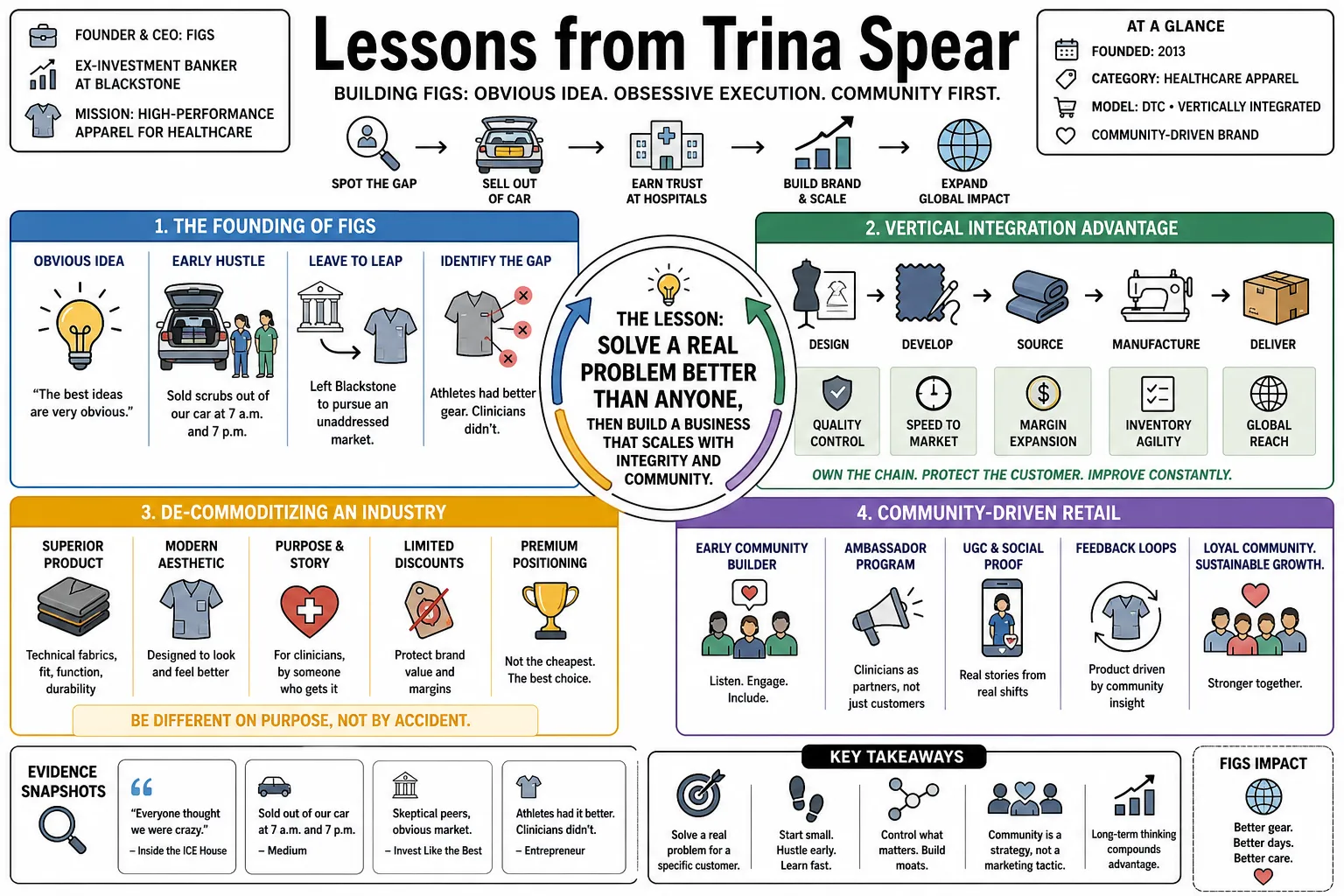
Part 1: The Founding of FIGS
- On obvious ideas: "The best ideas are, I think, are very obvious. Even though everyone thought we were crazy, it was obvious that this should exist." — Source: Inside the ICE House
- On early hustle: "In the beginning, we sold scrubs directly out of our car, waiting outside hospitals during shift changes at 7 a.m. and 7 p.m. to talk directly to nurses and doctors." — Source: Medium
- On leaving finance: Shopify Masters frames Spear's move out of Wall Street as a bet on a neglected healthcare-workwear market that looked obvious once she saw how poorly medical professionals were being served. — Reference: Shopify Masters episode with Trina Spear on building FIGS
- On identifying the gap: "While professional athletes had access to cutting-edge performance gear, there was no major brand dedicated solely to the needs of healthcare workers, despite the physical demands of their jobs." — Source: FIGS
- On early validation: "The immediate reaction from medical professionals trying on our initial prototypes validated the core premise: healthcare workers desperately wanted better uniforms." — Source: Kara Goldin Show
- On funding challenges: "Early investors struggled to understand the market size and the emotional connection healthcare professionals could have with their workwear." — Source: Shopify Masters
- On the initial product focus: "The initial goal was simply to fix the fit and fabric of scrubs, moving away from the boxy, scratchy materials that had been standard since the 1950s." — Source: Tufts University
- On naming the company: "The name FIGS was chosen because it represents a fruit that is restorative, nutritious, and sustaining, mirroring the intended impact of the apparel on medical professionals." — Source: Leaders Mag
- On early supply chain hurdles: "Finding manufacturers willing to produce technical, high-quality fabrics for a startup scrub company required persistence and a refusal to accept the industry standard." — Source: In Search of Excellence
- On complementary skills: "I brought the financial structuring and operational rigor, while Heather brought the initial product vision and design intuition." — Source: LA Times
Part 2: De-Commoditizing the Scrub Industry
- On shifting categories: The Invest Like the Best episode describes FIGS as a category-leading brand that took a plain-vanilla scrub purchase and rebuilt it as a branded consumer experience with vertical integration and customer obsession. — Reference: Apple Podcasts listing for Invest Like the Best with Trina Spear
- On unbranded markets: "Before FIGS, the scrub industry was largely composed of low-quality, licensed manufacturers selling unbranded goods to third-party wholesalers." — Source: Shopify Masters
- On fabric innovation: "We developed proprietary materials like FIONx fabric to ensure four-way stretch, anti-wrinkle properties, and moisture-wicking capabilities." — Source: FIGS
- On elevating the uniform: "By applying technical fabric technology and high-end design, the company sought to elevate the status of the uniform itself." — Source: Leaders Mag
- On emotional resonance: "A better uniform changes how a professional feels and carries themselves during a demanding shift, beyond improving physical comfort alone." — Source: Inside the ICE House
- On premium positioning: "Establishing a premium price point was necessary to support the research, development, and high-quality materials required for the garments." — Source: Modern Retail
- On breaking the licensing model: Shopify Masters presents FIGS as a direct brand built to own the full healthcare-apparel experience, which matches Spear's preference for controlling product quality and brand standards rather than outsourcing them to the old market structure. — Reference: Shopify Masters episode with Trina Spear on building FIGS
- On consistent sizing: "A major flaw in the legacy scrub market was inconsistent sizing; standardizing fit was required to build repeat customer trust." — Source: Kara Goldin Show
- On color drops: "Treating scrub colors like streetwear drops created a sense of urgency, excitement, and fashionability in a previously stagnant category." — Source: Shopify Masters
- On answering skepticism: "When investors asked why people getting blood on themselves cared about clothing, we proved that functionality and aesthetics are not mutually exclusive." — Source: Marie Claire
Part 3: Customer Obsession and Community
- On minimum acceptable standards: "We like to say the worst customer experience is no customer experience at all." — Source: Goldman Sachs
- On granular feedback: "Waiting outside hospitals in the early days allowed us to gather immediate, unfiltered data on pocket placement, waistbands, and fabric feel." — Source: Medium
- On Awesome Humans: "We frequently refer to healthcare professionals as Awesome Humans, embedding respect for the customer directly into the company's internal language." — Source: FIGS
- On word-of-mouth growth: "What’s so differentiating about our company is that so much of it is driven by word of mouth. Every healthcare professional is a walking billboard." — Source: Modern Retail
- On modern service: "We advocate for maintaining old-fashioned customer service with a modern twist to build a deeply loyal community." — Source: Inside the ICE House
- On the ambassador program: "We invest heavily in an ambassador program to maintain a one-to-one, authentic relationship with healthcare professionals on social media." — Source: Shopify Masters
- On deep understanding: "This is only possible by understanding our community at the most fundamental level so we can serve them in the most meaningful and empowering way." — Source: FIGS
- On listening at scale: Inside the ICE House says Spear built FIGS around mining data and pairing it with close customer contact, showing how the company tried to preserve learning loops even after the parking-lot phase ended. — Reference: Inside the ICE House episode with Trina Spear
- On representation in marketing: "Using real medical professionals in campaigns rather than standard models built credibility and demonstrated a genuine understanding of the target audience." — Source: Tufts University
- On humanizing healthcare: "Healthcare is human; it focuses on the people doing the work, rather than the institutions they work for." — Source: TMX
Part 4: Rethinking Retail and Distribution
- On direct-to-consumer necessity: Shopify Masters describes FIGS as a direct-to-consumer powerhouse, reflecting Spear's view that the brand needed an owned channel to deliver a better buying experience than the legacy scrub market allowed. — Reference: Shopify Masters episode with Trina Spear on building FIGS
- On vertical integration: "Maintaining a heavy focus on DTC allowed us to retain absolute control over the customer experience and the brand narrative." — Source: Shopify Masters
- On bypassing wholesale: "Bypassing traditional medical supply stores enabled higher margins, which were then reinvested into fabric technology and community building." — Source: Modern Retail
- On speed of feedback: "The DTC model creates a tight feedback loop, allowing the company to rapidly iterate on designs based on direct purchasing data and reviews." — Source: Kara Goldin Show
- On controlling the environment: "Selling through our own channels meant we didn't have to compete on crowded, poorly lit racks next to inferior products." — Source: Leaders Mag
- On data ownership: Inside the ICE House explicitly ties FIGS's growth to mining data, which supports Spear's operating belief that owning the relationship also gives the company better information about customers and demand. — Reference: Inside the ICE House episode with Trina Spear
- On inventory management: "The direct model allows for leaner, more precise inventory management based on real-time geographic and demographic purchasing trends." — Source: Goldman Sachs
- On digital storefronts: "We view the e-commerce platform as a digital hub for the healthcare community to engage with the brand, rather than a mere storefront." — Source: In Search of Excellence
- On scaling operations: "Building proprietary backend logistics was as important to the company's success as the apparel design itself." — Source: Inside the ICE House
Part 5: Leadership and Co-Founder Dynamics
- On co-leadership: "I think it’s an amazing thing to have two leaders that care as much as me and Heather at the top. I think it really does work for us." — Source: Inside the ICE House
- On clear divisions of labor: "We maintain a clear division of roles, focusing heavily on operations, finance, and strategy to prevent overlap and friction." — Source: LA Times
- On outworking competitors: "There is a sheer necessity of persistence and a willingness to outwork incumbents who are slow to adapt." — Source: Shopify Masters
- On hiring for mission: "Building the team required finding operators and creatives who fundamentally respected the healthcare profession and understood the company's core mission." — Source: Leaders Mag
- On making a greater impact: "Leaving Wall Street was driven by a desire to build a tangible business that directly improved people's daily lives." — Source: Tufts University
- On leading through data: Inside the ICE House presents Spear as someone who combines old-fashioned customer service with modern data work, suggesting that the emotional brand and the operating system underneath it are meant to reinforce one another. — Reference: Inside the ICE House episode with Trina Spear
- On female leadership: "We became the first female co-founders and co-CEOs to take a company public, setting a precedent in the financial markets." — Source: Medium
- On trusting intuition: "Alongside the data, I learned to trust my co-founder's intuition regarding product feel, aesthetic trends, and brand voice." — Source: Kara Goldin Show
- On maintaining focus: "As the company scaled, leadership required saying no to adjacent product lines that distracted from the core medical apparel mission." — Source: In Search of Excellence
Part 6: Navigating Skepticism and Resilience
- On early rejections: "We faced nearly a thousand nos from venture capitalists who failed to see the potential in a niche uniform market." — Source: Shopify Masters
- On controlling what you can: "You must focus strictly on what can be controlled, especially when building a brand in a skeptical market." — Source: Kara Goldin Show
- On proving the model: Invest Like the Best frames FIGS as a hidden-in-plain-sight opportunity that became a multi-billion-dollar public company through vertical integration and customer obsession, which is the clearest public proof point behind Spear's pitch to skeptics. — Reference: Apple Podcasts listing for Invest Like the Best with Trina Spear
- On ignoring industry norms: "By refusing to operate within the established rules of the medical supply industry, we were viewed as an outsider, which ultimately became our strength." — Source: Inside the ICE House
- On the value of persistence: "The transition from a secure finance job to waiting outside hospitals at dawn required a high tolerance for discomfort and rejection." — Source: Tufts University
- On reframing the narrative: "When investors asked why scrubs mattered, we reframed the question to ask why the people saving lives didn't deserve high-performance gear." — Source: Marie Claire
- On capital efficiency: "The early difficulty in raising capital forced the company to become highly capital-efficient, prioritizing profitability and unit economics early on." — Source: Leaders Mag
- On breaking molds: "Going public as female co-CEOs required navigating a traditional Wall Street environment that was largely unaccustomed to our leadership structure." — Source: Medium
- On maintaining conviction: "Despite the initial friction, we maintained absolute conviction that a premium, branded approach to scrubs would eventually win the market." — Source: In Search of Excellence
Part 7: Empowering Healthcare Professionals
- On the core mission: "Since day one, FIGS has been on a mission to improve the lives of healthcare workers globally." — Source: FIGS
- On advocacy: "We extend our empowerment mission beyond apparel by engaging in advocacy programs in Washington D.C. to support the well-being of medical staff." — Source: Leaders Mag
- On emotional well-being: "Providing a dignified, comfortable uniform directly impacts the emotional well-being and confidence of healthcare workers." — Source: Tufts University
- On high-production storytelling: "We invest in high-quality storytelling to highlight the real lives, struggles, and triumphs of medical professionals, treating them as heroes." — Source: Shopify Masters
- On the relationship with insurance: In Inspired, Spear talks about quickly pivoting during COVID and about serving healthcare professionals through real stress points, which supports a broader lesson that providers need more support from the systems around them, not more friction. — Reference: Inspired with Alexa von Tobel episode with Trina Spear
- On community support: "Our messaging consistently reinforces that medical professionals are part of a global, supportive community, rather than isolated workers." — Source: Inside the ICE House
- On addressing burnout: "By acknowledging the grueling nature of the profession, we position our products as a small but meaningful way to reduce daily friction." — Source: Modern Retail
- On professional identity: Made By Women describes FIGS as an effort to revolutionize medical workwear with fashionable, well-made scrubs, supporting Spear's view that better uniforms can reinforce pride and self-respect for healthcare professionals. — Reference: Made By Women episode with Trina Spear
- On philanthropic efforts: "Our Threads for Threads initiative donates scrubs to healthcare professionals in resource-poor countries, aligning corporate growth with global impact." — Source: FIGS
Part 8: Scaling and the Future of the Brand
- On international expansion: "Our goal over the coming years is to scale into more countries... It’s really all about becoming an iconic brand over the next 100 years." — Source: Goldman Sachs
- On category expansion: "We view the company's future as outfitting the entire lifestyle of the medical professional, including outerwear, loungewear, and footwear." — Source: Shopify Masters
- On maintaining authenticity at scale: Inspired says public-company leadership forced FIGS to improve what was not working while staying close to its user community, a useful summary of Spear's challenge in scaling without losing the intimacy of the early direct model. — Reference: Inspired with Alexa von Tobel episode with Trina Spear
- On utilizing data for growth: "Continued scaling relies heavily on utilizing massive amounts of proprietary customer data to predict trends and optimize inventory." — Source: Leaders Mag
- On defining a new sector: "We aim to solidify healthcare apparel as a permanent, standalone retail category, much like athleisure became a defined sector." — Source: In Search of Excellence
- On long-term vision: "We view FIGS as an enduring heritage brand that will serve generations of medical professionals, looking beyond its status as a successful startup." — Source: Kara Goldin Show
- On continuous innovation: "Scaling requires a continuous investment in material science and fabric technology to stay ahead of new entrants in the modernized scrub market." — Source: Inside the ICE House
- On institutional partnerships: "Expanding our reach involves selectively partnering with medical institutions while maintaining our core identity as a direct-to-consumer brand." — Source: Modern Retail
- On the ultimate goal: "The overarching objective remains unchanged: to ensure that every healthcare professional in the world has access to apparel that enables them to perform at their best." — Source: FIGS