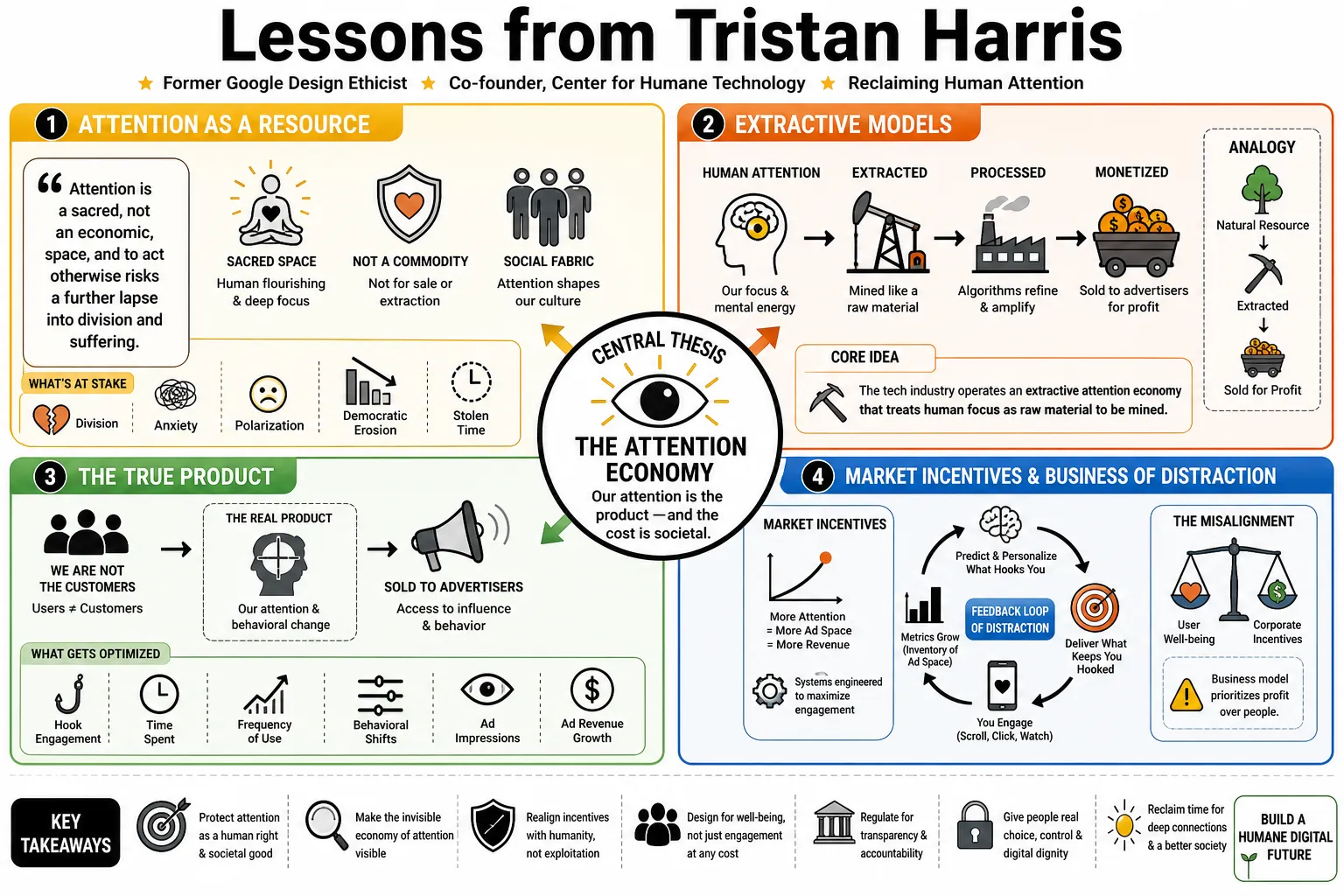
Lessons from Tristan Harris
Tristan Harris is a former Google design ethicist and co-founder of the Center for Humane Technology. He argues that digital platforms are intentionally built to exploit psychological vulnerabilities, driving an attention economy that destabilizes society. This profile outlines his core ideas on how persuasive technology manipulates behavior and what structural changes are needed to fix it.
Part 1: The Attention Economy
- On Attention as a Resource: "Attention is a sacred, not an economic, space, and to act otherwise risks a further lapse into division and suffering." — Source: [Medium]
- On Extractive Models: He describes the tech industry as an extractive attention economy where human focus is treated as raw material to be mined. — Source: [Forbes]
- On the True Product: We are not the customers; our attention and the incremental shifts in our behavior are the actual products being sold to advertisers. — Source: [The Social Dilemma]
- On Market Incentives: Technology companies are engineered to hook users in order to increase the inventory of ad space they can sell, rather than to serve user interests. — Source: [Timely]
- On the Business of Distraction: The business model of the internet is fundamentally misaligned with human well-being, as it profits from maximizing time on device. — Source: [Center for Humane Technology]
- On Competing for Time: The tech industry is engaged in a zero-sum race to monopolize the finite resource of human waking hours. — Source: [Your Undivided Attention]
- On the Cost of Free Services: Free digital services are paid for by degrading our individual and collective attention spans over time. — Source: [Wired]
- On Redesigning the Economy: It is time to redesign the attention economy so that it respects human limitations rather than exploiting them for engagement metrics. — Source: [Medium]
- On Attention Economics: Our minds are the battleground where the world's most valuable companies compete for a fraction of a second of engagement. — Source: [TED]
- On the Limit of Attention: While processing power scales infinitely, human attention is strictly bounded, creating a structural conflict between tech growth and human capacity. — Source: [Center for Humane Technology]
Part 2: Human Vulnerabilities
- On the Brain's Weaknesses: "Social media downgrades humanity with artificial intelligence that has gotten very good at exploiting our weaknesses." — Source: [Forbes]
- On Intermittent Reinforcement: Apps use the same psychological mechanisms as slot machines, specifically intermittent variable rewards, to keep users unpredictably hooked. — Source: [Goodreads]
- On Asymmetric Warfare: The supercomputers powering social feeds are pointed at our brains to predict and exploit our psychological tendencies better than we understand them ourselves. — Source: [The Social Dilemma]
- On the Digital Pacifier: "We're training and conditioning a whole new generation of people that when we are uncomfortable... we have a digital pacifier for ourselves." — Source: [Utah Statesman]
- On Fear of Missing Out: Tech design weaponizes our innate social anxieties and the fear of missing out to compel constant checking of devices. — Source: [Time]
- On Social Approval: Features like likes and read receipts hack our evolutionary need for social validation, tying our self-worth to engagement metrics. — Source: [Your Undivided Attention]
- On Emotional Manipulation: The algorithms actively filter for content that triggers high-arousal emotions like outrage or fear because those states reliably increase screen time. — Source: [Center for Humane Technology]
- On Cognitive Atrophy: Constant reliance on digital platforms for emotional regulation prevents people from developing internal resilience against boredom and anxiety. — Source: [Utah Statesman]
- On Hijacking Instincts: Persuasive design circumvents our rational thinking and targets the brain stem, triggering autonomic responses before we can consciously intervene. — Source: [TED]
Part 3: The Illusion of Choice
- On Menu Design: By shaping the menus of options we see on our screens, technology subtly hijacks our perception of what choices are available. — Source: [Goodreads]
- On Free Will: "The ultimate freedom is a free mind, and we need technology that’s on our team to help us live, feel, think and act freely." — Source: [Goodreads]
- On Daily Habits: "The average person checks their phone 150 times a day. Why do we do this? Are we making 150 conscious choices?" — Source: [Goodreads]
- On Manufactured Needs: The design of notifications creates a false sense of urgency, manufacturing needs that did not exist prior to interacting with the device. — Source: [TED]
- On Algorithmic Determinism: The feed curates reality to such a degree that users believe they are exploring freely while actually following a highly optimized path. — Source: [Your Undivided Attention]
- On Opt-Out Friction: Platforms employ dark patterns to make disconnecting or restricting permissions cognitively exhausting, ensuring users remain trapped by default. — Source: [Center for Humane Technology]
- On True Agency: Restoring choice requires moving away from the all-or-nothing terms of service that force users to accept exploitation in exchange for utility. — Source: [Freedom.to]
- On Subconscious Triggers: Designers know how to plant a thought in a user's mind simply by vibrating a phone in their pocket. — Source: [TED]
- On the Autoplay Feature: Removing stopping cues, such as automatically loading the next video or endless scrolling, strips the user of the moment needed to consciously disengage. — Source: [Center for Humane Technology]
- On Defining Freedom: Real freedom in the digital age requires tools that let us set our intentions in advance, without interference from engagement algorithms. — Source: [Clear Space Living]
Part 4: Shared Reality and Polarization
- On Fragmented Reality: "I think what I'm most concerned about is the shredding of a shared meaning-making environment and joint attention into a series of micro realities." — Source: [80,000 Hours]
- On the Fun House Mirror: Social media algorithms act as a fun house mirror that distorts reality, amplifying fringe conspiracies and outrage to maintain user engagement. — Source: [Medium]
- On Existential Threats: The destruction of objective conversation is an existential threat to democratic institutions and the functioning of civil society. — Source: [Medium]
- On Outrage Contagion: The most efficient way to maximize engagement is to show users content that enrages them about their political or social out-groups. — Source: [Your Undivided Attention]
- On Consensus Building: Technology that optimizes for personal engagement inherently destroys the overlap of shared facts required to build consensus. — Source: [The Social Dilemma]
- On Epistemic Chaos: By rewarding sensationalism over truth, platforms create an information environment where facts are indistinguishable from weaponized fiction. — Source: [Center for Humane Technology]
- On Filter Bubbles: Users are isolated in algorithmic echo chambers that validate their biases while simultaneously convincing them that the other side is irredeemable. — Source: [TED]
- On the Breakdown of Trust: The continuous exposure to synthetic controversies deteriorates baseline trust in neighbors and public institutions. — Source: [80,000 Hours]
- On Democratic Vulnerability: Authoritarian actors do not need to invent divisions; they simply exploit the existing algorithmic architecture to paralyze democratic nations from within. — Source: [Your Undivided Attention]
Part 5: Social Media Mechanics
- On Concentrated Power: "Never before in history have 50 designers made decisions that would have an impact on two billion people." — Source: [Atlantis Learning]
- On Notification Logic: Billions of people have thoughts they did not intend to have because a designer dictated how notifications populate a lock screen. — Source: [Atlantis Learning]
- On the Race for Engagement: The core driving force behind social media product evolution is the escalating race to capture and retain user attention at all costs. — Source: [Podcast Transcript AI]
- On Algorithmic Indifference: The recommendation engines do not know the difference between truth and falsehood; they only measure what keeps the user scrolling. — Source: [The Social Dilemma]
- On Fake News Dissemination: False information travels significantly faster and deeper on social networks because it is highly novel and emotionally triggering. — Source: [Your Undivided Attention]
- On Engineering Addiction: Platforms deploy teams of psychologists and data scientists to A/B test features that bypass rational thought and form compulsive habits. — Source: [Center for Humane Technology]
- On AI-Generated Notifications: Many alerts are calculated prompts generated by machine learning to lure users back into the app, rather than organic messages from friends. — Source: [80,000 Hours]
- On Gamification: Social interactions have been gamified into metrics like followers and streaks, reducing human connection to a competitive performance. — Source: [TED]
- On the Attention Arms Race: Companies cannot unilaterally disarm; if one platform makes its feed less addictive, a competitor will immediately capture the lost attention. — Source: [Center for Humane Technology]
- On Invisible Influence: The interface of an app is an invisible architecture that steers mass behavior with more precision than any traditional propaganda. — Source: [The Social Dilemma]
Part 6: Artificial Intelligence Risk
- On the Race to Recklessness: The current AI landscape is an arms race where speed and market dominance are prioritized over safety and human well-being. — Source: [AI race to recklessness]
- On Unintended Consequences: "Humane technologists are aware of the arms races their creations could set off before those creations run away from them." — Source: [Center for Humane Technology]
- On Systemic Coordination: "If we don't coordinate, the race will end in tragedy. No one company or actor can solve these systemic problems alone." — Source: [Center for Humane Technology]
- On Evolving Responsibility: "When we invent a new technology, we uncover a new class of responsibility. It is no longer okay to say it's someone else's job to define what responsibility means." — Source: [Center for Humane Technology]
- On Societal Destabilization: The deployment of generative AI acts like a Jenga tower, adding incredible capabilities at the top while pulling foundational stability out from the bottom. — Source: [The AI Dilemma]
- On Scaling Misinformation: AI drastically lowers the cost of producing convincing disinformation, threatening to flood digital channels beyond human capacity to moderate. — Source: [Center for Humane Technology]
- On First Contact: Social media was humanity's first contact with artificial intelligence, and the fact that we lost control of our attention bodes poorly for navigating generative AI. — Source: [Your Undivided Attention]
- On the Apocaloptimist Perspective: We must acknowledge the severe risks of an AI apocalypse while maintaining that collective action can still steer development toward a better future. — Source: [Reddit]
- On Autonomous Agents: The shift from algorithms that curate content to AI agents that execute actions introduces a completely new paradigm of uncontrollable externalities. — Source: [Center for Humane Technology]
Part 7: Humane Design
- On Time Well Spent: Success in tech design must be redefined, shifting the core metric away from time spent and moving toward time well spent. — Source: [Time Well Spent]
- On Digital Exoskeletons: "We need our smartphones, notifications screens and web browsers to be exoskeletons for our minds and interpersonal relationships that put our values, not our impulses, first." — Source: [Goodreads]
- On Intentional Interfaces: Technology should prompt users to ask, "In your life, what would be time well spent for you?" rather than forcing impulsive actions. — Source: [Goodreads]
- On Protecting Time: "People's time is valuable. And we should protect it with the same rigor as privacy and other digital rights." — Source: [Goodreads]
- On Ethical Boundaries: Humane design requires developers to recognize the psychological vulnerabilities of users and treat those weaknesses as off-limits for monetization. — Source: [Atlantis Learning]
- On Friction as a Feature: Adding intentional friction, such as pausing before loading a feed, can give users the cognitive breathing room needed to disengage. — Source: [Center for Humane Technology]
- On Notification Filtering: Users should be able to radically turn off all notifications except when a genuine human being is asking for their attention. — Source: [80,000 Hours]
- On Algorithmic Transparency: A humane interface allows the user to see and adjust the parameters of the recommendation engine, returning curation control to the individual. — Source: [Center for Humane Technology]
- On Aligning Incentives: True humane tech is impossible as long as the underlying corporate financial model depends strictly on behavioral extraction. — Source: [TED]
Part 8: Regulation and Solutions
- On Systemic Overhaul: Solving the attention crisis requires a comprehensive shift in how tech companies are legally and financially structured, rather than relying on individual willpower. — Source: [Your Undivided Attention]
- On Fiduciary Duty: Tech platforms that mediate our relationships and information should be treated as fiduciaries, legally obligated to act in the best interests of their users. — Source: [Center for Humane Technology]
- On Taxing Data Extraction: One structural solution is implementing a targeted tax on data collection and algorithmic manipulation to disincentivize the extractive business model. — Source: [Center for Humane Technology]
- On Breaking the Feedback Loop: Regulation must focus on disrupting the automated feedback loops that reward platforms for disseminating highly viral, polarizing content. — Source: [The Social Dilemma]
- On the Role of Government: Policymakers have a duty to treat attention economics as a public health issue and intervene where market forces fail to protect citizens. — Source: [Your Undivided Attention]
- On Industry Standards: Similar to building codes in construction, the tech industry needs enforceable safety standards for the psychological impact of digital products. — Source: [Center for Humane Technology]
- On Public Awareness: Generating a mass awakening about how algorithms manipulate behavior is the necessary first step to creating political pressure for reform. — Source: [Clear Space Living]
- On Redefining Growth: We must abandon the infinite growth model for social platforms and accept that healthy networks have natural limits to scale and engagement. — Source: [Center for Humane Technology]
- On Collective Agency: Escaping the social dilemma requires us to recognize that while we are individually outmatched by algorithms, we maintain the collective power to demand change. — Source: [The Social Dilemma]