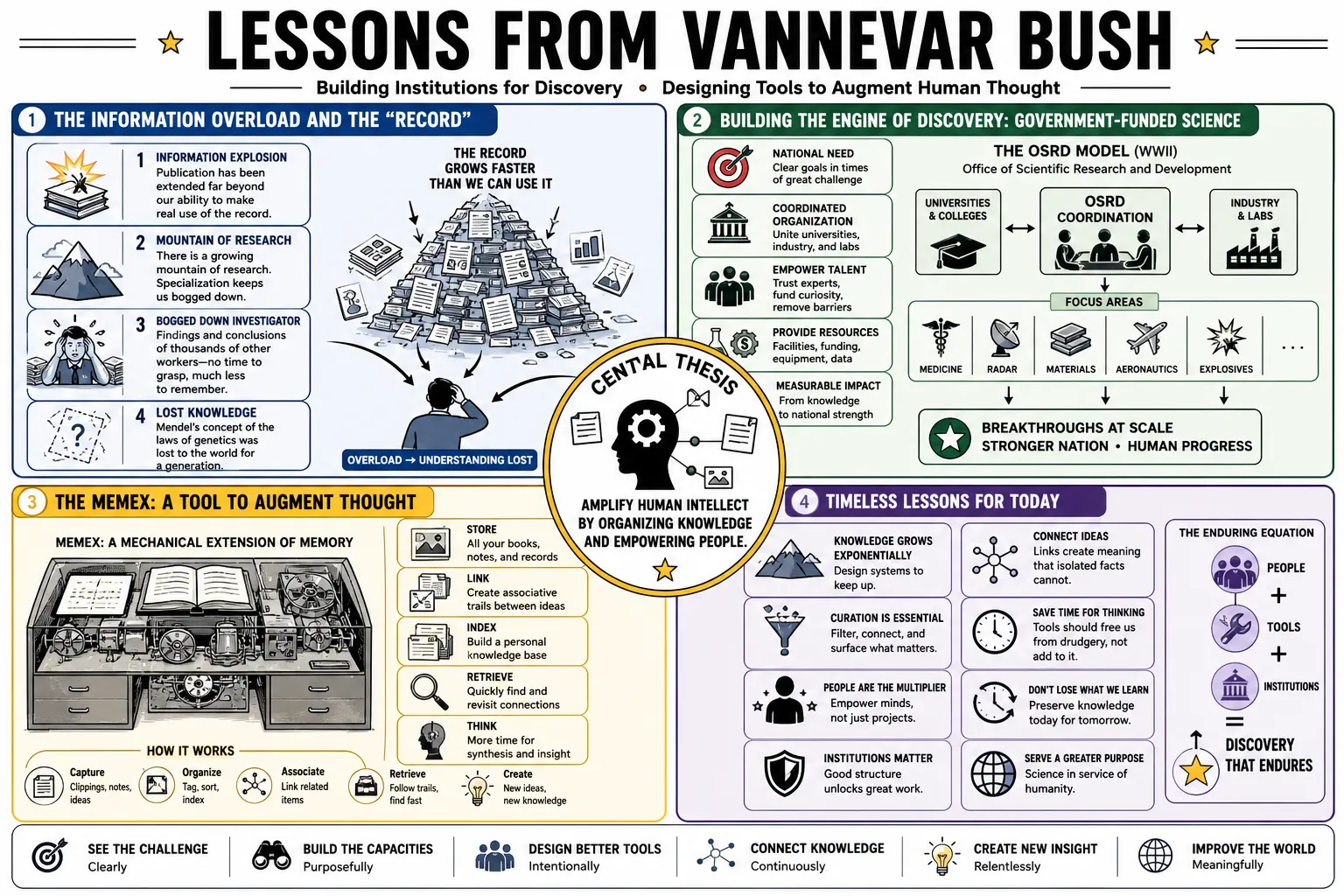
Vannevar Bush ran the Office of Scientific Research and Development during World War II, where he built the basic model for government-funded science. He is equally known for conceptualizing the "Memex," a mechanical precursor to the World Wide Web. This profile collects his clearest thoughts on managing massive organizations and designing tools to augment human thought.
Part 1: The Information Overload and the "Record"
- On the Information Explosion: "The difficulty seems to be, not so much that we publish unduly in view of the extent and variety of present-day interests, but rather that publication has been extended far beyond our present ability to make real use of the record." — Source: [As We May Think]
- On the Mountain of Research: "There is a growing mountain of research. But there is increased evidence that we are being bogged down today as specialization extends." — Source: [As We May Think]
- On the Bogged Down Investigator: "The investigator is staggered by the findings and conclusions of thousands of other workers—conclusions which he cannot find time to grasp, much less to remember, as they appear." — Source: [As We May Think]
- On Lost Knowledge: "Mendel's concept of the laws of genetics was lost to the world for a generation because his publication did not reach the few who were capable of grasping and extending it." — Source: [As We May Think]
- On Catastrophic Loss: "This sort of catastrophe is undoubtedly being repeated all about us, as truly significant attainments become lost in the mass of the inconsequential." — Source: [As We May Think]
- On Antiquated Methods: "Professionally our methods of transmitting and reviewing the results of research are generations old and by now are totally inadequate for their purpose." — Source: [As We May Think]
- On Threading the Maze: "The summation of human experience is being expanded at a prodigious rate, and the means we use for threading through the consequent maze to the momentarily important item is the same as was used in the days of square-rigged ships." — Source: [As We May Think]
- On Complex Civilization: "Man has built a civilization so complex that he needs to mechanize his records more fully if he is to push his experiment to its logical conclusion." — Source: [As We May Think]
- On Overtaxing Memory: "Man cannot merely become bogged down part way there by overtaxing his limited memory." — Source: [As We May Think]
Part 2: The Memex and Associative Thinking
- On the Memex Device: "A memex is a device in which an individual stores all his books, records, and communications, and which is mechanized so that it may be consulted with exceeding speed and flexibility." — Source: [As We May Think]
- On Supplementing Memory: "It is an enlarged intimate supplement to his memory." — Source: [As We May Think]
- On Associative Indexing: "Associative indexing, the basic idea of which is a provision whereby any item may be caused at will to select immediately and automatically another. This is the essential feature of the memex." — Source: [As We May Think]
- On Tying Items Together: "The process of tying two items together is the important thing." — Source: [As We May Think]
- On Human Mental Operation: "The human mind... operates by association. With one item in its grasp, it snaps instantly to the next that is suggested by the association of thoughts." — Source: [As We May Think]
- On the Web of Trails: "Association of thoughts occurs in accordance with some intricate web of trails carried by the cells of the brain." — Source: [As We May Think]
- On Duplicating the Mind: "Man cannot hope fully to duplicate this mental process artificially, but he certainly ought to be able to learn from it." — Source: [As We May Think]
- On Naming the Trail: "When the user is building a trail, he names it, inserts the name in his code book, and taps it out on his keyboard." — Source: [As We May Think]
- On Binding Sources: "It is exactly as though the physical items had been gathered together from widely separated sources and bound together to form a new book." — Source: [As We May Think]
- On Future Encyclopedias: "Wholly new forms of encyclopedias will appear, ready-made with a mesh of associative trails running through them, ready to be dropped into the memex and there amplified." — Source: [As We May Think]
Part 3: Basic Science as Capital
- On Scientific Capital: "Basic scientific research is scientific capital." — Source: [Science: The Endless Frontier]
- On Free Play of Intellects: "Scientific progress on a broad front results from the free play of free intellects, working on subjects of their own choice." — Source: [Science: The Endless Frontier]
- On Curiosity-Driven Discovery: "Intellects work in the manner dictated by their curiosity for exploration of the unknown." — Source: [Science: The Endless Frontier]
- On the Flow of Knowledge: "As long as scientists are free to pursue the truth wherever it may lead, there will be a flow of new scientific knowledge to those who can apply it to practical problems." — Source: [Science: The Endless Frontier]
- On the Endless Frontier: "Although geographic frontiers have more or less disappeared, the frontier of science remains." — Source: [Science: The Endless Frontier]
- On the Pioneer Spirit: "Science offers a largely unexplored hinterland for the pioneer who has the tools for his task." — Source: [Science: The Endless Frontier]
- On National Security: "Scientific progress is one essential key to our security as a nation, to our better health, to more jobs, to higher standard of living, and to our cultural progress." — Source: [Science: The Endless Frontier]
- On Progress Over Achievement: "Without scientific progress no amount of achievement in other directions can insure our health, prosperity, and security as a nation in the modern world." — Source: [Science: The Endless Frontier]
- On the Source of Basic Research: "The publicly and privately supported colleges, universities, and research institutes are the centers of basic research. They are the wellsprings of knowledge and understanding." — Source: [Science: The Endless Frontier]
- On Independent Centers: Research universities provide the independent foundation necessary for true breakthrough discoveries to occur. — Source: [Science: The Endless Frontier]
Part 4: The Innovation and Invention Process
- On the Joy of Creating: "An inventor can derive real satisfaction out of making an invention, even if he never expects to make a nickel out of it, even if he knows it is a bit foolish, provided he feels it involves ingenuity and insight." — Source: [Pieces of the Action]
- On the Compulsion to Invent: "An inventor invents because he cannot help it, and also because he gets quiet fun out of doing so." — Source: [Pieces of the Action]
- On Inventions Alone: "An invention by itself is usually useless. It must be paired with promotion, financing, development, engineering, and marketing if the inventor wants to actually make some money." — Source: [Pieces of the Action]
- On Curiosity and Utility: "A lot of invention appears merely because of curiosity and with little thought at the time of possible utility." — Source: [Pieces of the Action]
- On Toying With Ideas: "Any man who has a bit of ingenuity in his soul gets quite a lot of fun out of following around with things that do not amount to anything, for the reason that when he does so, he has no pressures." — Source: [Pieces of the Action]
- On Reliable Complexity: "The world has arrived at an age of cheap complex devices of great reliability, and something is bound to come of it." — Source: [As We May Think]
- On Invention as Art: "An invention has some of the characteristics of a poem." — Source: [Science Is Not Enough]
- On Delegating Tedium: "We should be able to pass the tedious work of numbers to machines and work on the intricate theory which puts them best to use." — Source: [As We May Think]
Part 5: Leadership, Bureaucracy, and the "End Run"
- On Coordination: "A leader's job is one of coordination... the path from idea to innovation is a long and winding one, inextricably bound to those involved." — Source: [Pieces of the Action]
- On Authority: "There should never be, throughout an organization, any doubt as to where authority for making decisions resides, or any doubt that they will be promptly made." — Source: [Pieces of the Action]
- On Overcoming Bureaucracy: "When he knows stumbling blocks may get in the way of a joint effort in which he is engaged, a man who is light on his feet tries to anticipate them, to figure out where they may arise and why, and how best to evade them." — Source: [Pieces of the Action]
- On the NDRC "End Run": "There were those who protested that the action of setting up N.D.R.C. was an end run, a grab by which a small company of scientists and engineers, acting outside established channels, got hold of the authority and money." — Source: [Pieces of the Action]
- On Bypassing Channels: "That, in fact, is exactly what it was. Moreover, it was the only way in which a broad program could be launched rapidly and on an adequate scale." — Source: [Pieces of the Action]
- On Institutional Lethargy: "Far-seeing, energetic individuals often overcome institutional conservatism and lethargy." — Source: [Pieces of the Action]
- On Stepping Aside: "I decided that I was not going to get in the way of younger men, and that, when the time came that I could not compete genuinely with them, I would get out." — Source: [Pieces of the Action]
- On Managing Fear: "Fear cannot be banished, but it can be calm and without panic; it can be mitigated by reason and evaluation." — Source: [Pieces of the Action]
- On Protecting Independence: To operate through established channels involved delays and the hazard that independence might be lost, which was the central feature of the organization's success. — Source: [Pieces of the Action]
Part 6: Collaboration and the "Team Effort"
- On Civilian and Military Alignment: "If I made any important contribution to the war effort at all, it would be to get the Army and Navy to tell each other what they were doing." — Source: [Pieces of the Action]
- On Joint Effort: "In order for great progress to be made on methods and weapons of war, there has to be a system of close joint effort of military and civilian men, especially engineers." — Source: [Pieces of the Action]
- On Civilian Independence: "The civilians must have independence and the opportunity to explore the bizarre; it is not enough that they be the engineers of contractors to the armed forces." — Source: [Pieces of the Action]
- On Mutual Respect: "Above all, there must be mutual respect and reliance. This must be present whenever we have to fight again." — Source: [Pieces of the Action]
- On the National Team: "Science can be effective in the national welfare only as a member of a team, whether the conditions be peace or war." — Source: [Science: The Endless Frontier]
- On Fostering Experts: "Give these people money, let them play, and they'll come up with something." — Source: [Wikiquote]
- On the Limits of Science Alone: "Science, by itself, provides no panacea for individual, social, and economic ills." — Source: [Science: The Endless Frontier]
- On Cross-Disciplinary Necessity: Modern scientific and military endeavors require bringing together divergent mentalities and forcing them to understand each other's domain context. — Source: [Pieces of the Action]
- On Broad Agendas: Collaboration scales best when civilian scientists operate with direct Presidential access, unburdened by standard military procurement processes. — Source: [Pieces of the Action]
Part 7: Education and Talent Development
- On Basic Educational Policy: "The future of science in this country will be determined by our basic educational policy." — Source: [Science: The Endless Frontier]
- On the Need for Qualified Scientists: "We shall have rapid or slow advance on any scientific frontier depending on the number of highly qualified and trained scientists exploring it." — Source: [Science: The Endless Frontier]
- On Removing Educational Ceilings: "A ceiling should not be imposed on a young person's educational opportunities either by limited family means or negative family attitudes." — Source: [Science: The Endless Frontier]
- On Youthful Rebellion: "Youth has always been in rebellion and should be if society is not to become static." — Source: [Pieces of the Action]
- On the Valuable Amateur: "As we subdivide fields of learning and render all of them more precise and more intricate, no man can be a master of all, but a man who sets his mind to it can become a valuable amateur in fields outside his mastership." — Source: [Pieces of the Action]
- On the Monastic Cell: "It is unfortunate when a brilliant and creative mind insists upon living in a modern monastic cell." — Source: [Science Is Not Enough]
- On Being Broad and Deep: "In these days, when there is a tendency to specialize so closely, it is well for us to be reminded that the possibilities of being at once broad and deep did not pass with Leonardo Da Vinci." — Source: [Pieces of the Action]
- On Nurturing Ingenuity: Scientific talent is not uniformly distributed, making it paramount that the government identifies and supports capable students early in their development. — Source: [Science: The Endless Frontier]
- On History: "The study of history can aid in avoiding mistakes, provided it is recent history and accurate, that is, before it has degenerated into a myth." — Source: [Pieces of the Action]
Part 8: The Human Spirit and the Purpose of Science
- On the Mission of Science: "Science has a simple faith, which transcends utility... It is the faith that it is the privilege of man to learn to understand, and that this is his mission." — Source: [Science Is Not Enough]
- On the Persistence of the Mission: "If we abandon that mission under stress we shall abandon it forever, for stress will not cease." — Source: [Science Is Not Enough]
- On Understanding vs. Prevailing: "Knowledge for the sake of understanding, not merely to prevail, that is the essence of our being." — Source: [Science Is Not Enough]
- On the Framework of the Spirit: "To pursue science is not to disparage the things of the spirit. In fact, to pursue science rightly is to furnish the framework on which the spirit may rise." — Source: [Science Is Not Enough]
- On the Well-Supplied House: "The applications of science have built man a well-supplied house, and are teaching him to live healthily therein." — Source: [As We May Think]
- On the Peril of Humanity: "He may perish in conflict before he learns to wield that record for his true good." — Source: [As We May Think]
- On Logic and Reality: "If scientific reasoning were limited to the logical processes of arithmetic, we should not get very far in our understanding of the physical world." — Source: [Science Is Not Enough]
- On the Mathematics of Poker: "One might as well attempt to grasp the game of poker entirely by the use of the mathematics of probability." — Source: [Science Is Not Enough]
- On Pride of Accomplishment: "Pride of the right sort does not go before a fall; pride of accomplishment leads to greater accomplishment." — Source: [Pieces of the Action]