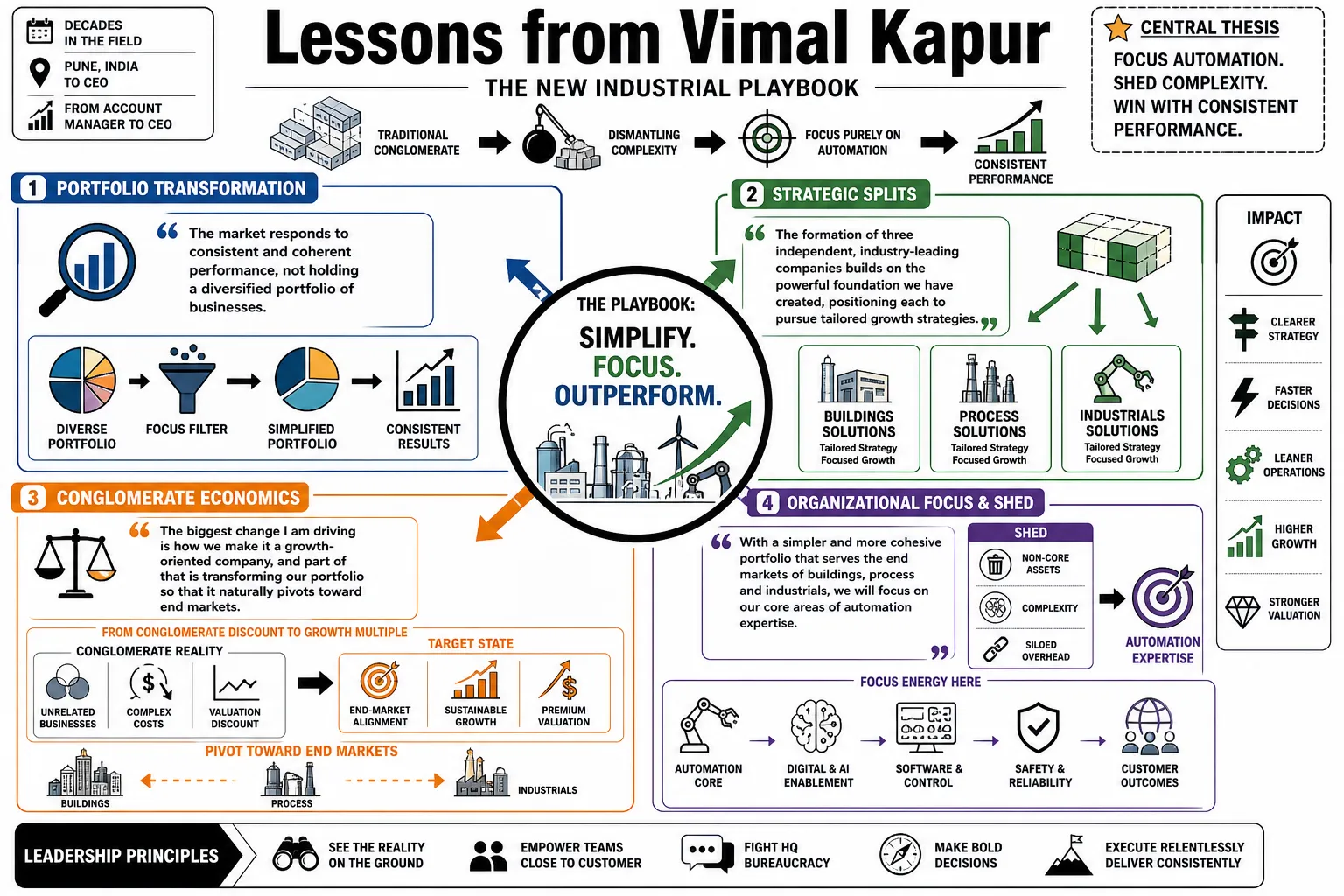
Lessons from Vimal Kapur
Vimal Kapur spent decades in the field before rising from an account manager in Pune, India, to CEO of Honeywell. He is dismantling the company's traditional conglomerate structure to focus purely on automation. This profile breaks down his perspective on portfolio shaping, fighting headquarters bureaucracy, and the physical realities of the energy transition.
Part 1: The New Industrial Playbook
- On Portfolio Transformation: "The market responds to consistent and coherent performance, not holding a diversified portfolio of businesses." — Source: [Bloomberg Masters in Business]
- On Strategic Splits: "The formation of three independent, industry-leading companies builds on the powerful foundation we have created, positioning each to pursue tailored growth strategies." — Source: [Honeywell Corporate Announcement]
- On Conglomerate Economics: "The biggest change I am driving is how we make it a growth-oriented company, and part of that is transforming our portfolio so that it naturally pivots toward end markets." — Source: [Semafor]
- On Organizational Focus: "With a simpler and more cohesive portfolio that serves the end markets of buildings, process and industrials, we will focus on our core areas of automation expertise." — Source: [Honeywell Corporate Announcement]
- On Shedding Non-Core Assets: "Following a three-year process to simplify our portfolio, we have the foundation in place to accelerate profitable growth by building on our vast installed base." — Source: [Morningstar]
- On Pure-Play Alignment: "When you break up an industrial giant, you expose the difficult truth of where your focus really lies." — Source: [Semafor]
- On Clarity of Purpose: "A streamlined structure provides absolute clarity about where employees should focus their efforts." — Source: [Goldman Sachs Exchanges]
- On Tailored Growth Strategies: "Each distinct entity must pursue its own tailored growth strategy rather than relying on a shared corporate umbrella." — Source: [Forbes]
- On Secular Growth Drivers: "Our portfolio must be exposed to long-term secular growth drivers that position us as a global automation leader." — Source: [Honeywell Thought Leadership]
- On Evolving the Playbook: "Companies need to find their strategic direction and take their shareholders along with them." — Source: [Financial Times]
Part 2: The Arrival of Industrial AI
- On the AI Inflection Point: "The promise of industrial AI has arrived, as companies now rely on the technology to substitute for skilled workers." — Source: [Bloomberg Masters in Business]
- On Autonomy vs. Automation: "We are transitioning from traditional automation, which relied on manual interventions and preset rules, to an autonomous future powered by AI algorithms." — Source: [Honeywell Thought Leadership]
- On Physical AI: "Physical AI in industrial settings is about applying machine intelligence to tangible, mission-critical assets that impact daily life." — Source: [Goldman Sachs Exchanges]
- On Real-Time Learning: "The next era of industrial technology relies on algorithms that learn from real-time data rather than executing static code." — Source: [Axios House]
- On Legacy Integrations: "I am immensely proud of our long history of leadership in automation, but the future requires reshaping industries across the globe with intelligent systems." — Source: [Honeywell Thought Leadership]
- On Workforce Augmentation: "AI is not about replacing effort; it is about augmenting workforce capabilities in environments where skilled labor is scarce." — Source: [World Economic Forum]
- On System Resiliency: "When you embed AI into core industrial businesses, the primary goal must be driving safety, resiliency, and sustained performance." — Source: [CERAWeek]
- On Anticipating Future Needs: "Autonomy is not simply about short-term gains; it is about setting new industry standards and anticipating the complex needs of tomorrow." — Source: [Honeywell Corporate Announcement]
- On Data as an Asset: "Our vast installed base provides the foundation necessary to deliver actionable, real-time insights through software-enabled services." — Source: [Morningstar]
- On Outcome-Based Solutions: "We are prioritizing outcomes-based solutions over simple product sales, using AI to guarantee specific operational results." — Source: [Goldman Sachs Exchanges]
Part 3: Bureaucracy and the Front Line
- On Front-Line Empathy: "My empathy for the problems people face on the front line is very high." — Source: [Fast Company]
- On Fighting Bureaucracy: "Given that I was on the receiving side of requests from headquarters, I generally bash bureaucracy a lot." — Source: [Fast Company]
- On Headquarters Disconnect: "When you spend decades outside the global headquarters, you understand how corporate mandates actually translate to field execution." — Source: [Forbes]
- On Career Progression: "Starting as a sales manager in India taught me that customer reality often diverges from boardroom theory." — Source: [Forbes]
- On Relentless Simplification: "Since becoming CEO, I have maintained a relentless focus on simplifying our business model and removing friction for our teams." — Source: [World Economic Forum]
- On Empowering Teams: "A leader must remove obstacles so that the organization remains highly responsive to the actual problems happening on the ground." — Source: [Semafor]
- On the Futureshapers Culture: "Connecting with our global workforce means treating every employee as a 'Futureshaper' who contributes to tangible outcomes." — Source: [CERAWeek]
- On Practical Leadership: "Leadership in an industrial setting cannot be purely academic; it must be rooted in deep operational experience." — Source: [Bloomberg Masters in Business]
- On Corporate Agility: "We split the company precisely to increase focus and agility, removing layers that previously insulated decision-makers from the market." — Source: [Goldman Sachs Exchanges]
- On Direct Communication: "The best insights come from the people who have to live with the consequences of the decisions we make in the executive office." — Source: [Axios House]
Part 4: The Energy Transition Reality
- On Energy Intensity: "Solar power cannot produce cement. Solar power cannot produce steel. They are very energy intensive." — Source: [World Economic Forum]
- On the Physics of Industry: "The physics of heavy industry require consistent, high-intensity energy that current renewables cannot reliably provide." — Source: [World Economic Forum]
- On Pragmatic Sustainability: "We absolutely see demand for energy transition with our customers, but we must approach it with technical realism." — Source: [CNBC]
- On Transitional Fuels: "Energy intensity is a critical factor in the transition alongside the energy mix, which means gas and nuclear remain essential." — Source: [World Economic Forum]
- On Megatrend Alignment: "Our business is aligned with three powerful megatrends: automation, the future of aviation, and the energy transition." — Source: [Honeywell Thought Leadership]
- On Complex Challenges: "As a trusted partner, we help organizations solve the world's toughest challenges to make operations more secure and sustainable." — Source: [Honeywell Thought Leadership]
- On Sustainability as Strategy: "True sustainability must be embedded into the operational efficiency of the business, not treated as a separate initiative." — Source: [CERAWeek]
- On Customer Mandates: "The market environment now demands a growing emphasis on achieving higher levels of operational efficiency alongside environmental goals." — Source: [Honeywell Thought Leadership]
- On Market Realities: "Index reemphasizes our commitment to and leadership in sustainability from every angle, grounded in what is physically possible today." — Source: [Honeywell Corporate Announcement]
Part 5: Rethinking Aerospace and Building Tech
- On Building Technologies: "Transforming building technologies requires shifting from passive infrastructure to active, high-growth automation platforms." — Source: [World Economic Forum]
- On the Aerospace Spin-off: "Separating Aerospace allows it to pursue a highly specialized growth trajectory aligned with the future of aviation." — Source: [Morningstar]
- On Performance Materials (PMT): "Delivering strong financial growth in Performance Materials requires establishing a sustainable technologies platform that can scale." — Source: [Honeywell Corporate Announcement]
- On Sector-Specific Agility: "A monolithic structure limits the margin expansion potential of distinct sectors like building technologies." — Source: [Goldman Sachs Exchanges]
- On Future Aviation: "The future of aviation will be defined by software-enabled services and enhanced safety automation." — Source: [Bloomberg Masters in Business]
- On Smart Buildings: "Buildings must evolve into intelligent environments that actively manage energy consumption and optimize occupant safety." — Source: [Honeywell Thought Leadership]
- On Material Innovation: "Advanced materials are the unseen foundation for the energy transition and next-generation industrial applications." — Source: [CERAWeek]
- On Domain Expertise: "Building on deep domain expertise in mission-critical environments is how we maintain leadership in aerospace and process industrials." — Source: [Morningstar]
- On Tailored Strategies: "Each business unit, whether aerospace or buildings, requires its own tailored approach to capital allocation and product development." — Source: [Forbes]
Part 6: Operational Excellence and the "Accelerator"
- On Standardized Systems: "The Honeywell Accelerator is our internal operating system used to standardize tools, processes, and playbooks across the organization." — Source: [Honeywell Thought Leadership]
- On Working Capital: "Streamlining operations and driving continuous improvement must ultimately reflect in how efficiently we manage working capital." — Source: [CNBC]
- On Supply Chain Resilience: "Navigating global disruptions like chip shortages requires rapid product redesigns and a flexible supply chain architecture." — Source: [Bloomberg Masters in Business]
- On Base Discipline: "Discipline in operations is table stakes; if you cannot execute the fundamentals, you cannot earn the right to grow." — Source: [Semafor]
- On Digital Twins in Operations: "Integrating AI-analytics and digital tools into our own operations helps us identify inefficiencies and reduce costs internally." — Source: [Honeywell Corporate Announcement]
- On Managing Disruption: "You must build supply chain resilience before the crisis hits, strengthening global networks systematically." — Source: [Goldman Sachs Exchanges]
- On One-Company Mindset: "A 'one Honeywell' mindset means applying the Accelerator operating system rigorously to drive sustainable, scalable growth." — Source: [CERAWeek]
- On Executing Transformations: "A CEO’s primary focus should remain on growth, but that requires dedicating a disciplined portion of time to driving operational execution." — Source: [Semafor]
- On Upgrading Portfolios: "Operational excellence enables us to upgrade the portfolio through disciplined M&A and the shedding of non-core assets." — Source: [World Economic Forum]
Part 7: Human-Led Decision Making in a Machine Age
- On the Human Element: "Despite the rapid rise of AI, human-led decision-making remains absolutely necessary in high-stakes industrial settings." — Source: [Goldman Sachs Exchanges]
- On Trusting Algorithms: "We deploy physical AI to augment operators, ensuring that human judgment acts as the final check on mission-critical systems." — Source: [World Economic Forum]
- On Skill Shortages: "Technology serves as a bridge for the skilled labor gap, capturing institutional knowledge before experienced workers retire." — Source: [Bloomberg Masters in Business]
- On Safety and AI: "In industrial operations, an algorithm’s failure can have physical consequences, which is why AI must operate within strict safety parameters." — Source: [CERAWeek]
- On Operator Empowerment: "The goal of advanced automation is to elevate the operator's role from manual execution to strategic oversight." — Source: [Honeywell Thought Leadership]
- On Technology and Reliability: "We view technology as a way to solve complex challenges that impact daily life, focusing on resiliency and absolute reliability." — Source: [Goldman Sachs Exchanges]
- On Change Management: "Adopting AI in a legacy environment requires as much cultural change management as it does technical integration." — Source: [Axios House]
- On Machine Learning Limits: "Machine learning is powerful for identifying patterns, but context and nuanced risk assessment require a human mind." — Source: [Semafor]
- On the Future Workforce: "Our responsibility is to train the next generation of workers to collaborate seamlessly with autonomous systems." — Source: [Forbes]
Part 8: The Long Game of Value Creation
- On Shareholder Alignment: "Transformative change only works if you find a clear strategic direction and take your shareholders along with you." — Source: [Financial Times]
- On Organic Growth: "We expect to once again drive strong organic growth fueled by the conversion of our record backlog." — Source: [Morningstar]
- On Legacy and Evolution: "Respecting a company's history does not mean preserving its outdated structures; it means evolving its core strengths for the modern era." — Source: [Bloomberg Masters in Business]
- On Capital Allocation: "Disciplined M&A is about acquiring capabilities that directly accelerate our transition toward software-enabled outcomes." — Source: [World Economic Forum]
- On Navigating Activism: "Addressing investor pressure requires facing the reality of where your structure is hindering growth, rather than defending the status quo." — Source: [Semafor]
- On Installed Base Value: "Our greatest asset is our installed base; the value creation of the next decade will come from upgrading that physical footprint with digital intelligence." — Source: [Goldman Sachs Exchanges]
- On Long-Term Resiliency: "Building long-term resiliency means focusing on end markets that are inherently growth-oriented and resistant to cyclical downturns." — Source: [Honeywell Thought Leadership]
- On Product Innovation: "To be a growth-oriented company, we must continually change our own capabilities on new product development and innovation." — Source: [Axios House]
- On Delivering Results: "Ultimately, the market rewards coherent execution and the delivery of tangible, profitable outcomes." — Source: [Forbes]