Virginia Tufte was a professor emerita of English at the University of Southern California and the author of Grammar as Style and Artful Sentences: Syntax as Style. Rather than treating grammar as a rigid set of rules to avoid errors, she analyzed how accomplished writers use sentence structure as a toolkit to control rhythm, momentum, and meaning. This profile outlines her descriptive approach to syntax, demonstrating how small mechanical choices dictate the way prose feels on the page.
Part 1: The Philosophy of Syntax
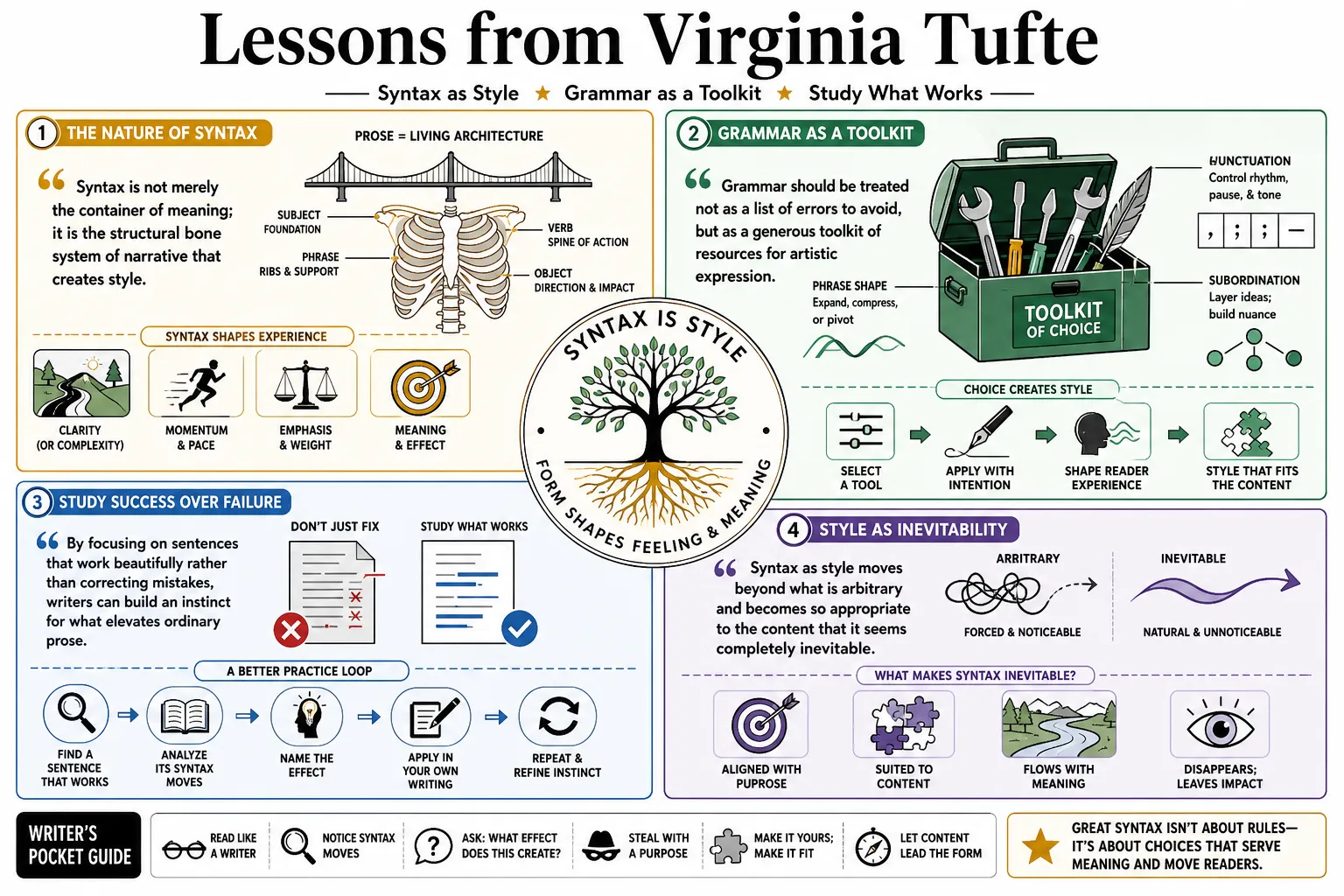
- On the nature of syntax: "Syntax is not merely the container of meaning; it is the structural bone system of narrative that creates style." — Source: [Goodreads: Artful Sentences]
- On breaking prescriptive rules: "Grammar should be treated not as a list of errors to avoid, but as a generous toolkit of resources for artistic expression." — Source: [Edward Tufte's Graphics Press]
- On studying success over failure: "By focusing on sentences that work beautifully rather than correcting mistakes, writers can build an instinct for what elevates ordinary prose." — Source: [The Blue Garret: Grammar as Style]
- On style as inevitability: "Syntax as style moves beyond what is arbitrary and becomes so appropriate to the content that it seems completely inevitable." — Source: [Goodreads: Artful Sentences]
- On grammar as a craft: "Professional writers do the best they can, and their best is often eloquent, precise, and artful enough to serve as a practical model for others." — Source: [Edward Tufte's Graphics Press]
- On words vs. structure: "While individual words provide the sparkle and flavor, syntax provides the foundational power to relate those words in a sequence that drives rhythm and meaning." — Source: [Archive.org: Grammar as Style]
- On observation over regulation: "A descriptive approach to grammar—showing what master writers actually do—is far more instructive than prescribing what they ought to do." — Source: [Madam Mayo: Reading Tufte]
- On the essence of prose: "Prose is fundamentally linear. It is read sequentially and is meant to move the reader continuously forward." — Source: [Goodreads: Artful Sentences]
- On the accessibility of style: "Artful sentence construction relies on specific, identifiable skills that are widely applicable and can be learned by anyone." — Source: [Coriolis Company: Sentence Studies]
- On imitating masters: "Reading sentences by accomplished writers is like visiting a smorgasbord; it offers patterns that can be readily imitated and adapted to one's own voice." — Source: [Bookey: Artful Sentences Summary]
Part 2: The Power of Short Sentences
- On the core message: "The foundational 'kernel' of any sentence—a simple subject and verb clause—carries the ultimate weight and must be completely sound before modifiers are added." — Source: [Archive.org: Grammar as Style]
- On pacing and tempo: "Short sentences operate as the stylistic brakes of a narrative, forcing the reader to pause, focus, and absorb immediate clarity." — Source: [Edward Tufte's Graphics Press]
- On slamming starts: "Opening a paragraph with a stark, brief sentence immediately arrests the reader's attention and sets a declarative tone for the details to follow." — Source: [Goodreads: Artful Sentences]
- On absolute clarity: "Sometimes the shortest possible sentence—like the two-word 'Jesus wept'—delivers the highest emotional impact because it strips away all distraction." — Source: [The Blue Garret: Grammar as Style]
- On juxtaposition: "Placing a very short sentence immediately after a winding, complex paragraph creates an abrupt and highly effective turn in the narrative." — Source: [Coriolis Company: Sentence Studies]
- On bright impact: "Brevity creates a 'bright' impact in prose, cutting through the dense foliage of descriptive passages like a sudden beam of light." — Source: [Madam Mayo: Reading Tufte]
- On simple closures: "Ending a complex thought with a brief, unadorned sentence provides a satisfying sense of finality and rhetorical grounding." — Source: [Archive.org: Grammar as Style]
- On isolation for emphasis: "Isolating a key noun and verb without any modifiers forces the reader to confront the unadorned truth of the action taking place." — Source: [Edward Tufte's Graphics Press]
- On avoiding monotony: "An unbroken sequence of short sentences creates a staccato rhythm that can simulate tension or panic, but if overused, it quickly dulls the ear." — Source: [Goodreads: Artful Sentences]
Part 3: Noun Phrases and the Weight of Detail
- On the architecture of nouns: "Expanded noun phrases carry the heavy lifting of description, allowing a writer to pack dense sensory detail without cluttering the verb structure." — Source: [Archive.org: Grammar as Style]
- On the elegance of the appositive: "The appositive is a writer's most efficient tool; it allows for the elegant renaming or detailing of a noun phrase without the clunky mechanics of starting a new sentence." — Source: [Edward Tufte's Graphics Press]
- On immediate redefinition: "Using an appositive directly next to a noun gives the writer a second chance to define something, instantly layering meaning." — Source: [Goodreads: Artful Sentences]
- On noun modifiers: "Choosing highly specific nouns reduces the need for adjectives, as the noun itself does the work of painting the image." — Source: [The Blue Garret: Grammar as Style]
- On avoiding noun strings: "Stacking too many nouns together as modifiers creates impenetrable 'noun walls' that obstruct the reader's forward motion." — Source: [Madam Mayo: Reading Tufte]
- On syntactic weight: "Placing heavy, complex noun phrases at the end of a sentence creates a feeling of culmination and satisfying resolution." — Source: [Coriolis Company: Sentence Studies]
- On delayed appositives: "Moving an appositive to the end of a sentence creates a dash of suspense, delaying the precise clarification for dramatic effect." — Source: [Edward Tufte's Graphics Press]
- On subjective re-evaluations: "Appositives are not just for facts; they are prime real estate for a narrator to interject a subjective opinion about the noun just stated." — Source: [Archive.org: Grammar as Style]
- On lists as noun phrases: "A well-constructed sequence of nouns operates as a rhythmic inventory, giving the reader a sweeping view of a scene's contents." — Source: [Goodreads: Artful Sentences]
- On clarity over clutter: "When the subject of a sentence becomes too bogged down by modifiers, the reader loses sight of the actor in the scene." — Source: [The Blue Garret: Grammar as Style]
Part 4: Verbs and the Engines of Action
- On the engine of prose: "Verb phrases act as the central engines of the sentence; if the verb is weak, the entire structure stalls, regardless of how beautiful the adjectives are." — Source: [Edward Tufte's Graphics Press]
- On participial phrases: "Using present participles creates a sense of continuous motion and immediacy, dropping the reader directly into unfolding action." — Source: [Goodreads: Artful Sentences]
- On passive voice utility: "While active verbs are generally preferred, the passive voice is a precise tool for when the object of the action is the most important element in the room." — Source: [Archive.org: Grammar as Style]
- On burying the verb: "Separating the subject and verb by too much descriptive distance drains the sentence of its energy and confuses the reader's orientation." — Source: [Madam Mayo: Reading Tufte]
- On compound predicates: "Attaching multiple verbs to a single subject allows a writer to execute rapid-fire actions without repeating the noun." — Source: [Coriolis Company: Sentence Studies]
- On subtle transitions: "Verb choice dictates the psychological transition of a scene; switching from active verbs to state-of-being verbs forces the narrative from action into reflection." — Source: [The Blue Garret: Grammar as Style]
- On verb precision: "A single exact verb replaces the need for an adverb, cleaning the sentence of unnecessary friction." — Source: [Edward Tufte's Graphics Press]
- On the imperative mood: "Using imperative verbs breaks the fourth wall, commanding the reader's attention and making the prose suddenly intimate." — Source: [Goodreads: Artful Sentences]
- On avoiding forms of 'to be': "Over-relying on 'is' and 'was' flattens a narrative, turning what should be an active landscape into a static painting." — Source: [Archive.org: Grammar as Style]
Part 5: Modifiers and Branching Logic
- On free modifiers: "Free modifiers—phrases set off by commas—give the writer the liberty to graft complex layers of detail onto a simple sentence without collapsing its core structure." — Source: [Edward Tufte's Graphics Press]
- On right-branching sentences: "Starting with the main subject and verb, then trailing off into accumulating modifiers, creates a natural, conversational flow that mirrors how human thought unfolds." — Source: [Goodreads: Artful Sentences]
- On left-branching sentences: "Placing modifiers before the main subject delays the core meaning, creating a sense of anticipation and rhetorical suspense." — Source: [Archive.org: Grammar as Style]
- On mid-branching logic: "Inserting a modifier between the subject and verb forces a slight hesitation, mimicking a breath or a second thought before the action resolves." — Source: [Madam Mayo: Reading Tufte]
- On spatial depth: "Prepositional phrases operate as the camera operators of a sentence, establishing the spatial relationships and physical geometry of the scene." — Source: [The Blue Garret: Grammar as Style]
- On adjective placement: "Placing adjectives after a noun rather than before it elevates the tone and forces the reader to pause on the description." — Source: [Coriolis Company: Sentence Studies]
- On avoiding modifier pileups: "When too many modifiers hang off a single kernel, the sentence loses its structural integrity and begins to sag under its own weight." — Source: [Edward Tufte's Graphics Press]
- On absolute phrases: "Absolute phrases modify the entire sentence rather than a single noun, painting a broad atmospheric wash over the specific action taking place." — Source: [Goodreads: Artful Sentences]
- On the precision of adverbs: "Adverbs should be used surgically to shift the meaning of a verb in an unexpected direction, not merely to intensify what the verb already implies." — Source: [Archive.org: Grammar as Style]
Part 6: Coordination, Subordination, and Parallelism
- On saying like things: "Parallelism is the art of saying like things in like ways, creating a sense of balance and structural integrity that pleases the ear." — Source: [Goodreads: Artful Sentences]
- On the power of 'and': "Conjunctions are not just glue; an extended use of 'and' between clauses creates a biblical, relentless cadence that drives the narrative forward." — Source: [Edward Tufte's Graphics Press]
- On managing the flow: "Coordination treats ideas as equals, laying them side by side so the reader can view the landscape without prioritizing one element over another." — Source: [Archive.org: Grammar as Style]
- On subordination and hierarchy: "Subordination tells the reader exactly what matters most, burying the secondary information in dependent clauses so the main action stands clear." — Source: [The Blue Garret: Grammar as Style]
- On breaking parallelism: "Intentionally breaking a parallel structure at the very end of a list delivers a stylistic jolt, signaling that the final item is wildly out of place." — Source: [Madam Mayo: Reading Tufte]
- On the rhythm of threes: "Triadic structures—lists of three parallel phrases—provide the most satisfying rhythmic resolution in the English language." — Source: [Coriolis Company: Sentence Studies]
- On asyndeton: "Removing conjunctions entirely from a list strips the sentence of its relaxed pace, creating a hurried, urgent, or breathless effect." — Source: [Edward Tufte's Graphics Press]
- On polysyndeton: "Using excessive conjunctions slows the reader down, forcing them to dwell on each individual item as if examining beads on a string." — Source: [Goodreads: Artful Sentences]
- On placing the news: "Inversion—moving the most important 'news' of a sentence to its very end—ensures the reader's eye lands firmly on the climax." — Source: [Archive.org: Grammar as Style]
- On balancing weight: "A sentence fails aesthetically when a heavy, complex dependent clause is balanced against a frail, underweight independent clause." — Source: [The Blue Garret: Grammar as Style]
Part 7: Syntactic Symbolism
- On form mimicking function: "Syntactic symbolism occurs when the grammatical shape of the sentence physically enacts the very meaning of the words it contains." — Source: [Edward Tufte's Graphics Press]
- On the winding road: "A long, meandering sentence with multiple right-branching clauses perfectly simulates the experience of a long, unpredictable journey." — Source: [Goodreads: Artful Sentences]
- On simulating chaos: "Interrupting the core subject and verb with erratic, fragmented free modifiers forces the reader to experience the same disorientation as the characters." — Source: [Archive.org: Grammar as Style]
- On structural entrapment: "Burying the main action inside layers of dependent clauses mimics the feeling of being physically trapped or psychologically overwhelmed." — Source: [Coriolis Company: Sentence Studies]
- On replicating speed: "Short words, active verbs, and absent commas accelerate the eye, mimicking the kinetic velocity of a chase or sudden realization." — Source: [Madam Mayo: Reading Tufte]
- On enacting hesitation: "Excessive punctuation and mid-sentence appositives force the reader into a stutter-step rhythm, perfectly capturing a narrator's doubt." — Source: [The Blue Garret: Grammar as Style]
- On physical balance: "A perfectly symmetrical sentence, pivoted around a central conjunction, evokes the physical sensation of scales settling into equilibrium." — Source: [Edward Tufte's Graphics Press]
- On syntactic anticlimax: "Ending a beautifully soaring, complex sentence with a blunt, ugly monosyllabic word pulls the rug out from under the reader's expectations." — Source: [Goodreads: Artful Sentences]
- On the geometry of text: "Sentences have a physical geometry; the way they stack, slope, and resolve on the page creates an unconscious emotional resonance before the meaning is even processed." — Source: [Archive.org: Grammar as Style]
Part 8: Cohesion and the Music of Prose
- On the glue between sentences: "Cohesion is the invisible thread that binds sentences together; it relies on syntax smoothly picking up the exact thought where the previous sentence left off." — Source: [Edward Tufte's Graphics Press]
- On sentence openers: "Varying the entry points of sentences prevents the paragraph from sounding like a robotic list; not every sentence should begin with the subject." — Source: [Goodreads: Artful Sentences]
- On reading aloud: "The ear is the ultimate judge of syntax; reading prose aloud instantly reveals the clotted verbs, the awkward branches, and the missing beats." — Source: [The Blue Garret: Grammar as Style]
- On transitions without words: "A well-constructed sequence of sentences does not need heavy-handed transition words like 'however' or 'moreover'; the structural logic itself acts as the bridge." — Source: [Archive.org: Grammar as Style]
- On paragraph shape: "A masterfully built paragraph resembles a funnel, starting with broad structural strokes and narrowing down to a tight, perfectly balanced final point." — Source: [Madam Mayo: Reading Tufte]
- On the music of the line: "Every sentence carries an inherent musicality; the arrangement of stressed and unstressed syllables dictated by syntax is what makes prose sing." — Source: [Coriolis Company: Sentence Studies]
- On editing for energy: "When editing, writers should scan the syntax for energy leaks—places where passive constructions or misplaced modifiers bleed the momentum out of the line." — Source: [Edward Tufte's Graphics Press]
- On the final impact: "The final position in any sentence is the point of greatest power; a writer must engineer the syntax so the most resonant word lands exactly at the period." — Source: [Goodreads: Artful Sentences]
- On the writer's goal: "The ultimate goal of studying syntax is to internalize these patterns so deeply that the act of writing becomes less about applying rules and more about trusting the rhythm." — Source: [Archive.org: Grammar as Style]