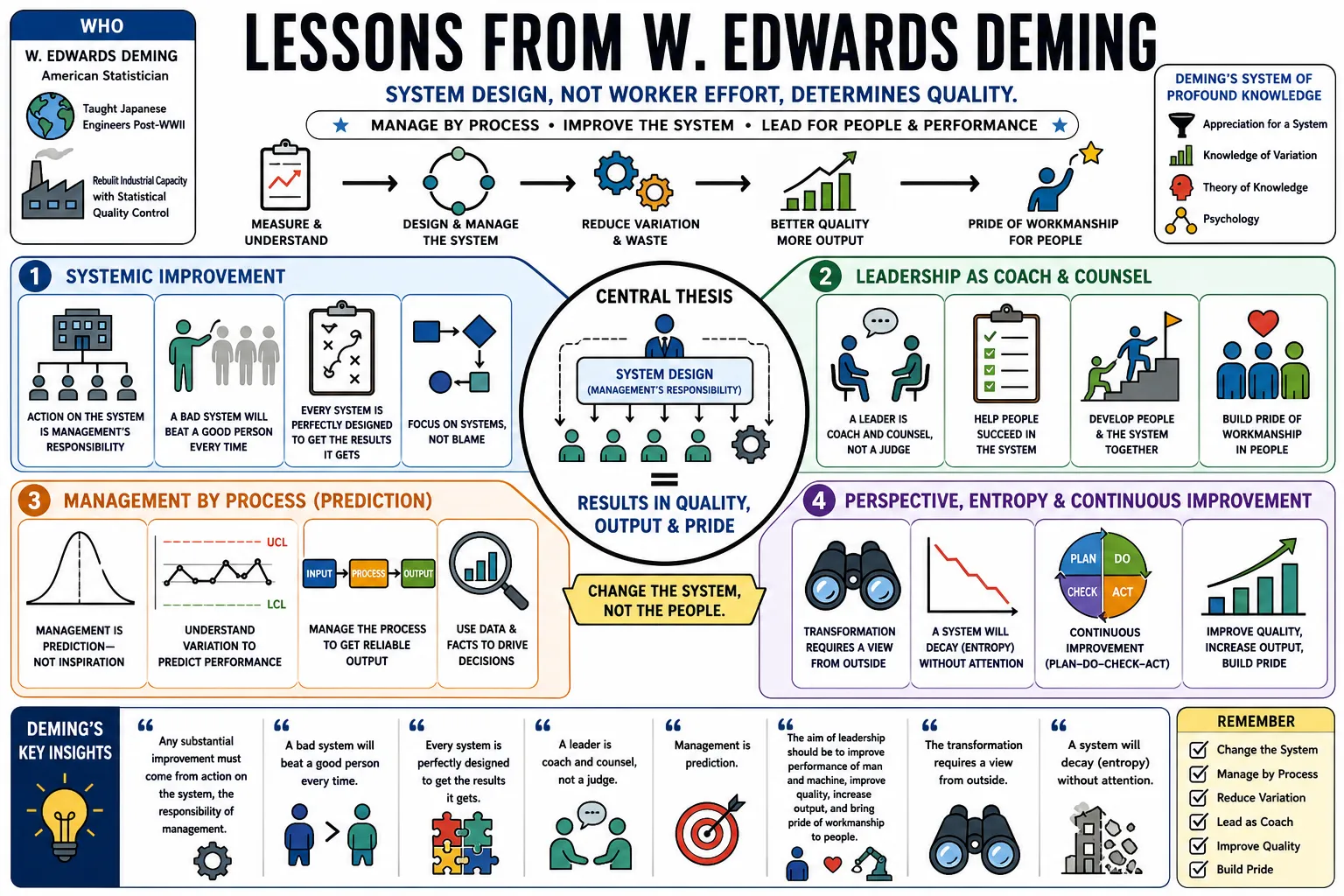
Lessons from W. Edwards Deming
W. Edwards Deming was an American statistician who taught post-war Japanese engineers to rebuild their industrial capacity using statistical quality control. His System of Profound Knowledge argued that system design, not worker effort, dictates product quality. This profile covers the insights he used to convince executives to abandon quotas and manage by process.
Part 1: The System and Leadership
- On Systemic Improvement: "Any substantial improvement must come from action on the system, the responsibility of management." — Source: [Out of the Crisis]
- On Faulty Systems: "A bad system will beat a good person every time." — Source: [The W. Edwards Deming Institute]
- On the Role of a Leader: "A leader is coach and counsel, not a judge." — Source: [Out of the Crisis]
- On Management's Function: "Management is prediction." — Source: [The New Economics]
- On the Aim of Leadership: "The aim of leadership should be to improve the performance of man and machine, to improve quality, to increase output, and simultaneously to bring pride of workmanship to people." — Source: [Out of the Crisis]
- On Perspective: "The transformation requires a view from outside." — Source: [The New Economics]
- On Entropy: "A system must be managed. It will not manage itself." — Source: [The New Economics]
- On Corporate Responsibility: "Quality is made in the boardroom." — Source: [Out of the Crisis]
- On Supervision: "The job of management is not supervision, but leadership." — Source: [Out of the Crisis]
Part 2: Knowledge and Variation
- On Interconnected Disciplines: "Knowledge about psychology is incomplete without knowledge of variation." — Source: [The New Economics]
- On Theory: "Without theory, there is nothing to modify or learn." — Source: [The New Economics]
- On Experience: "Experience by itself teaches nothing." — Source: [The New Economics]
- On Prediction: "Rational prediction requires theory and builds knowledge through systematic revision and extension of theory based on comparison of prediction with observation." — Source: [The New Economics]
- On Information vs. Knowledge: "Information is not knowledge. Let us not confuse the two." — Source: [The New Economics]
- On Misguided Effort: "We are being ruined by best efforts." — Source: [The New Economics]
- On Inquiry: "If you do not know how to ask the right question, you discover nothing." — Source: [Out of the Crisis]
- On Inevitable Differences: "Variation there will always be, between people, in output, in service, in product." — Source: [Out of the Crisis]
Part 3: Quality and Production
- On Inspection: "Inspection to improve quality is too late, ineffective, costly." — Source: [Out of the Crisis]
- On Process Improvement: "Quality comes not from inspection, but from the improvement of the production process." — Source: [Out of the Crisis]
- On Defining Work: "If you can't describe what you are doing as a process, you don't know what you're doing." — Source: [Out of the Crisis]
- On Mass Inspection: "Cease dependence on mass inspection to achieve quality." — Source: [Out of the Crisis]
- On the Cost of Defects: "Defects are not free. Somebody makes them, and gets paid for making them." — Source: [Out of the Crisis]
- On Shared Responsibility: "Quality is everyone's responsibility." — Source: [Out of the Crisis]
- On the Consumer: "The consumer is the most important part of the production line." — Source: [Out of the Crisis]
- On Vendor Pricing: "End the practice of awarding business on the basis of price tag." — Source: [Out of the Crisis]
- On Continuous Improvement: "Improve constantly and forever the system of production and service." — Source: [Out of the Crisis]
Part 4: People and Motivation
- On Workplace Culture: "Drive out fear, so that everyone may work effectively for the company." — Source: [Out of the Crisis]
- On Craftsmanship: "Remove barriers that rob people of pride of workmanship." — Source: [Out of the Crisis]
- On Fulfillment: "People are entitled to joy in work." — Source: [The New Economics]
- On Incentives: "Pay is not a motivator." — Source: [The New Economics]
- On Cooperation: "What we need to do is learn to work in the system... for contribution to the system as a whole on a win-win basis." — Source: [The New Economics]
- On Individuality: "A manager of people needs to understand that all people are different." — Source: [The New Economics]
- On Growth: "Institute a vigorous program of education and self-improvement." — Source: [Out of the Crisis]
- On Wasted Potential: "The greatest waste in America is failure to use the abilities of people." — Source: [Out of the Crisis]
- On Silos: "Break down barriers between departments." — Source: [Out of the Crisis]
- On Empowerment: "Supervisors must be empowered to inform management of conditions that need correction." — Source: [Out of the Crisis]
Part 5: Metrics and Targets
- On Arbitrary Goals: "Management by numerical goal is an attempt to manage without knowledge of what to do." — Source: [Out of the Crisis]
- On Slogans: "Eliminate slogans, exhortations, and targets for the work force asking for zero defects and new levels of productivity." — Source: [Out of the Crisis]
- On Quotas: "Eliminate work standards (quotas) on the factory floor. Substitute leadership." — Source: [Out of the Crisis]
- On Management by Objective: "Eliminate management by objective. Eliminate management by numbers, numerical goals. Substitute leadership." — Source: [Out of the Crisis]
- On Data Integrity: "Whenever there is fear, you will get wrong figures." — Source: [Out of the Crisis]
- On Unknowable Figures: "The most important figures that one needs for management are unknown or unknowable, but successful management must nevertheless take account of them." — Source: [Out of the Crisis]
- On Stagnation: "A quota is a fortress against improvement of quality and productivity." — Source: [Out of the Crisis]
- On Focus: "Focus on outcome is not an effective way to improve a process or an activity." — Source: [The New Economics]
Part 6: Transforming Management
- On Purpose: "Create constancy of purpose toward improvement of product and service." — Source: [Out of the Crisis]
- On the New Age: "Adopt the new philosophy. We are in a new economic age." — Source: [Out of the Crisis]
- On Skill Development: "Institute training on the job." — Source: [Out of the Crisis]
- On Collective Effort: "Put everybody in the company to work to accomplish the transformation." — Source: [Out of the Crisis]
- On Shared Duty: "The transformation is everybody's job." — Source: [Out of the Crisis]
- On Action: "It is not enough to do your best; you must know what to do, and then do your best." — Source: [Out of the Crisis]
- On Survival: "Learning is not compulsory... neither is survival." — Source: [The New Economics]
- On Quick Fixes: "There is no instant pudding." — Source: [Out of the Crisis]
- On Technology: "The transformation can only be accomplished by man, not by hardware (computers, gadgets, automation, new machinery)." — Source: [Out of the Crisis]
Part 7: The Seven Deadly Diseases
- On Short-Term Planning: "Lack of constancy of purpose to plan product and service that will have a market and keep the company in business, and provide jobs." — Source: [Out of the Crisis]
- On Dividends: "Emphasis on short-term profits: short-term thinking... fed by fear of unfriendly takeover, and by push from bankers and owners for dividends." — Source: [Out of the Crisis]
- On Merit Ratings: "Evaluation of performance, merit rating, or annual review... The effects of these are devastating." — Source: [Out of the Crisis]
- On Job-Hopping: "Mobility of management builds tumors into the organization." — Source: [Out of the Crisis]
- On Blind Metrics: "Management by use only of visible figures, with little or no consideration of figures that are unknown or unknowable." — Source: [Out of the Crisis]
- On Employee Health: "Excessive medical costs are a significant burden on the organization and its ability to compete." — Source: [Out of the Crisis]
- On Legal Burdens: "Excessive costs of liability, swelled by lawyers that work on contingency fees, drain resources away from improvement." — Source: [Out of the Crisis]
- On Performance Appraisals: "The performance appraisal nourishes short-term performance, annihilates long-term planning, builds fear, demolishes teamwork, nourishes rivalry and politics." — Source: [Out of the Crisis]
- On Relying on Spreadsheets: "He that would run his company on visible figures alone will in time have neither company nor figures." — Source: [Out of the Crisis]
Part 8: The New Economics and Profound Knowledge
- On Frameworks: "The System of Profound Knowledge provides a lens. It provides a new map of theory by which to understand the organizations that we work in." — Source: [The New Economics]
- On Accessibility of Ideas: "One need not be eminent in any part of profound knowledge in order to understand it and to apply it." — Source: [The New Economics]
- On Interdependence: "The various segments of the system of profound knowledge cannot be separated. They interact with each other." — Source: [The New Economics]
- On Internal Blindness: "A system cannot understand itself." — Source: [The New Economics]
- On Uninformed Effort: "Hard work and best efforts, put forth without guidance of profound knowledge, may well ruin us." — Source: [The New Economics]
- On Innovation: "Innovation comes from the producer—not from the customer." — Source: [The New Economics]
- On Long-Term Suppliers: "The result of long-term relationships is better and better quality, and lower and lower costs." — Source: [Out of the Crisis]
- On Raising Standards: "We are in a new economic age... We can no longer live with commonly accepted levels of delays, mistakes, defective materials, and defective workmanship." — Source: [Out of the Crisis]