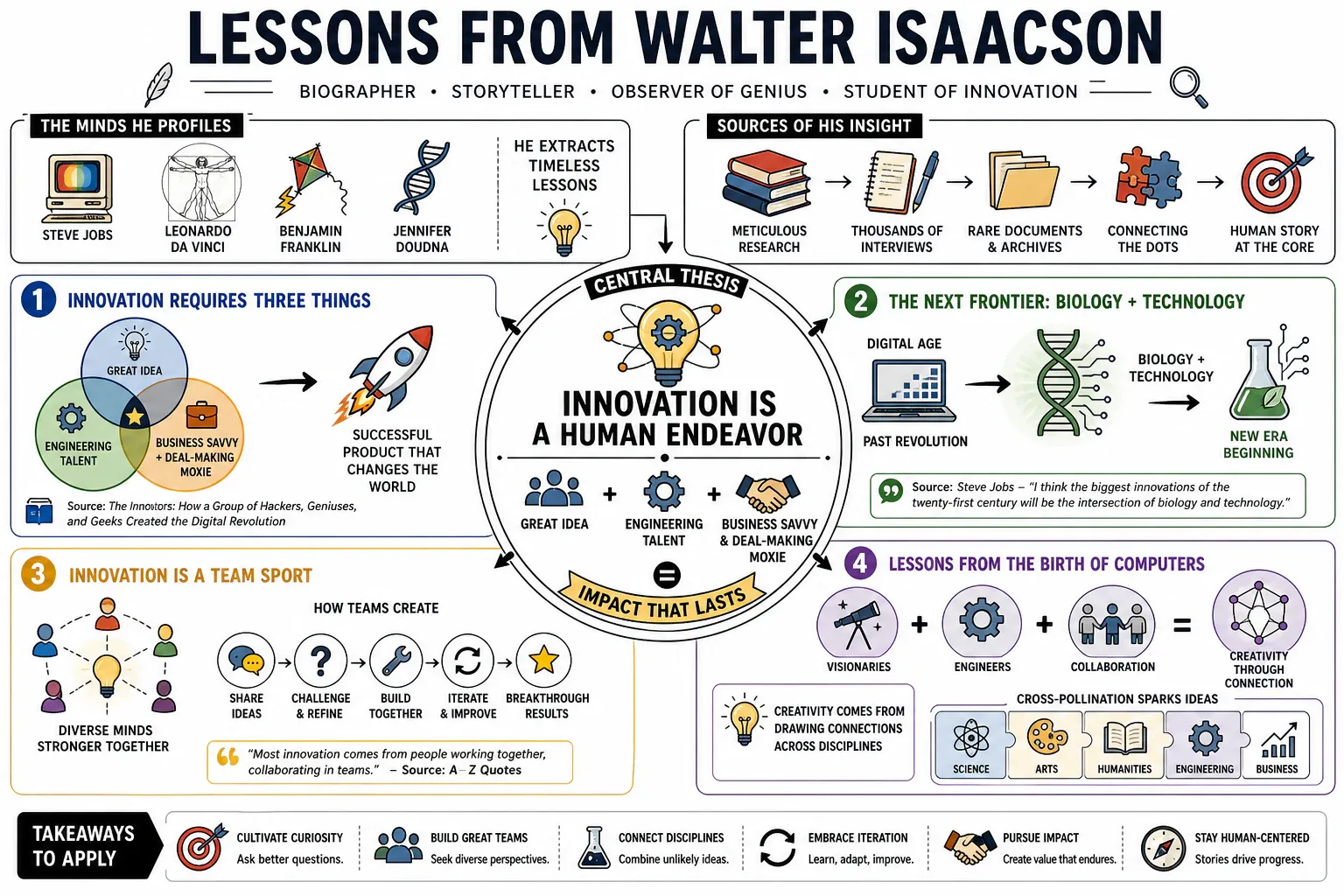
The items below are things Walter Isaacson said on podcasts about biography, innovation and curiosity. — Walter Isaacson on EconTalk, Hubris, Humility, and the AI Revolution (November 2026).
On EconTalk, Isaacson said: "First of all, the algorithms of social media, instead of uniting us, found a better business model with enraging us". — Walter Isaacson on EconTalk, Hubris, Humility, and the AI Revolution (November 2026).
On EconTalk, Isaacson said: "You're going to be somebody who with A lot of persistence, but also a little bit of humility will be able to make things work". — Walter Isaacson on EconTalk, Hubris, Humility, and the AI Revolution (November 2026).
On EconTalk, Isaacson said: "Because I'm doing something I can't do, and I'm doing something that academics generally don't do, which is I'm standing there watching, listening, and taking notes". — Walter Isaacson on EconTalk, Hubris, Humility, and the AI Revolution (November 2026).
On EconTalk, Isaacson said: "To me, scientists and technologists and people who connect science and technology to business have actually more of an impact on our lives than maybe even some of the presidents do". — Walter Isaacson on EconTalk, Hubris, Humility, and the AI Revolution (November 2026).
On EconTalk, Isaacson said: "That curiosity drives me each day, and it wants me to try to learn everything about all sorts of fields". — Walter Isaacson on EconTalk, Hubris, Humility, and the AI Revolution (November 2026).
On Charlie Rose, Isaacson said: "I get to write about great people, but I don't mix myself up with the people I write about". — Walter Isaacson on Charlie Rose, The Greatest Sentence Ever Written (November 2026).
On Charlie Rose, Isaacson said: "I'm also, weirdly enough, an optimist that AI will create more jobs Then it destroys". — Walter Isaacson on Charlie Rose, The Greatest Sentence Ever Written (November 2026).
On Charlie Rose, Isaacson said: "I'll never be the most creative person, but I have led a blessed life where I can make a living by being curious". — Walter Isaacson on Charlie Rose, The Greatest Sentence Ever Written (November 2026).
On Charlie Rose, Isaacson said: "We need a few preachers in this world, but we need a whole lot more storytellers". — Walter Isaacson on Charlie Rose, The Greatest Sentence Ever Written (November 2026).
On The Builders, Isaacson said: "I was not a tough enough, a disruptive enough manager, and I didn't have it in my heart to want to be". — Walter Isaacson on The Builders, ON MUSK Episode Four (October 2026).
On The Builders, Isaacson said: "Whether you're writing about Leonardo da Vinci or you're writing about Elon Musk, you put all your notes in chronological order". — Walter Isaacson on The Builders, ON MUSK Episode Four (October 2026).
On The Builders, Isaacson said: "Read it out loud on paper, let my wife read it, and then do one more round of polishing". — Walter Isaacson on The Builders, ON MUSK Episode Four (October 2026).
On The Builders, Isaacson said: "Those of us who are biographers have to be able to create characters that we hold many things in our minds about them". — Walter Isaacson on The Builders, ON MUSK Episode Four (October 2026).
On Harvard Business Review, Isaacson said: "I think most of what you learn in school, and even in college, involves teamwork, collaboration, socializing, the social skills you get, being able to work together". — Walter Isaacson on Harvard Business Review, Can History's Innovators Teach Us How to Survive 2020? (May 2026 re-release).
On Harvard Business Review, Isaacson said: "I suspect that the 21st century will be a, also be a century of technology, science, and business, not of politicians". — Walter Isaacson on Harvard Business Review, Can History's Innovators Teach Us How to Survive 2020? (May 2026 re-release).
On Harvard Business Review, Isaacson said: "Benjamin Franklin felt that compromisers may not make great heroes, but they do make great democracies". — Walter Isaacson on Harvard Business Review, Can History's Innovators Teach Us How to Survive 2020? (May 2026 re-release).
On BIO from the BAYOU, Isaacson said: "Our moral processing power as a species tends to have kept up with most technologies". — Walter Isaacson on BIO from the BAYOU, Episode 135 (May 2026 re-release).
On Armchair Expert, Isaacson said: "I do it based on you letting me embed myself in your life for two years and just watch you and shadow you". — Walter Isaacson on Armchair Expert with Dax Shepard (January 2026).
On Armchair Expert, Isaacson said: "There's no one formula but there is a through line of all the people I've written about". — Walter Isaacson on Armchair Expert with Dax Shepard (January 2026).
On Armchair Expert, Isaacson said: "Einstein once said that every great advance is a leap of intuition, but every leap of intuition comes from years of having absorbed data". — Walter Isaacson on Armchair Expert with Dax Shepard (January 2026).
On Armchair Expert, Isaacson said: "That will just show how this AI combined with the humanities will find new products and new jobs for people". — Walter Isaacson on Armchair Expert with Dax Shepard (January 2026).
On Armchair Expert, Isaacson said: "Even the villains have backstories, and we shouldn't just say somebody's all or nothing". — Walter Isaacson on Armchair Expert with Dax Shepard (January 2026).
On Armchair Expert, Isaacson said: "I think everybody should have their own set of beliefs, but I think the key there is to be tolerant". — Walter Isaacson on Armchair Expert with Dax Shepard (January 2026).
On The Next Big Idea, Isaacson said: "You quoted some of the statistics, but democracy is not just there because it's useful". — Walter Isaacson on The Next Big Idea, As America Turns 250, Are You in the Mood to Celebrate? (July 2026).
On The Next Big Idea, Isaacson said: "People are either unwilling to compromise or sometimes they're too willing to compromise". — Walter Isaacson on The Next Big Idea, As America Turns 250, Are You in the Mood to Celebrate? (July 2026).
On The Next Big Idea, Isaacson said: "I'd also like to say that it gets to that notion of balance, which is similar to compromise". — Walter Isaacson on The Next Big Idea, As America Turns 250, Are You in the Mood to Celebrate? (July 2026).
On The Next Big Idea, Isaacson said: "I also think there's a practical and a moral reason for putting things in the commons". — Walter Isaacson on The Next Big Idea, As America Turns 250, Are You in the Mood to Celebrate? (July 2026).
On The Next Big Idea, Isaacson said: "If you had to say one thing we can all agree on is this should be a land of opportunity". — Walter Isaacson on The Next Big Idea, As America Turns 250, Are You in the Mood to Celebrate? (July 2026).
On The Next Big Idea, Isaacson said: "He wanted to have libraries in the commons because he said that gave everybody the opportunity to be as well educated as the princes of Europe". — Walter Isaacson on The Next Big Idea, As America Turns 250, Are You in the Mood to Celebrate? (July 2026).
On The Next Big Idea, Isaacson said: "The fabric that holds us together, that makes us feel we're all part of this together, that begins to fray". — Walter Isaacson on The Next Big Idea, As America Turns 250, Are You in the Mood to Celebrate? (July 2026).
On The Context Window, Isaacson said: "As I say, it becomes not a description of America, but a mission statement, an aspiration statement that forces, becomes a forcing mechanism". — Walter Isaacson on The Context Window with David Deming, the sentence that built a country (July 2026).
On The Context Window, Isaacson said: "AI was very good at transcribing those things, getting all the facts right, but it had to be a real person with me editing it that said, okay, let's have a feel for this guy". — Walter Isaacson on The Context Window with David Deming, the sentence that built a country (July 2026).
On Clear+Vivid, Isaacson said: "Secondly, we should look for social media outlets, podcasts like yours and others that unite us rather than divide us". — Walter Isaacson on Clear+Vivid with Alan Alda, Are these truths still self-evident? (June 2026).
On Clear+Vivid, Isaacson said: "It's a business structure of social media that the algorithms are geared to try to have as much engagement as possible". — Walter Isaacson on Clear+Vivid with Alan Alda, Are these truths still self-evident? (June 2026).
In the Harvard Business Review essay on Steve Jobs, Isaacson wrote: "His petulance and impatience were part and parcel of his perfectionism". — Walter Isaacson, The Real Leadership Lessons of Steve Jobs, Harvard Business Review (April 2012).
In the Harvard Business Review essay on Steve Jobs, Isaacson wrote: "So I think the real lessons from Steve Jobs have to be drawn from looking at what he actually accomplished". — Walter Isaacson, The Real Leadership Lessons of Steve Jobs, Harvard Business Review (April 2012).
In the Harvard Business Review essay on Steve Jobs, Isaacson wrote: "Jobs aimed for the simplicity that comes from conquering, rather than merely ignoring, complexity". — Walter Isaacson, The Real Leadership Lessons of Steve Jobs, Harvard Business Review (April 2012).
In the Harvard Business Review essay on Steve Jobs, Isaacson wrote: "The mark of an innovative company is not only that it comes up with new ideas first. It also knows how to leapfrog when it finds itself behind". — Walter Isaacson, The Real Leadership Lessons of Steve Jobs, Harvard Business Review (April 2012).
In the Harvard Business Review essay on Steve Jobs, Isaacson wrote: "Caring deeply about what customers want is much different from continually asking them what they want; it requires intuition and instinct about desires that have not yet formed". — Walter Isaacson, The Real Leadership Lessons of Steve Jobs, Harvard Business Review (April 2012).
In the Harvard Business Review essay on Steve Jobs, Isaacson wrote: "CEOs who study Jobs and decide to emulate his roughness without understanding his ability to generate loyalty make a dangerous mistake". — Walter Isaacson, The Real Leadership Lessons of Steve Jobs, Harvard Business Review (April 2012).
In the Harvard Business Review essay on Steve Jobs, Isaacson wrote: "The creativity that can occur when a feel for both the humanities and the sciences exists in one strong personality was what most interested me in my biographies of Franklin and Einstein, and I believe that it will be a key to building innovative economies in the 21st century". — Walter Isaacson, The Real Leadership Lessons of Steve Jobs, Harvard Business Review (April 2012).
In the Harvard Business Review essay on Steve Jobs, Isaacson wrote: "It is the essence of applied imagination, and it's why both the humanities and the sciences are critical for any society that is to have a creative edge in the future". — Walter Isaacson, The Real Leadership Lessons of Steve Jobs, Harvard Business Review (April 2012).
In the Harvard Business Review essay on Steve Jobs, Isaacson wrote: "None of these men was a saint, but long after their personalities are forgotten, history will remember how they applied imagination to technology and business". — Walter Isaacson, The Real Leadership Lessons of Steve Jobs, Harvard Business Review (April 2012).
In the Harvard Business Review essay on Steve Jobs, Isaacson wrote: "Jobs and Apple took end-to-end responsibility for the user experience—something too few companies do". — Walter Isaacson, The Real Leadership Lessons of Steve Jobs, Harvard Business Review (April 2012).