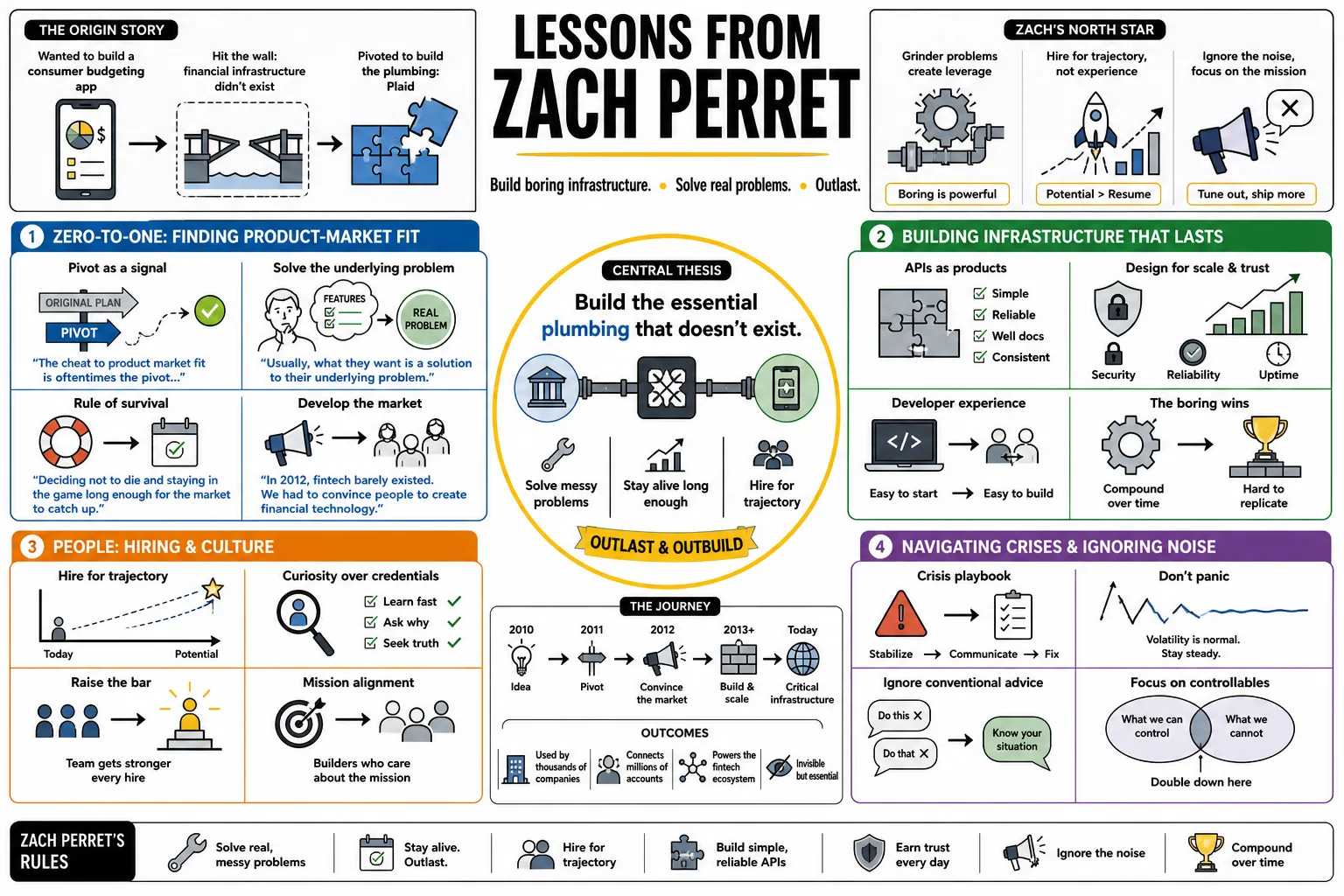
Lessons from Zach Perret
Zach Perret set out to build a consumer budgeting app, but pivoted to create Plaid when he realized the required financial infrastructure didn't exist. His best advice focuses on the unglamorous mechanics of company building: tackling messy "grinder" problems and hiring for trajectory over experience. This profile breaks down his practical rules for designing APIs, navigating crises, and ignoring conventional startup advice.
Part 1: The Zero-to-One Phase & Finding Product-Market Fit
- On the pivot as a signal: "The cheat to product market fit is oftentimes the pivot... a company doesn't generally pivot into something unless it's very clear that it's a good idea." — Source: [Invest Like the Best]
- On solving the right problem: "Customers will often ask for features... but the features aren't usually what they want. Usually, what they want is a solution to their underlying problem." — Source: [SaaStr Annual]
- On the rule of survival: "Sometimes the most important lesson is simply deciding not to die and staying in the game long enough for the market to catch up." — Source: [Acquired Podcast]
- On market development: In 2012, fintech barely existed, so they had to actively convince people to create financial technology startups just to build a market for their own product. — Source: [Acquired Podcast]
- On finding early validation: Working with Venmo was the first major signal that there was massive pent-up demand for a reliable way to connect bank accounts to applications. — Source: [Invest Like the Best]
- On velocity versus speed: "Velocity is speed in a given direction... being right is the most important thing, and then speed. Once you found product-market fit, move fast. Before that, spend the time to be right." — Source: [Turpentine VC]
- On filtering early customers: In the early days, they tested beta customers by asking if they were going to launch fast and requesting their phone numbers to guarantee raw, immediate feedback. — Source: [Invest Like the Best]
- On default consumptive states: Builders must escape the state where they accept how things work and constantly ask why legacy systems operate the way they do. — Source: [Invest Like the Best]
- On ignoring standard advice: Most startup wisdom is narrowly applicable; copy 80% of standard operations, but be fiercely original on the 20% that defines your specific edge. — Source: [Y Combinator]
- On the value of great challenges: Look for problems that are intellectually stimulating and have the potential to make a massive structural impact on the world. — Source: [Invest Like the Best]
Part 2: Hiring & Talent Density
- On evaluating trajectory: "Hire for slope, not y-intercept." Focus on a candidate's potential for growth rather than their current baseline of experience. — Source: [Lattice]
- On the ultimate priority: A great team can fix a mediocre strategy, but a bad team will fail regardless of how brilliant the plan is. — Source: [Lattice]
- On hiring for spikes: Avoid indexing on well-rounded candidates; look for people with extraordinary talent in one specific area, even if they have glaring weaknesses elsewhere. — Source: [20VC]
- On the 'too hungry to eat' fallacy: When managers claim they are too busy to recruit, it is like saying they are too hungry to eat, because recruiting is the only lever to solve an overwhelming workload. — Source: [Lattice]
- On founder-led recruiting: Early on, the founders must take personal responsibility for sourcing and interviewing the first 100 hires rather than delegating the work to an agency. — Source: [NEA]
- On hiring managers as sourcers: Even as the company scales, hiring managers should co-own the pipeline by actively sending cold emails and mining their own professional networks. — Source: [Lattice]
- On core candidate traits: The three non-negotiable characteristics to look for in every new hire are humility, ambition, and urgency. — Source: [Lattice]
- On learning to love recruiting: "I started out hating recruiting... I realized if I didn't start to enjoy recruiting then that would be a challenge for me. I figured out ways to trick myself to love it." — Source: [Turpentine VC]
- On settling for convenience: "Sometimes you get really annoyed with a search that's been going on for a long time and you're like 'I just need to hire someone.' Often that will lead you to make a mistake." — Source: [Turpentine VC]
- On technical sales roles: Instead of hiring traditional account executives early on, hire engineers who can have deeply technical, relationship-driven conversations with developer clients. — Source: [a16z]
Part 3: Leadership & Operating Cadence
- On the CEO's role: The chief executive functions as a symphony conductor, establishing the rhythm, tempo, and underlying structure for the entire organization. — Source: [Lattice]
- On setting strategy: Leadership must define the overarching direction and desired outcomes while letting the team determine the specific tactical path to get there. — Source: [Lattice]
- On operating rhythm: A predictable cadence of goal-setting, check-ins, and reviews creates the necessary beat for a company to scale without chaos. — Source: [Lattice]
- On intellectual honesty: Teams must cultivate a culture of being ruthlessly honest about what is working and what is failing, creating the space to pivot quickly. — Source: [Lattice]
- On continuous improvement: Leaders must maintain a state of being pleased but not satisfied to ensure the team celebrates wins while retaining the urgency to solve the next problem. — Source: [Acquired Podcast]
- On three-year plans: "Any three-year strategy is 100% going to be wrong," but it serves as an indispensable directional guide to align the company's daily decisions. — Source: [Lattice]
- On tracking free radicals: Pay close attention to product champions who switch jobs; following these individuals as they move between companies is a massive organic growth engine. — Source: [Invest Like the Best]
- On doing more with less: Early teams should set ambitious goals and beat them by maintaining a lean, high-functioning group rather than defaulting to aggressive headcount expansion. — Source: [NEA]
- On cascading execution: Strategic mandates should be established top-down, but the actual execution plans and specific goal-setting must be generated bottom-up. — Source: [Lattice]
Part 4: Product Development & API Design
- On product-driven cultures: Being genuinely product-driven means the organization's first priority is always building a tool that provides immediate utility to the end user. — Source: [Zach Perret Blog]
- On usage over feedback: What customers explicitly ask for is easy to build, but building what they will fundamentally rely on and use daily is the true metric of product success. — Source: [SaaStr Annual]
- On early architecture: "Go slow at the beginning, and make sure you get it right. It's tough to modify how a platform is built over time." — Source: [SaaStr Annual]
- On API versioning: Establish strict versioning policies before acquiring your first 100 customers to avoid breaking their builds later. — Source: [SaaStr Annual]
- On selling through the basement: Target the lowest-level engineer; if they can integrate your API in an afternoon and show a working prototype to their manager, the sale is closed. — Source: [a16z]
- On documentation as marketing: For infrastructure products, the API documentation is your primary marketing page; it must be exceptionally clear, searchable, and interactive. — Source: [a16z]
- On abstracting complexity: The core value of a great API is taking a nightmare of fragmented legacy systems and synthesizing them into a single, elegant interface. — Source: [Invest Like the Best]
- On reliability as a feature: Uptime is the most critical component of the developer experience; if the infrastructure breaks, trust is irreparably damaged. — Source: [Invest Like the Best]
- On empowering developers: Design developer tools that make individual engineers look like heroes to their wider organization by removing tedious backend work. — Source: [a16z]
- On solving complete problems: Avoid shipping superficial features; instead, investigate and build the underlying infrastructure required to solve the complete problem a customer faces. — Source: [Acquired Podcast]
Part 5: Strategy, Growth & Defensibility
- On grinder problems: Focus on solving deeply unglamorous, operationally intensive issues that require manual effort, as most competitors will avoid them entirely. — Source: [Turpentine VC]
- On early-stage moats: "I don't really think any startup has defensibility on day one... a year in, absolutely, we could have grinded out a load of work." — Source: [Turpentine VC]
- On late-stage defensibility: Founders worry too much about defensibility in the immediate term and worry far too little about cementing structural defensibility in the late stages. — Source: [Turpentine VC]
- On the snake and the elephant: When scaling products, it is better to eat three sheep sequentially rather than trying to digest one massive project at once. — Source: [Turpentine VC]
- On distribution as strategy: The best product does not automatically win, meaning distribution must be treated as a core product strategy rather than a secondary sales function. — Source: [Zach Perret Blog]
- On trusting authenticity: Be truly authentic to the developer community, because organic developer users will eventually become your most effective and credible evangelists. — Source: [SaaStr Annual]
- On cold outreach: Founders should leverage automated software to scale cold email outreach, viewing it as the fastest way to build early network density. — Source: [Lattice]
- On sweating the details: In the early days, the quality of the smallest touchpoints—API documentation, UI polish, customer support tone—is what establishes brand trust. — Source: [Turpentine VC]
- On the future of fintech: The integration of fintech is happening everywhere, turning financial services into invisible connections across all software. — Source: [Forbes]
Part 6: Venture Capital & Fundraising Mechanics
- On fundraising as a distraction: Try to raise money as infrequently as possible, ideally every two or three years, to prevent fundraising from distracting the team from actual company building. — Source: [Turpentine VC]
- On capital discipline: Treat venture capital strictly as a resource to be acquired only when the business fundamentally requires it to scale, rather than a vanity metric. — Source: [Turpentine VC]
- On the broken VC model: The traditional venture capital model is on its last legs and requires significant evolution to remain useful to the highest-performing founders. — Source: [20VC]
- On the zero-to-one gap: There is a massive market gap because very few venture capitalists possess true zero-to-one, product-market fit experience. — Source: [Turpentine VC]
- On valuation buffers: Never blindly chase the highest possible valuation; treat valuation as a strategic choice in a decade-long plan to avoid punishing down-rounds if the market turns. — Source: [Y Combinator]
- On the 'bat phone' philosophy: Founders need investors on their cap table who have lived through the zero-to-one grind and can offer tactical advice during an internal crisis without judgment. — Source: [Mischief VC]
- On the ground game: The best investors focus on a quiet ground game of delivering tangible results for founders rather than being loud on social media. — Source: [Turpentine VC]
- On institutionalizing support: True venture value comes from institutionalizing peer-to-peer founder support networks rather than relying strictly on board governance. — Source: [Turpentine VC]
- On network events: Host structured dinners with 10-12 people and ask attendees to recommend others, treating network density as an intentional, compoundable asset. — Source: [Turpentine VC]
Part 7: Navigating Crises & The Failed Visa Acquisition
- On the rollercoaster: "They say that startups are like a rollercoaster. Indeed the ride doesn't end, it just keeps going. The magnitude gets even larger." — Source: [Acquired Podcast]
- On operating during an acquisition: "My view was great, we're operating the same as a startup. We're going to push as hard as we can as fast as we can on everything... we were just full speed ahead." — Source: [Acquired Podcast]
- On emotional all-hands meetings: Announcing the acquisition was complex: "There was anger, frustration, surprise, joy. Some people were crying. I couldn't tell if they were happy or sad." — Source: [Acquired Podcast]
- On peer support: A fellow CEO called after the deal was announced and said that if the acquisition failed, Plaid would be fine and potentially even better off. — Source: [Acquired Podcast]
- On walking away: "At that point, I believe Plaid was worth more. Frankly, a lot of the concerns that we had about our business, a lot of the impetus for selling was gone." — Source: [Acquired Podcast]
- On regulatory timelines: "The realities of going through a multiyear regulatory review are just not compatible with the fast-moving realities of a startup." — Source: [Forbes]
- On customer duty: "The reality of leaving our business in a multiyear review... is not in the best interests of our customers." — Source: [Forbes]
- On leveraging the 'stamp of approval': Even though the deal fell through, the fact that Visa was willing to pay billions provided an immense brand credibility boost that propelled their independent growth. — Source: [Acquired Podcast]
- On resetting the valuation: Following the collapsed deal, deciding to raise at a higher valuation was a validation that their independent mission was the right long-term path. — Source: [20VC]
Part 8: Contrarian Management & Startup Fallacies
- On 'Founder Mode': The recent 'Founder Mode' essay is dangerous because it serves as a convenient excuse for founders to aggressively micromanage their teams. — Source: [20VC]
- On the danger of misinterpretation: "I think it's going to be one of the blog posts that is the most misused and actually causes a lot of the worst behavior in startups for a long time." — Source: [Turpentine VC]
- On rejecting OKRs: OKRs are fundamentally unsuited for early-stage software companies; they often degrade into a bureaucratic exercise that severely slows down execution. — Source: [20VC]
- On misapplying manufacturing logic: "OKRs were built for manufacturing. We don't manufacture software... don't just read the Andy Grove book and try to apply this thing that worked for Intel to your business." — Source: [Turpentine VC]
- On leaving consulting: "I worked at Bain for 12 months... I earned one bonus check, which was $4,000. It was the most money I'd ever seen... and lasted me a full two months of rent in New York City." — Source: [Acquired Podcast]
- On false precision: Avoid applying rigid corporate frameworks to fluid, early-stage problems where survival depends on instinct and speed rather than perfect measurement. — Source: [20VC]
- On early-stage delegation: Stay extremely close to the core issues that matter, but avoid using a hands-on philosophy to stifle the executives you hired to scale the company. — Source: [Turpentine VC]
- On the illusion of strategy: Success is rarely about the intellectual brilliance of an idea; it is almost entirely about your visceral desire and stamina to do the unglamorous work. — Source: [Turpentine VC]
- On embracing the grind: If you are willing to grind through operations that others find tedious, you will inherently build a product that no one else is capable of replicating. — Source: [Turpentine VC]