Lessons from Aileen Lee
Aileen Lee founded Cowboy Ventures after more than a decade at Kleiner Perkins and co-founded All Raise. Her 2013 research introduced “unicorn” for the rare young U.S. technology companies valued above $1 billion. Her work spans seed investing, capital efficiency, and access to venture capital. — Cowboy Ventures anniversary essay.
Part 1: The "Unicorn" Phenomenon
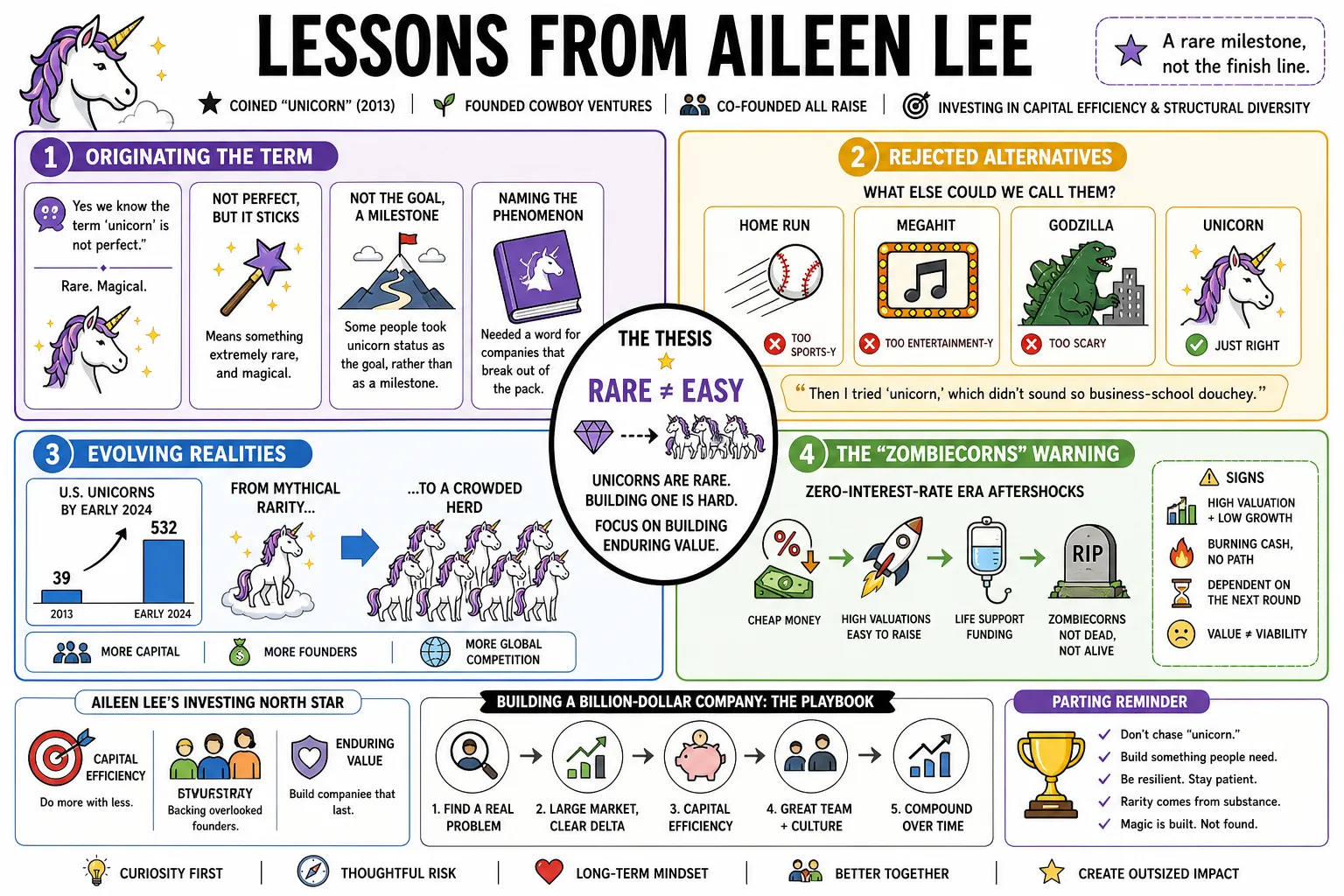
- Originating the Term: Lee used “unicorn” for the rare, hard-to-build billion-dollar companies identified in her 2013 analysis. — Inc. interview.
- Milestone, Not Goal: Lee later cautioned that some founders treated a billion-dollar valuation as an objective rather than a milestone in building a durable company. — Inc. interview.
- Naming the Phenomenon: Lee considered “home run,” “megahit,” and “Godzilla” before choosing “unicorn” to convey rarity and a sense of alchemy. — Inc. interview.
- A Larger Herd: Cowboy’s comparable U.S. datasets grew from 39 qualifying companies in 2013 to 532 in its 2023 review; the later cohort spans more sectors. — Cowboy Ventures Unicorn Club update.
- Zombiecorns: Cowboy warned that some companies last valued during the low-rate boom faced short runways and might become stagnant “zombiecorns.” This was a risk assessment, not a count of confirmed failures. — Cowboy Ventures Unicorn Club update.
- Unicorpses: Cowboy used “unicorpses” for former unicorns that shut down, emphasizing that a paper valuation does not guarantee survival. — Cowboy Ventures Unicorn Club update.
- Papercorns: In Cowboy’s 2023 cohort, 93% were “papercorns”: companies whose billion-dollar valuations remained private and had not yet become liquid exits. The term does not itself mean a company optimized for valuation. — Cowboy Ventures Unicorn Club update.
- Fund-Size Incentives: Lee argued that larger venture funds need larger outcomes to return capital, influencing check sizes and valuations. — Cowboy Ventures Unicorn Club update.
- Premature Valuations: Lee warned that reaching unicorn status too early can become a burden when the underlying business has not grown into its valuation. — Cowboy Ventures Unicorn Club update.
- Fundraising Discipline: Cowboy advised seed founders in a tougher financing market to adjust planned burn, runway, and fundraising targets to the later-stage funding climate. — Cowboy Ventures investor offsite.
- Potential AI Superunicorn: In its 2024 retrospective, Cowboy predicted that OpenAI might become the first superunicorn of that decade and AI a major technology trend; this was a forecast, not a settled outcome. — Cowboy Ventures Unicorn Club update.
- ZIRPicorns: Cowboy called companies last valued between January 2020 and March 2022 “ZIRPicorns”; that low-rate valuation vintage covered about 60% of its 2023 unicorn cohort. — Cowboy Ventures Unicorn Club update.
Part 2: The Data Behind the Magic
- Founder Age: The original 2013 unicorn cohort had an average founder age of 34, challenging the idea that only very young founders build such companies. — Cowboy Ventures Unicorn Club update.
- Co-founding Teams: In Cowboy’s 2023 cohort, 83% of unicorns had co-founders and roughly 65% of founders had previously worked or studied together. These are cohort observations, not a rule against solo founders. — Cowboy Ventures Unicorn Club update.
- Enterprise Capital Efficiency: In Cowboy’s original cohort, enterprise unicorns had a 26x valuation-to-private-capital-raised ratio, about 2.4 times the consumer-company figure under its definition. — Cowboy Ventures Unicorn Club update.
- Overlooked Industries: Cowboy sees opportunities for software tailored to overlooked sectors such as construction, healthcare, and logistics when teams understand specific customer pain points. — Cowboy Ventures vertical AI essay.
- Data and Judgment: Lee collected founder and funding data to learn from prior breakout companies, while also saying seed investments often require intuition before a product exists. — Stanford eCorner transcript.
- AI Services Opportunity: Lee’s 2026 thesis identifies a large opportunity for AI-native companies to improve labor-intensive professional services, especially where software can deliver faster and lower-cost outcomes. — Cowboy Ventures AI services essay.
- Enterprise Budget Pressure: Cowboy warned that tighter enterprise budgets and a desire for fewer vendors could make new software sales and renewals harder. — Cowboy Ventures investor offsite.
- Too Much Money Early: Cowboy cautioned founders and investors about raising too much money too early and too fast, especially when valuations outrun fundamentals. — Cowboy Ventures Unicorn Club update.
- Statistical Rarity: Cowboy estimated that fewer than 1% of venture-backed startups became unicorns in its 2023 U.S. cohort, even after the category expanded. — Cowboy Ventures Unicorn Club update.
- Capital-Efficiency Decline: Cowboy estimated that enterprise unicorn capital efficiency fell from 26x in the original cohort to 7x in its 2023 cohort, noting that paper valuations may inflate the latter figure. — Cowboy Ventures Unicorn Club update.
- Broader Educational Backgrounds: Only about 20% of co-founders in Cowboy’s 2023 unicorn cohort attended a top-ten university, versus roughly two-thirds in the original cohort. — Cowboy Ventures Unicorn Club update.
- Nontechnical Co-founders: About 40% of co-founders in Cowboy’s 2023 cohort had nontechnical backgrounds, complicating the stereotype that every founder must be an engineer. — Cowboy Ventures Unicorn Club update.
Part 3: Changing the Face of Venture Capital
- Original Gender Gap: Only about 5% of companies in the original 39-company unicorn cohort had a female co-founder, and none had a female founding CEO. — Cowboy Ventures Unicorn Club update.
- Slow Progress: In Cowboy’s 2023 cohort, 14% of unicorns had a female co-founder and 5% a female founding CEO—higher than the 2013 cohort but far from parity. — Cowboy Ventures Unicorn Club update.
- Beyond Meritocracy Claims: Lee described how informal, male-dominated professional networks gave some investors access to trust and information that women were less likely to receive. — All Raise essay by Aileen Lee.
- An Email Became a Movement: All Raise traces its origins to a 2017 email and a group of senior women investors who organized to make venture more equitable. — All Raise founding team.
- All Raise Mission: All Raise works to advance women and nonbinary investors and founders by changing who holds influence and investment authority in venture. — All Raise annual report.
- Constructive Change: Lee urged women founders and investors to turn frustration about inequity into practical changes in hiring, investment, and venture leadership. — Y Combinator interview.
- Diversity as an Investment Consideration: Lee argued that founders should build diversity into teams and said she expected stronger companies when a wider range of people contribute. This is her investment view, not a quantified return guarantee. — Startup Grind interview.
- Build Support Structures: All Raise emphasizes networks, mentorship, and paths to decision-making power for women and nonbinary investors rather than counting participation alone. — All Raise annual report.
- Names Versus Representation: Cowboy’s 2023 cohort had more founders named Michael, David, and Andrew than female founding CEOs, illustrating how far gender representation still had to go. — Cowboy Ventures Unicorn Club update.
Part 4: Lessons from the Seed Stage
- People and Market at Seed: Lee looks for founder integrity, scrappiness, a relevant connection to the problem, and a credible plan for a large market; no single initial product is guaranteed to last. — Y Combinator interview.
- Early Hiring Help: Lee said seed founders often need help defining and making their first specialist hires, including sales and design leaders. The original 50% time rule was not verified. — Y Combinator interview.
- A Personal Problem Connection: For Lee, a team’s relevant background or personal connection to the problem helps explain why it is suited to build the company. — Y Combinator interview.
- Story Plus Evidence: Lee said a founder’s story should communicate the mission and market but also be grounded in product feedback and a plausible financial plan. — Y Combinator interview.
- Execution Beyond the Idea: Lee looks for founders who have tested assumptions and built or shipped something before asking investors to fund the next step. — Startup Grind interview.
- Early Seed Uncertainty: Lee said Cowboy sometimes invests before a product is shipped, making its early-stage decisions a judgment about people and plans as well as metrics. — Stanford eCorner transcript.
- Learning Velocity: Cowboy looks for teams that pick up customer and market signals, iterate, and ship product and go-to-market work quickly. — Cowboy Ventures investor offsite.
- Co-founder History: Cowboy’s cohort analysis tracks how co-founders met and notes that prior work or school ties were common among its unicorn teams. It is an observation rather than a stability test. — Cowboy Ventures Unicorn Club update.
- Repeat Consumer Value: Lee advises consumer founders to measure engagement, purchase frequency, and customer lifetime value rather than stopping at initial utility. — Cowboy Ventures B2C essay.
- Difficult Execution as a Moat: Lee argues that solving hard operational or technical problems can create defensibility, especially when network effects reinforce the product. — Cowboy Ventures B2C essay.
Part 5: Leadership and the "Marshmallow Test"
- Restraint at High Valuations: Cowboy’s retrospective warns that abundant capital and high paper valuations can encourage premature spending; founders need to preserve business fundamentals. — Cowboy Ventures Unicorn Club update.
- Founder Motivation: Lee said investors try to understand what motivates a founder and whether that person can navigate an eight-to-ten-year company-building journey. — Startup Grind interview.
- Resilience Through Constraints: Cowboy looks for gritty teams that can do more with less and adapt during difficult fundraising and customer markets. — Cowboy Ventures investor offsite.
- Relationships Matter: Lee built Cowboy to work personally and hands-on with founders, with trust and direct support rather than large-firm overhead. — Y Combinator interview.
- Choose the Board Member: Lee advised founders to choose a Series A board member carefully because the relationship may last a decade and affect how the CEO develops. — Y Combinator interview.
- Qualify Potential Investors: Lee recommends that founders explain their market, team, product feedback, economics, and use of funds so investors can assess fit. The “enterprise sales job” analogy was not verified. — Y Combinator interview.
- Independent Thinking: Lee described Cowboy’s values as integrity, independent thinking, resilience, and willingness to work with limited resources. — Cowboy Ventures anniversary essay.
- Start With a Real Problem: Lee asks founders to show why they care about the problem and what they have learned from testing it—not merely a desire to carry the founder title. — Startup Grind interview.
- Use Seed Capital Deliberately: Lee asks seed teams for an ambitious but doable plan and advises that a seed round ideally lasts at least 18 to 24 months. — Y Combinator interview.
Part 6: Building the "Life 2.0" Thesis
- Life 2.0: Lee described Cowboy’s Life 2.0 thesis as backing software that changes how people work and live in large, growing markets. — Startup Grind interview.
- Software Reaches Daily Life: Lee’s Life 2.0 examples include news, note-taking, transport, and access to the home—software moving into ordinary routines. — Startup Grind interview.
- Work and Personal Routines: Lee connected enterprise workflows and personal-life routines in a broad software thesis; the original claim of a dissolved work–home boundary went beyond the source. — Startup Grind interview.
- More Than Digitization: Lee looked for technology that makes familiar tasks more efficient, transparent, or enjoyable. — Startup Grind interview.
- Large, Reachable Markets: Lee said venture investors seek very large markets that a startup can realistically access, accounting for regulatory and economic risks. — Startup Grind interview.
- Consumer Delight: Lee sees room for consumer products that make existing behaviors more accessible or delightful, not merely digitized. — Cowboy Ventures B2C essay.
- Modern Teamwork Software: Cowboy invests in software for work and internal operations, including future-of-work and vertical SaaS categories. The old named thesis was not independently located, so this is bounded to its current investing guide. — Cowboy Ventures investing guide.
- The First Call: Lee said Cowboy aims to be the investor a founder calls when things are not going well, not just when the company has good news. — Cowboy Ventures anniversary essay.
- Founder Insight: Cowboy’s diligence asks whether founders have a distinctive insight into a customer problem, a large market, and a plan to execute. — Cowboy Ventures investing guide.
- Platform-Shift Window: Lee observed that several major consumer companies emerged two to ten years after prior platform shifts and argued that AI might create another window. — Cowboy Ventures B2C essay.
- Adaptive AI Interfaces: Lee predicted that successful consumer AI products would use natural-language input and memory to personalize and evolve their experience. It is a forecast, not a demonstrated standard. — Cowboy Ventures B2C essay.
- The Free-Product Bar: Lee argued that free utility from frontier AI products raises the bar for specialized consumer AI apps that seek subscription or transaction revenue. — Cowboy Ventures B2C essay.
Part 7: On Diversity, Inclusion, and All Raise
- Bias Requires Action: Lee described exclusion and bias in venture as persistent and called for constructive changes to hiring, investing, and who advances to partner. — Y Combinator interview.
- Decision-Making Power: All Raise now emphasizes women and nonbinary investors leading deals and taking board seats, not simply joining the industry. — All Raise annual report.
- A More Representative Ecosystem: All Raise seeks a venture ecosystem where more women and nonbinary investors and founders have access to leadership and capital. — All Raise annual report.
- Include Men as Allies: Lee said men as well as women recognized the stacked deck in venture and could help change investment decisions and founder access. — Y Combinator interview.
- Organize for Change: Lee’s account of women investors organizing in 2017 focused on shared knowledge, stronger networks, and coordinated action. — All Raise essay by Aileen Lee.
- Builders Should Reflect Users: Lee urged founding teams to consider diversity from the outset, arguing that the technology industry had substantial room to improve representation. — Startup Grind interview.
- More Women Founders: Lee called for more women to build high-growth companies and for investors to make access to capital more equitable. — Y Combinator interview.
- From Representation to Power: All Raise says participation is a foundation, while success means more women and nonbinary investors actually writing checks, leading deals, and taking board seats. — All Raise annual report.
Part 8: The Journey from Gap to Kleiner to Cowboy
- Leaving an Established Firm: Lee said she left a secure, well-compensated role at Kleiner Perkins to start a smaller and more personal seed-focused firm. — Cowboy Ventures anniversary essay.
- An Unplanned VC Career: Lee said she originally joined Kleiner Perkins to learn about startups and did not expect to spend thirteen years there. — Startup Grind interview.
- Building a Focused Seed Firm: Lee started Cowboy as a small seed fund to spend more time directly with founders and less time in large-firm internal meetings. — Y Combinator interview.
- Investor Fallibility: Lee wrote that founders and investors alike miss opportunities, make mistakes, and experience slumps; the useful response is reflection, feedback, and continued improvement. — No One in Silicon Valley Is Batting 1000.
- The Long Game: Lee told founders that building a company can take eight to ten years and looks for people able to navigate that long road. — Startup Grind interview.
- Early Capital Partnership: Cowboy focuses on leading or co-leading seed rounds and staying involved through later funding and company-building stages. — Cowboy Ventures investing guide.
- Managing Self-Doubt: Lee described learning to see herself as a “dolphin,” not a “guppy,” while working in a male-dominated venture industry—a way to retain confidence without copying its prevailing culture. — Stanford eCorner transcript.
- Retail Operating Experience: Before venture investing, Lee held operating roles at Gap and later drew on consumer and marketing experience when starting Cowboy. — Cowboy Ventures anniversary essay.
- Earned Consumer Growth: Lee says referrals, virality, and network effects can create lower-cost consumer growth, but they are difficult to manufacture and require product worth talking about. — Cowboy Ventures B2C essay.
- Support Beyond Capital: Cowboy describes practical seed-investor work as helping with hires, product and go-to-market planning, introductions, later fundraising, and difficult periods. — Cowboy Ventures investing guide.