Lessons from Alex Rampell
Alex Rampell is a general partner at Andreessen Horowitz and previously founded TrialPay and co-founded Affirm. His first-person writing and interviews examine startup distribution, financial infrastructure, payment networks, systems of record and AI software that performs work. This collection organizes those directly documented views. — Alex Rampell: About Me.
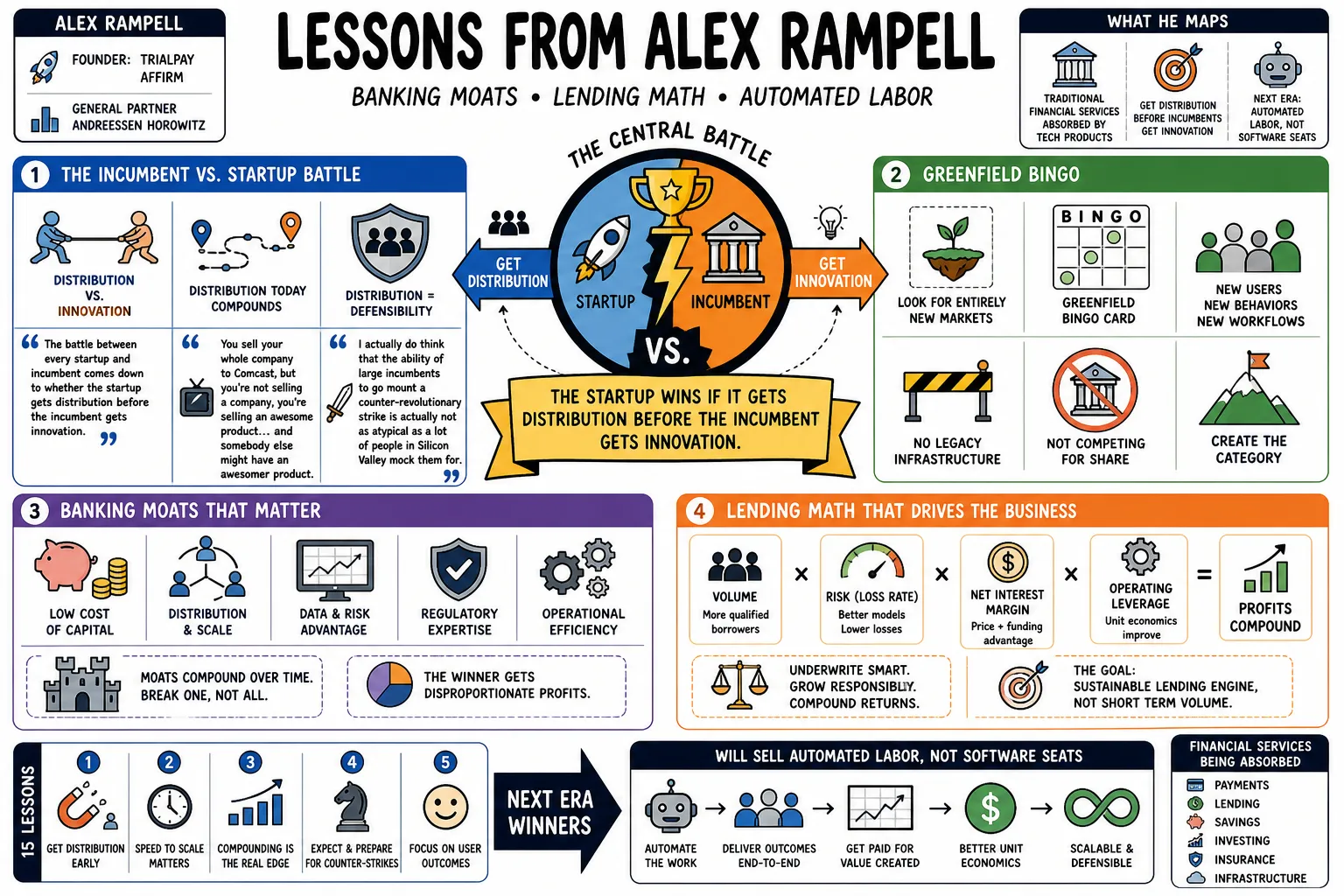
Part 1: The Incumbent vs. Startup Battle
- Distribution before imitation: For startups facing an incumbent, Rampell frames the central race as getting distribution before the incumbent acquires or builds the innovation. — Distribution v Innovation.
- The TiVo problem: A cable distributor could buy TiVo’s product without valuing its independent business, or build a competing DVR and win through distribution. — Distribution v Innovation.
- Incumbents can counterattack: Do not assume established distributors are unable to respond to a startup’s new feature; Rampell points to their ability to copy or acquire innovation. — 20VC: Rampell Interview.
- Greenfield customers: AI-native startups can target newly formed businesses that are not already locked into an incumbent system, rather than paying to displace one. — The Greenfield Strategy.
- The middle of venture capital: Rampell argues that mid-sized generalist venture funds face pressure between very large platforms and focused specialists; this is a venture-fund thesis, not a claim about every business. — 20VC: Rampell Interview.
- Bank data fees as a chokepoint: Rampell argues that proposed bank fees for data access or money movement could create a new competitive chokepoint for fintech companies. — Big Bank Fees Could Kill Competition.
- The cost of moving money: His illustrative $10 fee on a $100 transfer shows how pricing a connection or transfer can discourage consumers from trying a competing fintech service; it is a hypothetical, not an observed universal fee. — Big Bank Fees Could Kill Competition.
- The deposit funding advantage: In the SALT interview, Rampell notes that banks with retail deposits can fund lending more cheaply than challengers without comparable deposit access. — SALT Talks #223.
- Infrastructure debt: Rampell and da Costa argue that legacy banking systems make it harder to add modern AI workflows; replacing or modernizing the underlying records can be part of the opportunity. — Investing in Stitch.
- Buzzwords are not a use case: Rampell warns against requesting blockchain or other fashionable technologies without identifying why the application needs them. — 20VC: Rampell Interview.
Part 2: Systems of Record & The "Hostage" Dynamic
- Hostages and customers: Some systems of record retain customers because the cost and risk of leaving are high, but Rampell now cautions that improved migration tools may weaken that hold. — Systems of Record.
- Investing in operating systems: Rampell looks for software that becomes central to how a business works, especially a durable system of record rather than a disposable feature. — Systems of Record.
- Atomic business records: A system of record tracks atomic business units such as personnel, inventory, calendars and ownership records. — Systems of Record.
- Switching cost is contextual: A record system can remain sticky even at a higher price when migration costs and mistakes exceed the savings, though tools that lower migration friction can change that calculation. — Systems of Record.
- Digital filing cabinets: Much earlier software digitized paper records and gave human workers access to them; it often changed storage more than who performed the work. — Input Coffee, Output Code.
- Outcomes rather than seats: Rampell expects AI that resolves tasks itself to create opportunities for per-outcome pricing instead of billing only by human seat. — Outcome Based Pricing.
- Match cash to maturity: An unprofitable startup should avoid tying operating cash to long-maturity investments even when those investments appear safe. — Maturity Matters.
- Vertical operating systems: A vertical operating system can bundle several records a particular business needs, such as customers, staff calendars, inventory and accounting for an HVAC contractor. — Systems of Record.
Part 3: Fintech Fundamentals & The Math of Lending
- First-principles lending math: In a simplified example with a $100 loan and a 50% chance of nonpayment, Rampell says the lender needs a $200 payoff on repayment merely to break even before other costs. — First Principles on Lending.
- APR and credit access: Rampell argues that caps on high short-term APRs can make some risky small loans uneconomic; that is his policy argument, not a universal proof about every borrower or product. — First Principles on Lending.
- Speed and adverse selection: Rampell uses a hypothetical one-minute, no-blood-test insurance application to illustrate why the easiest policy to buy could attract people who privately know they are high-risk. — Fintech for Startups and Incumbents.
- Selection matters in insurance: An insurer needs to understand how product design changes who chooses to buy; otherwise seemingly attractive convenience can worsen adverse selection. — Fintech for Startups and Incumbents.
- Beware selected loan pools: When a lender offers only a subset of its loans for sale, an outside buyer should consider what the lender kept; Rampell warns that underwriting a selected slice without the full pool invites adverse selection. — Stochastic Gross Margins.
- The cost to serve: A bank can reject a small loan even when it considers the borrower creditworthy if the loan is too small to cover the cost of underwriting and servicing it. — Fintech for Startups and Incumbents.
- Lending inside merchant software: Square Capital can use payment-flow visibility to offer financing to merchants it already serves and collect through those flows; Rampell presents this as an embedded-finance advantage. — SALT Talks #223.
- Fintech becomes ordinary finance: Rampell predicts that consumers may eventually think of these services simply as their bank, insurance or retirement account, not as a separate fintech category. — Waiter’s Pad Interview.
Part 4: O2O Commerce & Real Estate (Friction Removal)
- Online-to-offline commerce: Online-to-offline commerce acquires or commits a customer online and completes the purchase or experience in the physical world. — Online2Offline Commerce.
- Service as a SKU: Packaging a physical service into a standard sellable unit lets it be discovered, purchased and fulfilled much like a product. — Service as a SKU.
- Measure offline intent: When a reservation or purchase starts online, a seller can connect that action to at least part of the subsequent offline transaction. — Online2Offline Commerce.
- Sell at the moment of intent: Rampell compares selling a complementary item during an existing purchase to offering ketchup when someone is buying fries: the customer’s intent is already visible. — 20VC: Rampell Interview.
- Home transaction friction: Rampell describes home purchases as complex transactions involving several intermediaries, creating opportunities for software to reduce coordination costs. — Software and Real Estate.
- Dated agent economics: In 2018, Rampell cited roughly two million US real-estate agents and pointed to a Washington-state example in which zero transactions was the modal outcome; the latter was not a nationwide figure. — FlyHomes.
- Real-estate commissions: In a 2020 investment essay, Rampell estimated US residential real-estate commissions at about $100 billion and argued software could change how that value is delivered. — Investing in Loft.
- A company as home counterparty: Rampell predicted that companies could increasingly act as the direct buyer or seller of a home, simplifying a transaction normally coordinated between individuals. — Divvy.
- Data-informed listing decisions: Rampell argues that a company with property data and analytic staff can inform listing decisions in ways an individual agent may struggle to replicate alone. — Waiter’s Pad Interview.
Part 5: Vertical Software & "Drinking the Milkshake"
- Software plus financial services: Rampell describes a cloud-software era in which embedded payments and lending made some vertical software markets large enough to support companies such as Toast and ServiceTitan. — Input Coffee, Output Code.
- Go boring first: At TrialPay, Rampell learned that owning a merchant’s core payment-processing relationship could matter more than building a clever add-on around payments. — Distribution v Innovation.
- Embed finance in existing relationships: Companies with frequent customer interactions can find opportunities to add financial services inside the relationship they already own; it is an opportunity, not an inevitability for every company. — SALT Talks #223.
- Data moats need scale: Rampell argues that an anti-fraud company with observations across billions of people can outperform a small entrant, but a tiny lead in customer data rarely establishes a meaningful moat. — Rampell and Haber on AI Moats.
- Bundle the vertical records: A vertical operating system can combine several record systems essential to one industry—for example, customer, personnel, calendar and inventory records in an HVAC business. — Systems of Record.
Part 6: Visa, Protocols, and Networks
- Protocol design protects participants: In his Visa analysis, Rampell argues that a carefully designed protocol can protect network participants more durably than contractual or corporate arrangements alone. — Payment Networks, Protocols, and Crypto.
- Decentralization and value capture: Rampell uses Visa as a counterfactual for how a decentralized network might preserve independence and keep value with participants rather than a central owner. — Payment Networks, Protocols, and Crypto.
- Visa as a payment protocol: Rampell describes BankAmericard’s evolution into a bank consortium and Visa’s role in authorizing, settling and clearing transactions among payment participants. — Payment Networks, Protocols, and Crypto.
- Visa’s governance changed: Rampell contrasts Visa’s bank-owned nonprofit origins with its later for-profit public-company structure to illustrate how the central network can capture value. — Payment Networks, Protocols, and Crypto.
- BNPL as a parallel network: Rampell argues that buy-now-pay-later services can form parallel merchant-and-consumer payment networks with SKU-level information that traditional card intermediaries often lack. — Why BNPL Is an Early Threat.
- A real data network effect: In anti-fraud software, Rampell says observations of very many users can improve results for each additional customer; having only a few more observations is not yet a defensible data network effect. — Rampell and Haber on AI Moats.
- Choose decentralization for a reason: Rampell asks whether a particular application actually benefits from a decentralized database or whether a centralized architecture serves it better. — 20VC: Rampell Interview.
- The Visa blockchain counterfactual: Rampell suggests that a decentralized design might have kept Visa’s central ledger independent rather than allowing a single company to capture so much network value. — Payment Networks, Protocols, and Crypto.
Part 7: Founder Psychology & The Materialization Framework
- Materialize the startup inputs: When assessing seed founders, Rampell looks for the ability to recruit strong early hires, attract further capital and reach initial customers. — How to Invest in People.
- Recruit the first five: Rampell asks prospective founders who their first five hires will be, looking for people who can attract capable colleagues into an uncertain new venture. — How to Invest in People.
- Raise the next round: Rampell evaluates whether a founder can present the opportunity and credibly raise the capital needed after a seed investment. — How to Invest in People.
- Find the first customers: Alongside hiring and funding, Rampell asks whether the founder has a plausible path to the first five customers before the company has an established product or reputation. — How to Invest in People.
- Revenge as motivation: Rampell says revenge—proving doubters or people who wronged a founder mistaken—can be a powerful motivator, while treating it as one founder signal rather than a requirement. — How to Invest in People.
- Conviction over consensus: Rampell’s “conviction beats consensus” observation concerns venture decisions: an investor may need to back a nonconsensus opportunity rather than wait for everyone to agree. — Stanford GSB Venture Mindset Interview.
- Decisive founder agency: Rampell looks for founders who make decisions quickly, persist through adversity and can lead others through unpopular but necessary choices. — How to Invest in People.
- Study the category’s history: Rampell values founders who learn what earlier players tried and why, citing the Robinhood, Stripe and Brex teams as examples of domain study. — How to Invest in People.
Part 8: AI as Labor & The Future of Software
- Software addresses labor spend: Rampell argues that AI lets software carry out some work previously purchased as human labor, expanding the opportunity beyond traditional software budgets. — Input Coffee, Output Code.
- Capital becomes software labor: Rampell describes capital paying for engineers and compute that yield code able to perform some labor, a thesis he frames as a shift in what software can sell. — Input Coffee, Output Code.
- AI can reduce banking inertia: Rampell forecasts that AI-assisted sign-up and money movement could make it easier for consumers to leave low-yield accounts, pressuring bank profit pools built on friction. — How AI Will Erode Bank Profit Pools.
- Payroll tasks become SKUs: Rampell expects some tasks formerly purchased by hiring people to become digital services bought by card, creating additional payment volume. — Digital Payments Are Going to Grow.
- From records to actions: Rampell contrasts software that stores records for people to act on with AI software that can perform some of those tasks itself. — Input Coffee, Output Code.
- Labor dwarfs software spend: Rampell contrasts enterprise software spending of roughly $300 billion a year with white-collar labor spending in the many trillions, without claiming an exact $13 trillion figure. — Input Coffee, Output Code.
- The cost of omission: In venture investing, Rampell’s attributed view is that missing an exceptional opportunity can matter more than backing a failed investment; this is an investor risk frame, not a universal rule. — Venture Mindset Keynote.
- Find the opening before saturation: Rampell describes an attractive market inflection as a point with real consumer pull but before competition has made acquisition prohibitively crowded. — 20VC: Rampell Interview.