Anish Acharya is a General Partner at Andreessen Horowitz who focuses on consumer technology, fintech, and the emerging capabilities of artificial intelligence. Before becoming an investor, he built and sold two companies—including Snowball, which was acquired by Credit Karma, where he then scaled their US credit card business to over 100 million members. This collection organizes his observations on how AI is breaking enterprise software lock-in, why the best consumer applications are "weird and working," and the evolving relationship between users and financial products.
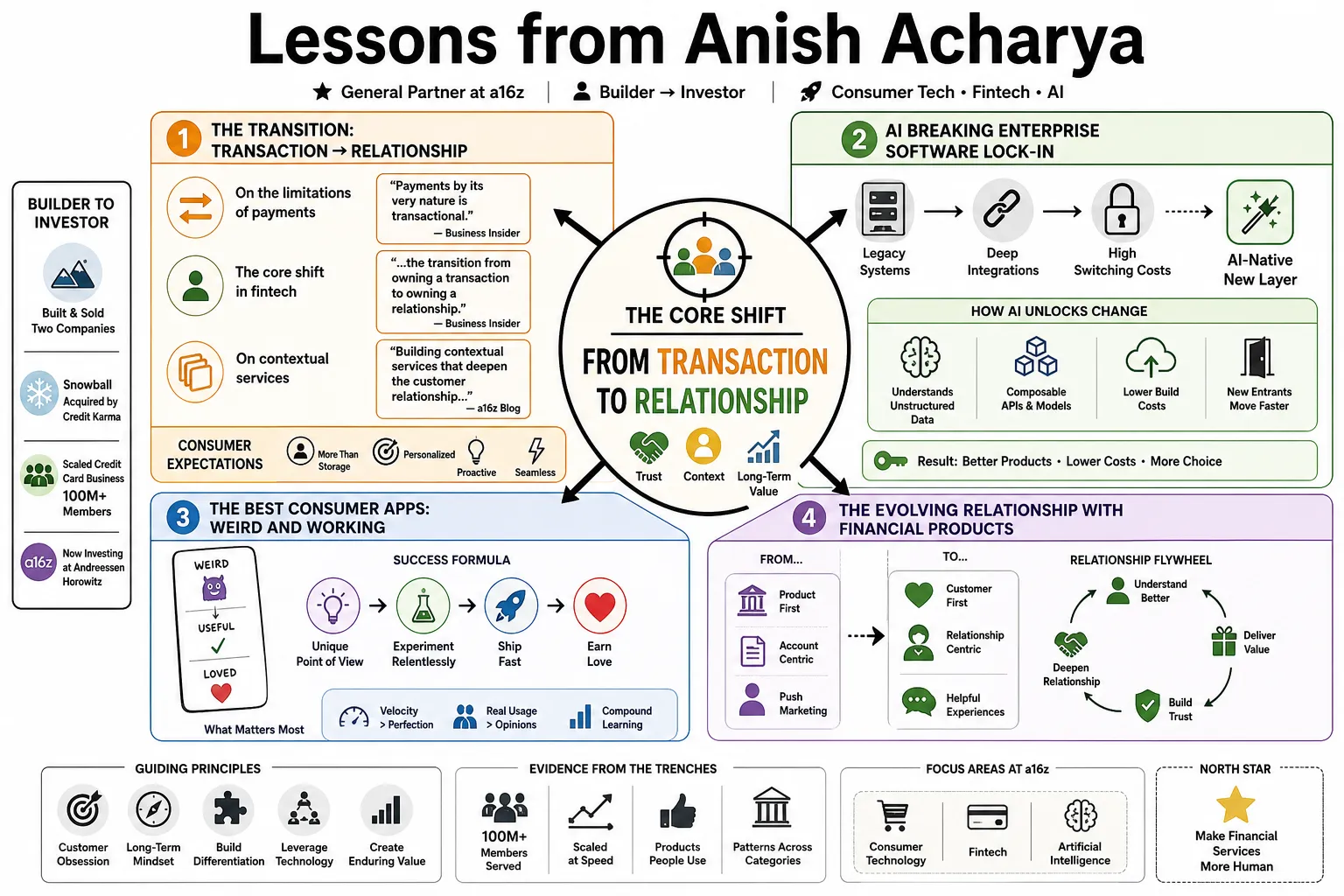
Part 1: The Transition from Transaction to Relationship
- On the limitations of payments: "Payments by its very nature is transactional. It's facilitating a transaction." — Source: Business Insider
- On the core shift in fintech: "I think one of the big things I'm seeing is the transition from owning a transaction to owning a relationship." — Source: Business Insider
- On contextual services: "Building contextual services that deepen the customer relationship matters more than just facilitating cost-efficient transactions." — Source: a16z Blog
- On consumer expectations: "Consumers no longer just want a place to store money; they want a financial partner that understands their context." — Source: Fintech Leaders
- On public financial transparency: "So the fact that people are actually talking publicly about their debt is a new behavior. In the past, spending was public but debt was private." — Source: a16z Blog
- On the destigmatization of debt: "For the first time, debt is starting to become a public conversation among younger generations." — Source: a16z Blog
- On the role of social in finance: "Social accountability and peer transparency are becoming fundamental drivers in how people manage their money." — Source: The a16z Show
- On loyalty versus utility: "Utility gets you the first interaction, but trust and relationship-building secure long-term loyalty." — Source: Fintech Leaders
- On the future of retail banking: "The banks that win will act less like vaults and more like proactive financial advisors." — Source: Business Insider
Part 2: Embedded Finance
- On the modularity of finance: "Financial services infrastructure is becoming increasingly modular and accessible, similar to how AWS transformed computing." — Source: a16z Blog
- On the embedded thesis: "Every company will eventually embed financial services into their core offerings." — Source: a16z Blog
- On new revenue streams: "Embedding payments or lending directly into an existing platform unlocks entirely new revenue streams for non-financial companies." — Source: The a16z Show
- On solving needs at the point of interaction: "The best financial product is the one that solves your problem exactly when and where it occurs." — Source: a16z Blog
- On the default global company: "Embedded finance is accelerating the rise of the default global company by abstracting away the complexity of international payments." — Source: The a16z Show
- On software eating finance: "Software isn't just eating finance; it's integrating it so deeply that the financial component becomes invisible to the end user." — Source: a16z Blog
- On customer acquisition costs: "Non-financial platforms already have the customer attention, making their cost to acquire a financial customer significantly lower." — Source: The a16z Show
- On the API transformation: "APIs are the building blocks that allow any software company to become a fintech company overnight." — Source: a16z Blog
- On the evolution of e-commerce: "E-commerce platforms are no longer just storefronts; they are increasingly the primary financial partner for their merchants." — Source: a16z Blog
Part 3: The API Economy and Infrastructure
- On the foundational layer: "The importance of Plaid and the API market more broadly cannot be overstated." — Source: a16z Blog
- On data accessibility: "Programmatic access to financial data is the prerequisite for the entire modern fintech ecosystem." — Source: a16z Blog
- On extending the API model: "We are seeing new API providers extend this model to payroll, insurance, credit, and ERP data." — Source: a16z Blog
- On developer experience: "In the API economy, the developer is the customer, and developer experience is the product." — Source: The a16z Show
- On removing friction: "Great infrastructure companies don't just move data; they systematically remove friction from complex, legacy processes." — Source: a16z Blog
- On the plumbing of the internet: "APIs are the invisible plumbing that powers the consumer experiences we've come to expect." — Source: The a16z Show
- On legacy systems: "Legacy financial systems are being abstracted away by API wrappers that provide modern, usable interfaces." — Source: a16z Blog
- On standardizing fragmented data: "The true value of an API often lies in taking messy, fragmented data from hundreds of sources and standardizing it into a single clean feed." — Source: The a16z Show
- On infrastructure moats: "Once an infrastructure API is embedded into a company's core workflow, it becomes incredibly sticky." — Source: a16z Blog
Part 4: The SaaS Apocalypse Myth and Enterprise AI
- On the "SaaS is dead" narrative: "The idea that vibe coding will effortlessly replace all software development and kill SaaS is flat wrong." — Source: 20VC
- On enterprise spend realities: "SaaS currently represents only 8 to 12 percent of total enterprise spend." — Source: Wave
- On strategic focus: "Do not point your innovation bazooka at rebuilding standard enterprise tools like payroll or CRM systems where the ROI is limited." — Source: Wave
- On the real opportunity of AI: "The real opportunity is applying AI to optimize the other 90 percent of business costs, not just the software budget." — Source: Wave
- On switching costs: "AI agents are legitimately making it easier and cheaper to switch between SaaS providers, altering customer retention dynamics." — Source: 20VC
- On legacy lock-in: "AI will break the lock-in of legacy software providers by dramatically lowering the barrier to migrating data and workflows." — Source: 20VC
- On competing on value: "Incumbents will be forced to compete more aggressively on actual product value rather than relying on customer inertia." — Source: The a16z Show
- On AI as a moat: "AI itself is not a moat; it is merely a new mechanism to deliver value." — Source: 20VC
- On building enduring products: "Companies must still build enduring products and sustainable advantages to fend off fast followers." — Source: Wave
- On systems of process: "We are shifting from software as systems of record to software as dynamic systems of process." — Source: The a16z Show
Part 5: "Weird and Working" and Consumer AI
- On a new class of software: In "Notes on AI Apps in 2026," Acharya argues that AI-native apps are separating from base models by combining model orchestration, domain-specific interfaces, and rapidly expanding feature surface, creating a distinct application layer rather than just another utility wrapper. — Reference: a16z on AI-native apps diverging from base models through orchestration, UI, and feature surface
- On blending emotion and utility: "The most interesting consumer AI products integrate emotional intelligence and creativity alongside technical function." — Source: Cognitive Revolution
- On emotional interfaces: In "Technology, Culture, and the Next AI Interface with signüll," Acharya frames the next consumer interface wave around culture, relationships, and products that feel less purely utilitarian, pointing toward AI experiences that behave more like relational products than rigid tool flows. — Reference: a16z podcast on technology reshaping relationships and less-utilitarian AI interfaces
- On the consumer renaissance: In "How AI Created the Fastest Product Cycle in History," Acharya says consumer tech is surging again because AI is accelerating the pace of company creation and opening the door to breakout products at unprecedented speed. — Reference: a16z on AI driving the fastest product cycle in tech history and a new consumer surge
- On solo creators: In "Software's YouTube Moment is Happening Now," Acharya says tools like Cursor, Codex, Claude Code, Replit, and Wabi have compressed the path from idea to working app from weeks to hours, letting even non-programmers start shipping software on their own. — Reference: a16z on AI tools shrinking build time from weeks to hours so anyone can ship an app
- On the shift from code to creativity: "AI is shifting the primary bottleneck from raw coding skill to creative direction, taste, and intuition." — Source: Cognitive Revolution
- On the ‘Weird and Working’ thesis: In his Cognitive Revolution conversation, Acharya says a16z looks for products at the intersection of weird and working because seemingly odd or unserious experiences often become the real consumer winners. — Reference: Cognitive Revolution on looking for products at the intersection of weird and working
- On AI companionship: "AI companionship is moving from novelty to a distinct utility for wellness, creativity, and connection." — Source: Cognitive Revolution
- On intuition over logic: In "Notes on AI Apps in 2026," Acharya expects the next wave of AI tools to emphasize exploration and thinking, not just execution, which shifts advantage toward product instinct and judgment over rigid workflow logic. — Reference: a16z on exploration-first AI tools and the move beyond execution-only workflows
- On the abundance agenda: "The AI abundance agenda is about recognizing that AI will democratize access to personalized, creative, and emotional support tools." — Source: Cognitive Revolution
Part 6: Navigating Product-Market Fit
- On the startup superpower: "Before achieving product-market fit, a startup's primary superpower is the speed of learning." — Source: Products That Count
- On iterating toward fit: "The faster a team can experiment and learn, the faster they can iterate toward a product that genuinely resonates." — Source: Products That Count
- On false signals: "Founders must avoid mistaking the mechanics of building the company for the actual finding of product-market fit." — Source: Mercury
- On execution versus value: "Product-market fit is not about flawless execution of business processes; it is about ensuring the product meets a desperate market need." — Source: Mercury
- On intellectual honesty: "It requires immense intellectual honesty to admit when you haven't truly found product-market fit." — Source: Wave
- On the 0 to 1 journey: "It is incredibly easy to overestimate your progress on the path from zero to one." — Source: Wave
- On assuming fit prematurely: "One of the most dangerous traps for an early-stage company is assuming you have achieved fit when you are still searching for it." — Source: Wave
- On marketing vs. product: "In the current AI-native era, there are essentially no marketing problems, only product problems." — Source: The AI Opportunities
- On competitor growth: "If a competitor is growing and charging while you are not, it reflects a deficiency in your product's value, not a failure of your marketing." — Source: The AI Opportunities
Part 7: Lessons on Entrepreneurship
- On building Snowball: "When we built Snowball, the goal was to unify fragmented messaging into a single priority inbox." — Source: BetaKit
- On evolving products: "Your initial vision rarely survives contact with the user; Snowball evolved from a messaging aggregator to a smart notification manager." — Source: BetaKit
- On scaling Credit Karma: "Scaling Credit Karma's card business taught me the profound difference between finding early adopters and serving a hundred million members." — Source: a16z Blog
- On mass market finance: "Building for the mass market requires abstracting away complexity until the financial decision feels completely natural." — Source: Fintech Leaders
- On operational scale: "Operational scale is not just about server capacity; it's about scaling trust and reliability." — Source: a16z Blog
- On the transition to leadership: "Moving from a scrappy startup to a massive organization like Credit Karma requires fundamentally changing how you measure personal impact." — Source: Fintech Leaders
- On solving the right problem: "Entrepreneurs often fall in love with their solution, but the market only cares if you've deeply understood their problem." — Source: Products That Count
- On consumer pain points: "The best consumer products are born from a visceral, personal frustration with the status quo." — Source: BetaKit
- On resilience: "The founder journey is largely an exercise in sustaining conviction when all external signals suggest you should quit." — Source: Fintech Leaders
Part 8: The Venture Capital Lens
- On working sessions: "I love to have the working session because even if for some reason we don't get to an investment, hopefully, you took away something productive." — Source: Business Insider
- On the quality of being right: "In venture capital, the quality of being right is vastly more critical than adhering to a strict analytical process." — Source: Wave
- On the founder to investor transition: "Moving from founder to investor means shifting from building the product to recognizing the kingmakers." — Source: Fintech Leaders
- On identifying outliers: "Venture capital is not about predicting average outcomes; it is about having the conviction to back extreme outliers." — Source: 20VC
- On geographic advantage: "San Francisco retains a unique, compounding network effect that remains highly advantageous for building generational tech companies." — Source: Wave
- On evaluating teams: "We invest in founders who possess an almost irrational obsession with the problem they are trying to solve." — Source: The a16z Show
- On the pace of AI: In his Kevin Rose Show conversation, Acharya argues that AI is rewriting the rules of consumer software and weakening purely technical defensibility because new apps can be spun up quickly, shifting the competitive burden toward distribution, product quality, and durable user value. — Reference: a16z on AI speeding app creation and making pure technology moats less durable in consumer software
- On deflationary tech: In "How AI Will Usher in an Era of Abundance," Acharya argues AI can collapse the cost of expert-like help such as tutoring, wealth advice, therapy, and other high-touch services that were previously too expensive for most people. — Reference: a16z on AI making expert support dramatically cheaper and more broadly accessible
- On restoring the human element: "By using AI to automate the administrative overhead, we can restore the focus to actual human interaction." — Source: The a16z Show
- On long-term optimism: In "Software's YouTube Moment is Happening Now," Acharya says AI has massively democratized leverage and productivity for creative people and argues there has never been a better time for people with strong ideas to build. — Reference: a16z on AI democratizing leverage and making this an unusually strong moment to build