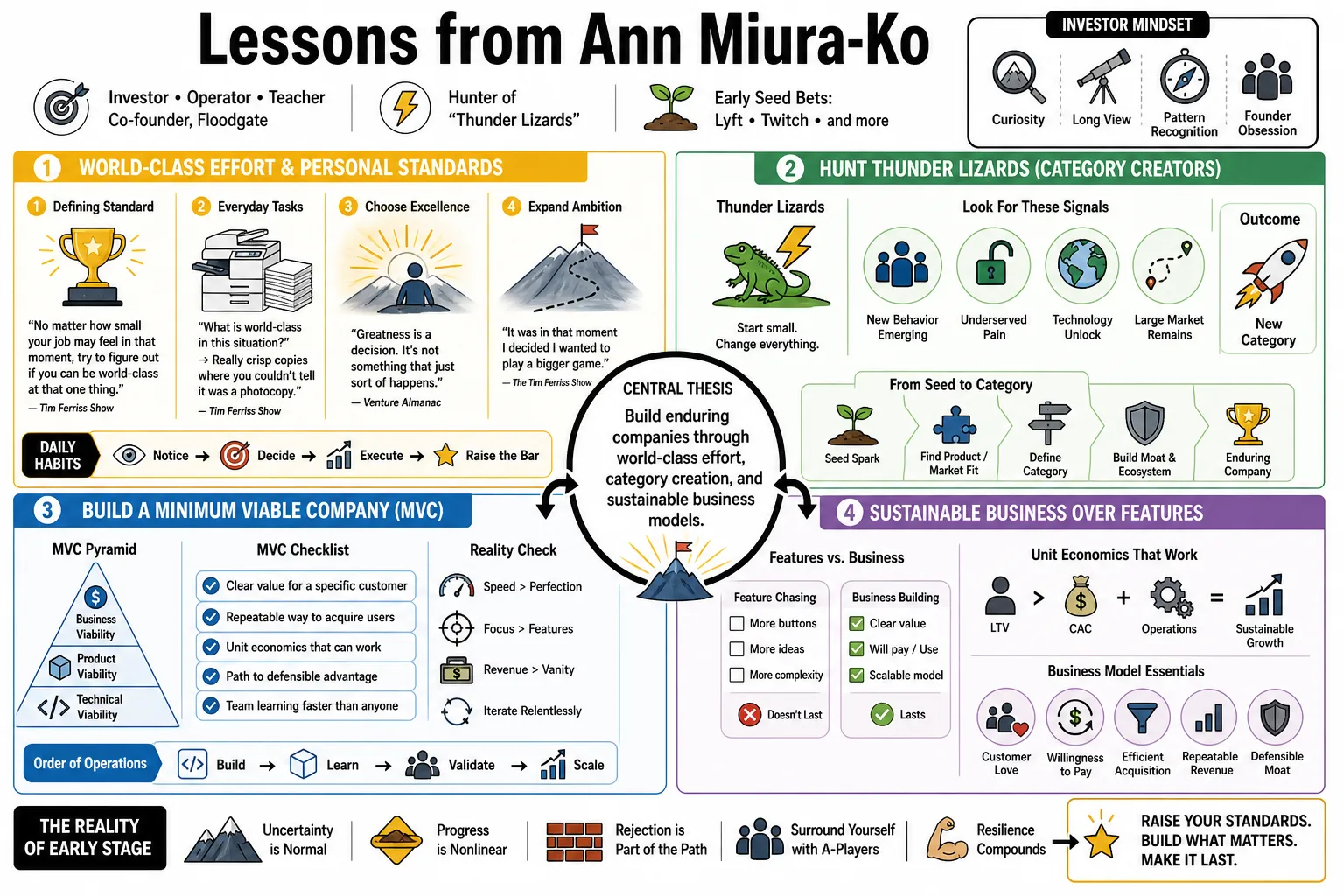
Lessons from Ann Miura-Ko
Ann Miura-Ko co-founded Floodgate and made early seed bets on companies like Lyft and Twitch. She is known for hunting category-creating "Thunder Lizards" and pushing founders to build a Minimum Viable Company, demanding sustainable business models over pure product features. This collection pulls from her lectures and essays to map out the realities of early-stage survival and the exacting standards required to build a company that lasts.
Part 1: World-Class Effort & Personal Standards
- On the defining standard: "No matter how small your job may feel in that moment, try to figure out if you can be world-class at that one thing." — Source: The Tim Ferriss Show
- On everyday tasks: "I remember standing in front of this photocopy machine with a stack of papers thinking to myself, 'What is world-class in this situation?' And I decided it was really crisp copies where you couldn’t tell that it was a photocopy." — Source: The Tim Ferriss Show
- On choosing excellence: "Greatness is a decision. It’s not something that just sort of happens. You have to wake up every morning and decide to be great." — Source: Venture Almanac
- On expanding ambition: "It was in that moment... that someone suggested to me that maybe I should dream a bigger dream." — Source: Stanford eCorner
- On authentic success: "The most wonderful asset we all have is ourselves. And the more we are ourselves, the more successful we will be." — Source: Invest Like the Best
- On building career capital: "Your 20s is the time in which you’re putting capital into the bank with respect to your experiences and your knowledge." — Source: Stanford eCorner
- On arguing vs. living: "This is a lesson that I continue to try to learn and relearn is that life is not a debate... it’s not about being right." — Source: The Tim Ferriss Show
- On the unquantifiable self: "No test will ever be able to measure the vastness of your human potential. Don’t let any teacher, parent, coach, or friend ever make you feel that it can." — Source: Recall.it
- On optimizing for freedom: The goal of wealth generation is optimizing life for the ability to freely pursue the beauty you see in the world. — Source: GitHub Reading Notes
- On demanding the best: You must commit to greatness personally, and explicitly decide to demand greatness from the people around you. — Source: Applied Intuition
Part 2: Defining the Thunder Lizard
- On the origin of the metaphor: "Thunder lizards, for those of you who are not familiar with Godzilla, were hatched from radioactive atomic eggs. And this is actually the stage of the market that we, at Floodgate, like to invest in." — Source: Floodgate
- On the ultimate goal: "They want to be the only Thunder Lizard on the block. For example, Netflix didn't start out trying to be a better Blockbuster. They created their own separate category." — Source: Floodgate
- On spotting potential: "We like to say that our job is to spot radioactive atomic eggs." — Source: Floodgate
- On creating monopolies: A true thunder lizard avoids direct competition; they destroy incumbents by defining and owning an entirely different category of business. — Source: Invest Like the Best
- On converting advantages: A core quality of a Thunder Lizard is the ability to continuously convert early structural advantages into long-term disruptive power. — Source: Forbes
- On debt avoidance: Thunder Lizards aggressively minimize technical debt and organizational debt from day one to maintain extreme agility. — Source: TechCrunch
- On market behavior: Rather than surviving a bloody market share battle, a thunder lizard hatches quickly, adapts to the environment, and becomes universally feared. — Source: Floodgate
- On asymmetric upside: The entire venture capital model relies on finding the rare, fearsome companies that return the fund many times over, bypassing a portfolio of moderate successes. — Source: The Twenty Minute VC
- On non-consensus ideas: To become a category-defining company, the initial concept usually has to look deeply strange or unpromising to the rest of the market at first glance. — Source: Substack Notes
Part 3: Minimum Viable Company vs. MVP
- On moving past the MVP: "True Product Market Fit is a Minimum Viable Company." — Source: Medium
- On the MVC triad: "To have created a minimum viable company, a company needs all three of these elements — value propositions, business model, and ecosystem — working in concert." — Source: Yannick Oswald
- On the 10x threshold: "To succeed, a startup must be at least a 10x improvement for their customer on some dimension. Without a 10x advantage, there may be a slow increase in customer satisfaction, but there's no spike of delight." — Source: Medium
- On delight vs. utility: "You know you've found product-market fit when your product delights the customer so much that they refuse to do business any other way — including the old way." — Source: Medium
- On features as enablers: "Features, however, aren't the product — they're merely enablers of value propositions: promises of how the product will drastically improve a customer's life." — Source: Beehiiv
- On the illusion of growth: "Founders who focus first on growth without knowing the basic ingredients of their minimum viable company are more likely to fuel an addictive and destructive cycle around fake growth." — Source: Beehiiv
- On the sequence of scaling: "Founders must develop insights and customers before focusing on growth." — Source: Beehiiv
- On the ecosystem reality: "Startups deliver a product to more than just their customer; they deliver it into an ecosystem. Promoters, detractors, brokers, salespeople... all influence your customers." — Source: Medium
- On ecosystem risk: "Even if a product is valuable to one group, failing to consider the behavior of another could kill the product." — Source: Beehiiv
- On what makes a market: "If a lot of people care and a lot of people care enough to pay for it, that's what a market ultimately is." — Source: The PNR
Part 4: The Superthinker & Superbuilder Dynamic
- On the ideal founding duo: The most powerful startup dynamic is a powerful loop of vision and velocity created by pairing a superthinker with a superbuilder. — Source: Floodgate
- On the Superthinker's core skill: "They are deeply strategic, visionary, and relentlessly curious. They ask the right questions before others even see the problem." — Source: Ann.vc
- On shaping markets: "The superthinker shapes markets with insight and narrative." — Source: Floodgate
- On framing the opportunity: Superthinkers know how to frame an opportunity, articulate a compelling story, and position a product within a broader market narrative. — Source: CSQ
- On the Superbuilder's mindset: "They are technically gritty, experimentally minded, and unafraid to start over... They care more about the act of building than they do the attachment to what they already have built." — Source: Floodgate
- On architectural thinking: Modern superbuilders build rapidly while simultaneously maintaining a strong intuition for systems and architectural logic. — Source: Floodgate
- On prototyping: Superbuilders treat prototypes strictly as instruments for learning rather than finished assets to protect. — Source: Floodgate
- On discarding sunk costs: The best technical founders operate with extreme urgency, tight iterations, and zero emotional attachment to sunk costs. — Source: Floodgate
- On the ultimate filter: "I look for Superthinkers and Superbuilders — people with deep conviction and the ability to turn bold ideas into reality." — Source: Ann.vc
- On Organizational legibility: For AI to effectively drive operations, a company's workflows must be machine-legible rather than living in people's minds or undocumented meetings. — Ann Miura-Ko Substack: Everyone wants to be AI-pilled
- On Breaking technical bottlenecks: AI tools are removing traditional development bottlenecks by empowering non-engineers to independently handle tasks like writing database queries or building automated pipelines in a fraction of the time. — Ann Miura-Ko Substack: The AI-pilled compounding startup
Part 5: Early Stage Survival & Pivoting
- On near-death experiences: "The best ideas have some of the worst near-death experiences." — Source: Substack
- On cash out scenarios: During the early days of Zimride transitioning into Lyft, there were agonizing months where the company operated on fumes with very little cash left. — Source: The Twenty Minute VC
- On differentiation as a weapon: "I think the most impactful was the decision to be different." — Source: The Twenty Minute VC
- On the lifeblood of a startup: "If you run out of iterations, you don't have hope anymore." — Source: Invest Like the Best
- On capital vs. moats: Capital itself is rarely a defensible moat; it must be deployed to validate a core secret before it can be weaponized against legacy competitors. — Source: The Twenty Minute VC
- On the ultimate motivation: You should only start a company if you deeply believe that by failing to try, you would die a thousand deaths. — Source: Startup Grind
- On finding the metric that matters: When evaluating Lyft's early marketplace health, Floodgate realized the core metric was neither driver count nor rider volume in isolation, but strictly the ETA. — Source: The Twenty Minute VC
- On business resilience: Avoiding failure relies on a defensive strategy that forces a company to hedge; surviving the early stages requires a total commitment to an offensive strategy to win. — Source: The Tim Ferriss Show
- On the danger of silos: "Your business is not operating at 100% efficiency if any of these three areas [value, business model, ecosystem] live in a silo." — Source: Beehiiv
- On The cost of debating strategy: In the current environment, the gap between companies that have internalized an AI-native operational model and those that are still just debating their AI strategy is widening irreversibly. — Ann Miura-Ko Substack: The AI-pilled compounding startup
Part 6: Business Models & Value Hacking
- On the company's spine: "Your business model is your company's backbone. Pick the wrong business model, and your company is doomed from the start." — Source: Beehiiv
- On value extraction: Success requires making something people love combined with the structural ability to extract economic value. — Source: Venture Almanac
- On the essence of a startup: "A startup is ultimately... about whether or not you can create a business around it." — Source: Business Insider
- On testing facets: "We need to be able to test all these different facets of our business model, and do so quickly." — Source: Business Insider
- On the Value Stack: A durable business rests on four escalating layers of power: proprietary power, product power, company power, and category power. — Source: Floodgate
- On proprietary power: This is your foundational structural advantage, usually technological, which prevents outsiders from replicating your starting point. — Source: Floodgate
- On category power: The highest tier of the Value Stack is creating and completely monopolizing a new market category where no true peers exist. — Source: Floodgate
- On value hacking: A Value Hacker seeks a unique secret that allows them to produce a value proposition vastly superior to the status quo, fundamentally altering market dynamics. — Source: Floodgate
- On ecosystem fit: "Your business model and pricing must fit your ecosystem. They must also generate enough sales volume and revenue to sustain your business." — Source: Yannick Oswald
- On nailing it before scaling it: The economic mechanics of the business must be meticulously proven and refined before injecting massive amounts of capital into marketing and headcount. — Source: Medium
- On AI and competitive advantage: When execution becomes virtually free, having taste becomes a company's ultimate competitive moat. — Ann Miura-Ko Substack: The AI-pilled compounding startup
- On The AI-pilled organization: An "AI-pilled" company is not simply an AI-assisted version of an old company; it is an organization rebuilt entirely around a new operating model. — Ann Miura-Ko Substack: Everyone wants to be AI-pilled
- On AI maturity levels: True AI integration requires moving beyond isolated tools to a state where autonomous agents can query systems of record, take bounded action, and propagate workflows across teams. — Ann Miura-Ko Substack: Everyone wants to be AI-pilled
- On The binary trap of AI adoption: Avoid treating AI integration as a binary state; instead, recognize that companies exist at different levels of maturity, from basic individual use to deep organizational infrastructure. — Ann Miura-Ko Substack: Everyone wants to be AI-pilled
Part 7: Hiring, Talent, and Founder DNA
- On the currency of the valley: The true currency of Silicon Valley is the development of unique insights, overriding simple networking connections. — Source: Applied Intuition
- On meaningful networking: "Networking is having a deep curiosity about the person you're talking to." — Source: Venture Almanac
- On genetic wiring: "Invest in people that are genetically wired differently." — Source: YouTube
- On unconventional teams: "Some of the best teams look like an island of misfit toys to outsiders." — Source: YouTube
- On the illusion of resumes: Venture capitalists fail when they index purely on impressive credentials rather than seeking out individuals with a distinct capacity for independent thought. — Source: Ann.vc
- On seeking truth: In a startup environment, integrity fundamentally means seeking the truth of the market rather than forcing an artificial narrative onto reality. — Source: Stanford University
- On follow-through: "Integrity is the common thread... doing what you say you’re going to do." — Source: Stanford University
- On mentorship: True mentoring involves addressing the whole person and holding them to high standards of character, instead of solely teaching them technical mechanics. — Source: Stanford University
- On diversity of thought: The most resilient teams embrace non-consensus perspectives, rejecting the pressure to conform to the standard Silicon Valley mold. — Source: YouTube
- On Redefining the org chart: In some AI-native organizations, traditional roles collapse as product management responsibilities are quietly absorbed directly into engineering and design. — Ann Miura-Ko Substack: The AI-pilled compounding startup
Part 8: Decision-Making & Venture Capital Philosophy
- On the core of VC: "VC is a series of decisions you make." — Source: Invest Like the Best
- On the nature of seed investing: "Successful seed investing is not investing in a company but the development of a set of secrets." — Source: The Twenty Minute VC
- On making money in venture: "You make money by being non-consensus, finding unproven assets that people have under-valued, where you have proprietary information allowing you to value them correctly." — Source: Invest Like the Best
- On the VC-founder relationship: "A great VC cares deeply about the company they're partnering with; they're a co-conspirator, not just an investor." — Source: Boring Business Nerd
- On winning vs. not losing: "This is probably the hardest piece—knowing the difference between a winning strategy versus a strategy not to lose." — Source: The Tim Ferriss Show
- On the danger of hedging: "Not losing often involves a lot of hedging. And when you feel that urge to hedge, you need to focus. You need to be offensive." — Source: The Tim Ferriss Show
- On explicit processes: Decision-making requires explicit articulation of your frameworks so that you can effectively learn from both your successes and your structural failures. — Source: Invest Like the Best
- On co-conspiracy: Viewing the founder-investor dynamic as a co-conspiracy shifts the focus away from oversight and toward a shared mission to fundamentally change the world. — Source: NFX
- On the courage to build: Ultimately, venture capital exists to support those rare individuals who are willing to bet their lives and reputations on unpopular visions of the future. — Source: Substack