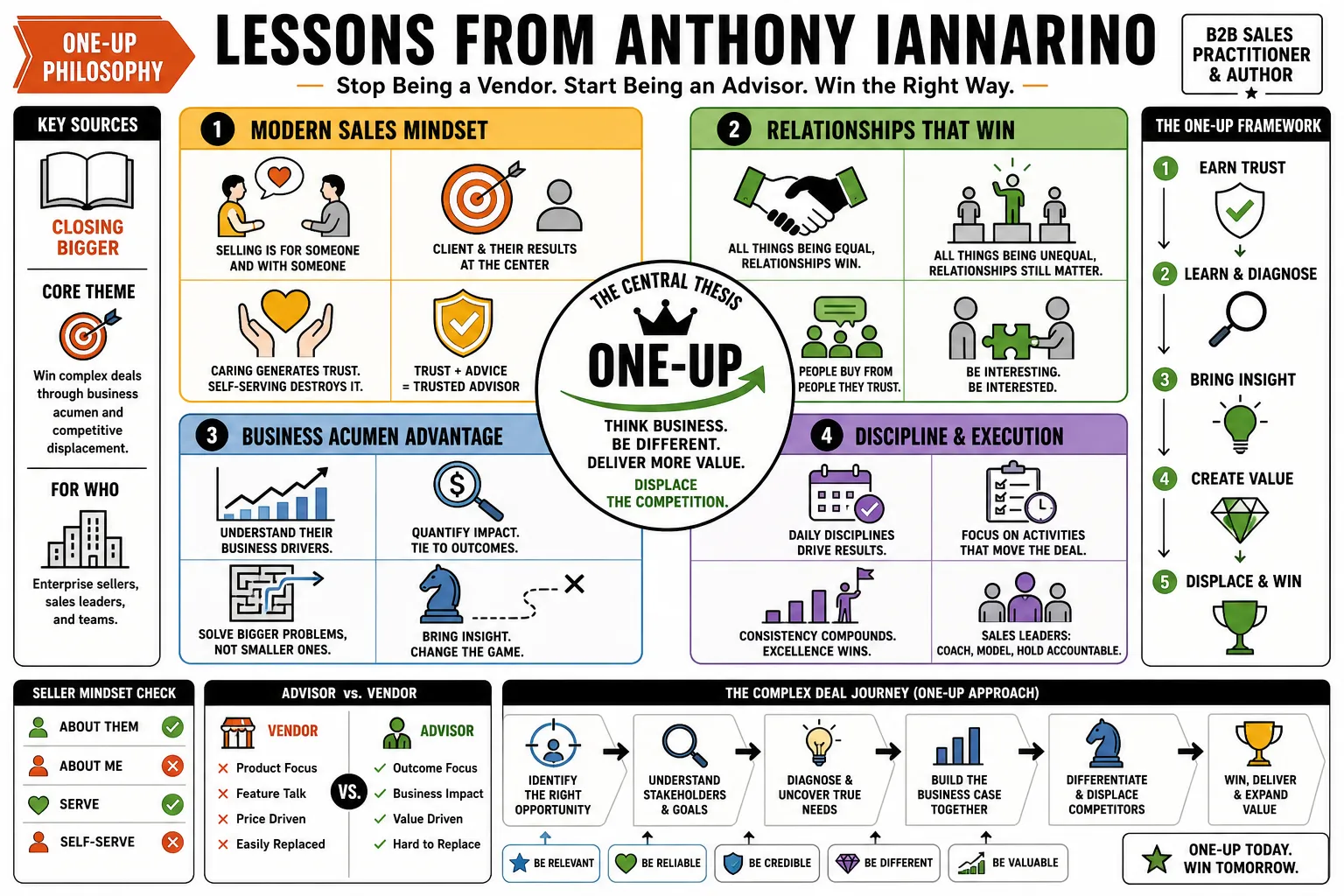
Lessons from Anthony Iannarino
Anthony Iannarino is a B2B sales practitioner and author who argues salespeople must stop acting like vendors and start acting like business advisors. His "One-Up" philosophy focuses on winning complex deals through business acumen and competitive displacement rather than just pitching features. This collection organizes his advice on navigating enterprise sales, maintaining personal discipline, and leading teams. — Wiley, Elite Sales Strategies (2022).
Part 1: The Modern Sales Mindset
- On the Nature of Selling: "Selling isn't something you do to someone. It's something you do for and with someone." (The Only Sales Guide You'll Ever Need) — Reference: Pure Muir, review of The Only Sales Guide You'll Ever Need.
- On Caring as an Advantage: "When you come from a place of caring, you generate trust and build powerful relationships." (The Only Sales Guide You'll Ever Need) — Reference: Michael Feeley, "Enrollment or Being Told What to Do" (quoting Iannarino).
- On Trust: To be a trusted adviser, "you need trust and advice." — Reference: Sales Babble #130, "The Only Sales Guide You Will Ever Need with Anthony Iannarino" (2016).
- On Relationships: "All things being unequal, relationships still win." — Reference: The Sales Blog, "All Things Being Unequal, Relationships Win".
- On Patience: "Fast is slow and slow is fast." — Reference: The Sales Blog, "Why Fast Is Slow".
- On Client Retention: "Absence does not make the heart grow fonder. Absence makes the heart go wander. If you don't invest in your client relationships, know that someone else will." — Reference: The Sales Blog, "Absence Makes the Heart Go Wander" (2012).
Part 2: Self-Discipline and Personal Management
- On Personal Discipline: Self-discipline is "the art of 'me management'"—"the difference between success and failure." (The Only Sales Guide You'll Ever Need) — Reference: UpYourTelesales, "Self-Discipline: The Art of Me Management" (quoting Iannarino).
- On Initiative: "The antidote to complacency is initiative." (The Only Sales Guide You'll Ever Need) — Reference: BooksRun, The Only Sales Guide You'll Ever Need (reader review quoting the book).
- On Dealing with Defeat: "When you lose a deal, you should not be negative about that at all, because there's two things that can happen. You either decide that you have a loss, or you have a lesson." — Reference: The Q&A Sales Podcast, "How can The Negativity Fast boost my sales?" (2023).
- On Mindset Control: "If you can talk yourself into it, you can talk yourself out of it." — Reference: The Q&A Sales Podcast, "How can The Negativity Fast boost my sales?" (2023).
- On Media Diets: On cable news: "if you're ingesting this, what you're doing is poisoning your mindset… anything that's negative like that, get rid of it." — Reference: The Q&A Sales Podcast, "How can The Negativity Fast boost my sales?" (2023).
- On the Toxicity of Complaining: "It seems that negativity is the only cancer that's transmitted between humans. It metastasizes when one negative person starts complaining." — Reference: Forbes, "How You Can Stay Positive In A Negative World" (2023).
Part 3: The "One-Up" Advantage
- On Generating Value: "The value you create for your clients doesn't come from asking them what's keeping them up at night. It comes from telling them what should be keeping them up at night." (The Lost Art of Closing) — Reference: Selling and Persuasion Techniques, summary of The Lost Art of Closing.
- On the Illusion of the Decision Maker: "If you are looking for a single decision-maker in a B2B sales, you are unlikely to find one. Instead, you must now seek out all who are going to participate in any decision to change." — Reference: The Sales Blog, "The New Rules of Building Consensus" (2018).
Part 4: Redefining the Close
Part 5: Competitive Displacement
- On the Reality of Displacement: "I think most of our dream clients, probably a hundred percent of them already belong to a competitor." — Reference: The Salesman Podcast, "How To Steal Your Competitors Business" with Anthony Iannarino.
- On Leading the Conversation: Lead with a value proposition about the client's world: "I want to have a conversation about strategic outcomes and what's going on in your world and the trends and things that we're concerned with." — Reference: The Salesman Podcast, "How To Steal Your Competitors Business" with Anthony Iannarino.
Part 6: Prospecting with Purpose
- On the Purpose of Outbound: "Most of us say something like, 'well, I'd love to come out, introduce myself and my company… and then learn a little bit about you.' That is just not a great value proposition." — Reference: The Salesman Podcast, "How To Steal Your Competitors Business" with Anthony Iannarino.
- On Handling Rejection: "If you understand they were rejecting an offer, not you—much easier for you to process that." — Reference: The Q&A Sales Podcast, "How can The Negativity Fast boost my sales?" (2023).
Part 7: Creating Value Beyond the Product
- On Level 1 Value: Level 1 is the product: "If you show up and you start from that part of the conversation, you look and sound like a commodity." — Reference: The Salesman Podcast, "How To Steal Your Competitors Business" with Anthony Iannarino.
- On Level 2 Value: Level 2: "what kind of experience do you offer? Are you easy to do business with, do you have the service and support?" — Reference: The Salesman Podcast, "How To Steal Your Competitors Business" with Anthony Iannarino.
Part 8: Sales Leadership and Accountability
- On the Essence of Leadership: "The truth is that leadership is about people. There is a difference between people in your employ and followers." — Reference: The Sales Blog, "Everyone Deserves a Good Leader" (2011).
- On the Role of the Manager: "Sales leadership isn't waiting for people to turn in their numbers. It's doing the work of helping them to make their numbers." — Reference: The Sales Blog, "Everyone Deserves a Good Leader" (2011).
- On Accountability vs. Pay: "The biggest mistake I have ever made in business was believing that if I hired people and paid them well enough that I would not have to hold them accountable." — Reference: The Sales Blog, "The Leadership Playbook: The Law of Accountability".
- On Building Team Capacity: "Leadership is building your team's ability and capacity to perform, as well as the abilities and capacities of the individuals that make up that team." — Reference: The Sales Blog, "Everyone Deserves a Good Leader" (2011).
- On True Caring from Leaders: "Great leaders care about their people, and the best leaders care deeply about them and they treat them accordingly. They find talented people, and they develop them into something really special." — Reference: The Sales Blog, "Everyone Deserves a Good Leader" (2011).
- On Macro-Management: "The opposite of micromanagement is macro-management. Where managing every detail of an employee's work is terrible, managing the significant outcomes that lead to success is useful and necessary." — Reference: The Sales Blog, "Poor Results Are Caused by Too Little Leadership".
- On Managerial Duties: "Managers don't exist to manage paperwork and provide reporting. All managers must be leaders, someone responsible for future results." — Reference: The Sales Blog, "Poor Results Are Caused by Too Little Leadership".
- On Owning Failure: "Without accountability, that failure belongs to the person providing too little leadership, not the person who is failing to perform." — Reference: The Sales Blog, "Poor Results Are Caused by Too Little Leadership".
- On Helping Teams Improve: "Allowing someone you are responsible for to fail is not leadership. Waiting for a person to figure out something they believe they already know isn't going to help them improve." — Reference: The Sales Blog, "Poor Results Are Caused by Too Little Leadership".