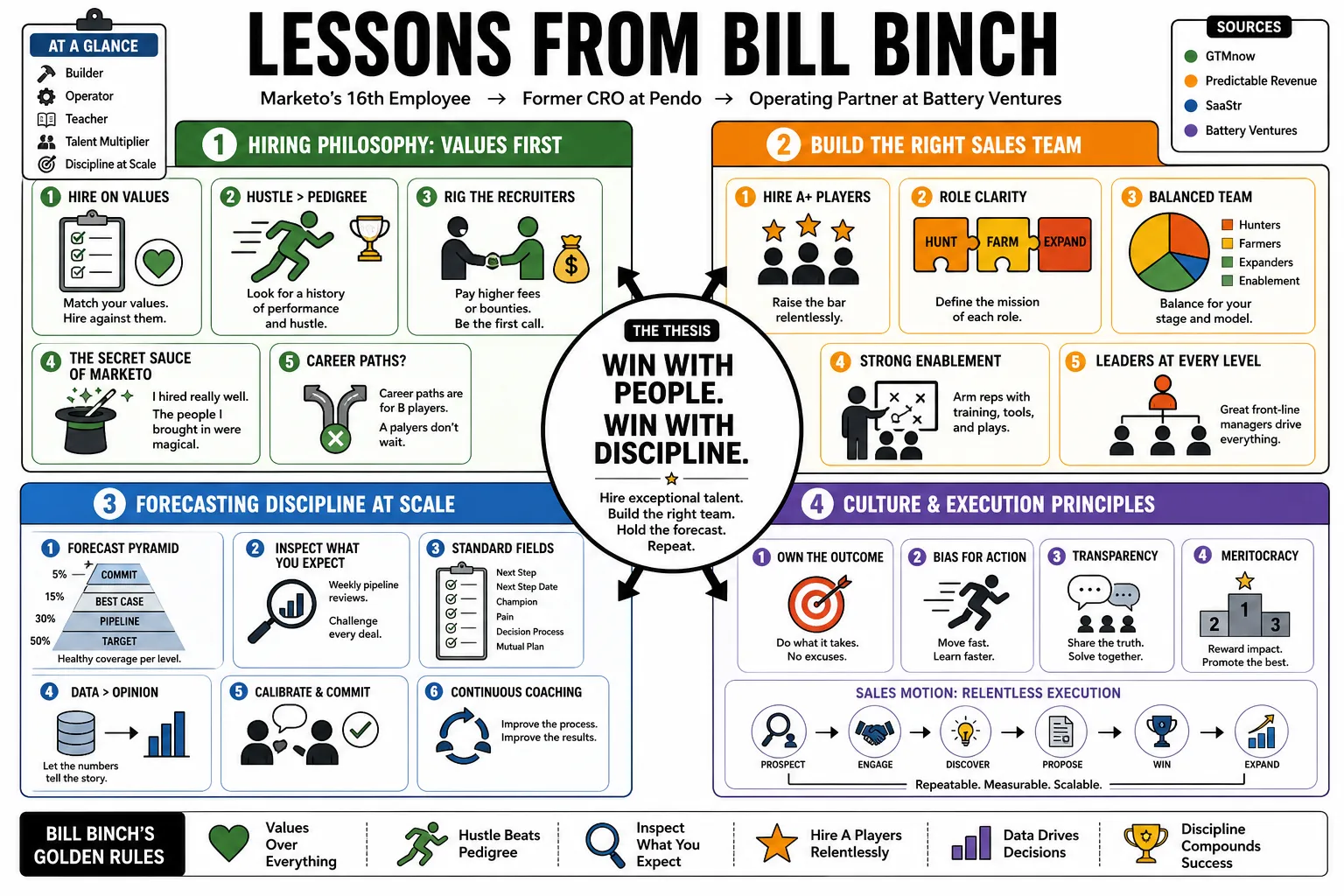
Lessons from Bill Binch
Bill Binch led global sales as Marketo's 16th employee before serving as CRO at Pendo. Now an Operating Partner at Battery Ventures, he teaches founders the actual mechanics of software sales. This profile outlines his specific rules for structuring sales teams and enforcing forecasting discipline at scale.
Part 1: The Hiring Philosophy
- On Values: "Hire the ones that match your values. And make sure you hire against those values. That's the key." — GTMnow: 116 Quarters on Quota Interview with Bill Binch
- On Hustle vs. Pedigree: "The best thing you can look for in a sales rep is a history of performance and hustle. Don't just hire polished reps from giants like Oracle or Salesforce because of their resume." — Predictable Revenue: About
- On "Rigging the Recruiters": "To win the best talent against larger companies, pay recruiters a higher fee or a bounty for specific roles to ensure your startup is the first one they call." — SaaStr: Bill Binch Articles & Sessions
- On The Secret Sauce of Marketo: "If you really ask me what the secret sauce was to Marketo's success... I hired really well. The people that I brought in were magical." — Battery Ventures: Bill Binch Profile
- On Career Paths: "Career paths are for B players. A players don't wait for a defined 12-month promotion cycle; they look for special opportunities and high-growth environments where they can create their own path." — SaaStr: Bill Binch Articles & Sessions
- On Rigidity vs Opportunity: "Standardized paths provide a predictable roadmap for people who want security. High performers should be comfortable with the ambiguity of a fast-growing startup where the path might not exist yet." — SaaStr: Bill Binch Articles & Sessions
- On Internal Growth: "Starting internally and building from there is critical. That's where things can get unique and special." — GTMnow: 116 Quarters on Quota Interview with Bill Binch
- On Over-Hiring for Capacity: "In high-growth phases, over-hiring can be a strategic move to ensure you have enough trained-up people in seats to handle the incoming funnel." — Battery Ventures: Bill Binch Profile
- On Avoiding Detractors: "You need to find the high flyers who flourish in any environment and actively avoid detractors who drag the team down." — Modern Sales Pros: About
- On The Mission: "Top talent should focus on joining the right company and solving the biggest problems. If the company wins, your career will naturally accelerate." — SaaStr: Bill Binch Articles & Sessions
Part 2: Managing and Scaling The Machinery
- On Exporting the Machinery: "You've got to be able to export your machinery. Take a place where you get some momentum. You have repeatability. You can export the machinery to the next segment." — GTMnow: 116 Quarters on Quota Interview with Bill Binch
- On Avoiding the "Boil the Ocean" Approach: "My first advice is don't try and do small, mid, and enterprise at the same time because you're gonna fail on all three fronts." — GTMnow: 116 Quarters on Quota Interview with Bill Binch
- On Repeatability Before Headcount: "You must build repeatability into the sales motion before trying to scale headcount." — SaaStr: Bill Binch Articles & Sessions
- On Manufacturing Success: "In the early days of Marketo, we manufactured success by creating a logo-based quota with aggressive accelerators to build momentum when the brand was unknown." — Modern Sales Pros: About
- On The Dallas Cowboys Playbook: "The Dallas Cowboys don't run around the field without a plan, neither should you. You need a structured playbook." — Battery Ventures: Bill Binch Profile
- On Focus on Transactions Over Dollars: "Start collecting logos. Focus on transactions, not dollars, as a new sales team." — Predictable Revenue: About
- On Collecting Logos: "Getting 10 logos teaches you more about how people buy and use your software than one whale deal that might mislead your product roadmap." — GTMnow: 116 Quarters on Quota Interview with Bill Binch
- On Building Momentum from Zero: "Momentum is built by stringing together small wins early on rather than waiting for massive enterprise contracts." — Modern Sales Pros: About
- On The Math Problem of Hiring: "If you are running at 70 percent of your planned sales capacity but expecting 100 percent of the revenue plan, the math will never work." — Battery Ventures: Bill Binch Profile
- On Logo Velocity: "Track the speed at which you are acquiring new customers, regardless of deal size, to ensure the market is actually adopting your product." — GTMnow: 116 Quarters on Quota Interview with Bill Binch
Part 3: Moving Upmarket to Enterprise
- On The Enterprise Stress Test: "Before moving to enterprise sales, ask three questions: How would your software be implemented? How would the data be stored? Do you have a legal team ready to work with theirs?" — Modern Sales Pros: About
- On Implementation at Scale: "Enterprise clients require more than a self-service login; you need to know exactly how your software will be deployed across thousands of users." — Battery Ventures: Bill Binch Profile
- On Data Storage Requirements: "Enterprises have strict security, compliance, and residency requirements that your product must be ready to handle before you start selling to them." — Modern Sales Pros: About
- On Legal Readiness: "You need a legal team or process ready to redline and negotiate complex master service agreements with their legal department." — Modern Sales Pros: About
- On The Company-Wide Motion: "To get your company to move up from SMB and Mid-Market to Enterprise, it has to be a company-wide motion, not just a sales strategy." — Modern Sales Pros: About
- On Priority for Enterprise Bugs: "Enterprise clients require a structural shift where their product issues are treated with P0 priority by the engineering team." — Battery Ventures: Bill Binch Profile
- On Evolving the Pitch: "Your messaging must evolve from selling basic features to addressing the strategic operational needs of C-level executives." — SaaStr: Bill Binch Articles & Sessions
- On Aligning Product Roadmap: "Don't let a single massive enterprise deal dictate your entire product roadmap at the expense of your core market." — GTMnow: 116 Quarters on Quota Interview with Bill Binch
- On Customer Utility: "At the enterprise level, you have to guarantee that the thousands of seats you just sold are actually generating utility for the customer." — Battery Ventures: Bill Binch Profile
Part 4: Aligning Sales and Marketing
- On Friction Points: "Accidents happen in the intersections. Most friction occurs during the handoff from Marketing to Sales." — Battery Ventures: Bill Binch Profile
- On The Need for Shared Definitions: "Both teams must agree on the exact definition of an MQL, a prospect, and a closed sale." — GTMnow: 116 Quarters on Quota Interview with Bill Binch
- On Defining Lead Stages: "By having a contract or SLA on definitions, you eliminate the ambiguity that causes accidents at the intersection." — Battery Ventures: Bill Binch Profile
- On Building SLAs Between Teams: "Sales and marketing need a service level agreement that dictates how fast a lead must be followed up on and what qualifies it in the first place." — SaaStr: Bill Binch Articles & Sessions
- On Throwing it Over the Wall: "Marketing cannot just generate leads and throw them over the wall to Sales; there must be an integrated handoff." — Battery Ventures: Bill Binch Profile
- On Alignment as a Buzzword: "Alignment is often a big round word that lacks substance until you force both teams to agree on operational metrics." — GTMnow: 116 Quarters on Quota Interview with Bill Binch
- On Account-Based Marketing: "Account-Based Marketing is not a technology but a process that requires tight coordination between sales and marketing." — SaaStr: Bill Binch Articles & Sessions
- On Bridging the Funnel Gap: "Management efforts should be heavily focused on the middle of the funnel where marketing and sales operations overlap." — Battery Ventures: Bill Binch Profile
- On Feedback Loops: "Sales must provide direct, structured feedback on lead quality so marketing can adjust their campaigns in real time." — Predictable Revenue: About
Part 5: Data, Metrics, and Forecasting
- On The Mojo Metric: "You need a daily look at how much incremental pipeline the team has generated to catch slow leaks." — GTMnow: 116 Quarters on Quota Interview with Bill Binch
- On Additions to Pipeline: "Always track your gross new opportunities, expansion from existing customers, and deals pulled forward from future quarters." — Battery Ventures: Bill Binch Profile
- On Subtractions from Pipeline: "You must account for deals that are closed-lost, deals that have shrunk in value, and deals pushed to future quarters." — Battery Ventures: Bill Binch Profile
- On Forecast Conversations: "Sales leaders should always start conversations with 'My quota is...' rather than 'My forecast is...' to maintain accountability." — GTMnow: 116 Quarters on Quota Interview with Bill Binch
- On Quota Deployed vs Company Plan: "If a company has a 1 million dollar plan but only has 900k in actual quota deployed, they are mathematically unlikely to hit their goal." — Battery Ventures: Bill Binch Profile
- On Actual Quota vs Planned Quota: "Many pipeline problems are actually capacity problems caused by running at a fraction of your planned hiring." — GTMnow: 116 Quarters on Quota Interview with Bill Binch
- On The 5-Quarter Look-Back: "Every core slide in a board deck should be presented in a 5-quarter view to show historical performance trends." — GTMnow: 116 Quarters on Quota Interview with Bill Binch
- On Spotting Trend vs Seasonality: "Adding the fifth quarter allows for a direct Year-over-Year comparison to identify if performance is a genuine shift or a standard cyclical pattern." — Battery Ventures: Bill Binch Profile
- On Using Data for Coaching: "The whole point of data-driven sales management is not to use data just for laughs, it should be for coaching and modifying behavior." — Modern Sales Pros: About
- On Activity vs Results: "You have to track the leading indicators of success, like meetings and calls, against the lagging indicators of outcomes like bookings and win rates." — Battery Ventures: Bill Binch Profile
Part 6: Deal Mechanics and Execution
- On The Give and Get Rule: "Never give a concession, like a discount or a specific contract term, without getting something of value in return." — Battery Ventures: Bill Binch Profile
- On Maintaining Leverage: "Every request from a prospect should be met with a reciprocal request to ensure a balanced relationship and prevent the salesperson from losing leverage." — SaaStr: Bill Binch Articles & Sessions
- On Disqualifying Early: "It is better to lose a deal in the first week than in the last week of the quarter. Disqualify early." — Battery Ventures: Bill Binch Profile
- On Acknowledging Objections: "Validate the customer's concern or objection immediately so they feel heard." — Battery Ventures: Bill Binch Profile
- On Responding to Objections: "Once you acknowledge, provide a clear, concise answer or solution to the concern." — Battery Ventures: Bill Binch Profile
- On Moving On: "After responding, immediately transition to the next step in the process. Don't linger on the objection once it's addressed." — Battery Ventures: Bill Binch Profile
- On Protecting Sales Reps' Time: "Time is a salesperson's most valuable asset. Reps should focus their energy on high-probability opportunities rather than chasing ghosts." — GTMnow: 116 Quarters on Quota Interview with Bill Binch
- On Focusing on High-Probability Deals: "If a prospect refuses to provide a get, like introducing you to their boss, it is a red flag that the deal may not be real." — Modern Sales Pros: About
- On Getting Executive Alignment in Deals: "You have to ensure that your economic buyer is fully bought into the strategic value of the deal, not just the technical features." — SaaStr: Bill Binch Articles & Sessions
Part 7: Customer Success and Retention
- On Deliberately Underselling: "Sometimes it is better to sell a smaller initial footprint to ensure the customer is successful, which leads to higher Net Dollar Retention later." — Battery Ventures: Bill Binch Profile
- On Net Dollar Retention: "NDR is the ultimate measure of whether your sales team is bringing in the right customers who actually find value in the product." — GTMnow: 116 Quarters on Quota Interview with Bill Binch
- On Following the Alumni: "If a champion is part of a Reduction in Force or leaves the company, track them. They are your best source of new warm leads." — GTMnow: 116 Quarters on Quota Interview with Bill Binch
- On Leveraging Transitions: "Contact former champions 30 to 120 days into their new role at a different organization to rebuild the relationship." — Battery Ventures: Bill Binch Profile
- On The Playbook for Downsells: "A downsell requires a new playbook. You have to put your arm around the customer." — Modern Sales Pros: About
- On Wrapping Your Arms Around Remaining Users: "Make sure that those remaining users are getting lots of utility from your product so they don't churn entirely." — Modern Sales Pros: About
- On Downsell vs Churn: "Downsell is a reduction in spend or seat count, whereas churn is the total loss of a customer. You manage them differently." — Battery Ventures: Bill Binch Profile
- On Proactive Account Management: "Moving to enterprise requires a shift from reactive support to proactive account management to secure long-term renewals." — Battery Ventures: Bill Binch Profile
- On Post-Sale Utility: "The sale doesn't end at the signature; the product must deliver immediate, measurable utility to prevent early contraction." — GTMnow: 116 Quarters on Quota Interview with Bill Binch
Part 8: The Human Element of Leadership
- On The Role of a Sales Leader: "Sales leadership has to make sure deals are closed, forecasting is done, and learn to demo a particular tool in order to sell it." — Modern Sales Pros: About
- On The CEO and CRO Dynamic: "The dynamic between the CEO and CRO is the primary engine of growth. They must be aligned on logo acquisition versus ACV." — SaaStr: Bill Binch Articles & Sessions
- On In-Person Teams: "In-person teams often outperform remote ones due to hallway learning and cultural cohesion." — GTMnow: 116 Quarters on Quota Interview with Bill Binch
- On Quarters on Quota: "If you spend over 100 quarters on quota, you learn that consistency and accountability are the only things that survive market cycles." — GTMnow: 116 Quarters on Quota Interview with Bill Binch
- On Training and Readiness: "Having people in the seat and trained up is just as important as all the functions of the job itself." — Modern Sales Pros: About
- On Consistency: "You have to advocate for a rigorous, consistent hiring process rather than hiring in a vacuum." — Predictable Revenue: About
- On AI Workflows: "We need to move from basic AI features to AI-native workflows, such as using agents to replace traditional prospecting tasks." — Battery Ventures: Bill Binch Profile
- On Coaching Over Dashboards: "Sales managers should not just look at metrics for laughs; they must use the data to fundamentally modify rep behavior." — Modern Sales Pros: About
- On Legacy: "What I hope I'm really remembered for in a business context is hiring and developing great folks and watching them go on to great jobs after." — Battery Ventures: Bill Binch Profile