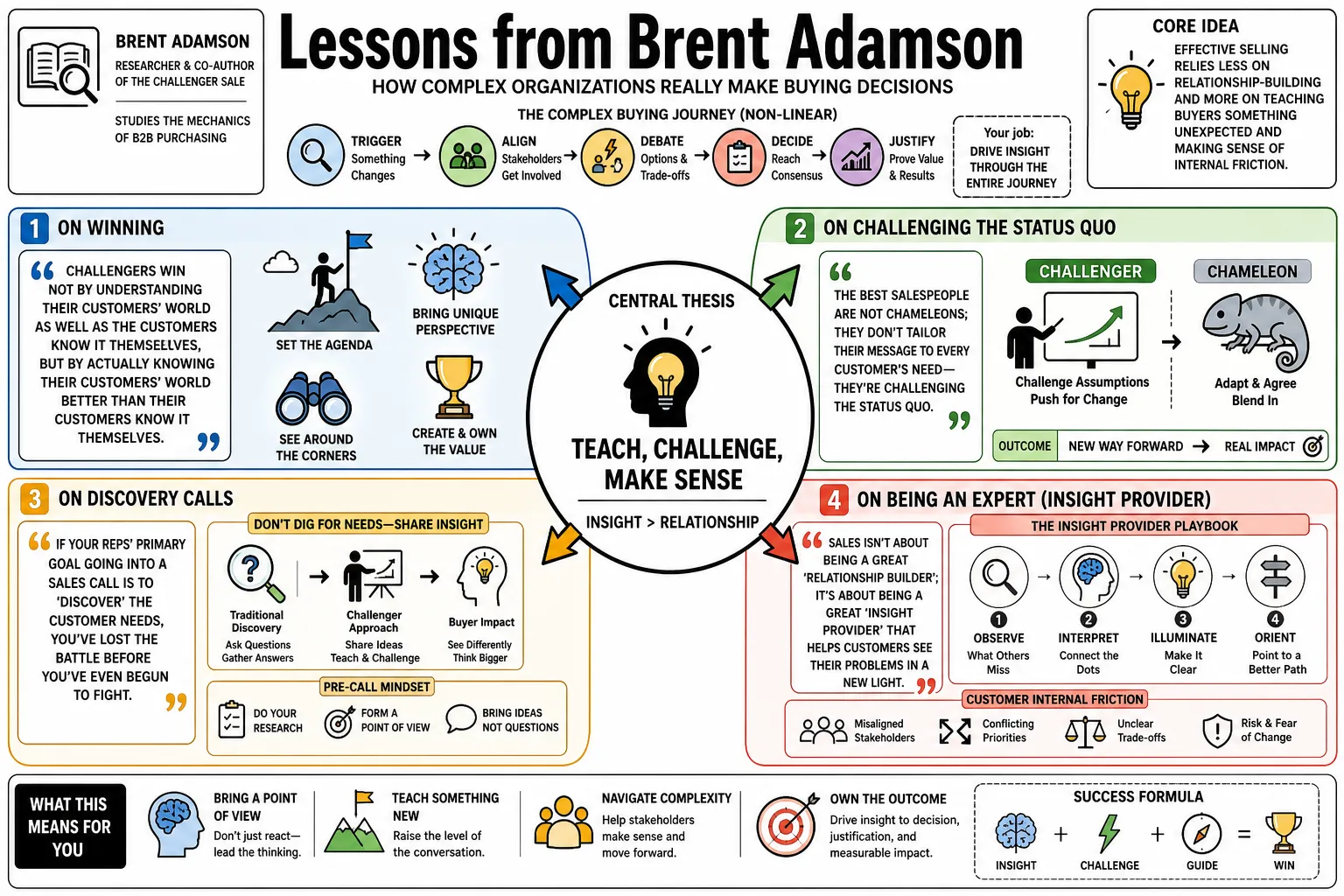
Lessons from Brent Adamson
Brent Adamson is a researcher and co-author of The Challenger Sale and The Challenger Customer who studies how B2B buyers and sellers interact. He was the chief storyteller for CEB (now Gartner) across its sales, marketing and customer service practices from 2003 to 2022, and later co-wrote The Framemaking Sale with Karl Schmidt. — In The Funnel / Selling Well: "Framemaking Sale: Improving The Buying Experience With Brent Adamson" (2026, transcript).
Part 1: The Challenger Mindset
- On the Challenger Profile: Adamson describes the Challenger as "the sort of the debater on the team" who uses deep knowledge of the customer's business to challenge the customer's thinking, "Not about us, not about what we do." — Bregman Leadership Podcast, Episode 68: "Brent Adamson – The Challenger Sale" (2017).
- On the Relationship Builder: Of the five profiles Adamson's research found, "the rep least likely to be a star performer was in fact the relationship builder." — Bregman Leadership Podcast, Episode 68: "Brent Adamson – The Challenger Sale" (2017).
- On Relationships Still Mattering: Adamson: "It's not that relationships don't matter." The question is what the relationship rests on, because "customers don't buy that way anymore" when it is mostly familiarity. — Bregman Leadership Podcast, Episode 68: "Brent Adamson – The Challenger Sale" (2017).
- On Not Being a Jerk: Adamson recalls co-author Matt Dixon saying "we didn't call them the jerk. We call them the challenger." Adamson says they're "not challenging the customer as a person, but rather they're challenging their thinking." — Bregman Leadership Podcast, Episode 68: "Brent Adamson – The Challenger Sale" (2017).
- On What Insight Is: Adamson: "a challenger conversation is really based around a surprising finding about the customer's own business that shows them a new way to compete that they haven't appreciated on their own." — Bregman Leadership Podcast, Episode 68: "Brent Adamson – The Challenger Sale" (2017).
- On Leading To Your Strengths: Adamson's short version of teaching is "Don't lead with, lead to," because "your customer doesn't want to have a conversation about your company, they want to have a conversation about their company." — Bregman Leadership Podcast, Episode 68: "Brent Adamson – The Challenger Sale" (2017).
- On Free Consulting: Adamson: "we call that free consulting, and very few people ever made much money off of free consulting." He says to "make sure that whatever you teach the customer about their business ultimately leads back to something that you can do better than anyone else." — Bregman Leadership Podcast, Episode 68: "Brent Adamson – The Challenger Sale" (2017).
- On How You Sell: Adamson: "it's not what you sell. It's how you sell. That's the heart and soul of Challenger," because "Even great complex solutions can be copied by great competitors." — Making Sales Social, Episode 107: "How You Sell Matters More Than What You Sell" (2022, transcript).
- On Behaviors Over Profiles: Adamson: "at the end of the day, the story isn't about the profiles, it's about the behaviors." — Bregman Leadership Podcast, Episode 68: "Brent Adamson – The Challenger Sale" (2017).
Part 2: Commercial Teaching and Constructive Tension
- On Teaching: For Adamson, teaching means "To teach the customer something new about the customer's business. Not about our products and services, it's about what the customer is actually doing or not doing." — Bregman Leadership Podcast, Episode 68: "Brent Adamson – The Challenger Sale" (2017).
- On Tailoring: Adamson: "if I'm going to teach the customer the way to make money or save money, I need to actually understand how they make money or how they save money." — Bregman Leadership Podcast, Episode 68: "Brent Adamson – The Challenger Sale" (2017).
- On Taking Control: Taking control means starting the conversation differently: "You start that conversation on your forward foot" with something worth showing, rather than asking what is keeping the customer up at night. — Bregman Leadership Podcast, Episode 68: "Brent Adamson – The Challenger Sale" (2017).
- On Pressuring Thinking: Adamson says a challenger should "pressure the customer, but not pressure them personally but to pressure their thinking." — Bregman Leadership Podcast, Episode 68: "Brent Adamson – The Challenger Sale" (2017).
- On a Story of Probabilities: Adamson calls the Challenger research a story of probabilities: "placing a bet on those behaviors that define challenger are by far the best bet to place." — Bregman Leadership Podcast, Episode 68: "Brent Adamson – The Challenger Sale" (2017).
- On Lone Wolves: Adamson: "you live by the sword, you die by the sword at the individual level," because with lone wolves "you have no scale, there's no process, everyone's doing their own thing." — Bregman Leadership Podcast, Episode 68: "Brent Adamson – The Challenger Sale" (2017).
- On Pushing Sellers to the End: Adamson says buyers do their own research and "want to push sales reps, as far back to the end of the purchase as they can." — Bregman Leadership Podcast, Episode 68: "Brent Adamson – The Challenger Sale" (2017).
- On What Customers Want to Know: Adamson lists what customers most want to know, including "What are ways I'm exposed to risk that I don't fully appreciate?" — Bregman Leadership Podcast, Episode 68: "Brent Adamson – The Challenger Sale" (2017).
- On Where Customers Learn: Adamson asks two questions of sellers and marketers: "Where do your customers learn? And are you present where that learning is happening?" — Making Sales Social, Episode 107: "How You Sell Matters More Than What You Sell" (2022, transcript).
Part 3: The B2B Buying Journey
- On the Smartness Arms Race: Adamson says we now live in "a world where the smartness arms race has ended in a tie" and adds that "the only one that loses is your customer." — Making Sales Social, Episode 107: "How You Sell Matters More Than What You Sell" (2022, transcript).
- On High-Quality Information: Adamson reports that most B2B buyers in Gartner research said "The information that we encountered as part of this purchase was generally of high quality." — Making Sales Social, Episode 107: "How You Sell Matters More Than What You Sell" (2022, transcript).
- On All Signal: For buyers, Adamson says, "it used to be a separate signal from noise, but now it is all signal." — Making Sales Social, Episode 107: "How You Sell Matters More Than What You Sell" (2022, transcript).
- On Zig and Zag: When one supplier tells buyers to zig and another to zag, both with data and experts, the buyer is "just confused at a higher level, because you're all pretty dang convincing." — Making Sales Social, Episode 107: "How You Sell Matters More Than What You Sell" (2022, transcript).
- On Losing to the Status Quo: Adamson: "we're losing to the status quo, not because customers love the status quo, we're losing the status quo, because customers don't feel confident to move forward." — Making Sales Social, Episode 107: "How You Sell Matters More Than What You Sell" (2022, transcript).
- On Internal Complexity: On the messy buying-journey chart he calls the spaghetti bowl, Adamson says buyers often think "It's not that I don't want to buy from you, It's I don't want to buy it because my own company's complexity is awful." — Making Sales Social, Episode 107: "How You Sell Matters More Than What You Sell" (2022, transcript).
- On Not Disarming: Adamson does not say to stop producing insight: being smart is "necessary but not sufficient," and "if you're going to be frame breaking in this world, you have to be incredibly accurate. You have to be incredibly precise." — Making Sales Social, Episode 107: "How You Sell Matters More Than What You Sell" (2022, transcript).
- On a Decision Journey: Adamson: "what you're solving for isn't buying, which is the thing you want, you're helping them decide," and he adds "it's not just how can I help my customers go on a buying journey, but a change journey." — Making Sales Social, Episode 107: "How You Sell Matters More Than What You Sell" (2022, transcript).
- On the Hard Part: Adamson: "the thing that's really hard isn't the buying of the thing, it's actually the whole changing story around it." — Making Sales Social, Episode 107: "How You Sell Matters More Than What You Sell" (2022, transcript).
Part 4: Sensemaking and Buyer Enablement
- On Frame Makers: Adamson asks "what if our role was not to be so much a frame breaker, but a frame maker." — Making Sales Social, Episode 107: "How You Sell Matters More Than What You Sell" (2022, transcript).
- On Confidence in Themselves: Adamson: "how do I help you feel more confident in you and the decisions that you're making on behalf of your company." — Making Sales Social, Episode 107: "How You Sell Matters More Than What You Sell" (2022, transcript).
- On the Phrase That Pays: Adamson calls "in working with other customers like you, one of the things we've learned" his "phrase that pays," because the seller acts as a connector rather than showing up with expertise. — Making Sales Social, Episode 107: "How You Sell Matters More Than What You Sell" (2022, transcript).
- On an Information Strategy: Adamson suggests a seller ask what a buyer has already read and "What conclusions have they probably arrived at as a result of consuming that information?" and "Where are they likely confused?" — Making Sales Social, Episode 107: "How You Sell Matters More Than What You Sell" (2022, transcript).
- On an Empathetic Posture: Adamson's model sensemaking opening is "I'd love to if you're open to it, maybe I can see if I can help you kind of work through it." — Making Sales Social, Episode 107: "How You Sell Matters More Than What You Sell" (2022, transcript).
- On Indiscriminate Generosity: Sending yet another link, poll or white paper "is fuel to the fire," Adamson says, and he calls it "indiscriminate generosity." — Making Sales Social, Episode 107: "How You Sell Matters More Than What You Sell" (2022, transcript).
- On Being Socratic: Adamson: "it's got to be done socratically, you have to believe it's your decision." — Making Sales Social, Episode 107: "How You Sell Matters More Than What You Sell" (2022, transcript).
- On Helping Customers Decide: Adamson recalls Expedient's Brian Smith telling his team "It's our job as a sales organization to help our customers make the best decision they can, in as little time as possible." — Making Sales Social, Episode 107: "How You Sell Matters More Than What You Sell" (2022, transcript).
- On Losing Early: Adamson: "if it's not us, I don't want to take 18 months to find out, if you're going to lose, lose early." — Making Sales Social, Episode 107: "How You Sell Matters More Than What You Sell" (2022, transcript).
Part 5: Consensus and Group Purchasing
- On the 75 Percent: Adamson: "If 75% of B2B buyers would prefer never to talk to a sales rep at all, this becomes a really interesting opportunity and a really interesting question." — In The Funnel / Selling Well: "Framemaking Sale: Improving The Buying Experience With Brent Adamson" (2026, transcript).
- On Being the Seller Buyers Want: Adamson: "Become the seller that customers want to talk to by being the one who shows up and helps them feel better about themselves." — In The Funnel / Selling Well: "Framemaking Sale: Improving The Buying Experience With Brent Adamson" (2026, transcript).
- On Anticipating Procurement: As an example of helping a buying group, Adamson suggests saying "By the way, when procurement gets involved, they're going to have these three questions." — In The Funnel / Selling Well: "Framemaking Sale: Improving The Buying Experience With Brent Adamson" (2026, transcript).
- On Saved-for-Later Carts: Adamson jokes, but says it is true, that "My wife has 582 items saved for later in her Amazon account. That is 582 purchase processes, individual ones, not company ones, that stalled out." — In The Funnel / Selling Well: "Framemaking Sale: Improving The Buying Experience With Brent Adamson" (2026, transcript).
- On Being a Sherpa: Adamson describes the seller's role as "almost like deciding to be a Sherpa or buying a coach." — In The Funnel / Selling Well: "Framemaking Sale: Improving The Buying Experience With Brent Adamson" (2026, transcript).
- On Telling Buyers What to Do: Adamson: "We actually know from the sensemaking work that actually does damage when you just show up and tell them what to do, it actually does damage their self-confidence." — In The Funnel / Selling Well: "Framemaking Sale: Improving The Buying Experience With Brent Adamson" (2026, transcript).
- On a Boundary of Evidence: Adamson: frame making is "what if I just put a boundary around that based on evidence and social proof from other people like you, not my opinion." — In The Funnel / Selling Well: "Framemaking Sale: Improving The Buying Experience With Brent Adamson" (2026, transcript).
- On Differentiating From AI: Adamson: "there's this window of opportunity for sellers to show up in this manner and not only differentiate themselves from other sellers, but differentiate themselves from AI in a really powerful way." — In The Funnel / Selling Well: "Framemaking Sale: Improving The Buying Experience With Brent Adamson" (2026, transcript).
- On Buyer Confidence: Adamson says a high-quality deal is driven by "the degree to which customers report a high level of confidence in the decision they're making on behalf of their company." — Learn It podcast 156: "The Buyer Confidence Gap That's Costing You Millions" (transcript).
- On Supplier-Agnostic Confidence: Adamson says the dimensions of confidence that lead to good deals are supplier-neutral: "it has nothing to do with the supplier at all it's all supplier agnostic." — Learn It podcast 156: "The Buyer Confidence Gap That's Costing You Millions" (transcript).
Part 6: Sales and Marketing Alignment
- On Challenger as a Go-to-Market Model: Carbon Design's summary of a 2019 interview says Adamson argued that Challenger should not be treated as a "sales methodology" but as more of a go-to-market model, one that sales and marketing should co-own. — Carbon Design: "How Has Challenger Changed? Interview with Brent Adamson" (2020).
- On Thought Leadership Factories: Adamson: "We've created thought leadership factories," and then everyone is left in what he calls the smartness arms race. — Making Sales Social, Episode 107: "How You Sell Matters More Than What You Sell" (2022, transcript).
- On Throwing Another Log: Adamson asks marketers and sellers a check question: "Ask yourself, am I just throwing another log in the fire?" — Making Sales Social, Episode 107: "How You Sell Matters More Than What You Sell" (2022, transcript).
- On Tools Over Information: Adamson suggests asking "How can I give them a framework, a scaffold, a guide, a tool, a diagnostic, a benchmark that is not going to just be one more piece of information". — Making Sales Social, Episode 107: "How You Sell Matters More Than What You Sell" (2022, transcript).
- On Helping: Adamson adds a third question to where customers learn and whether you are present: "are you in fact helping when that happens?" — Making Sales Social, Episode 107: "How You Sell Matters More Than What You Sell" (2022, transcript).
- On Where Confidence Was Aimed: Adamson says sellers have spent decades trying to make customers more confident in the seller, and "we're just walking right past the single biggest opportunity which is helping customers feel more confident in themselves." — Learn It podcast 156: "The Buyer Confidence Gap That's Costing You Millions" (transcript).
- On the Challenger Origin: Adamson says Challenger "started as a study on how to do segmentation better" before the research pointed elsewhere. — Learn It podcast 156: "The Buyer Confidence Gap That's Costing You Millions" (transcript).
Part 7: Customer Value and Ecosystems
- On Predicting Obstacles: Adamson says sellers can predict "the obstacles that they're going to run into in their own buying process" better than the customer can. — Learn It podcast 156: "The Buyer Confidence Gap That's Costing You Millions" (transcript).
- On Auditing Your Deals: His suggested audit is to list "all the ways that our deals have gone off the rails over the last 6 to 18 months" and document them as a process plan. — Learn It podcast 156: "The Buyer Confidence Gap That's Costing You Millions" (transcript).
- On Zombie Pipeline: Adamson says a common frustration is pipeline where stalled deals "have all been sitting there for 12 to 18 months and you're still chasing them." — Learn It podcast 156: "The Buyer Confidence Gap That's Costing You Millions" (transcript).
Part 8: Empathy, Leadership, and Change Management
- On Empathy: On making sales social, Adamson says "but have a little empathy, right?" before adding another asset to a buyer's pile. — Making Sales Social, Episode 107: "How You Sell Matters More Than What You Sell" (2022, transcript).
- On Sensemaking Being a Technique: Adamson: "this is not a personality type, this is not a profile," and the point is to engage in sensemaking, not be a sensemaker. — Making Sales Social, Episode 107: "How You Sell Matters More Than What You Sell" (2022, transcript).