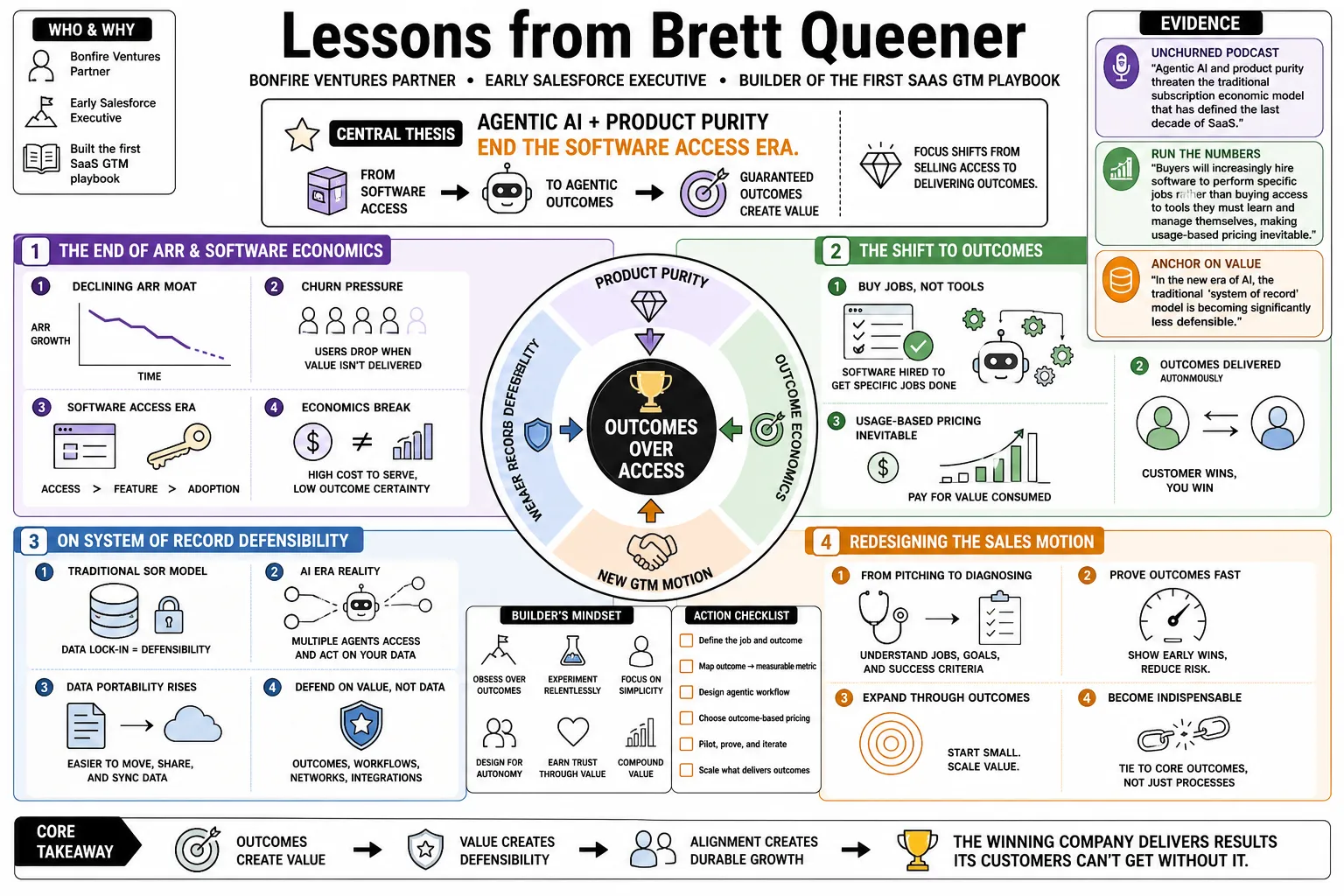
Lessons from Brett Queener
Brett Queener is a Bonfire Ventures partner and early Salesforce executive who helped build the initial go-to-market playbook for SaaS. He is known for his "product purity" thesis, which argues that autonomous AI agents are breaking traditional subscription economics by shifting the focus from selling software access to delivering guaranteed outcomes. This profile collects his practical advice on navigating market shifts, redesigning sales motions, and the hard realities of company building.
Part 1: The End of ARR & Software Economics
- On the Death of the Subscription Model: Brett Queener argues that agentic AI threatens the traditional subscription business model that has defined SaaS for the past decade. [2]
- On the Shift to Outcomes: "Buyers will increasingly hire software to perform specific jobs rather than buying access to tools they must learn and manage themselves, making usage-based pricing inevitable." — Source: Run the Numbers
- On System of Record Defensibility: "In the new era of AI, the traditional 'system of record' model is becoming significantly less defensible." — Source: Anchor
- On Value Delivery: "The end of ARR is coming because buyers are no longer willing to pay for the promise of value. They will only pay for automated delivery of that value." — Source: GTMnow
- On the AI Era Economy: "While Salesforce built a multi-hundred-billion-dollar valuation using a metadata customization model, the AI era is enabling similar outcomes with significantly fewer resources." — Source: GTMnow
- On Broken SaaS Economics: "The shift from annual contracts to outcome-based pricing is exposing zombie companies and fundamentally breaking traditional SaaS economics." — Source: Run the Numbers
- On Software Extinction: Brett Queener predicted that most customer-facing software companies would disappear as products finally start doing the work themselves instead of just recording it. [1]
- On the Change Economy: "Navigating rapid shifts in software innovation requires building businesses that are defensible not through lock-in, but through continuous value generation." — Source: Operations with Sean Lane
- On Growth Models: "Strict adherence to growth models like T2D3 can cause founders to miss functional lessons that may eventually torpedo the business." — Source: Bonfire Ventures
- On Earning the Right to Win: "The right to win in the modern market is a temporary status that must be aggressively re-earned every thirty days." — Source: GTMnow
Part 2: Product Purity & Agentic AI
- On Defining Product Purity: "Product purity is the state where a product actually delivers the promised job-to-be-done automatically, without requiring extensive human intervention." — Source: Tales from The Bonfire
- On Proactive Software: "Agentic AI is the transition of software from a passive tool waiting for user input to a proactive doer handling tasks autonomously." — Source: Bonfire Ventures
- On Collapsing Sales Motions: "AI is fundamentally collapsing traditional sales processes, rendering the 'king of explaining' obsolete as a competitive advantage." — Source: GTMnow
- On the Existential Threat: "Companies that fail to achieve product purity will struggle, while those that succeed will effectively replace human-led workflows entirely." — Source: Gainsight
- On Faster Pivots: "The AI era allows companies to pivot faster and build with a fraction of the resources that were required during the first cloud wave." — Source: GTMnow
- On Vertical Software: "Vertical software is becoming far more defensible in a world where anyone can build anything using AI." — Source: GTMnow
- On the Application Market Shift: "AI agents are fundamentally shifting the application software market from selling access to selling completed work." — Source: Operations with Sean Lane
- On Rapid Innovation: "Only 'WTF' products that deliver immediate, mind-blowing value can survive today's market conditions." — Source: SaaStr
- On the Demise of Explainers: "The traditional SaaS playbook relied on armies of explainers, but in an agentic world, the product must speak for itself through action." — Source: Gainsight
Part 3: Sales Forecasting & Pipeline Management
- On Silly Math: "You never win 25 percent of a deal. You either get it or you do not. Stop applying stage-based percentages to sales forecasts." — Source: Medium
- On Sales Integrity: "You do not get credit for forecasting you will do terrible and then actually doing terribly." — Source: Medium
- On the Eye of Sauron: "When diagnosing performance, leaders must focus on three levers: pipeline, close rate, and sales capacity. Orient the team toward the biggest bottleneck." — Source: Medium
- On Buyer-Centric Stages: "Let deals sit in their proper stage based entirely on the buyer's evaluation process, not your internal sales steps." — Source: Medium
- On Avoiding False Precision: "Forecasts built on overly complex probability matrices often obscure the reality of whether the customer is actually going to buy." — Source: Run the Numbers
- On Metric Segments: "Metrics are absolutely meaningless unless they are rigorously broken down by segments." — Source: Operations with Sean Lane
- On Forecasting Reality: "A forecast should be a reflection of reality and buyer intent, not a mathematical fantasy designed to placate the board." — Source: Medium
- On the Pipeline Bottleneck: "If pipeline is the bottleneck, no amount of sales coaching or closing tactics will save the quarter." — Source: Medium
- On Deal Velocity: "Deals that stall in a single stage are often deals you have already lost but have not admitted to yet." — Source: Run the Numbers
Part 4: Sales Capacity & Go-to-Market Talent
- On Sales Capacity: "Revenue growth is directly and mathematically tied to the number of productive sales reps you have hired and ramped." — Source: TenOneTen
- On Hiring Mechanics: "Seed-stage companies must hire 'mechanics' who can build and fix processes, rather than 'scalers' who expect a playbook to already exist." — Source: TenOneTen
- On the Rise of the SE: "Solutions Engineers are poised to become the most critical sales talent because technical expertise and trust are replacing traditional smooth-talking skills." — Source: GTM Shift
- On GTM Playbook Origins: "Building the early SaaS playbook required deep enterprise segmentation and meticulously designed sales motions, not just hiring more bodies." — Source: GTMnow
- On Face-to-Face Interaction: "Despite the digital shift, face-to-face interaction remains incredibly critical when buyers are making high-stakes, strategic decisions." — Source: GTMnow
- On Compensation: "Quota setting and SPIFFs must be aligned with the actual behaviors that drive product adoption, not just top-line bookings." — Source: Mostly Metrics
- On Early GTM Hires: "The earliest go-to-market hires must be operators capable of doing the work themselves instead of just managing others." — Source: Transistor
- On Scaling Sales: "You cannot scale a sales organization until the fundamental unit of economics, the individual fully-ramped rep, is consistently profitable." — Source: Run the Numbers
- On Sales Ratios: "Proper staffing ratios between SDRs, AEs, and SEs are critical. Misalignment here will destroy your customer acquisition cost." — Source: Run the Numbers
Part 5: Founder Traits & Execution
- On the Psycho Founder: "The best and most ambitious founders in the current environment are 'psychos' who are intensely driven, relentless, and obsessed with execution." — Source: GTMnow
- On Doing the Work: "Early-stage founders need the ability and willingness to actually do the work, rather than sit back and receive advice." — Source: Transistor
- On Operator-Led Investing: "Hands-on, operator-led venture capital is essential because building software companies is more complex than simply providing capital." — Source: Bonfire Ventures
- On Founder Delusion: "Founders often suffer from a reality distortion field regarding their product's readiness. The market will aggressively correct this." — Source: Tales from The Bonfire
- On Relentless Focus: "Building a category-defining company requires an almost irrational focus on solving a highly specific, painful problem for a highly specific buyer." — Source: Substack
- On Surviving the Seed Stage: "Seed stage is not about scaling. It is purely about proving that a painful problem can be solved profitably." — Source: Bonfire Ventures
- On Founder Adaptability: "The ability to rapidly pivot and discard broken assumptions is the most critical survival trait for early-stage teams." — Source: Tales from The Bonfire
- On Building During Shifts: "Generational companies are built by founders who leverage technological shifts to fundamentally change the unit economics of a workflow." — Source: Substack
- On Board Dynamics: "Founders must treat their board not as bosses to report to, but as resources to be extracted for operational value." — Source: Substack
Part 6: Customer Success & The Friction Gap
- On the Friction Gap: "The traditional Customer Success industry exists largely to bridge the massive friction gap between the software shipped and the value customers actually derive." — Source: Gainsight
- On Papering Over Flaws: "Armies of CSMs, onboarding teams, and QBRs were created primarily to paper over product deficiencies and manually drive adoption." — Source: Gainsight
- On the Purpose of CS: As agentic AI closes the gap between what products promise and what they deliver, Customer Success professionals have to become product experts who drive adoption rather than relationship managers papering over product gaps. [3]
- On Questioning CS Value: "Reference: In an [Un]Churned episode titled Why Do We Question the Value of Customer Success?, Queener discusses product fit, customer needs, whether CSMs should own renewals, and the economic sustainability of customer success resources." — Reference: Apple Podcasts [Un]Churned episode with Brett Queener on customer success value
- On Product-Led Retention: Brett Queener describes 'product purity' as products actually doing the job they promise without requiring armies of CSMs, endless onboarding, and quarterly business reviews to hold customers in place. [4]
- On Organizational Structure: "The reporting structure of Customer Success matters less than its alignment with the actual delivery of customer outcomes." — Source: SaaStr
- On QBRs: "Endless Quarterly Business Reviews are often just performative meetings that disguise a lack of automated product value." — Source: Gainsight
- On the Evolution of Support: "Support and success are merging. The customer does not care about your internal silos, they just want their problem fixed." — Source: Gainsight
- On Closing the Gap: "When a product achieves purity, the friction gap disappears, and the need for traditional onboarding drastically shrinks." — Source: Tales from The Bonfire
- On Future CS Roles: Brett Queener describes how a person's role shifts from doing the job step by step to reviewing and managing the output of AI agents that now do the job themselves. [5]
Part 7: Go-to-Market Strategy & Execution
- On Deploying Before Closing: "Adopt a 'deploy before you close' strategy to prove the software's value in the customer's actual environment before asking for the check." — Source: GTMnow
- On Early SaaS Mechanics: "The earliest SaaS playbooks succeeded because they treated GTM as an engineering problem to be systematically solved." — Source: SaaStr
- On the System of Record: "Being the system of record was the ultimate moat, but AI is shifting power to the system of action." — Source: Anchor
- On Segmentation: "Enterprise segmentation is not just about company size. It is about mapping your sales motion to the complexity of the buyer's procurement process." — Source: GTMnow
- On Product Marketing: "Great product marketing translates technical features into urgent business imperatives." — Source: Bonfire Ventures
- On Playbook Obsolescence: "The tactics that built the first wave of cloud giants will actively harm companies trying to scale in the AI era." — Source: Operations with Sean Lane
- On Proving Value: "If you cannot prove value within the first thirty days of deployment, you have effectively already churned the customer." — Source: GTM Shift
- On GTM Alignment: "Marketing, Sales, and Success must operate on a single, unified data model. Silos in data create silos in the customer experience." — Source: Operations with Sean Lane
- On Sales Motion Design: "Design your sales motion entirely around how the buyer wants to buy, not how you want to sell." — Source: GTMnow
Part 8: Leadership, Judgment, & Radical Candor
- On Radical Candor: "It does not matter who you are speaking to or what situation you are in, tell it how it is and lay out the problems as you see them." — Source: Medium
- On Human Judgment: "In an AI-driven world where software is easier to build than ever, human judgment is the last true moat." — Source: Gainsight
- On Outsourcing Thought: "Do not outsource your judgment to tools or AI agents. They are accelerators, not replacements for strategic thinking." — Source: Tales from The Bonfire
- On Sugarcoating: "Do not sugarcoat the reality of a situation. Be direct, be clear, and be relentlessly solutions-oriented." — Source: Medium
- On Leadership Focus: "Effective leaders do not try to fix everything at once. They identify the single biggest constraint in the system and attack it." — Source: Medium
- On Adapting: "Survival requires the humility to admit when a previously successful playbook is no longer working." — Source: Tales from The Bonfire
- On Building Teams: "Hire operators who have felt the pain of broken systems and have the mechanical aptitude to fix them." — Source: TenOneTen
- On Taking Responsibility: "Leadership means owning the forecast and the results, especially when the math does not look favorable." — Source: Medium
- On Trust: "In the era of AI, trust and deep technical competence are the ultimate currencies in business relationships." — Source: GTM Shift
- On True Moats: "Technology becomes a commodity. Speed of execution and clarity of judgment are the only enduring competitive advantages." — Source: Substack
Learn more:
- 75% of SaaS Companies Will Disappear ft. Brett Queener — Gainsight
- Is Agentic AI the End of ARR? ft. Brett Queener — Gainsight
- Is Agentic AI the End of ARR? ft. Brett Queener — Gainsight
- Is Agentic AI the End of ARR? ft. Brett Queener — Gainsight
- 75% of SaaS Companies Will Disappear ft. Brett Queener — Gainsight