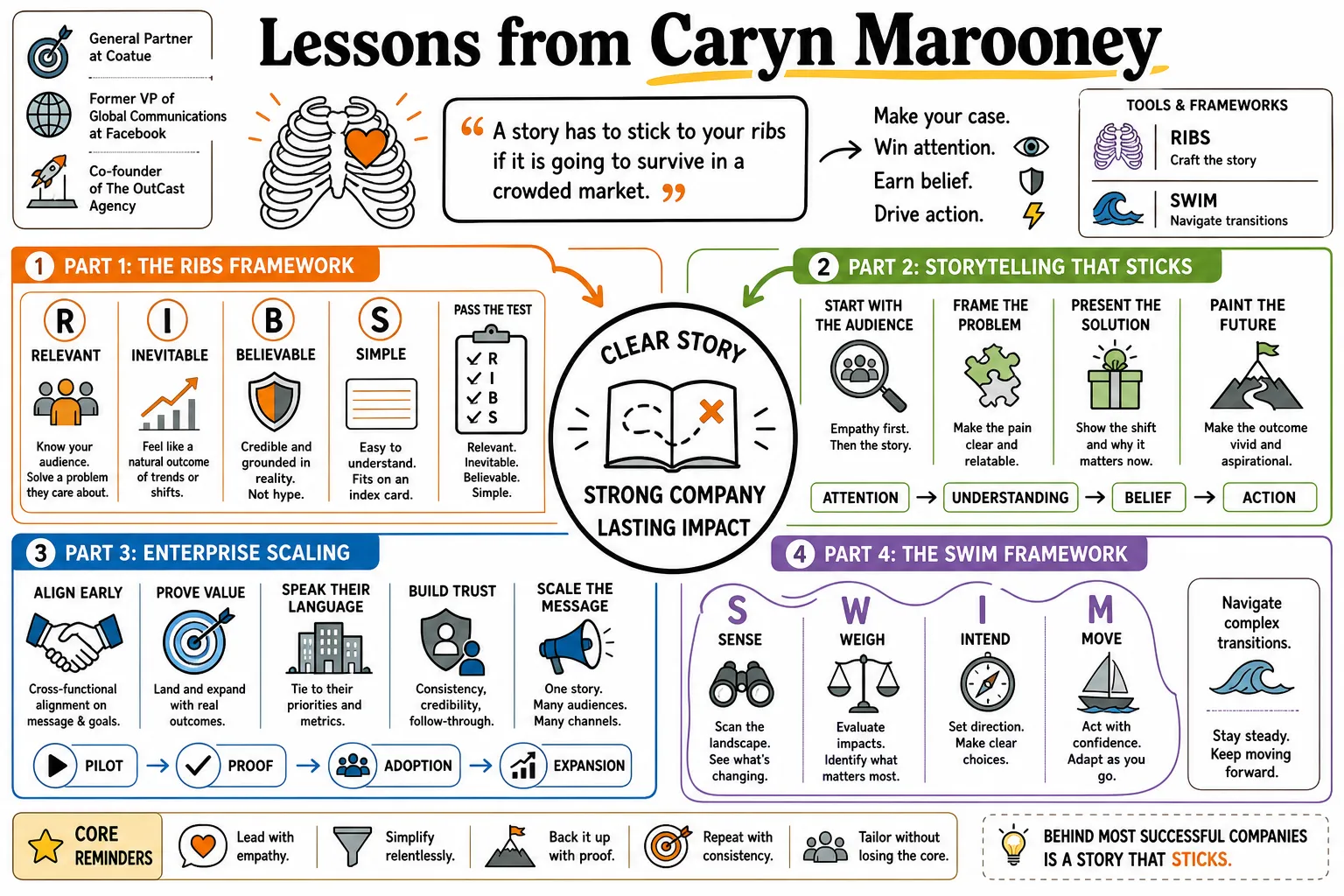
Lessons from Caryn Marooney
Caryn Marooney ran communications at Facebook for more than eight years and is now a general partner at Coatue. — Big Moment Communications Framework: S.W.I.M. - Caryn Marooney.
Part 1: The RIBS Framework
- On More Not Always Being Better: Caryn Marooney: "More employees are not always better; bigger teams are not always better; more offices are not always better; more features are not always better." — The 7 Deadly Sins of Startups.
- On Having No Track Record: Caryn Marooney: "Without a track record, there is no reason anyone should believe you’ll win, and there will always be a bigger or more established company that should be able to do what you’re trying to do." — RIBS — THE MESSAGING FRAMEWORK FOR ANY PRODUCT & COMPANY.
- On Living Values Every Day: Caryn Marooney: "Values need to be lived every day and communicated often through how leaders act, what they do, and what gets celebrated and rewarded — on day one, and every day after that." — How to Onboard Employees and Maintain Culture in a Remote Work Environment.
- On Knowing Your Oceans and Waves: Caryn Marooney: "The best founders are deeply aware of their oceans, while taking advantage of the best waves for them to gain momentum without losing focus." — 7 Deadly Sins: Founder’s Edition.
- On Being Crystal Clear on Your First Audience: Caryn Marooney: "Don’t try to be all things to all people: Be crystal clear on your first audience (your target ICP — ideal customer profile) and what unique value you deliver to them." — 7 Deadly Sins: Founder’s Edition.
- On a Simple, Honest Apology: Caryn Marooney: "A simple, honest apology can be incredibly powerful, and admitting when you made the wrong call or say the wrong thing can give you a lot of credibility." — 7 Deadly Sins: Founder’s Edition.
- On Sleep: Caryn Marooney: "The difference between hope and despair is a good night’s sleep: When you are tired, stressed, over caffeinated, under slept — it brings out the worst in us all." — 7 Deadly Sins: Founder’s Edition.
- On Money and Attention: Caryn Marooney: "A lot of money and attention can make you do dumb things: Don’t lose sight of why you started your company — whether it’s to serve someone else, or to make something better." — 7 Deadly Sins: Founder’s Edition.
- On the Crazy Thing at the Event: Caryn Marooney: "I have not talked with anyone (including myself) who was every happy they did that crazy thing at that event that everyone talked about the next day." — An Introverts Guide to An Offsite (or any Event).
- On What Is Out of Your Control: Caryn Marooney: "Chances are you will rise or fall because of what you do, or because of something like the global economy — which is out of your control — not because of another company." — The 7 Deadly Sins of Startups.
Part 2: The Art of Simplification
- On Getting the User Experience Right First: Caryn Marooney: "The first audience was not advertisers, because Facebook needed to get the user experience right first." — Pivot: Making the Most of a Pivot and Other Big Moments.
- On New Leaders in Technology Shifts: Caryn Marooney: "New leaders emerge in major technology shifts: Mainframe -> IBM, Client/Server -> MSFT, Internet -> Google/Amazon, Cloud -> Salesforce.com." — Pivot: Making the Most of a Pivot and Other Big Moments.
- On repeating yourself: Caryn Marooney: "Smart people hate repeating themselves, but people (including me) have the attention span of a gnat." — 7 Deadly Sins: Founder’s Edition.
- On repetition: Caryn Marooney: "We all need to hear the same message over and over before we have any clue you are even talking." — 7 Deadly Sins: Founder’s Edition.
- On rambling: Caryn Marooney: "It’s easy to ramble and trust that others will figure out what’s important." — The 7 Deadly Sins of Startups.
- On answering questions: Caryn Marooney: "If a customer, VC, investor, or reporters asks you a question, make sure your answer includes what’s important." — The 7 Deadly Sins of Startups.
- On conversation goals: Caryn Marooney: "If you’re starting a conversation with a customer, partner, investor, or reporter, know what you’d like to get out of it." — 7 Deadly Sins: Founder’s Edition.
- On forgettable messages: Caryn Marooney: "Think about how many times you’ve seen the same commercial and still have no idea who it was for — or how many times you’ve heard someone’s name and still can’t remember it." — 7 Deadly Sins: Founder’s Edition.
Part 3: Navigating Big Moments
- On big moments: Caryn Marooney: "You need to treat these moments as a series of intentional and strategic actions." — Pivot: Making the Most of a Pivot and Other Big Moments.
- On winning the new world: Caryn Marooney: "People may believe that the world is changing, but you then have to convince them that you will win in this new world." — Big Moment Communications Framework: S.W.I.M..
- On how long belief takes: Caryn Marooney: "Extra bonus points: it can take years for people to believe you are going to win." — Big Moment Communications Framework: S.W.I.M..
- On room for mistakes: Caryn Marooney: "As you make the changes internally and externally, you need to give yourself room for mistakes." — Big Moment Communications Framework: S.W.I.M..
- On pivoting: Caryn Marooney: "Pivoting — if you’re pivoting, you often have to over rotate to get to the middle." — Pivot: Making the Most of a Pivot and Other Big Moments.
- On celebrating fixing: Caryn Marooney: "Building a culture that doesn’t just celebrate shipping, but also celebrates fixing is key." — Pivot: Making the Most of a Pivot and Other Big Moments.
- On failed launches: Caryn Marooney: "Even the best companies and the most brilliant people have launched products that don’t work." — Pivot: Making the Most of a Pivot and Other Big Moments.
- On a starter ICP: Caryn Marooney: "The larger answer is broad and aspirational, but you need a starter ICP that is more specific and achievable." — Pivot: Making the Most of a Pivot and Other Big Moments.
- On horizontal platforms: Caryn Marooney: "The amazing feature is that horizontal platforms can become really important companies." — Pivot: Making the Most of a Pivot and Other Big Moments.
- On early go-to-market: Caryn Marooney: "The bug is that it can be harder to pinpoint the early ICP (ideal customer profile) and early GTM (go-to-market)." — Pivot: Making the Most of a Pivot and Other Big Moments.
Part 4: Founder Psychology and Focus
- On press and perception: Caryn Marooney: "You are never as good or as bad as the press (or VCs or Twitter) says you are." — The 7 Deadly Sins of Startups.
- On envy: Caryn Marooney: "Some of the worst presentations or launches I have ever seen involved people trying to be like someone else." — 7 Deadly Sins: Founder’s Edition.
- On leading with your own vision: Caryn Marooney: "Your job as a leader is to convince other people to follow your vision and passion — not someone else’s." — 7 Deadly Sins: Founder’s Edition.
- On distraction: Caryn Marooney: "Focus on what’s important and don’t get distracted by who’s up and who’s down, because tomorrow will be different." — 7 Deadly Sins: Founder’s Edition.
- On motion and progress: Caryn Marooney: "Don’t mistake motion for progress: You can be amazingly busy, but that does not mean you or your company is productive." — 7 Deadly Sins: Founder’s Edition.
- On past success: Caryn Marooney: "Relevance is earned every day: Just because you have success in your past (company, product, research), does not mean that you have it in the future." — 7 Deadly Sins: Founder’s Edition.
- On being consumed: Caryn Marooney: "Running a company is hard, and it’s easy to let it consume you, to become your whole world." — 7 Deadly Sins: Founder’s Edition.
- On the Midas touch: Caryn Marooney: "Midas touch: When things start to go right, you can believe everything you do is gold." — 7 Deadly Sins: Founder’s Edition.
- On distance from customers: Caryn Marooney: "Being busy and successful can distance you from your customers and the problems they are trying to solve." — The 7 Deadly Sins of Startups.
Part 5: Rethinking Public Relations and Launches
- On other people's goals: Caryn Marooney: "Customers, investors, press, and partners don’t work for you, so you have to think about what they’re trying to do." — The 7 Deadly Sins of Startups.
- On communicating in hard times: Caryn Marooney: "Competition, layoffs, bugs, execs leaving, controversies — these are the times when your teams need to hear more from you, not less." — The 7 Deadly Sins of Startups.
- On letting things go: Caryn Marooney: "Letting something go does not mean rolling over when people attack the most fundamental parts of who you are or what you do." — The 7 Deadly Sins of Startups.
- On conferences: Caryn Marooney: "A good conference is an important stamp of approval, but you shouldn’t rely on them to come up with your messaging and be your translator." — The 7 Deadly Sins of Startups.
- On a public mistake: Caryn Marooney: "The reason there was zero in mobile revenue was because of a very public strategic mistake Facebook had made in developing its mobile applications." — Pivot: Making the Most of a Pivot and Other Big Moments.
- On proving you care: Caryn Marooney: "You have to prove that you care more, and that you’re gaining momentum and traction." — RIBS — THE MESSAGING FRAMEWORK FOR ANY PRODUCT & COMPANY.
- On obvious problems: Caryn Marooney: "If you can convince people that a problem is obvious and your solution just makes sense, it will be like having a gust of wind at your company’s back — you’ll build momentum and the journey to relevance will be that much shorter." — RIBS — THE MESSAGING FRAMEWORK FOR ANY PRODUCT & COMPANY.
- On expecting to be beaten to it: Caryn Marooney: "Mark Zuckerberg used to say that he always expected someone to connect the world, he just didn’t think it would be him." — Pivot: Making the Most of a Pivot and Other Big Moments.
Part 6: Scaling to the Enterprise
- On fooling yourself about PMF: Caryn Marooney: "I talk to founders who are fooling themselves into thinking they have product market fit (PMF,) when they don’t." — 7 Deadly Sins: Founder’s Edition.
- On champions: Caryn Marooney: "Instead of trying to pull mid-market deals into an Enterprise sales cycle, focus on turning users into champions and letting them bridge the gap for you." — The Hamburger GTM: The Winning Go-To-Market Strategy.
- On users not leads: Caryn Marooney: "In a bottom-up model, marketing creates users — not leads and those users are never touched by sales." — The Hamburger GTM: The Winning Go-To-Market Strategy.
- On waiting too long for enterprise sales: Caryn Marooney: "Many companies wait too long to start building out their enterprise sales — and end up ceding market share and ultimately failing to build the organization they need to achieve their potential." — The Hamburger GTM: The Winning Go-To-Market Strategy.
- On product-led expansion: Caryn Marooney: "The features, functionality and breadth of your product should unlock the next use-case and a path to incremental monetization — creating a virtuous cycle where product innovation is directly tied to expansion." — The Hamburger GTM: The Winning Go-To-Market Strategy.
- On pricing: Caryn Marooney: "In the Hamburger Model, pricing itself can be an important lever for growth — but only if you align price with customer value, and create natural on-ramps for customers to pay you more over time." — The Hamburger GTM: The Winning Go-To-Market Strategy.
- On the CRO: Caryn Marooney: "A strong Chief Revenue Officer can often be instrumental in bridging the bottom-up and top-down sales motions." — The Hamburger GTM: The Winning Go-To-Market Strategy.
- On doing both at once: Caryn Marooney: "Focusing on the different parts of the Hamburger Model at the same time is hard." — The Hamburger GTM: The Winning Go-To-Market Strategy.
- On serving both buns: Caryn Marooney: "For the bottom bun to be successful, product and engineering need to focus on self-service, simple billing and viral features." — The Hamburger GTM: The Winning Go-To-Market Strategy.
Part 7: AI, Agents, and Infrastructure
- On explorers: Caryn Marooney: "Explorers must relentlessly focus and obsess over customer value, as this is the direct path into the land of the Healthy." — 4 Quadrants of Startup Success: Are You Healthy, Survivor, Explorer, or In Danger?.
- On false starts: Caryn Marooney: "Often, you’ll have multiple false starts before you identify the right product." — 4 Quadrants of Startup Success: Are You Healthy, Survivor, Explorer, or In Danger?.
- On survivors: Caryn Marooney: "Remember: Many of the best companies in the world today were Survivors in the past." — 4 Quadrants of Startup Success: Are You Healthy, Survivor, Explorer, or In Danger?.
- On the danger zone: Caryn Marooney: "Unlike Explorers (who have the luxury of time) and Survivors (who can raise capital, maybe at less attractive terms), Danger Zone companies need to act with urgency." — 4 Quadrants of Startup Success: Are You Healthy, Survivor, Explorer, or In Danger?.
- On zombies: Caryn Marooney: "The challenge for Zombies is that you won’t know you are a Zombie until you need to raise capital again — and that might be years away." — 4 Quadrants of Startup Success: Are You Healthy, Survivor, Explorer, or In Danger?.
- On the Rule of 40: Caryn Marooney: "Companies with Growth + Margin above 40 generally have strong business models." — 4 Quadrants of Startup Success: Are You Healthy, Survivor, Explorer, or In Danger?.
- On breakeven: Caryn Marooney: "Survivors need a path to breakeven more than any other type of company." — 4 Quadrants of Startup Success: Are You Healthy, Survivor, Explorer, or In Danger?.
- On product-led growth: Caryn Marooney: "Today, we live in a world of product-led growth, where engineering (and the software they have built) is the biggest differentiator." — The Hamburger GTM: The Winning Go-To-Market Strategy.
- On performance management: Caryn Marooney: "Most companies in high growth don’t get around to being rigorous with performance management." — 4 Quadrants of Startup Success: Are You Healthy, Survivor, Explorer, or In Danger?.
Part 8: Leadership and Transitions
- On market circumstances: Caryn Marooney: "Employees need to be aware and make adjustments, but not be paralyzed or frozen by market circumstances." — 4 Quadrants of Startup Success: Are You Healthy, Survivor, Explorer, or In Danger?.
- On talking about the macro: Caryn Marooney: "While it’s critical to be clear-eyed, honest and direct about the macro, it’s even more important to empower your team to focus on what they can control, as well." — 4 Quadrants of Startup Success: Are You Healthy, Survivor, Explorer, or In Danger?.
- On talent: Caryn Marooney: "The best companies in the world attract and retain the best people and manage out the rest." — 4 Quadrants of Startup Success: Are You Healthy, Survivor, Explorer, or In Danger?.
- On founders in uncertain times: Caryn Marooney: "Companies need founders who can lead and inspire in uncertain times." — 4 Quadrants of Startup Success: Are You Healthy, Survivor, Explorer, or In Danger?.
- On knowing the values: Caryn Marooney: "Leaders should also ask themselves how many current employees know what the company’s values are." — How to Onboard Employees and Maintain Culture in a Remote Work Environment.
- On rocket ship mode: Caryn Marooney: "When you are in rocket ship mode — you have to be aware of things breaking and not scaling fast enough." — 7 Deadly Sins: Founder’s Edition.
- On knowing your mode: Caryn Marooney: "As a founder, you need to be aware which mode you are in and act accordingly." — 7 Deadly Sins: Founder’s Edition.
- On hiring: Caryn Marooney: "Think carefully about what you need, why, and what role that person will play day in and day out." — 7 Deadly Sins: Founder’s Edition.
- On prioritizing: Caryn Marooney: "What to resource, what to prioritize, and what not — is one of the most important jobs of a founder." — 7 Deadly Sins: Founder’s Edition.
- On consuming recorded content: Caryn Marooney: "Employees also need to spend time actually consuming the content on their own time." — How to Onboard Employees and Maintain Culture in a Remote Work Environment.