Connie Chan is a venture capitalist and former Andreessen Horowitz general partner whose writing examines consumer technology, Chinese mobile products, social commerce and AI companions. In 2024 she said she was stepping back from a16z to form theses for her next chapter. — A Personal Update.
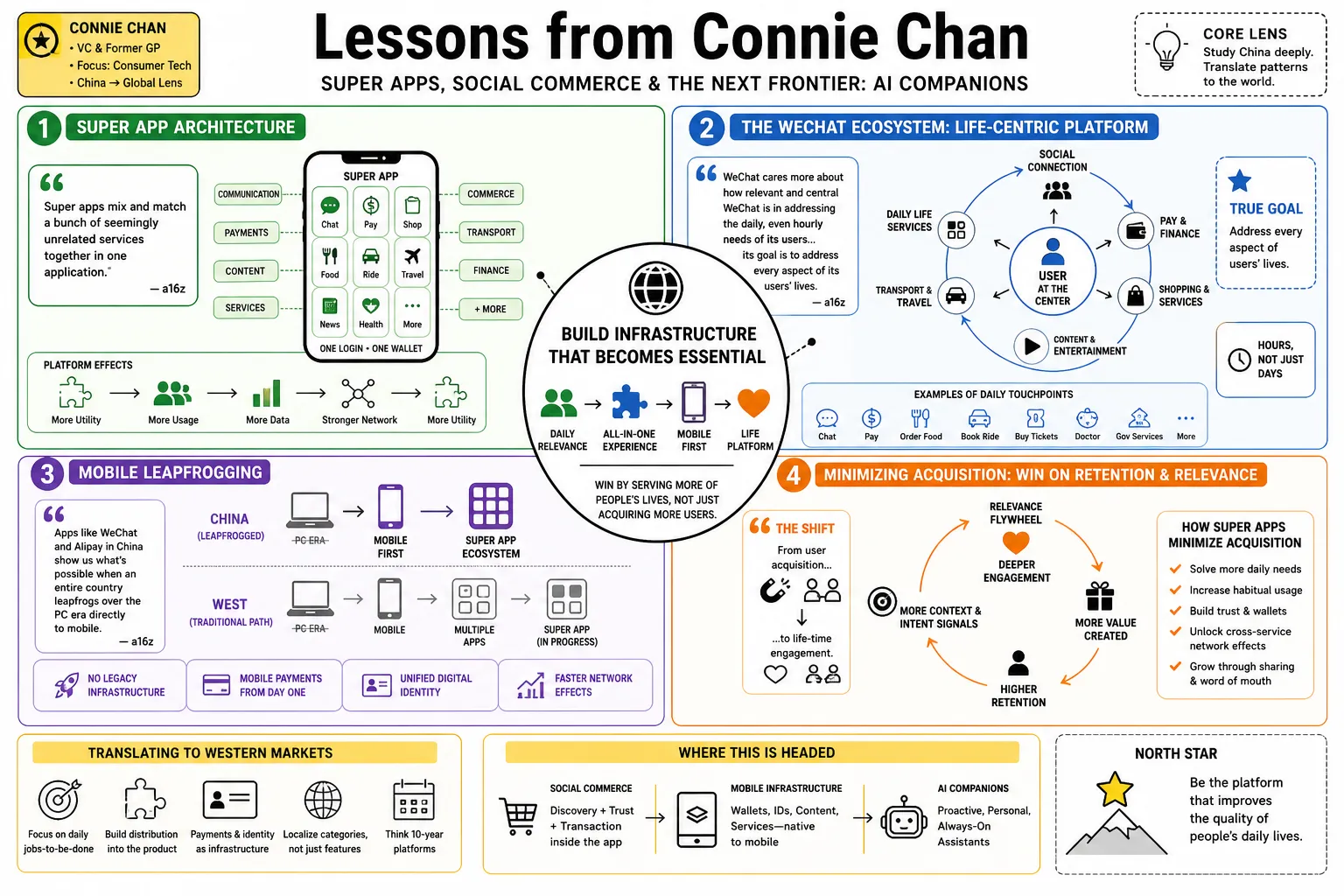
Part 1: Super Apps and the WeChat Ecosystem
- On Super-App Architecture: A super app combines frequent core use with additional services, giving people reasons to return and allowing the platform to serve more of their needs. — Four Trends in Consumer Tech.
- On WeChat’s Goal: Chan argued that WeChat optimized for being relevant to users’ daily needs, including non-social services, rather than only maximizing the size of a social network. — WeChat and Mobile in China.
- On the Platform Concept: Chan viewed WeChat as more than messaging: its portal, payments and third-party accounts made it function in some respects like a mobile operating system. — WeChat and Mobile in China.
- On Mobile Leapfrogging: WeChat and Alipay illustrated for Chan what product design could look like when a market moved directly into a mobile-first era rather than adapting a PC web experience. — Rise of the Super App.
- On Acquisition Economics: Chan used Meituan to show how a high-frequency service such as food delivery could distribute lower-frequency services like hotel bookings at low incremental customer-acquisition cost. — Four Trends in Consumer Tech.
- On Apps Within Apps: WeChat’s official accounts let third-party businesses provide app-like functions inside the messaging platform, often without requiring users to install separate native apps. — WeChat and Mobile in China.
- On User Mindshare: The value of a super app is repeated relevance: a service that people already open often can introduce adjacent transactions using its distribution and customer knowledge. — Four Trends in Consumer Tech.
- On Frictionless Transactions: WeChat Wallet joined identity, payment credentials and selected partner services so users could transact without repeatedly leaving the app or entering information. — WeChat and Mobile in China.
- On Mobile Infrastructure: Chan emphasized WeChat’s infrastructure role: official accounts, payments and phone sensors connected online services with offline actions. — WeChat and Mobile in China.
- On Western Lessons: Chan treated WeChat as a prompt for Western businesses to redesign from a mobile-first starting point, not as a template that could simply be copied into another market. — WeChat and Mobile in China.
Part 2: Social Commerce and E-commerce Innovation
- On Shopatainment: Chan described shopatainment as video-based selling that people browse for entertainment as well as products, blending storytelling, demonstrations and transactions. — Shopatainment.
- On Next-Generation Ecommerce: Chan argued that the next generation of commerce would combine online choice with the serendipitous discovery people enjoy in physical stores. — The Future of Ecommerce.
- On Discovery Versus Search: Search works when buyers know what they want; Chan argued that discovery-based feeds can surface appealing products they did not think to seek out. — The Future of Ecommerce.
- On Seller Connection: Chan said live shopping can create a personal connection with the seller through stories, demonstrations and real-time interaction. — Shopatainment.
- On Scarcity in Live Shopping: Limited inventory and time can make a live sale more compelling; Chan illustrated this with rare products such as a Birkin bag or limited-edition card. — The Future of Ecommerce.
- On Interactive Shopping: Chan imagined a celebrity-led shopping stream where viewers could ask questions, react and claim offers as the presentation unfolded. — Live, Social, and Shoppable.
- On Belonging in Commerce: Chan described Whatnot as an eBay-like live marketplace where buyers and sellers form friendships and a sense of belonging alongside transactions. — A Personal Update.
- On Commerce Inside Content: Chan expected shopping to appear within entertainment, video, social and messaging apps rather than remain confined to dedicated storefronts. — Four Trends in Consumer Tech.
Part 3: Video-First Interfaces and Entertainment
- On Participatory Video: Chan predicted video products would become more participatory, letting audiences react to and shape an experience in real time instead of only watching it. — Live, Social, and Shoppable.
- On Seller-Buyer Connection: Video commerce lets shoppers see products demonstrated and hear a seller’s story, creating a more direct connection than a static listing can offer. — Shopatainment.
- On Social Reach: Chan argued video-first services could support more engaging social interactions across distance, from shopping and learning to events. — Live, Social, and Shoppable.
- On Shoppable Media: Chan described formats in which viewers can move from a video demonstration to a purchase within the same experience. — The Future of Ecommerce.
- On Feedback Loops: Video platforms can learn from real-time viewer actions such as scrolling, reacting and following, then use those signals to personalize what people see. — Live, Social, and Shoppable.
- On Immersive Shopping: Chan saw live product demonstrations and seller storytelling as a way to make online browsing entertaining, not merely an efficient checkout task. — Shopatainment.
- On Video Versus Product Photos: Chan predicted more online retailers would use video rather than only photo-based listings so sellers could demonstrate products and tell their stories. — Shopatainment.
Part 4: Consumer Behavior and Discovery
- On Leaving the Bubble: Chan urged consumer investors to gain first-hand experience outside the Bay Area so they can understand people and products beyond their own environment. — Stanford eCorner: Career Advice from a VC Pro.
- On Universal Needs: Chan saw Chinese bike-sharing as evidence of a last-mile mobility need, but said U.S. adoption required adaptation rather than a direct copy. — Stanford eCorner: Career Advice from a VC Pro.
- On Earshare: Chan called rising audio consumption a new way for products and marketers to reach consumers during moments when screens are unavailable. — Four Trends in Consumer Tech.
- On Audio-First Design: Chan encouraged founders to design content expressly for listening—using narration, sound and the moments people spend commuting or doing chores. — Four Trends in Consumer Tech.
- On Technology in Physical Space: Chan expected digital identity and software to extend into physical places, citing facial-recognition pilots and other offline integrations. — Four Trends in Consumer Tech.
- On QR Codes as Bridges: Chan described QR codes as a simple link between physical objects or locations and online identity, payments and additional information. — 16 Ways QR Codes Are Used in China.
- On Temu’s Data-Bootstrap Strategy: Chan argued that recommendation-led apps may spend heavily at launch to gather enough user and product data for useful personalization. — Temu: What It Is.
- On Social Proof in Shopping: Chan said seeing other shoppers buy a product can increase trust and confidence, especially when inventory or time is limited. — The Future of Ecommerce.
- On Talking Beyond Coastal Markets: Chan warned that consumers in the middle of America face different problems from people in Palo Alto; direct conversations and travel can reveal needs that desk research misses. — Stanford eCorner: Career Advice from a VC Pro.
Part 5: Startup Strategy and Founder Advice
- On a Shared Ideal: Chan describes investing as a partnership with founders around a shared desire to realize the company’s vision at meaningful scale. — Connie Chan: Investment Philosophy.
- On Evaluating Markets: Ben Horowitz observed that Chan began investment analysis with the target customer, then worked back toward the entrepreneur and market size. — Ben Horowitz on Connie Chan.
- On Truth Seeking: Chan urged investors to pursue first-hand consumer insight and convictions instead of following the industry’s prevailing conversation. — Stanford eCorner: Career Advice from a VC Pro.
- On Founder Growth: Chan values seeing a startup develop from an idea into a large enterprise and seeing its founders mature as leaders along the way. — A Personal Update.
- On Hope as an Investment Motive: Chan says she uses venture investing to support founders who believe they can build a more enjoyable or efficient future. — Connie Chan: Investment Philosophy.
- On the Work After Promotion: Chan compared becoming a general partner to making an Olympic team: the opportunity to compete was not the same as having won. — A Personal Update.
- On an Out-of-Scope Investment: Chan described KoBold Metals as her first deal as general partner, one she backed despite its being outside her consumer-technology remit. — A Personal Update.
- On Products That Address Loneliness: Chan saw an opportunity for consumer products that help people feel understood and connected, while acknowledging technology cannot replace all human relationships. — How Chatbots Can Become Great Companions.
- On Validating Consumer Demand: Chan said she watched Asian consumer products with tens of millions of users for signals of demand, then asked whether the underlying need would translate to the United States. — Stanford eCorner: Career Advice from a VC Pro.
Part 6: Global Tech Trends
- On Learning from China: Chan argued that China could offer U.S. companies a glimpse of future practices in selected consumer categories, including mobile payments and online-to-offline commerce. — Innovation in China.
- On Market Translation: Chan warned against treating non-Western companies as clones of U.S. products; their local conditions and inventions can reveal needs worth studying and adapting. — Innovation in China.
- On Distinct Market Conditions: Chan urged investors to study the specific infrastructure and consumer conditions behind international products instead of assuming the same design will transfer unchanged. — Stanford eCorner: Career Advice from a VC Pro.
- On Mobile-First Infrastructure: Chan used Chinese mobile payments and WeChat services to show how products can develop around smartphones rather than copying a desktop-web path. — WeChat and Mobile in China.
- On Multiple Live-Commerce Formats: Chan described live shopping as a broad market with room for different categories and formats, rather than one universal show type. — Shopatainment.
- On Testing Live Shopping: Chan treated Chinese live-commerce adoption as evidence that video can alter product discovery, while warning U.S. products still need a locally compelling format. — Shopatainment.
- On Mobile as a Lifestyle Layer: Chan observed that WeChat combines communication with services such as payments and merchant interactions, making the phone a gateway to daily activities. — WeChat and Mobile in China.
- On Changing Consumer Expectations: Chan argued that consumers accustomed to mobile-first services may expect convenient, integrated interactions that go beyond a single-purpose app. — WeChat and Mobile in China.
Part 7: Creator Economy and Monetization
- On Creator Economics: Chan and Avery Segal argued that creators who invest time and resources in an audience need better ways to earn money directly on the platforms where that audience gathers. — Making a Living Off Likes.
- On Multiple Creator Revenues: Chan and Segal described creator revenue through paid memberships, Q&As, tips and native commerce alongside advertising and sponsorships. — Making a Living Off Likes.
- On Direct Selling: Chan and Segal showed how short-video and social platforms let creators or producers sell products directly to viewers, sometimes bypassing a conventional retailer. — The Video-First Future of Ecommerce.
- On Product Curation: Chan described how product demos and recommendations in video can help viewers discover goods they would not have searched for. — The Video-First Future of Ecommerce.
- On Fan Tipping: Chan and Segal described tips as one of several ways fans can financially reward creators inside a social platform. — Making a Living Off Likes.
- On Live Product Demonstration: Chan and Segal showed how video can demonstrate a product’s use or craftsmanship and let viewers ask questions before buying. — The Video-First Future of Ecommerce.
- On Creator-Made Goods: Chan and Segal noted that some influencers sell their own branded merchandise through native social-commerce tools. — Making a Living Off Likes.
- On Specialist Live Shopping: Chan used niche examples such as collectibles and apparel to explain why live-commerce products can serve focused enthusiast communities. — Shopatainment.
- On Discovery Beyond Search: Chan and Segal argued that recommendation-driven video can surface products a shopper might never search for, creating a different path to commerce. — The Video-First Future of Ecommerce.
Part 8: Future of Consumer Tech and Investing
- On Generative AI as a Platform: Chan and Justine Moore argued in 2023 that generative AI could become a platform for new consumer product categories and improve existing products. — Generative AI: The Next Consumer Platform.
- On Lower-Stakes AI Conversation: Chan argued that some users may feel safer speaking candidly with companion chatbots because bots do not carry every interpersonal risk associated with human relationships. — How Chatbots Can Become Great Companions.
- On Memory in Companion Bots: Chan proposed that a companion chatbot that remembers prior conversations could notice patterns and ask more personally relevant questions. — How Chatbots Can Become Great Companions.
- On Evaluating Companions: Chan framed a useful AI companion around feeling understood and being able to sustain natural, attentive conversation. — How Chatbots Can Become Great Companions.
- On AI’s Relationship Limits: Chan cautioned that bots cannot provide physical affection or fully replace trained therapists, and may fail to challenge people as real friends do. — How Chatbots Can Become Great Companions.
- On Availability: Chan noted that phone-based companion bots can be accessible at odd hours, which may appeal to people seeking conversation during insomnia or when building social confidence. — How Chatbots Can Become Great Companions.
- On an Assistant Becoming a Companion: Chan imagined a practical assistant that learns a person’s routines and can gradually become a more personal conversational companion. — How Chatbots Can Become Great Companions.
- On Forming New Theses: After twelve years at a16z, Chan said she was stepping back to spend time forming theses for her next chapter. — A Personal Update.