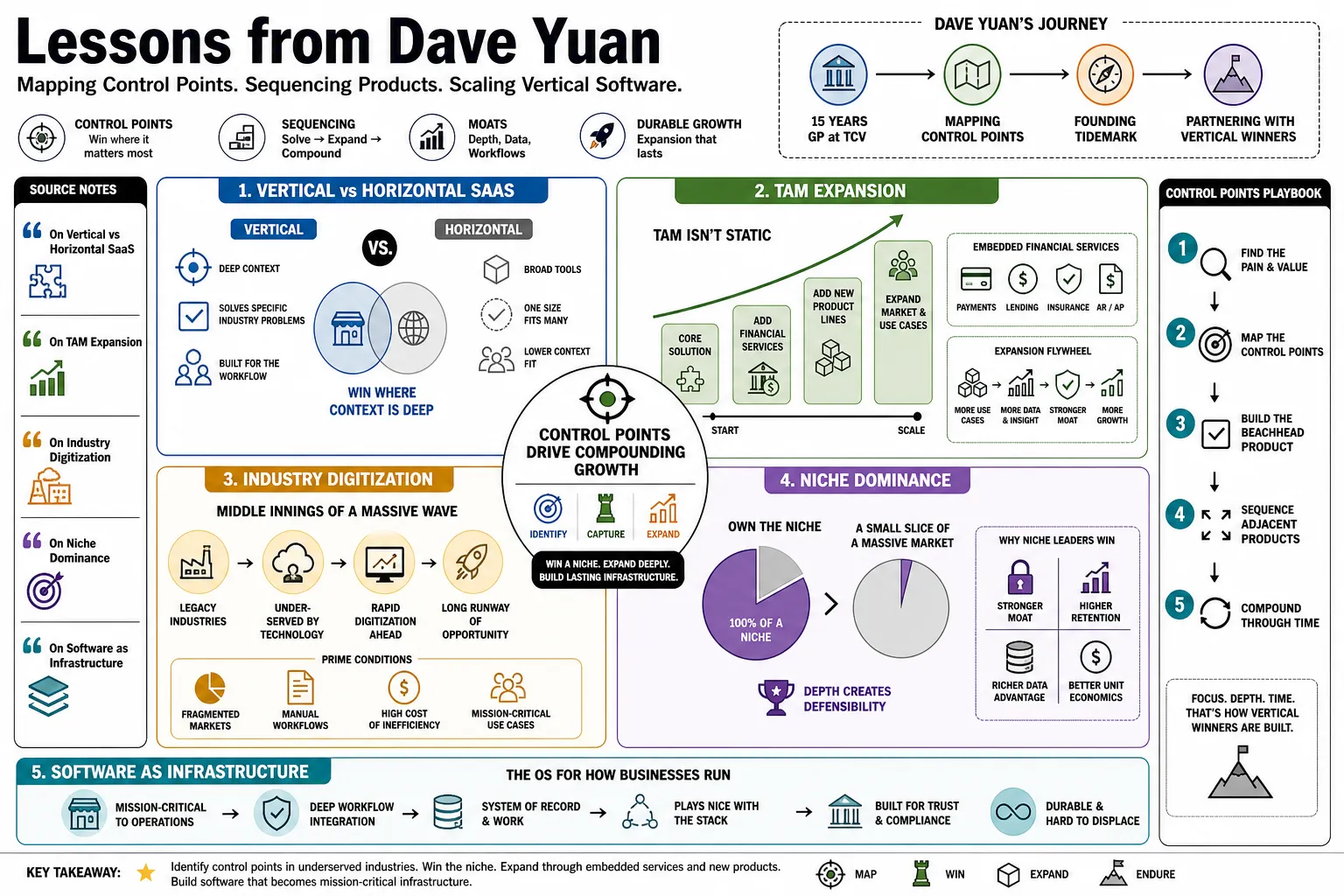
Lessons from Dave Yuan
Dave Yuan founded Tidemark in 2021 after 15 years at TCV. His vertical-software writing focuses on control points, multi-product expansion and industry platforms. — The Platform Journey Interview.
Part 1: The Vertical SaaS Opportunity
- Vertical Fit: Industry-specific products can solve specialized, regulated or complex problems that horizontal tools may require substantial customization to address. — Truths about Vertical SaaS.
- Expand the Addressable Market: A control point can create an opportunity to grow revenue per merchant through additional software and financial products; expansion is an execution challenge, not an automatic outcome. — Truths about Vertical SaaS.
- Choose the Industry Carefully: Evaluate an industry's current size, fragmentation and future growth before assuming it is an attractive vertical software market. — Picking Your Market.
- Depth in a Vertical: Yuan argues that focused vertical leaders can attain high market share in a smaller market, partly because fewer rivals pursue it. — Truths about Vertical SaaS.
- Operational Software: A control point is a merchant's most important application and may sit in the front or back office of day-to-day operations. — Truths about Vertical SaaS.
- Specific Needs Matter: Complexity, regulation and specialization can make an industry-specific product easier to adopt than a heavily customized horizontal alternative. — Truths about Vertical SaaS.
- Control-Point Retention: A product embedded in a merchant's most important workflow may have strong retention, though that advantage is not guaranteed. — Control Point Patterns.
- An Opening for Challengers: A challenger can enter through an important adjacent workflow and integrate around an incumbent control point; incumbent status alone does not settle the contest. — Control Point Patterns.
- Know the Customer's Language: Vertical focus can make product and sales teams more fluent in customer needs, strengthening local brand awareness and distribution. — Truths about Vertical SaaS.
- What Vertical SaaS Serves: In Yuan's framework, a vertical SaaS vendor sells industry-focused software to merchants and may expand toward their employees, suppliers and consumers. — Truths about Vertical SaaS.
Part 2: Control Points and Software Gravity
- Define the Control Point: A control point is the most important application in a merchant's suite—the one the customer would be last to turn off at the end of the day. — Truths about Vertical SaaS.
- Workflow Gravity: The most valuable workflow, the one where decisions begin or where users spend substantial time, can give a product a path into adjacent processes. — The Paths to Multi-Product.
- Data Gravity: Data gravity arises when a system creates and holds critical information that other products need; it can support expansion but is not permanent protection. — The Paths to Multi-Product.
- Account Gravity: An important vendor with customer trust, attention and procurement acceptance may have an easier opening to offer a second product. — The Paths to Multi-Product.
- Front and Back Office: Yuan identifies one or two common control points in a small business: a front-office application touching sales and a back-office application. — Truths about Vertical SaaS.
- Systems of Record: A control point often functions as a system of record; integrated products can become more valuable when they share that workflow or information. — The Paths to Multi-Product.
- An Opportunity to Expand: Owning a control point gives a vendor an opportunity to sell compounding products, but building and selling them remain difficult. — The Paths to Multi-Product.
- Integration Gravity: Important workflows can become integration hubs because adjacent tools need to work with the system that anchors the merchant's operations. — The Paths to Multi-Product.
- Retention, Not Immunity: Yuan associates control points with high retention, while also warning that new applications can integrate around and eventually challenge them. — Hg Orbit Interview.
- Find the Core Workflow: Start with an important workflow that creates meaningful outcomes, then let observed customer needs guide adjacent automation. — The Paths to Multi-Product.
Part 3: Multi-Product Sequencing
- Multi-Product Potential: Vertical software can develop into a multi-product business because one merchant may need several connected tools; that is an opportunity, not a universal mandate. — Born Multi-Product.
- Follow the Workflow: An adjacent product can automate the next connected process, reducing handoffs and duplicate entry while using the core workflow as a starting point. — The Paths to Multi-Product.
- Follow the Money: Transaction workflows may open adjacent opportunities in documents, reconciliation, invoicing and payments when the vendor can reduce friction between systems. — The Paths to Multi-Product.
- Sequence the Second Product: A major new product may take years to build and distribute, while even strong companies can focus on only one or two big initiatives at once; timing deserves deliberate choice. — The Platform Journey Interview.
- Avoid Product Sprawl: Multi-product expansion splits development, sales and management attention, so products that reinforce one another have a stronger rationale than disconnected additions. — The Paths to Multi-Product.
- Let Data Improve Adjacent Products: Integrated workflows and a richer shared data set can make a second product more useful, provided the integration improves the customer's work. — The Paths to Multi-Product.
- One Point of Accountability: Busy small-business owners may prefer fewer vendors so there is one place to turn when a product or service fails. — Truths about Vertical SaaS.
- Extend Across the Value Chain: After winning a merchant control point, a vendor may build offerings for employees, suppliers or consumers; Yuan presents this as a possible industry-platform path. — Industry Transformation.
- Allocate Product Capital Deliberately: Yuan urges leaders to consider capital allocation across products and explain the long-term logic of investments to their boards, even where AI payback is uncertain. — Hg Orbit Interview.
Part 4: AI and the Shift to Systems of Action
- AI Opportunity and Threat: Yuan sees AI as a potential opportunity for modern control points, but an incumbent that neglects competing applications can lose the system-of-action role. — Hg Orbit Interview.
- From Record to Action: Yuan's system-of-action thesis asks whether vertical software can perform work for customers rather than merely store records of it. — The Race to Own the Agentic Future.
- Integrate and Surround: An AI-native application may enter through a useful wedge, integrate with an incumbent and progressively capture workflow engagement; this is a risk, not an inevitable outcome. — Hg Orbit Interview.
- Fast and Slow Waters: Yuan distinguishes markets where users actively seek AI tools from less visible jobs where automation may nevertheless find demand. — Hg Orbit Interview.
- Respond to the AI Shift: Yuan argues that control-point providers need to move quickly on agentic products; a current distribution advantage does not mean the race is won. — The Race to Own the Agentic Future.
- Data Gravity Can Erode: AI may make data easier to access across applications, weakening an incumbent's former data-gravity advantage; proprietary records alone do not guarantee an AI moat. — AI and Data Gravity.
- Automate Valuable Work: Yuan describes AI tools for both sought-after user tasks and less attractive but necessary work, with value judged by outcomes rather than a feature label. — Hg Orbit Interview.
- Defend the Control Point: A modern control point may have a head start in offering agents, but needs to deliver useful automation before challengers win user engagement. — The Race to Own the Agentic Future.
- Do Not Assume a Data Moat: Data access and workflow ownership are contested in the AI transition; an incumbent must create useful applications rather than rely only on historical lock-in. — AI and Data Gravity.
- Agentic Vertical Software: Yuan envisages vertical systems of action that increasingly execute work; this is a forward-looking thesis, not an established universal change in SMB economics. — The Race to Own the Agentic Future.
Part 5: Building for the SMB Customer
- Time to Value for Owners: Small-business owners on tight budgets need easy-to-use products that solve their industry's immediate problem and show value quickly. — Truths about Vertical SaaS.
- Support Beyond Features: Yuan argues that a vertical software provider can help overwhelmed business owners with advice, coaching and community as well as software. — Everyone Needs a Coach.
- Easy to Use, Quick to Value: Yuan links ease of use and a short path to return on investment to the needs of busy small-business owners. — Truths about Vertical SaaS.
- Efficient Local Distribution: Fragmented, local merchant markets can make location-level sales efficiency, brand awareness and a finite lead pool important operating considerations. — Truths about Vertical SaaS.
- Do Not Overstate SMB Churn: Yuan notes that small-business closures can hurt retention, while multi-product control points have helped some vendors build stronger customer economics. — The Platform Journey Interview.
- Familiarity Helps Adoption: When workers and owners know a vertical system, that familiarity can support local word of mouth and adoption elsewhere; it is not an insurmountable switching barrier. — Truths about Vertical SaaS.
- Help the Owner Succeed: Yuan frames additional guidance, content and community as ways a vertical vendor can improve outcomes for time-constrained owners. — Everyone Needs a Coach.
- Build Customer Community: Shared learning and coaching can extend a vertical platform's value beyond the application itself. — Everyone Needs a Coach.
- Fit the Merchant's Problem: An industry-built product may require less customization for specialized or regulated tasks, though horizontal software remains suitable for some functions. — Truths about Vertical SaaS.
Part 6: Unit Economics, Pricing, and Growth
- Payments as an Expansion Product: Embedded payments can add a transaction-based revenue stream to vertical software, but payment operations and economics need careful assessment. — Payments.
- Earn More per Merchant: Yuan's growth equation combines locations and revenue per merchant; connected products and financial services can raise the latter when customers adopt them. — Truths about Vertical SaaS.
- Measure Expansion, Do Not Assume It: The benchmark examines how control-point selection relates to adoption of later products; cross-sell opportunity should be tested through actual attach rates. — 2024 Vertical & SMB SaaS Benchmark Report.
- Balance Defense and Offense: Yuan advises sound financing and controlled unit economics before investing aggressively to gain share in an uncertain market. — Hg Orbit Interview.
- Use Attach Rates as Evidence: Track whether merchants adopt subsequent products rather than assuming that a larger catalog proves a successful multi-product strategy. — 2024 Vertical & SMB SaaS Benchmark Report.
- Payments Bring Operating Costs: Embedded payments require attention to onboarding, underwriting, risk and compliance; attractive take rates cannot be evaluated apart from these costs. — Payments.
- Follow Transaction Value: Payments can let a vendor participate in the transaction flow it helps manage, though realized economics depend on merchant adoption and operating obligations. — Payments.
- Control the Financing Path: Yuan urges CEOs to remain adequately financed and keep unit economics under control so they can choose when to invest offensively. — Hg Orbit Interview.
- Acquisition Economics Can Improve: Higher revenue per customer from an adopted second product can support more acquisition spending, but only if the expansion actually materializes. — The Paths to Multi-Product.
Part 7: Venture Philosophy and Tidemark
- A Purpose-Built Firm: Tidemark launched in 2021 as a growth-equity firm designed to support category-leading companies and share operator knowledge. — The Platform Journey Interview.
- Growth Equity Focus: Tidemark describes its role as helping established category-leading technology companies win and scale, in partnership with operators. — The Platform Journey Interview.
- Codify Observed Patterns: Yuan says Tidemark drew on experience with vertical and SMB software companies to publish reusable frameworks rather than keep those learnings private. — Hg Orbit Interview.
- Invest on a Long Horizon: Yuan says Tidemark weighs secular growth and a company's ability to compound over time more heavily than short-term market cycles. — Hg Orbit Interview.
- Show Investor Value: Yuan's approach is to publish useful frameworks and bring operators together so founders can see an investor's thinking before a financing conversation. — Hg Orbit Interview.
- Share the Playbook: Yuan says the Vertical SaaS Knowledge Project codifies Tidemark's operating patterns and complements them with community and benchmark data. — Hg Orbit Interview.
- Specialized Investor Contribution: Tidemark focuses on vertical software and tries to demonstrate value through sector frameworks, experienced operators and peer learning. — Hg Orbit Interview.
- Make Product Bets Legible to the Board: Yuan says uncertain AI investments need a credible long-term logic that a CEO can discuss openly with the board. — Hg Orbit Interview.
- Back Potential Category Leaders: Yuan describes looking for companies that can compound over a long horizon as category leaders; he does not claim every market has a single winner. — Hg Orbit Interview.
Part 8: Leadership and Founder Psychology
- Focus the Roadmap: A vertical platform may have many possible adjacent products, but Yuan says even strong teams can focus on only one or two major initiatives at a time. — The Platform Journey Interview.
- Capital Allocation Is a CEO Decision: Yuan calls for deliberate allocation across sales, marketing and products, including AI experiments whose short-term payoff is uncertain. — Hg Orbit Interview.
- Multi-Product Is Hard: The shift to multiple products divides engineering and sales attention and makes roadmap decisions harder; an integrated second product can still create compounding value. — The Paths to Multi-Product.