David Cahn is a Sequoia Capital partner whose writing examines AI infrastructure, the gap between capital spending and end-customer revenue, and the changing growth benchmarks for AI startups. — Sequoia: David Cahn.
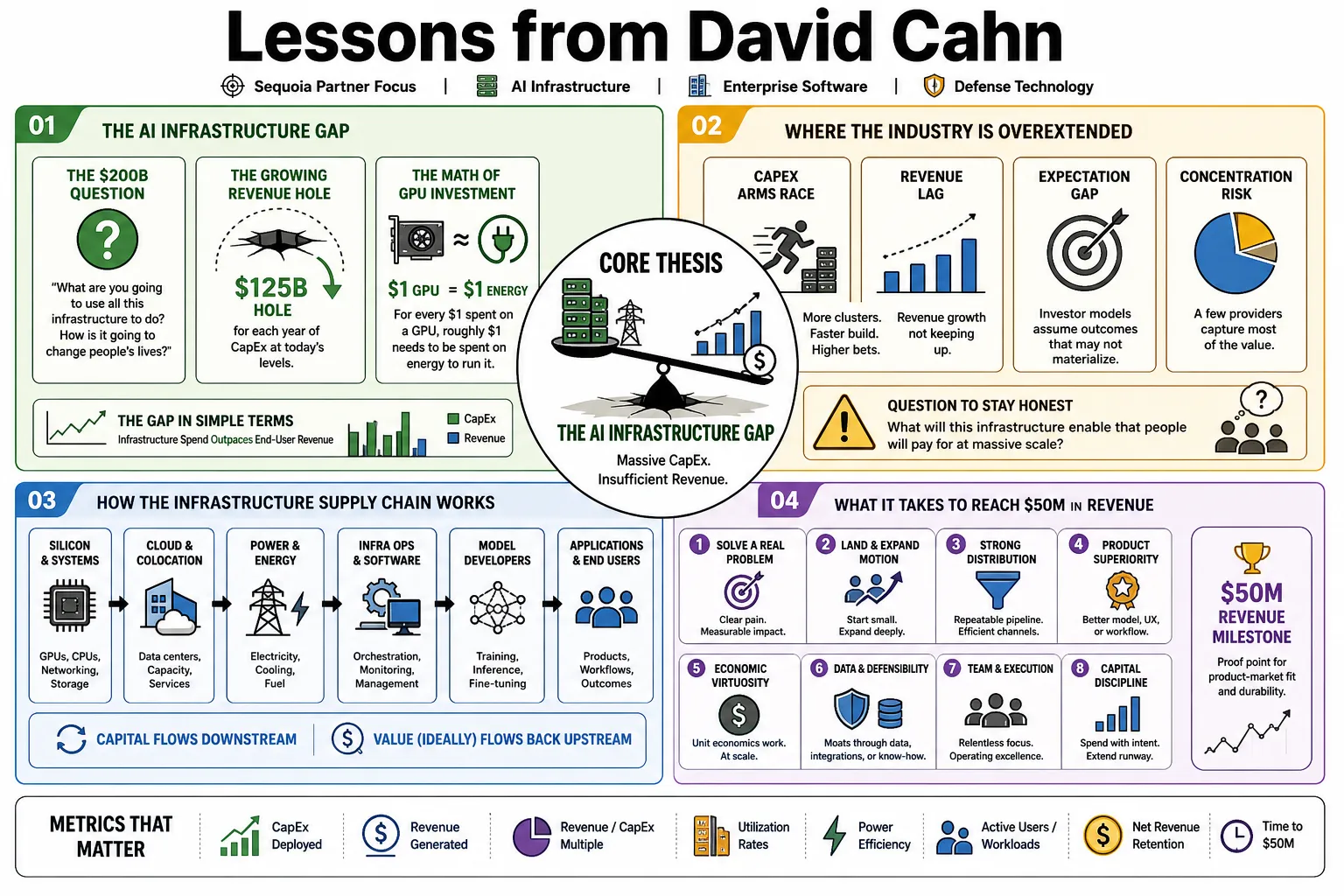
Part 1: The AI Infrastructure Gap
- On the core CapEx question: Cahn asks what all the new AI infrastructure will actually be used for and how it will improve people’s lives; the $200B figure was his illustrative revenue requirement for one year of GPU capital spending. — Sequoia: AI’s $200B Question.
- On the growing revenue hole: Using generous assumptions for incumbent AI revenue, Cahn estimated a $125B-plus annual shortfall between the end-customer revenue needed to justify the 2023 GPU buildout and revenue then visible. — Sequoia: AI’s $200B Question.
- On the math of GPU investment: "For every $1 spent on a GPU, roughly $1 needs to be spent on energy costs to run the GPU in a data center." — Sequoia: AI’s $200B Question
- On end-user margins: "Let's assume they need to earn a 50% margin. This implies that for each year of current GPU CapEx, $200B of lifetime revenue would need to be generated by these GPUs to pay back the upfront capital investment." — Sequoia: AI’s $200B Question
- On the escalating math: In June 2024 Cahn updated his estimate of the lifetime end-customer revenue needed to support a year of AI infrastructure spending from $200B to roughly $600B; this was an illustrative requirement, not realized revenue. — Sequoia: AI’s $600B Question.
- On Nvidia’s run-rate: Cahn estimated an AI revenue requirement by doubling Nvidia’s run-rate data-center sales to approximate the full data-center cost, then doubling again for an assumed 50% end-user gross margin. — Sequoia: AI’s $600B Question.
- On the 2025 CapEx trajectory: In June 2025 Cahn estimated that his earlier $600B revenue-requirement question had become roughly $840B, conditional on Nvidia reaching about $210B in run-rate data-center revenue by year-end. — Sequoia: Why AI Labs Look Like Sports Teams.
- On the timeline for payback: Cahn kept updating the implied lifetime revenue requirement as AI infrastructure spending rose, reaching an illustrative $1.5T for a year of CapEx in July 2026; he also noted that coding AI had made the path to monetization clearer. — AI’s $1.5T Question.
- On the delusion of automatic returns: "We need to make sure not to believe in the delusion... that says that we're all going to get rich quick, because AGI is coming tomorrow, and we all need to stockpile the only valuable resource, which is GPUs." — Sequoia: AI’s $600B Question
- On long-term company building: "Those who remain level-headed through this moment have the chance to build extremely important companies." — Sequoia: AI’s $600B Question
Part 2: Data Centers, Energy, and Compute
- On physical constraints: Building AI is a heavy industrial process constrained by physical reality, requiring steel, concrete, and vast amounts of power. — Sequoia: Steel, Servers and Power
- On the cost of ownership: GPUs represent only about half of the total cost of ownership for AI data centers; the other half goes to energy, buildings, and backup generators. — Sequoia: AI’s $600B Question
- On infrastructure bottlenecks: Cahn argues that AI buildout depends on real estate, power, steel, industrial capacity, and labor, while fast-changing model and GPU requirements can leave physical infrastructure behind. — The Game Theory of AI CapEx.
- On competitive land grabs: "Supply constraints turbocharge this dynamic: If you don't acquire land, power and labor now, someone else will." — The Game Theory of AI CapEx
- On data center delays: Cahn predicted that industrial components and skilled-labor bottlenecks could delay 2026 data-center projects; he presented this as a forecast, not an inevitable outcome. — Sequoia: AI in 2026.
- On the scale of energy required: The trillion-dollar scale of infrastructure and energy investments projected over the coming five years dwarfs the current end revenue from AI. — Sequoia: AI in 2026
- On the transition of compute: Cahn describes frontier AI capacity as a large construction project: land and power are secured, then steel, concrete, industrial systems, and GPUs are assembled over roughly two years. — Sequoia: Steel, Servers and Power.
- On founder grit in infrastructure: In Sequoia's essay on the opening, midgame, and endgame in startups, Cahn points to Crusoe's shift from crypto mining to AI factory building as a story of grit and judgment, supporting the broader lesson that infrastructure founders need to keep adapting as the market changes. — Sequoia: The Opening, Midgame and Endgame
- On the physical pillars of AI: In his 20VC conversation, Cahn framed data-center capacity around servers, steel, and power rather than treating AI scaling as a software-only problem. — 20VC: David Cahn on AI Infrastructure.
Part 3: The AI Supply Chain and Big Tech
- On demand risk: "Here’s the question now being asked all across the AI ecosystem: Is there a way for someone else to take on the demand risk from AI, while I capture the profits?" — Sequoia: The AI Supply Chain Tug of War
- On Big Tech as risk-absorbers: Cahn argues that large cloud companies absorb demand risk for their AI suppliers and customers, helping to sustain the infrastructure buildout. — Sequoia: The AI Supply Chain Tug of War.
- On CapEx escalation: Big Tech takes on maximum demand risk to drive the supply chain toward greater and greater CapEx escalation. — Sequoia: The AI Supply Chain Tug of War
- On risk transfer: "In the supply chain, risks are transferred from suppliers, who need to build CapEx to manufacture products, upstream up to their customers, who pay a margin that compensates for this capital expenditure over time." — Sequoia: The AI Supply Chain Tug of War
- On the current equilibrium: "Today, the tug of war has resulted in a temporary equilibrium. Supply chain players are offloading their demand risk to Big Tech, to the maximum degree possible." — Sequoia: The AI Supply Chain Tug of War
- On Big Tech's motivations: "Big Tech companies—either due to AI optimism or oligopolistic competition—are stepping in to absorb this risk and keep CapEx cranking." — Sequoia: The AI Supply Chain Tug of War
- On the arms race: Cahn describes an AI infrastructure arms race in which Microsoft, Amazon, and Google have incentives to match one another’s spending to defend their cloud positions. — The Game Theory of AI CapEx.
- On playing defense: Established cloud incumbents often accept massive capital expenditures to protect their existing enterprise businesses from disruption. — The Game Theory of AI CapEx
- On the customer's luxury: "At the end of this long and complex chain, there is an application layer AI startup or an Enterprise buyer... What is 'demand risk' to everyone else is 'the luxury of choice' to the customer." — Sequoia: The AI Supply Chain Tug of War
Part 4: Real Revenue vs. Hype
- On actual product usage: "Outside of ChatGPT, how many AI products are consumers really using today?" — Sequoia: AI’s $600B Question
- On consumer spending benchmarks: "Consider how much value you get from Netflix for $15.49/month or Spotify for $11.99. Long term, AI companies will need to deliver significant value for consumers to continue opening their wallets." — Sequoia: AI’s $600B Question
- On vendor switching: Customers have the luxury of choice, which allows them to use AI models on-demand and easily switch between vendors at their discretion. — Sequoia: The AI Supply Chain Tug of War
- On early stage friction: Cahn warned that infrastructure investment alone would not prove AI product value; startups still had to build products customers use, love, and will pay for. — Sequoia: AI’s $200B Question.
- On end revenue constraints: The end revenue from AI applications sits in the tens of billions, which does not match the infrastructure spending required to support it. — Sequoia: AI in 2026
- On evaluating product-market fit: Cahn describes durable growth as a function of market size and product-market fit, alongside the quality of the management team, rather than treating a short burst of usage as sufficient evidence. — After Certainty.
- On open-source coexistence: Cahn identified Meta’s open-source Llama strategy as a distinct route in the model race alongside proprietary approaches; he did not present open source as an inherently necessary outcome. — AI in 2025: Building Blocks Firmly in Place.
- On open-source pricing pressure: Cahn expected dedicated AI-cloud competition and improving chips to put pressure on GPU-compute pricing, which would benefit startups buying compute but challenge infrastructure returns. — Sequoia: AI’s $600B Question.
- On the real impact of AI: Cahn argues that AI may create substantial economic value even if investors overpay for infrastructure during a speculative buildout. — Sequoia: AI’s $600B Question.
Part 5: Startup Growth and Execution
- On the most important growth metric: Cahn noted that some leading AI startups were generating more than $1M in revenue per employee, which he interpreted as evidence of customer pull rather than a push sale. — Sequoia: AI in 2026.
- On discarding old playbooks: In 20VC’s published takeaways from his interview, the old “triple, triple, double, double” growth heuristic is described as outdated for the fastest-scaling AI startups. — 20VC: David Cahn Episode Takeaways.
- On the zero-to-100M club: "If anything, the best startups are growing faster than ever from $0 to $100M in revenue." — Sequoia: AI in 2026
- On future benchmarks: "In 2026, we'll begin to talk about the '$0 to $1B' club." — Sequoia: AI in 2026
- On founder iteration: In the opening-midgame-endgame essay, Cahn argues that the best founders hold multiple phases of the company in mind at once and adjust their strategy when conditions change, which supports a more defensible lesson that iteration is about rapid learning and course correction, not protecting a polished image. — Sequoia: The Opening, Midgame and Endgame
- On transcendent missions: Cahn argues that strong founders serve a larger purpose and test difficult decisions against their long-term vision, sometimes turning down distracting short-term revenue. — What Are You Serving?.
- On shifting skill sets: Cahn's Crusoe example is explicitly about a company reinventing itself from crypto mining into AI factory building, supporting the lesson that founders who can shift capabilities across technology waves are better positioned to survive big market transitions. — Sequoia: The Opening, Midgame and Endgame
- On execution speed: In Cahn’s data-center analysis, day-to-day construction execution can determine who wins a race constrained by land, power, labor, and industrial components. — Sequoia: Steel, Servers and Power.
Part 6: AI vs. Historical Bubbles
- On real value delivery: Cahn identified coding tools and ChatGPT as AI applications with significant revenue while warning that total end-customer revenue remained small beside the infrastructure bill. — Sequoia: AI in 2026.
- On speculative frenzies: Speculative markets often lead to capital incineration, even when the underlying technology ultimately succeeds. — Sequoia: AI’s $600B Question
- On historical parallels: In AI's $600B Question, Cahn explicitly accepts the railroad analogy while warning that speculative infrastructure waves still destroy capital before the long-term utility becomes obvious, which supports a measured comparison between AI buildout and earlier boom-bust technology cycles. — Sequoia: AI’s $600B Question
- On overbuilding: Cahn argues that infrastructure overbuilding can destroy investor capital yet lower the marginal cost of future AI products and spur application development. — Sequoia: AI’s $200B Question.
- On irrational exuberance: Cahn cautions that investors can react to AI uncertainty through fragile, sweeping narratives even while AI adoption and capability move at different speeds. — After Certainty.
- On distinguishing the tech from the trade: Cahn argues that AI can create large long-term value while a speculative GPU buildout still harms investors who overpay or face depreciation. — Sequoia: AI’s $600B Question.
- On the cost of compute: Cahn expected competition and newer chips to reduce GPU-compute prices over time; this helps AI builders but makes older infrastructure less valuable. — Sequoia: AI’s $600B Question.
- On macroeconomic reality: Cahn describes AI data-center construction as an economy-wide investment wave and points to reported GDP effects, while warning that its payoff depends on future adoption. — AI CapEx Now Hinges on Deus ex Machina.
Part 7: Defense, Intelligence, and Hard Tech
- On the shift to hard tech: Deep tech and hard tech attract attention because they tackle complex, capital-intensive physical problems that traditional SaaS avoided. — After Certainty
- On modernizing defense: In Sequoia's Kela partnership essay, Cahn backs a team building a modern defense prime around border protection and intelligence software, which supports the broader lesson that national security modernization increasingly depends on startups with specialized technology and speed. — Sequoia: Partnering with Kela
- On the intelligence age: In the Kela partnership essay, Cahn and his coauthors argue that cyberwarfare, AI, autonomy, and electronic systems are becoming more important in modern defense. — Sequoia: Partnering with Kela.
- On barriers to entry: Cahn notes that deep-tech and hard-tech businesses can require very large capital commitments and face high entry barriers, unlike familiar software-only models. — After Certainty.
- On startup agility in defense: Cahn and his coauthors cite Kela’s first field deployments within seven months as an example of a defense startup moving faster than legacy development timelines. — Sequoia: Partnering with Kela.
- On evaluating hard tech: Cahn contrasts the clearer growth and valuation yardsticks of the SaaS era with today’s varied AI and hard-tech risks; he does not prescribe one replacement metric. — After Certainty.
- On Western alliances: The Kela essay is framed around helping defend the Western world order and exporting advanced defense technology to allies, supporting a more careful lesson that AI and defense leadership are becoming strategic questions for Western alliances, not just procurement choices. — Sequoia: Partnering with Kela
- On capital requirements: Cahn says competing in deep tech and hard tech may require hundreds of millions of dollars, making capital needs materially different from many software startups. — After Certainty.
- On building outside the Valley: The Kela partnership is a specific example of advanced defense technology built by an Israeli team for local and Western military customers; it does not establish a general geographic talent trend. — Sequoia: Partnering with Kela.
Part 8: Predictions and Market Reality
- On the bifurcation of AI: "My prediction for 2026 is that it will be a tale of two AIs. On the one hand, it will be a year of delays... At the same time, AI adoption will continue its relentless rise." — Sequoia: AI in 2026
- On the AGI timeline: Cahn predicted both data-center construction delays and a later AGI horizon in 2026; he did not claim that the former inevitably causes the latter. — Sequoia: AI in 2026.
- On ignoring the hype: "The fading of hype will have little impact on fundamentals." — Sequoia: AI in 2026
- On the lack of a magical fix: "Those expecting a rapid AI takeoff would prefer to see a deus ex machina moment carry us straight to the finish line. I think that dream is likely to disappoint." — Sequoia: AI in 2026
- On the work required ahead: "Instead, the next leg of the AI story will require hard work, creative brilliance, and endurance to reach a new threshold where AI radically transforms the economy." — Sequoia: AI in 2026
- On short-term patience: Cahn expected AI adoption to continue despite enterprise implementation fatigue and argued that the next stage would require sustained work rather than an instant breakthrough. — Sequoia: AI in 2026.
- On evaluating progress: Across his AI capex essays, Cahn keeps returning to the same scoreboard: whether end-customer value and revenue are actually materializing against the infrastructure bill, so the cleanest measure of progress is not model spectacle alone but application-layer revenue and real customer usefulness. — Sequoia: AI’s $200B Question