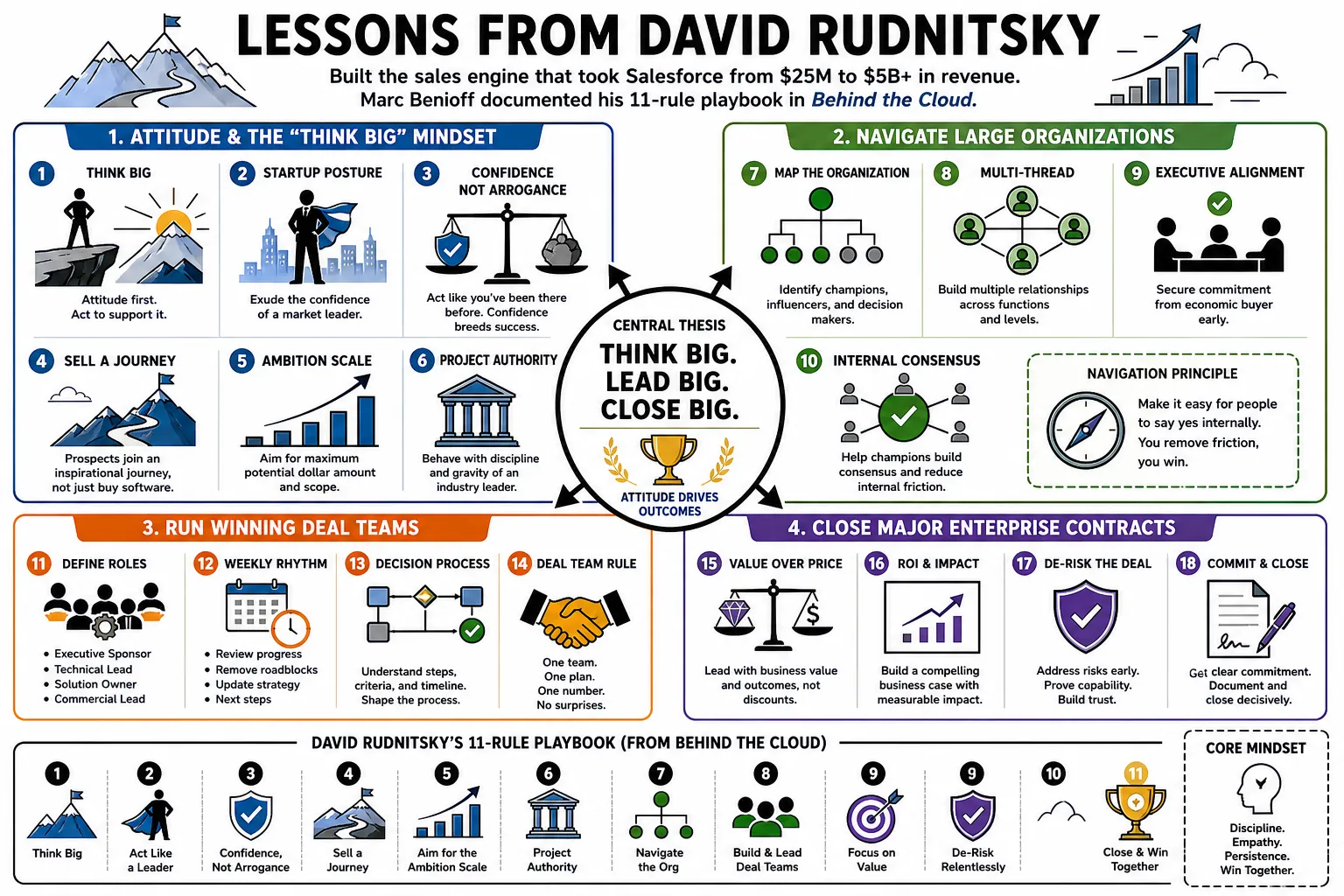
Lessons from David Rudnitsky
David Rudnitsky built the sales engine that took Salesforce from $25 million to over $5 billion in revenue. Marc Benioff later documented his 11-rule playbook in Behind the Cloud. Here is exactly how Rudnitsky navigated large organizations, ran deal teams, and closed major enterprise contracts.
Part 1: Attitude and the "Think Big" Mindset
- On Thinking Big: "Thinking big is an attitude, and it requires deliberate actions to support it. You have to walk into the room like you own it." — Source: [6sense TalkingSense Podcast]
- On Startup Posture: "Even if your company is still small, you must exude the confidence of a market leader." — Source: [Behind the Cloud]
- On Confidence Versus Arrogance: "Act like you’ve been there before. That posture gives you confidence, and confidence breeds success, not arrogance." — Source: [6sense TalkingSense Podcast]
- On Selling a Journey: "Prospects should feel they are joining an inspirational journey, rather than merely purchasing a piece of software." — Source: [Behind the Cloud]
- On Ambition Scale: "Do not focus on the immediate, small opportunity in front of you. Aim for the maximum potential dollar amount and scope." — Source: [InsideSales Interview]
- On Projecting Authority: "A small startup must behave with the discipline and gravity of an established enterprise player." — Source: [Behind the Cloud]
- On Game-Changing Targets: "Focus on deals that fundamentally change the company's entire trajectory, rather than ones that just add incremental revenue." — Source: [InsideSales Interview]
- On the Value of Whales: "Winning one revolutionary account provides more long-term value than dozens of small, safe wins." — Source: [Behind the Cloud]
- On Mindset Shifts: "Shifting from a small business mindset to a large enterprise posture is the first prerequisite for revenue growth." — Source: [Norwest Venture Partners]
- On Internal Belief: "If you do not believe you belong at the table with the biggest companies in the world, the buyer will sense it immediately." — Source: [6sense TalkingSense Podcast]
Part 2: The Architecture of the Deal
- On Securing the Close: "Always take the deal off the table. If it is ready to close, close it immediately." — Source: [Behind the Cloud]
- On Deal Momentum: "Momentum is fragile in enterprise sales. Letting a deal sit over a weekend or a holiday gives the prospect time to second-guess." — Source: [InsideSales Interview]
- On Artificial Deadlines: "Never assume a deal is safe just because a quarter is ending. Close it the moment the conditions are met." — Source: [Behind the Cloud]
- On Administrative Friction: "Be aggressive about getting NDAs, security reviews, and contracts through the prospect's legal departments." — Source: [Behind the Cloud]
- On the Danger of Procurement: "Do not let a deal die in the administrative phase. If you wait for the customer to move the paperwork, the deal will stall." — Source: [InsideSales Interview]
- On Managing Legal Reviews: "Stay ahead of the administrative hurdles. You must manage the legal process yourself rather than waiting on the buyer's timeline." — Source: [Behind the Cloud]
- On Tracking Engagement: "Measure specific KPIs around rep engagement. A deal's health is directly correlated to how deeply the rep is interacting with the account." — Source: [6sense TalkingSense Podcast]
- On Competitive Threats: "Leaving a finalized deal unsigned is an open invitation for a competitor to swoop in at the last minute." — Source: [InsideSales Interview]
- On Urgency: "Deals are like fruit. If they sit on the vine too long, they spoil." — Source: [Behind the Cloud]
Part 3: Preparation and Deep Research
- On the Death of Cold Calling: "Never cold call. Always call with a plan and avoid dialing for dollars." — Source: [InsideSales Interview]
- On Connecting the Dots: "Use your network, mutual contacts, and extensive research to find a warm path to the right decision-maker." — Source: [Behind the Cloud]
- On the Definition of a Warm Call: "An unsolicited call should still feel warm because you have already done your homework on the prospect's exact situation." — Source: [Norwest Venture Partners]
- On Building Instant Credibility: "Knowing specific, obscure details about your prospect's business challenges proves you are a partner, rather than a vendor." — Source: [Behind the Cloud]
- On Researching the Individual: "Do deep research on the individuals you are selling to, including their hobbies, alma mater, or recent achievements." — Source: [InsideSales Interview]
- On Earning the Right to Speak: "You must know the customer's industry and pain points better than they do before you pick up the phone." — Source: [6sense TalkingSense Podcast]
- On Personalized Value: "Using specific, data-driven success stories from their direct competitors builds immediate trust." — Source: [Behind the Cloud]
- On Systemic Preparation: "Enterprise selling is about rigorous discipline and preparation, not individual charisma or charm." — Source: [Norwest Venture Partners]
- On Finding Entry Points: "Always map the organization before reaching out so you know exactly which dots to connect to reach the economic buyer." — Source: [Behind the Cloud]
Part 4: The Team Sport of Enterprise Sales
- On the Lone Wolf: "A selfish salesperson doesn't have a very long shelf life. Sales is a team sport." — Source: [InsideSales Interview]
- On Winning Together: "I am less impressed with someone who closes a two million dollar deal alone than someone who brought the whole team in to close it." — Source: [InsideSales Interview]
- On Cross-Functional Leverage: "Involve colleagues from marketing, engineering, and management to brainstorm and support the complex sales cycle." — Source: [Behind the Cloud]
- On Executive Alignment: "Leverage your own executives to provide the best possible experience and peer-to-peer alignment for the prospect." — Source: [Behind the Cloud]
- On Hoarding Tactics: "Never hoard a successful strategy. When a tactic works, it must be distributed immediately." — Source: [6sense TalkingSense Podcast]
- On Sharing Best Practices: "If a specific email template or discovery question is working, share it with the entire team. A rising tide lifts all boats." — Source: [Behind the Cloud]
- On Replicating Success: "Success should be documented and replicated across the organization, not kept as a secret weapon by one top performer." — Source: [Norwest Venture Partners]
- On Collaborative Deal Reviews: "Bring multiple perspectives into a deal review to identify blind spots the primary rep might be missing." — Source: [InsideSales Interview]
- On Cultural Transparency: "A winning sales culture requires absolute transparency about what is working and what is failing." — Source: [Behind the Cloud]
Part 5: Negotiation and Closing Tactics
- On the Rule of Exchange: "Always get quid pro quo in negotiations. Never give a concession without getting something in return." — Source: [Behind the Cloud]
- On Discounting: "If you give a price discount, mandate a press release, a specific close date, or a commitment to additional users." — Source: [Behind the Cloud]
- On the Confidence to Say No: "Great salespeople have the confidence to walk away or say no if the terms are not mutually beneficial." — Source: [InsideSales Interview]
- On Securing Marketing Assets: "Use the negotiation phase to secure referenceability, speaking engagements, or case studies." — Source: [Norwest Venture Partners]
- On Preserving Value: "Giving away terms without a trade diminishes the perceived value of your product and weakens your negotiating posture." — Source: [6sense TalkingSense Podcast]
- On Establishing Boundaries: "Consider exactly what else you can extract from the deal before you ever say yes to a buyer's demand." — Source: [InsideSales Interview]
- On Trading for Speed: "If a buyer wants a financial concession, trade it for an accelerated timeline that benefits your quarter." — Source: [Behind the Cloud]
- On Mutually Assured Success: "Negotiation is not about caving to demands; it is about structuring an agreement where both sides make meaningful commitments." — Source: [Norwest Venture Partners]
- On Maintaining Leverage: "The moment you give something away for free, you teach the buyer that your initial pricing was merely a suggestion." — Source: [6sense TalkingSense Podcast]
Part 6: Mitigating Risk and Focusing on "Why Not"
- On the Danger of Optimism: "Most salespeople focus entirely on why a deal will close. You must obsess over why it might not." — Source: [Behind the Cloud]
- On Anticipating Deal Killers: "Identifying the reasons a deal might fail early allows you to proactively neutralize risks before they kill the deal." — Source: [InsideSales Interview]
- On Preventing Surprises: "Addressing obstacles at the beginning of the cycle prevents catastrophic surprises at the end of the quarter." — Source: [Behind the Cloud]
- On Uncovering Internal Saboteurs: "Look for the hidden stakeholders who have a vested interest in seeing your deal fail, and address their concerns." — Source: [Norwest Venture Partners]
- On Budget Fragility: "Assume the budget will shift or disappear, and build a business case so strong that the finance department cannot cut it." — Source: [6sense TalkingSense Podcast]
- On Competitive Blind Spots: "Always assume a competitor is quietly working the account. Find out who it is and neutralize their arguments." — Source: [InsideSales Interview]
- On Telling the Truth: "Tell leadership what they need to hear about a vulnerable deal, not what you think they want to hear." — Source: [6sense TalkingSense Podcast]
- On Rigorous Qualification: "A healthy pipeline is built by disqualifying bad deals early, not by carrying doomed deals to the finish line." — Source: [Behind the Cloud]
- On Internal Honesty: "Never sugarcoat the status of a massive enterprise deal. Radical honesty saves time and resources." — Source: [Norwest Venture Partners]
- On Neutralizing Risks: "When you fixate on the 'why nots,' you construct a defense that protects your forecast from late-stage variables." — Source: [InsideSales Interview]
Part 7: The "Face in the Place" (Presence and Relationships)
- On the Limits of Screens: "Despite the rise of digital selling, there is no substitute for getting your face in the place." — Source: [InsideSales Interview]
- On Physical Presence: "Meet customers in person. Being physically present builds a level of trust that cannot be established over an email." — Source: [Behind the Cloud]
- On Walking the Halls: "Walking the halls provides vital institutional knowledge and reveals the reality of the customer's operations." — Source: [Behind the Cloud]
- On Reading the Room: "In-person meetings allow you to pick up on office politics and non-verbal cues that are invisible on a video call." — Source: [6sense TalkingSense Podcast]
- On Building Real Relationships: "Enterprise deals are built on personal trust, which requires shaking hands and looking people in the eye." — Source: [Norwest Venture Partners]
- On the Hybrid Compromise: "Even in a remote world, you must find ways to virtually walk the halls and deeply engage with multiple layers of the company." — Source: [6sense TalkingSense Podcast]
- On Bypassing Gatekeepers: "Physical presence often allows you to bump into secondary decision-makers you would never reach via phone." — Source: [InsideSales Interview]
- On Investing Time: "Traveling to a prospect signals that you value their business enough to disrupt your own schedule." — Source: [Behind the Cloud]
- On Informal Discovery: "The most valuable information is often shared in the hallway after the formal presentation has concluded." — Source: [Norwest Venture Partners]
Part 8: Hiring, Culture, and Standards of Excellence
- On the Baseline of Talent: "Whatever you define as the baseline standard of excellence, never compromise on it." — Source: [6sense TalkingSense Podcast]
- On the Cost of Settling: "The minute you compromise on talent, you start to lose the game right away." — Source: [6sense TalkingSense Podcast]
- On the Illusion of Smart Work: "There is no easy money in what we do. I hate when people say they work smart; you still have to grind." — Source: [InsideSales Interview]
- On Execution Versus Ideas: "The streets are littered with really good ideas. What matters is whether or not a team can actually execute." — Source: [Norwest Venture Partners]
- On the Definition of Execution: "If you build the greatest product in the world but cannot execute on it, you will fail. Executing means selling." — Source: [6sense TalkingSense Podcast]
- On the Value of a Playbook: "A playbook is a framework for a specific point in time; it must adapt to macroeconomic changes and new realities." — Source: [6sense TalkingSense Podcast]
- On Celebrating Wins: "Celebrate your successes as a team, but more importantly, dissect them so everyone can learn from the victory." — Source: [Behind the Cloud]
- On the Role of a Leader: "If you do this long enough, you start to see the patterns of success and failure, and your job becomes giving founders a blueprint." — Source: [Norwest Venture Partners]
- On Continuous Improvement: "The best sales organizations never believe they have figured it all out; they are constantly refining their approach." — Source: [InsideSales Interview]
- On the Ultimate Goal: "Enterprise selling is about transforming the trajectory of both the customer's business and your own." — Source: [Behind the Cloud]