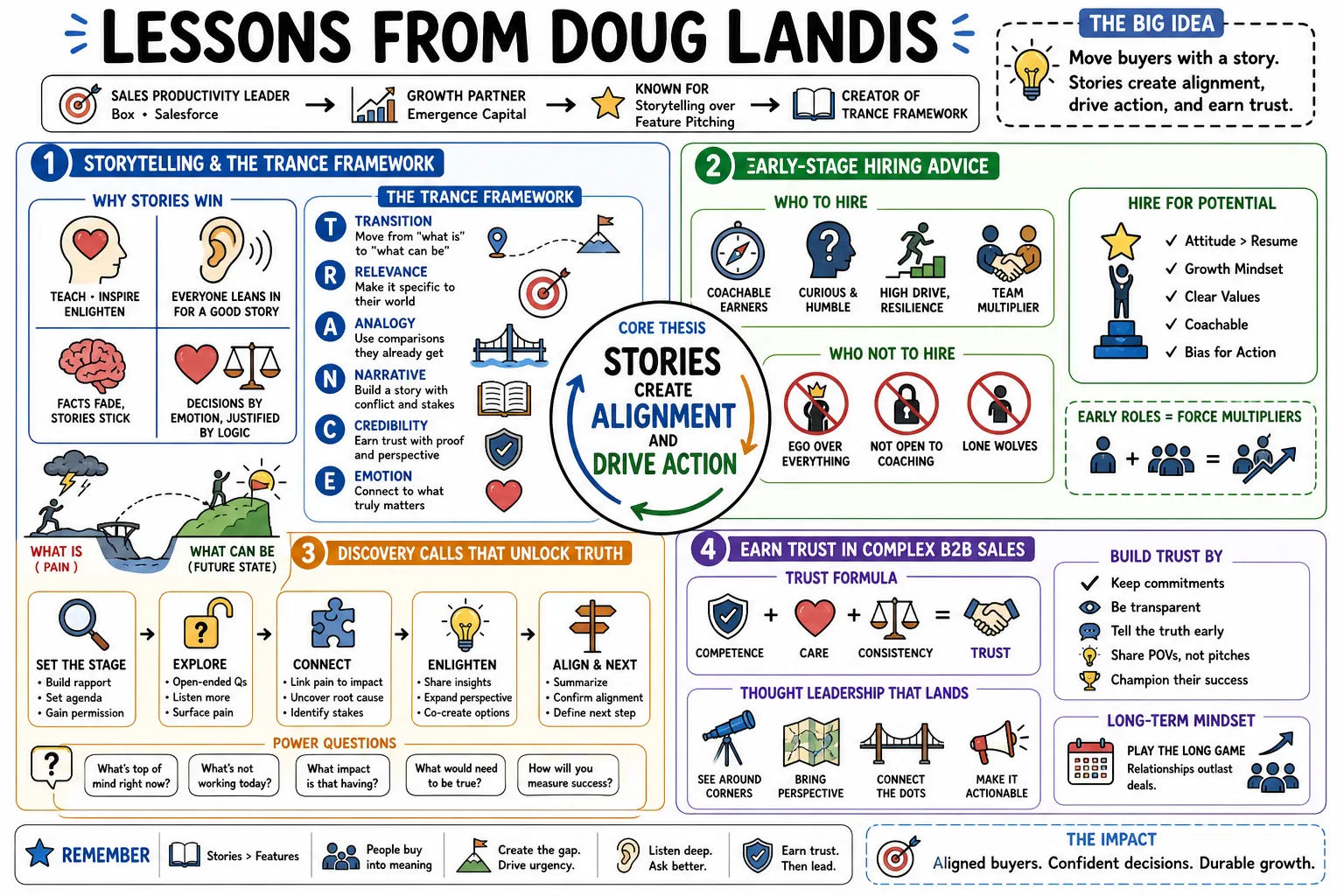
Lessons from Doug Landis
Doug Landis ran sales productivity at Box and Salesforce before joining Emergence Capital as a growth partner. He made his name by pushing reps to drop feature pitches in favor of narrative storytelling, an approach he formalized in his TRANCE framework. This profile breaks down his advice on early-stage hiring, discovery calls, and earning trust in complex B2B sales.
Part 1: Storytelling and the TRANCE Framework
- On the primary function of stories: "Stories teach you, inspire you, and enlighten you. They help us make sense of events that happen and create alignment between different groups." — Source: Medium
- On attention span: "People may stop listening to advice, information, or small talk, but everyone leans in for a good story." — Source: Medium
- On retention: "Facts fade, stories stick. While data is important, people make decisions based on emotion and justify them with logic." — Source: SalesTuners
- On the T in TRANCE: "Take them on a journey by moving the listener from the current pain of 'what is' to the future state of 'what can be', creating a gap that generates urgency." — Source: High Alpha
- On the R in TRANCE: "Relevance means you must craft the story around the customer’s specific point of view, using the Rule of Three for beginning, middle, and end." — Source: Six & Flow
- On the A in TRANCE: "Use analogies and metaphors to make abstract or technical concepts instantly relatable to your audience." — Source: High Alpha
- On the N in TRANCE: "Ensure the narrative is organized and has a clear, singular point, rather than feeling like a disjointed list of bullet points." — Source: High Alpha
- On the C in TRANCE: "Identify a human hero in your story, because companies are not characters; talk about the people, not the logos." — Source: High Alpha
- On the E in TRANCE: "Tap into the audience's emotion to create tension and triumph; people never forget how you make them feel." — Source: HubSpot
- On presentation composition: "65% of your presentation material should come across like a story. If you have a 10-slide deck, 6 out of 10 slides should give you the opportunity to tell a story." — Source: SalesTuners
Part 2: Hypothesis-Led Discovery and The PPO Framework
- On traditional discovery: "Discovery is dead. Asking a prospect 20 questions is selfish because it provides value to the salesperson but none to the buyer." — Source: ClientSuccess
- On leading with insights: "Do the legwork upfront so you can lead with research-led conversations rather than interrogating the buyer." — Source: SaaStr
- On hypothesis selling: "Come to a meeting with a pre-formed hypothesis about the prospect's business challenges based on what you've learned from similar clients." — Source: ClientSuccess
- On earning the right: "You must add value in the first few minutes to earn the right to ask deeper questions." — Source: SalesTuners
- On setting expectations: "Give people permission to say 'no' at any point in the sales process to lower their defensive barriers." — Source: 30 Minutes to President's Club
- On the Purpose in PPO: "Always define the purpose of the call upfront: 'The goal of today’s call is to get a sense of your priorities around X and see if we can support them'." — Source: 30 Minutes to President's Club
- On the Plan in PPO: "Outline how the time will be spent so the buyer feels secure: 'I’d love to share a hypothesis, ask a few questions, and do a 5-minute overview'." — Source: 30 Minutes to President's Club
- On the Outcome in PPO: "Clarify the decision to be made at the end: 'By the end, I’d love to have a frank discussion around whether or not you felt we could be a fit'." — Source: 30 Minutes to President's Club
- On cold calling: "Sell the test drive, not the car. Focus entirely on the value of the meeting itself, not pitching the product." — Source: 30 Minutes to President's Club
- On conversational leveling: "Meet with prospects outside of their office—like at lunch—to lower the formality of your interactions and level with them." — Source: 30 Minutes to President's Club
Part 3: Selling to the C-Suite and The Invisible Evaluation
- On the trust deficit: "When you have 'sales' in your job title, people automatically don't trust you. You start the relationship with a trust deficit." — Source: Six & Flow
- On the invisible evaluation: "Today’s buyers are 80% to 90% through their decision process before they ever speak to a sales representative, conducting invisible evaluations online." — Source: Audible
- On the crisis of sameness: "We're in an era of sameness right now, where AI makes all sellers sound identical; the last true differentiators are trust and empathy." — Source: Audible
- On business implications: "When selling to larger companies, you must move away from product conversations and instead have business implication conversations." — Source: SaaStr
- On the POV mandate: "You must come to every conversation with a point of view about their business and understand their strategic initiatives before you speak." — Source: Qualified
- On executive education: "Selling to a CEO is an educational motion, not a pain-based one. Executives already know their problems; they need someone to rethink what is possible." — Source: SalesTuners
- On the first slide rule: "Your first slide needs to be about what you’ve learned from your customers to establish instant credibility." — Source: Forbes
- On avoiding company voice: "Stop using the 'company voice' of features and benefits, and start using the 'customer voice' by speaking the language of their specific industry." — Source: Art19
- On demonstrating empathy: "Move beyond talking about empathy to actually demonstrating it by understanding the buyer's ontology—their way of being and the pressures they face." — Source: Audible
Part 4: Hiring for the Stage
- On the golden rule of hiring: "You must hire for the stage of the company that you're in, not necessarily the stage of the company that you'd like to become." — Source: Quora
- On the builder profile: "If you're zero to $10 million in revenue, you need to hire a builder who can actually build the process and the foundation from scratch." — Source: Medium
- On the deal manager superpower: "Deal Managers are gunslingers who live in the pipeline, relentless about the details of every deal, and willing to get on the front lines." — Source: Medium
- On the process manager superpower: "Process Managers are the architects who focus on efficiency and systems, turning a chaotic sales environment into a repeatable machine." — Source: Avenue Talent Partners
- On the company manager superpower: "Company Managers are strategists who excel at managing up to the board and across departments with data-driven hypotheses." — Source: Avenue Talent Partners
- On the culture manager superpower: "Culture Managers are evangelists with a knack for galvanizing people, building high-morale teams, and wooing investors." — Source: Avenue Talent Partners
- On big-company scalers: "Avoid hiring a 'scaler' from a big company like Google or Salesforce too early; they are used to having a massive support infrastructure that startups lack." — Source: Entrepreneur
- On startup failure rates: "Startups often fail because they don't hire for success at the right time in their stage of development." — Source: Quora
- On focus: "A lot of early-stage companies get distracted by the shiny penny and lose focus on executing on what they're really, really good at." — Source: Quora
- On the ultimate goal of a VP: "The ultimate goal for a VP of Sales is to make themselves irrelevant by building a team and process that manages the sales cycle without their intervention." — Source: Art19
Part 5: Enablement and Sales Productivity
- On defining productivity: "Sales productivity is the relationship between input—time, effort, calls—and output—revenue, closures, retention." — Source: SlideShare
- On effort vs output: "Productivity is not about being busy; it is about efficiently converting effort into revenue." — Source: SlideShare
- On working smarter: "If two salespeople work the same hours but one closes 3x more revenue, it’s not about working harder; it’s about working smarter, focused, and structured." — Source: SlideShare
- On the role of enablement: "Enablement is not just training; it is the bridge between input and output, helping reps provide value in the final 10% of the buyer's journey." — Source: Audible
- On leadership documentation: "It’s one thing to tell your reps what to do, but it’s another to show them how. You need documentation of what execution actually looks and sounds like." — Source: 30 Minutes to President's Club
- On the CEO mindset: "Sellers must show up as business leaders—the 'CEO of their territory'—rather than just process followers." — Source: Art19
- On sales and marketing alignment: "Sales and marketing must be on the same team, with marketing measured primarily by revenue rather than just top-of-funnel lead volume." — Source: Art19
- On the purpose of presentations: "The goal of a great presentation is to take someone on a journey; without structure, there’s no flow, and everyone is lost." — Source: HubSpot
- On story democratisation: "A company’s story shouldn't just be the founder’s story; it must be a repeatable narrative that every Account Executive can tell." — Source: Art19
Part 6: Customer Success and Trigger Moments
- On the secret weapon: "Customer Success is any company's secret weapon, inextricably linked to the broader revenue cycle." — Source: ClientSuccess
- On trigger moments: "Trigger Moments are the specific points in the customer journey where they transition from exploring a product to not being able to live without it." — Source: ClientSuccess
- On finding triggers: "Reps should look for external or internal triggers—like a new executive hire or a regulatory change—that create a window of opportunity." — Source: ClientSuccess
- On sticky status: "Customer Success teams must identify the specific usage patterns or outcomes that signal a customer has reached sticky, indispensable status." — Source: ClientSuccess
- On the sales to CS handoff: "The hand-off from Sales to Customer Success is often where the narrative breaks, causing friction in the customer experience." — Source: ClientSuccess
- On leveraging CS data: "Sales reps should use what Customer Success has learned from similar clients to form their discovery hypotheses." — Source: ClientSuccess
- On health scores: "A customer health score should be treated as a leading indicator of retention, actively managed and monitored by the CS team." — Source: ClientSuccess
- On time to value: "Time to Value measures how quickly a customer reaches their first Trigger Moment, which is critical for long-term retention." — Source: ClientSuccess
- On storytelling with success: "Use the success stories of existing customers not just as case studies, but to paint a narrative picture of what is possible for the prospect." — Source: ClientSuccess
Part 7: Go-To-Market and The Leaky Bucket
- On the leaky bucket: "If a company's Gross Revenue Retention is dropping, they have a 'leaky bucket' problem that cannot be solved simply by adding more new customers." — Source: ClientSuccess
- On prioritizing retention: "For companies scaling past $10M, Net Dollar Retention is just as important, if not more so, than new logo revenue." — Source: ClientSuccess
- On hiring sequence: "Founders should hire Customer Success before Marketing; you can't afford to waste acquisition investment if customers leave after a terrible experience." — Source: ClientSuccess
- On pattern recognition: "When raising a Series A or B, investors look for pattern recognition in your customer acquisition and retention metrics." — Source: Art19
- On cohort analysis: "You must know your GTM metrics deeply, tracking retention and expansion on a cohort-by-cohort basis." — Source: Art19
- On predicting churn: "Companies must harness the power of Customer Success data to predict and prevent churn before it actually happens." — Source: ClientSuccess
- On sales mix: "Revenue leaders must carefully monitor the sales mix—the healthy balance between net new business and expansion revenue." — Source: Art19
- On fixing the leak: "To fix a leaky bucket, a company must shift its operational focus toward NRR and driving organic expansion." — Source: ClientSuccess
- On the scaling gap: "The skills and processes required to scale a startup from $0 to $10M are fundamentally different from those needed to go from $10M to $100M." — Source: Medium
Part 8: Leadership, Relationships, and Mindset
- On the cheat code to networking: "My personal 'cheat code' is simply giving a shit—being genuinely interested in people and their success without expecting an immediate return." — Source: Doug Landis Linktree
- On making deposits: "Building a network is about making deposits into your reputation by spending time engaging with content and offering unsolicited help." — Source: Doug Landis Linktree
- On personal brand: "Your brand is the sum of every interaction you have; nurturing connections with quick check-ins is vital for long-term career longevity." — Source: Doug Landis Linktree
- On control vs choice: "You cannot always control outcomes or market shifts, but you always have the choice of how you react and show up." — Source: Doug Landis Linktree
- On identity and title: "It is dangerous to tie your identity to your job title; do not say 'I am a salesperson,' but rather view yourself as a professional who experiences sales." — Source: Doug Landis Linktree
- On professional detachment: "Practicing professional detachment allows you to maintain consciousness and perspective even when you miss your quota or face layoffs." — Source: Doug Landis Linktree
- On reading for mindset: "Foundational texts like The Untethered Soul and The Surrender Experiment are crucial for developing a resilient professional mindset." — Source: Doug Landis Linktree
- On people buying from people: "Ultimately, people buy from people they like, and more importantly, people buy from people they trust." — Source: Six & Flow
- On authentic value: "To overcome the inherent skepticism buyers have of salespeople, you must be unconditionally ready to provide value through what you deliver and who you support." — Source: Six & Flow