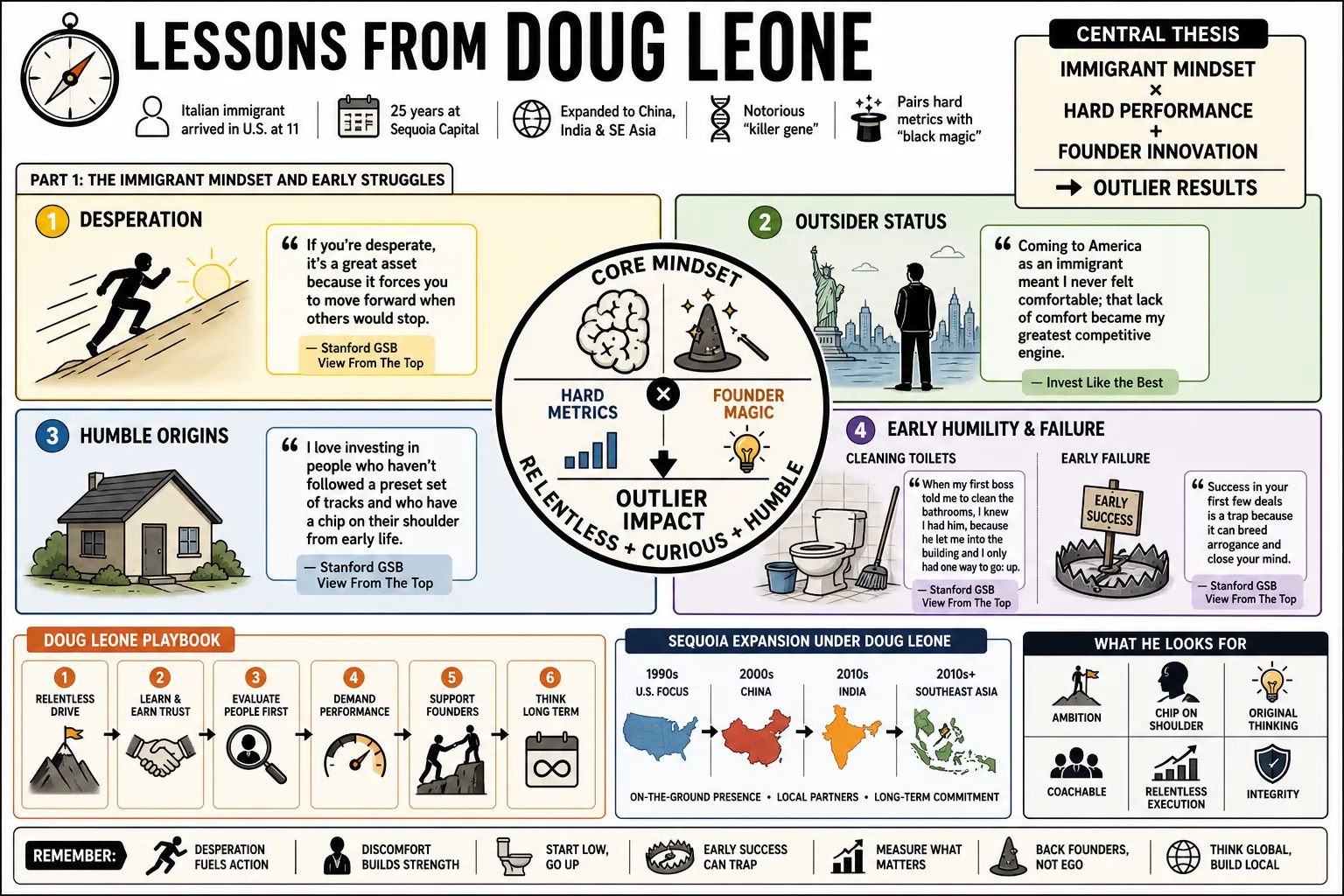
Lessons from Doug Leone
Doug Leone spent 25 years running Sequoia Capital, where he directed the firm’s expansion into China, India, and Southeast Asia. An Italian immigrant who arrived in the U.S. at eleven, Leone is known for a notorious "killer gene" and an approach that pairs hard performance metrics with the "black magic" of founder-led innovation.
Part 1: The Immigrant Mindset and Early Struggles
- On Desperation: "If you’re desperate, it’s a great asset because it forces you to move forward when others would stop." — Source: Stanford GSB View From The Top
- On Outsider Status: "Coming to America as an immigrant meant I never felt comfortable; that lack of comfort became my greatest competitive engine." — Source: Invest Like the Best
- On Humble Origins: "I love investing in people who haven’t followed a preset set of tracks and who have a chip on their shoulder from early life." — Source: Stanford GSB View From The Top
- On Cleaning Toilets: "When my first boss told me to clean the bathrooms, I knew I had him, because he let me into the building and I only had one way to go: up." — Source: Stanford GSB View From The Top
- On Early Failure: "Success in your first few deals is a trap because you start believing you’re a genius and you stop doing the real work." — Source: The Twenty Minute VC
- On Institutional Gatekeeping: "Stanford rejected me twice, and I made sure to mention that when they finally asked me to come speak there as a success." — Source: Stanford GSB View From The Top
- On the "Bathroom Test": "You can tell a lot about a person's character by how they treat people who can do absolutely nothing for them." — Source: Invest Like the Best
- On Hunger: "I want to hire people who are so hungry they are willing to crawl through broken glass to win." — Source: Acquired Podcast
- On Economic Scarcity: "Growth is easy when money is free; true character is revealed when you have to fight for every dollar of revenue." — Source: Slush 2022
Part 2: The "Killer Gene": Identifying Outlier Founders
- On "Insufferable" Founders: "If a founder is described as insufferable or maniacal, they might just have the drive needed to disrupt an entire industry." — Source: Invest Like the Best
- On the Killer Gene: "We look for people who are killers—not to make money, but killers to get the job done." — Source: Sequoia Capital
- On Spiky Individuals: "Avoid the well-rounded person; look for spiky, non-linear people who are exceptional in one dimension even if they are injured in others." — Source: Stanford GSB View From The Top
- On Listening: "Many of our most successful founders were described as 'bad listeners' early on; they weren't deaf, they just had a different frequency." — Source: Acquired Podcast
- On Personal Pain Points: "The best founders are usually solving a problem they personally experienced, like Jan Koum needing private messaging for WhatsApp." — Source: Stanford GSB View From The Top
- On Founder Soul: "You lose the founder, you lose the soul of the company; we will fight to keep the founder in place as long as humanly possible." — Source: Invest Like the Best
- On Reality Bias: "A winning founder is someone who can look at a disaster and see it with brutal honesty while still believing they can fix it." — Source: The Twenty Minute VC
- On Courage: "Courage isn't the absence of fear; it's the willingness to make a decision when every data point is screaming at you to stop." — Source: Slush 2022
- On Selfishness: "Be ruthlessly selfish with your equity in the early days; don't give it away to people who aren't helping you take the hill." — Source: Stanford GSB View From The Top
Part 3: The Merchandising Cycle and Business Physics
- On the Laws of Physics: "Business strategies change, but the laws of physics—like the relationship between mass and acceleration—are immutable." — Source: Sequoia Capital
- On Newton's First Law (Inertia): "A company at rest stays at rest; a CEO’s job is to be the external force that breaks organizational inertia." — Source: Sequoia Entrepreneur Summit
- On Mass and Acceleration (F=MA): "To move fast, you must keep your headcount low; the more mass you add, the harder it is to accelerate." — Source: Sequoia Entrepreneur Summit
- On the Merchandising Cycle: "Revenue is the end of a chain; if it stalls, the problem is almost always upstream in product marketing or demand gen." — Source: Invest Like the Best
- On Product Marketing: "Positioning is broken if a mere mortal can't understand what your product does in one sentence." — Source: Invest Like the Best
- On Debugging Upstream: "Always look one step higher in the merchandising cycle than where the symptom appears." — Source: Sequoia Capital
- On Pressure and Volume: "If you increase growth pressure without the right unit economics, the entire company will pop." — Source: Sequoia Entrepreneur Summit
- On Entropy: "As a company grows, disorder naturally increases; don't try to control the chaos, try to guide it through culture." — Source: Sequoia Capital
- On the Ideal Gas Law: "Adding heat to a startup requires expanding your market volume carefully to maintain stable pressure." — Source: Sequoia Entrepreneur Summit
- On Leverage: "A startup doesn't need to be bigger than an incumbent; it just needs a longer lever, which usually means better technology." — Source: Sequoia Capital
Part 4: The Sequoia Culture: Building a High-Performance Team
- On Team vs. Family: "Sequoia is a team, not a family; we provide support, but performance is the requirement for being on the roster." — Source: The Twenty Minute VC
- On Winning and Culture: "Execution eats strategy for breakfast, and nothing builds a great culture like the momentum of winning." — Source: Slush 2022
- On Sharing the Dough: "We keep our partners hungry by sharing the carry and fees broadly rather than hoarding them at the top." — Source: Acquired Podcast
- On Stewardship: "The goal of a partner is to leave the firm in better shape for the next generation than when they found it." — Source: Invest Like the Best
- On the Lockstep Partnership: "Operating with total equality at the top prevents the internal politics that destroy venture firms." — Source: Acquired Podcast
- On Paranoia: "Success is the worst teacher; you have to remain slightly paranoid to stay at the top of a competitive market." — Source: Stanford GSB View From The Top
- On Performance Reviews: "Be brutally honest in private so you can be a united front in public." — Source: Invest Like the Best
- On Internal Competition: "We compete with the world, not with each other; if you're looking over your shoulder at your partner, you're losing." — Source: Acquired Podcast
- On Duty: "There is an unwavering sense of duty to the brand that supersedes any individual ego in our partnership." — Source: The Twenty Minute VC
Part 5: Leadership and the Art of "Mere Mortal Stuff"
- On Black Magic: "Founders do the black magic—the initial spark of creation; VCs only help with mere mortal stuff like scaling and hiring." — Source: Invest Like the Best
- On the "We" Pronoun: "If you want to lead, stop saying 'I' and start saying 'we'; take responsibility for failure and share success." — Source: Stanford GSB View From The Top
- On the Inception Method: "If a founder has a weak executive, don't tell them; introduce them to the three best people in the world so they see the gap themselves." — Source: Acquired Podcast
- On Vision vs. Management: "Without a vision, you are just a manager; without execution, you are just a visionary." — Source: Slush 2022
- On the A+ Engineer: "One A+ engineer will recruit other A players; hire a B player early and your company's talent density is done." — Source: Slush 2022
- On Empathy: "I was surprised late in my career to find that colleagues valued my empathy more than my ability to solve math problems." — Source: The Twenty Minute VC
- On Aligning Interests: "The most important human law is alignment; if interests are misaligned, the physics of the company will fail." — Source: Sequoia Capital
- On Decision Types: "Distinguish between irreversible Type 1 decisions and reversible Type 2 decisions; don't let a Type 2 decision slow you down." — Source: Sequoia Entrepreneur Summit
- On Following the Money: "Most business problems reveal themselves as money conversations; understand the financial motivations of every stakeholder." — Source: Sequoia Capital
- On Being Smart, Not Greedy: "The leadership team will notice if you are looking out for the collective good or just your own carry." — Source: Invest Like the Best
Part 6: Investing Frameworks and the "Abyss"
- On the Abyss: "Every great investor goes through an abyss where they realize they aren't as smart as they thought; that's when you really learn." — Source: The Twenty Minute VC
- On Investment Memos: "A great memo focuses on the one or two strongest reasons why a company will win, not twenty mediocre ones." — Source: Invest Like the Best
- On Private Equity vs. Venture: "If you stop taking risks on early, unproven ideas, you aren't a venture capitalist; you’re a private equity firm." — Source: The Twenty Minute VC
- On Price Sensitivity: "Discipline is important, but for the outlier winners, you must be willing to pay up because the power law returns everything." — Source: The Twenty Minute VC
- On Market Tops: "The more you hear the words 'billion-dollar market cap' in coffee shops, the closer you are to the top of a cycle." — Source: Stanford GSB View From The Top
- On Company Building: "Venture is about building a machine, not just allocating capital; you can't build a machine if you're doing five deals a week." — Source: The Twenty Minute VC
- On the "Seed" Mindset: "Sequoia’s most strategic move is always being the first $100,000 in; that’s where the real partnerships are forged." — Source: Acquired Podcast
- On Data Over Emotion: "I will always change my mind based on new data, but never based on emotions." — Source: Sequoia Blog
- On Fail-Fast Philosophy: "Failing fast is painful to the ego, but failing slowly is fatal to the fund." — Source: Sequoia Blog
Part 7: Go-To-Market Strategy and Removing "Rocks"
- On Rocks in the River: "A company's growth is like water; a CEO's job is not to push the water, but to remove the rocks blocking the path." — Source: Invest Like the Best
- On Product Drag: "Avoid products that require six months of onboarding; implementation should never be the bottleneck for growth." — Source: Slush 2022
- On the VP of Sales: "Founders fire the VP of Sales too early; 90% of the time, the problem is positioning or a lack of demand gen leads." — Source: Invest Like the Best
- On Stealth: "Little companies only have speed and stealth; stay away from the cocktail circuit and stay in the lab." — Source: Invest Like the Best
- On Sales Efficiency: "Even a terrible salesperson can sell a product with perfect product-market fit." — Source: Invest Like the Best
- On Market Winners: "Markets don't split evenly; winners take 70% and leave the scraps for everyone else." — Source: Stanford GSB View From The Top
- On Unit Economics: "Run as fast as possible until you hit the imprudence curve—the point where you start violating the physics of business." — Source: Invest Like the Best
- On Product First: "In a crisis, prioritize the core product accelerator; tough times are when you build a superior offering for the recovery." — Source: Slush 2022
- On Demand Gen: "If the sales team isn't hitting numbers, the first question is whether marketing is giving them enough leads to fail." — Source: Invest Like the Best
- On Self-Service: "Move toward configurability and self-service to shorten sales cycles and reduce the support burden." — Source: Acquired Podcast
Part 8: The Long Game: Legacy, Family, and Growth
- On Career Longevity: "I want my epitaph to say: 'He died a young man,' meaning I stayed curious and open to new ideas until the end." — Source: Sequoia Blog
- On Life Priorities: "Invest in your family and kids first; when you have thirty minutes to live, you won't be wishing you became EVP." — Source: Stanford GSB View From The Top
- On a Work in Progress: "The moment you think you have all the answers and have made it, you are equivalent to being dead." — Source: The Twenty Minute VC
- On Insecurity: "My insecurity—wanting to prove myself to the world—was a weakness that also served as my most powerful engine." — Source: The Twenty Minute VC
- On Dreaming Big: "My biggest mistake was not dreaming big enough with founders in their earliest days." — Source: Sequoia Capital
- On Taking Risks: "Always take risks; if something is working like a dream, find a way to break it and improve it." — Source: Stanford GSB View From The Top
- On Misery: "You learn most in misery; successful periods are when you get lazy and stop checking the fundamentals." — Source: Sequoia Blog
- On the 3-5 Year Horizon: "When making a hard choice, ask what the company could be in 3 to 5 years, not what it's worth today." — Source: Slush 2022
- On Success: "To be brutally honest with yourself is the first step toward professional excellence." — Source: Sequoia Blog