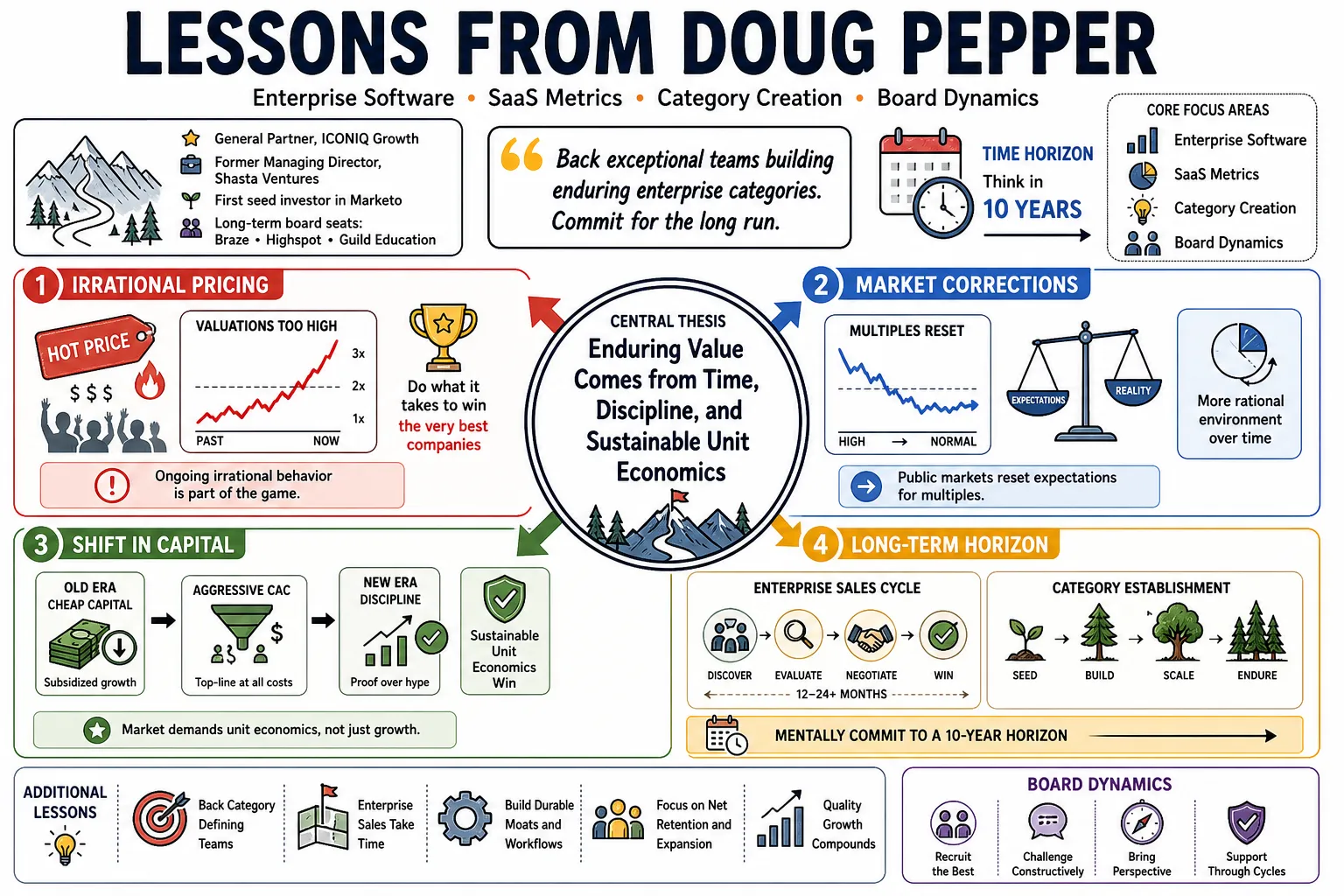
Lessons from Doug Pepper
Doug Pepper is a general partner at ICONIQ Growth and a former managing director at Shasta Ventures. He has invested in enterprise software from early-stage Marketo through growth-stage companies and has spoken about SaaS growth, founder partnerships and category creation. — The Full Ratchet #353.
Part 1: The SaaS Market and Valuations
- Expect Exceptional Deals to Stay Competitive: In October 2022, Pepper expected some investors to keep paying unusually high prices for exceptional companies even while average private valuations reset. — The Full Ratchet #353.
- Let the Public Reset Reach Private Markets: Pepper argued in 2022 that private software valuations would gradually adjust after the public-market decline, with long startup cash runways delaying some transactions. — The Full Ratchet #353.
- Rebalance Growth and Spending: Pepper said the easy funding of 2020–21 let some SaaS firms tolerate high cash burn, whereas the 2022 market again required growth accompanied by efficiency. — The Full Ratchet #353.
- Allow More Time Than the Plan Suggests: Pepper said Marketo’s 2006 revenue projections proved far too optimistic by 2010, yet the team continued building and eventually achieved much greater scale. — SaaStr — Marketo Category-Leader Talk.
- Compare Private Prices With Public Multiples: Pepper said in 2022 that some well-funded private companies still sought prices that had not caught up with comparable public-software valuation declines. — The Full Ratchet #353.
- Recognize the Burden of a High Valuation: Pepper wrote that a repeat founder may raise more money at a high valuation, but later financings still depend on achieving business milestones rather than founder reputation. — Doug Pepper — It’s Better the Second Time Around.
- Use Retention to Assess SaaS Quality: Pepper connected strong customer retention and expansion to efficient growth because additional dollars from existing customers generally cost less to acquire. — The Full Ratchet #353.
- Do Not Let a Past Round Set Today’s Price: Pepper observed that large 2021 cash raises let some companies avoid new financings while they tried to grow into earlier valuations; those needing capital faced a different market. — The Full Ratchet #353.
- Separate Must-Have from Nice-to-Have Software: The 2023 ICONIQ efficiency session observed that many studied companies were cutting software spend, especially tools they regarded as nice-to-have rather than essential. — SaaStr — Building Resilience Through Efficient Scaling.
- Distinguish Dry Powder from Deal Terms: Pepper acknowledged substantial undeployed venture capital in 2022, but expected investors to demand stronger evidence of efficient growth rather than automatically restoring 2021 prices. — The Full Ratchet #353.
Part 2: Growth vs. Efficiency
- Return to More Efficient Growth: Pepper said successful SaaS companies still needed growth after the 2022 reset, but many also had to relearn how to grow while burning less cash. — The Full Ratchet #353.
- Compare Revenue and Expense per Employee: In their 2023 SaaS benchmark presentation, Pepper and Christine Edmonds discussed rising ARR per employee while annual operating expense per employee remained relatively steady among the studied companies. — SaaStr — ICONIQ Growth and Efficiency Study.
- Use Growth and Cash Flow Together: Pepper explained the Rule of 40 as revenue growth plus free-cash-flow margin and said the public companies he admired often reached a higher combined level. — The Full Ratchet #353.
- Measure Burn Against New ARR: Pepper used burn multiple—cash burn relative to net new ARR—to show how some 2020–21 SaaS companies had become less capital-efficient than earlier successful cohorts. — The Full Ratchet #353.
- Do Not Assume Headcount Guarantees Output: The 2023 ICONIQ GTM session described how rapidly doubling sales, marketing and customer-success teams could coincide with lower quota attainment and longer ramp time, making leadership and enablement important. — SaaStr — Scaling GTM Through IPO.
- Include Gross Margin in Valuation Analysis: The ICONIQ GTM session named gross margin, alongside growth, retention and profitability, among the drivers investors examine when valuing public SaaS companies. — SaaStr — Scaling GTM Through IPO.
- Adjust the Sales Plan as Productivity Changes: The ICONIQ GTM session notes that growing sales teams can face lower quota attainment and longer ramp time; leaders need management, enablement and segmented processes as complexity grows. — SaaStr — Scaling GTM Through IPO.
- Build an Inbound Engine as GTM Scales: The ICONIQ GTM session recommended investing in an inbound engine and more sophisticated marketing as a SaaS company moves into later growth stages. — SaaStr — Scaling GTM Through IPO.
- Show a Path Toward Efficient Growth: Pepper said in 2022 that growth remained central, but investors increasingly wanted companies to show a credible path toward efficient growth as they approached the growth stage. — The Full Ratchet #353.
Part 3: Founder Traits and Relationships
- Look for Product-Oriented Founders: Pepper wrote that the teams attracting him were mission-driven, product-focused builders with breakthrough products and unusually happy customers. — Doug Pepper — Joining ICONIQ.
- Build Venture Partnerships on Trust: Pepper wrote that trusted relationships—with founders, their teams and investment partners—were fundamental to how he chose to work. — Doug Pepper — Joining ICONIQ.
- Value Relationships Beyond the Exit: In a coauthored reflection on Braze, Pepper and ICONIQ colleagues said the work with its founders and executives became a lasting partnership and friendship, not only a financial investment. — ICONIQ Growth — Braze Journey.
- Expect a Longer SaaS Journey: Pepper used Marketo to show that a software company can take much longer than its original revenue plan to mature while founders keep making difficult product and fundraising decisions. — SaaStr — Marketo Category-Leader Talk.
- Value Experienced Teams That Have Worked Together: Pepper cited Marketo’s founders’ prior shared experience and product insight as factors that reduced team risk in his initial investment decision. — SaaStr — Marketo Category-Leader Talk.
- Pair Ambition with Hard Decisions: Pepper described Marketo’s founders persisting through fundraising rejection, then abandoning an early product despite having paying customers to pursue their fuller vision. — SaaStr — Marketo Category-Leader Talk.
- Keep Founders Close to Early Sales: The ICONIQ GTM session described founder-led selling as valuable in the earliest stage because it lets founders hear buyers and refine the product before they add specialized sales leadership. — SaaStr — Scaling GTM Through IPO.
- Replan for the Demand Environment: Pepper explained in 2022 that ICONIQ companies were revising both revenue expectations and spending after pandemic-era demand slowed, with responses varying by company. — The Full Ratchet #353.
Part 4: Category Creation and Positioning
- Prepare Marketing for the IPO Story: The ICONIQ GTM session argued that a pre-IPO CMO must combine demand generation with storytelling that explains the company and its market to public investors. — SaaStr — Scaling GTM Through IPO.
- Find a Real Why-Now Market: Pepper said an attractive new SaaS category emerges when a newly urgent customer problem meets technology capable of solving it; Marketo’s marketing automation fit that pattern. — SaaStr — Marketo Category-Leader Talk.
- Study Marketo’s Marketing Role: Pepper said Marketo’s founders interviewed roughly 75 CMOs and recognized that digital channels and SaaS made marketing automation timely for buyers without capital-expenditure budgets. — SaaStr — Marketo Category-Leader Talk.
- Start Positioning with Buyer Need and Technology: Pepper’s Highspot investment essay frames a strong software market as one where a critical buyer problem meets newly capable technology; the company’s sales-content tool addressed that specific gap. — Doug Pepper — Highspot Investment Thesis.
- Prepare a Public-Market Story: The ICONIQ GTM session argued that a pre-IPO marketing leader needs to explain the company’s brand and market opportunity while building more predictable revenue generation. — SaaStr — Scaling GTM Through IPO.
- Competition Can Validate a Category: Pepper said he sometimes worries when a promising category has no serious competitors, because multiple strong founding teams often recognize a genuine why-now opportunity at once. — SaaStr — Marketo Category-Leader Talk.
- Innovate in How You Sell: Pepper credited Marketo’s high-velocity sales motion, thought leadership and content marketing alongside product innovation in competing with larger rivals. — SaaStr — Marketo Category-Leader Talk.
- Look for Customer-Loved Products: Pepper said customer diligence calls, adoption and ease of use were important to his Highspot investment thesis, alongside category timing and the team. — Doug Pepper — Highspot Investment Thesis.
Part 5: Go-to-Market and Sales Scaling
- Change the GTM Motion as You Scale: The ICONIQ GTM session described a transition from founder-led selling to specialized sales leadership and segmentation as ARR and organizational complexity grow. — SaaStr — Scaling GTM Through IPO.
- Hire Leaders for the Next Stage: The ICONIQ GTM session cautioned that a first head of sales may not be the person who takes a company through IPO; later stages often require different leadership and systems. — SaaStr — Scaling GTM Through IPO.
- Use Contract Terms to Protect Retention: The 2023 ICONIQ efficiency session discussed adjusting pricing and contract terms, including temporary concessions and multiyear incentives, to reduce churn during a tougher market. — SaaStr — Building Resilience Through Efficient Scaling.
- Account for Competition in Sales Efficiency: Pepper said Marketo’s crowded marketing-automation market lengthened sales cycles, reduced pricing and margins, and forced more fundraising than the company had hoped. — SaaStr — Marketo Category-Leader Talk.
- Align Sales Incentives with Desired Customers: The 2023 ICONIQ efficiency session discussed using AE and SDR compensation to steer sellers toward longer contracts and higher-quality customer segments. — SaaStr — Building Resilience Through Efficient Scaling.
- Expansion Supports Efficient Growth: Pepper said in 2022 that businesses with strong retention, upsells and expansion could grow more efficiently because revenue from existing customers costs less than winning new logos. — The Full Ratchet #353.
- Time International Expansion: The 2023 ICONIQ GTM session advised companies to evaluate customer use cases, references and local partners before expanding internationally, treating expansion as a strategic decision. — SaaStr — Scaling GTM Through IPO.
Part 6: Board Dynamics and Long-Term Partnership
- Keep Access to Exceptional Companies: Pepper wrote that missing an early investment in a world-class company could be less costly than failing to partner with it at any stage; ICONIQ broadened that opportunity for him. — Doug Pepper — Joining ICONIQ.
- Use the Network to Help Recruiting: Pepper wrote that ICONIQ’s platform connected portfolio companies with prospective executives and advisors, and in a 2022 interview described a team dedicated to making those introductions. — Doug Pepper — Joining ICONIQ.
- Public Listing Does Not End the Work: Pepper recalled that Marketo’s post-IPO stock price fell below its offer price before its acquisition, illustrating that operational and market challenges continue after going public. — SaaStr — Marketo Category-Leader Talk.
- Expect Nonlinear Company Journeys: Pepper and ICONIQ coauthors described Braze’s path as marked by uncertainty and shared challenges that strengthened long-term partnerships. — ICONIQ Growth — Braze Journey.
Part 7: Product and Customer Success
- Do Not Confuse Early Traction With the Full Product: Pepper recounted that Marketo won around 100 customers with a narrow early product, then shut it down to build the fuller marketing-automation vision. — SaaStr — Marketo Category-Leader Talk.
- Keep the Product Grounded in Customers: Pepper said Marketo competed hard in sales but kept its product roadmap grounded in customer needs and its own vision rather than copying rival demonstrations. — SaaStr — Marketo Category-Leader Talk.
- Prioritize Everyday Usability: Pepper cited Highspot’s intuitive design and strong salesperson adoption as important evidence of customer love in his investment diligence. — Doug Pepper — Highspot Investment Thesis.
- Protect the Core Product Vision: Pepper described Marketo’s decision to abandon an initial limited product and fund a fuller version aligned with the founders’ intended marketing-automation vision. — SaaStr — Marketo Category-Leader Talk.
- Treat Retention as a Growth Input: Pepper said the most efficient SaaS companies often combine continued new-logo acquisition with high retention and expansion from existing customers. — The Full Ratchet #353.
- Expand With Existing Customers: The ICONIQ GTM session describes customer success and support as part of retaining, upselling and cross-selling more complex enterprise accounts. — SaaStr — Scaling GTM Through IPO.
- Watch Early Customer Adoption: In his Highspot investment thesis, Pepper cited customer calls reporting rapid sales-team adoption and a product used daily as evidence of usefulness. — Doug Pepper — Highspot Investment Thesis.
- Earn the Right to Expand: In their Braze reflection, Pepper and colleagues said the company first solved a narrow mobile-notification use case, then added channels as customers asked it to extend the product. — ICONIQ Growth — Braze Journey.
- Broaden the Product Suite Deliberately: The ICONIQ GTM session described product-suite expansion and cross-selling as ways later-stage SaaS companies diversify revenue before IPO. — SaaStr — Scaling GTM Through IPO.
Part 8: The Venture Capital Business
- Follow Trusted Relationships: Pepper wrote that long-standing personal and professional relationships with ICONIQ partners were central to his 2019 decision to join the firm. — Doug Pepper — Joining ICONIQ.
- Bring More Than Capital: Pepper described ICONIQ’s network, commercial introductions, recruiting help and trusted partner relationships as ways its investing platform supported founders. — Doug Pepper — Joining ICONIQ.
- Stay Open Across Stages: Pepper wrote that ICONIQ gave him a chance to work with breakthrough companies even when he had missed the opportunity to invest early. — Doug Pepper — Joining ICONIQ.
- Use Benchmarks in Context: Pepper and Christine Edmonds presented ARR growth, per-employee costs, burn multiple and retention benchmarks as ways to assess SaaS growth and efficiency across stages. — SaaStr — ICONIQ Growth and Efficiency Study.
- Look for Opportunities After a Reset: Pepper said in 2022 that he wished he had invested more during the 2009 and March 2020 downturns and was examining opportunities after public software valuations fell. — The Full Ratchet #353.
- See Co-Investors as Partners: Pepper wrote that he first came to know ICONIQ through joint investments in his earlier portfolio companies and valued the firm’s ability to support them with a broader network. — Doug Pepper — Joining ICONIQ.
- Treat Investing as an Apprenticeship: Pepper described venture investing as a business learned through mentors, direct practice and patience rather than instant expertise. — The Full Ratchet #353.