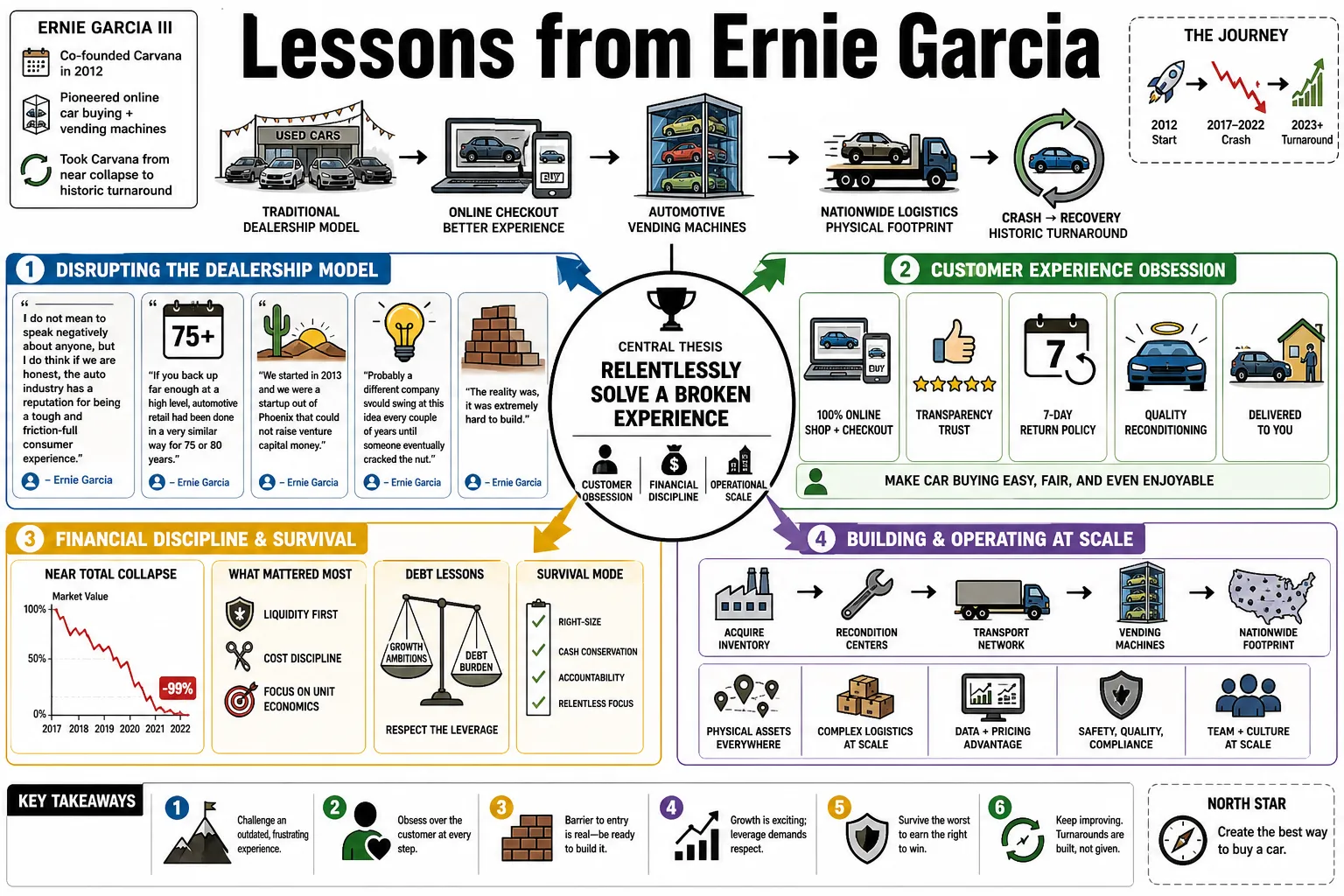
Lessons from Ernie Garcia
Ernie Garcia III co-founded Carvana to sell used vehicles online through a nationally integrated operation. The company later shifted from rapid growth toward efficiency and positive unit economics after its 2022 downturn. — Carvana 2023 Annual Report.
Part 1: Disrupting the Dealership Model
- On the traditional model: Garcia described traditional automotive retail as a difficult, friction-filled customer experience that Carvana set out to simplify. — Car Dealership Guy Interview.
- On industry stagnation: He noted that automotive retail had remained broadly similar for roughly 75 to 80 years even as technology and consumer preferences changed. — Car Dealership Guy Interview.
- On early skepticism: Garcia said Carvana's Phoenix location and capital-intensive model made private fundraising difficult during its early years. — Car and Driver Interview.
- On execution over ideas: He argued that the online used-car idea was not enough by itself; a company had to execute well enough to make consumers recommend it. — Car and Driver Interview.
- On the barrier to entry: Carvana's early test was whether customers would find the experience good enough to tell friends, not merely whether a website could list vehicles. — Car and Driver Interview.
- On breaking consumer habits: Garcia's core premise was that customers need not be physically next to a used car to buy it, which made a different national supply chain possible. — Founder's Field Guide Interview.
- On the value of selection: Pooling inventory nationally lets a buyer search beyond the limited stock of a local dealership. — Carvana 2023 Annual Report.
- On price transparency: Carvana's online process publishes vehicle prices and financing options before delivery, limiting the need for an in-person negotiation. — Carvana 2023 Annual Report.
- On the vending machines: Garcia described vending machines as both pickup/fulfillment sites and visible marketing for Carvana. — Entrepreneur Interview.
- On entrenched competitors: Garcia identified traditional dealerships' real-estate, staffing and advertising costs as part of the opportunity for a different retail model. — ASU Garcia Talk.
Part 2: Building for the Consumer
- On the core product: Garcia said the customer experience, rather than the vehicle alone, was at the root of Carvana's approach. — ASU Garcia Talk.
- On removing friction: Garcia described removing a confusing price-transparency graph when it made the buying experience harder rather than simpler. — Car Dealership Guy Interview.
- On return policies: Carvana offers a seven-day return policy and says the chance to live with a car after delivery helps customers buy without a conventional pre-purchase test drive. — Carvana 2023 Annual Report.
- On simple interfaces: Carvana combines vehicle search, financing, ancillary products, documentation and delivery in one online transaction despite the operational complexity behind it. — Carvana 2023 Annual Report.
- On word of mouth: Garcia argued that a strong customer experience could spread through customers' social networks far beyond ordinary word of mouth. — ASU Garcia Talk.
- On financing visibility: Carvana's financing tools display preapproved combinations of down payment, monthly payment and term; the preliminary checks are soft inquiries unless the customer completes a financed purchase. — Carvana 2023 Annual Report.
- On emotional purchases: Garcia saw an opening to improve a buying process many customers disliked by making the transaction more convenient and transparent. — ASU Garcia Talk.
Part 3: Navigating Crisis and Turnarounds
- On the 2022 stock crash: Garcia described the 2021–22 reversal in investor sentiment and rising financing pressure as a severe test of Carvana's model. — Car and Driver Interview.
- On facing reality: After the downturn, Carvana adopted a sequence of adjusted-EBITDA breakeven, stronger per-unit economics and then renewed growth. — Carvana Q3 2023 Shareholder Letter.
- On debt restructuring: Carvana's September 2023 debt exchange reduced outstanding debt by more than $1.3 billion and deferred maturities while lowering near-term required cash interest. — Carvana Q3 2023 Shareholder Letter.
- On operating under pressure: Garcia said the pressure of the prior two years pushed the company to focus on its most important operational priorities. — CNBC Garcia Interview.
- On public market scrutiny: Garcia advised builders to learn from outside criticism without letting distant market narratives displace what they know firsthand about the business. — 20VC Garcia Interview.
- On the ADESA acquisition: Carvana said integrating ADESA's auction footprint with its online model could increase inventory selection and reduce delivery distances and costs. — Carvana Q3 2024 Shareholder Letter.
- On cutting costs: Carvana redirected its operating plan from growth-first expansion toward staffing, advertising, inventory and process efficiency before returning to growth. — Carvana Q3 2023 Shareholder Letter.
- On post-crisis resilience: Garcia described resilience and calm leadership as important when the company faced a severe public-market drawdown. — Invest Like the Best Interview.
Part 4: Operations and Physical Logistics
- On capital intensity: Carvana's online sale is backed by inspection, reconditioning, financing and logistics infrastructure that required substantial investment before scale benefits arrived. — Founder's Field Guide Interview.
- On vehicle reconditioning: Carvana's inspection and reconditioning centers standardize the work needed to prepare used vehicles for online sale. — Carvana 2023 Annual Report.
- On transportation networks: The company expects a broader reconditioning footprint to shorten inbound and outbound transport distances, improve delivery times and reduce costs. — Carvana Q3 2024 Shareholder Letter.
- On vertical integration: Carvana built proprietary logistics software and an in-house delivery network to coordinate vehicle movement and provide specific delivery or pickup times. — Carvana 2023 Annual Report.
- On the ADESA integration: After the ADESA purchase, Carvana estimated that 80% of the U.S. population was within 100 miles of an inspection center or auction site, improving proximity to inventory. — Carvana 2023 Annual Report.
- On last-mile delivery: Home-delivery employees and vending-machine advocates are important in-person parts of an otherwise online purchase; neither is the customer's only possible physical interaction. — Carvana 2023 Annual Report.
- On inventory management: Carvana identified faster inventory turns as one way to reduce markdowns and improve gross profit per vehicle, all else equal. — Carvana 2023 Annual Report.
- On standardized inspections: Carvana's annotated, high-definition 360-degree vehicle tours disclose visible imperfections before a customer orders the car. — Carvana 2023 Annual Report.
- On scaling infrastructure: Building centralized reconditioning and logistics capacity required upfront fixed investment before the network could benefit from scale. — Founder's Field Guide Interview.
Part 5: Scaling and Managing Growth
- On opening new markets: Carvana's national logistics and reconditioning network let it add markets while sharing inventory and physical operations across them. — Carvana 2023 Annual Report.
- On hyper-growth: Rapid growth left many processes to optimize; after the downturn, Carvana introduced more granular software and standardized reconditioning workflows. — CNBC Garcia Interview.
- On market share: In its third-quarter 2024 letter, Carvana said it held about 1% of the U.S. used-car retail market while seeking to grow through better customer experience and selection. — Carvana Q3 2024 Shareholder Letter.
- On the IPO experience: Garcia recalled a difficult 2017 IPO: Carvana priced at $15 a share and traded near $8 in its first week after private funding had become scarce. — Car and Driver Interview.
- On data advantages: Carvana uses proprietary vehicle-purchasing algorithms and multiple data sources to evaluate quality, demand, reconditioning cost and location. — Carvana 2023 Annual Report.
Part 6: Financial Strategy and Unit Economics
- On gross profit per unit: Carvana tracks gross profit per unit together with operating costs and volume to judge whether growth is becoming more efficient. — Carvana Q3 2024 Shareholder Letter.
- On financing revenue: Retail vehicle sales create several revenue streams for Carvana, including loan-sale gains, wholesale sales and ancillary products in addition to vehicle margin. — Carvana 2023 Annual Report.
- On capital structure: Garcia called debt dangerous for a company that was not yet producing positive cash flow, while acknowledging that the financing helped avoid dilution. — 20VC Garcia Interview.
- On the cost of inventory: Carvana uses an inventory-secured floorplan facility; aging vehicles can trigger required principal repayments, making inventory speed financially consequential. — Carvana 2023 Annual Report.
- On asset-backed securitization: Carvana sells some originated auto loans through sponsored securitization trusts and financing partners rather than holding every loan to maturity. — Carvana 2023 Annual Report.
- On fixed cost leverage: Carvana said that excess inspection, reconditioning and fulfillment capacity could support future volume and create operating leverage as utilization rose. — Carvana Q3 2023 Shareholder Letter.
- On purchasing from consumers: Carvana reported that buying vehicles directly from customers avoids auction fees and, on average, yields more profit than buying the same vehicle at auction. — Carvana 2023 Annual Report.
Part 7: Culture and Organizational Design
- On hiring operators: Garcia said a disruptive auto retailer benefits from a mix of industry experience and outsiders' perspectives rather than relying exclusively on either. — Car Dealership Guy Interview.
- On fostering ownership: During the turnaround, Garcia described breaking projects into product, operational and financial milestones with regular accountability for results. — Invest Like the Best Interview.
- On operational rigor: Carvana's Carli tools record the steps and costs of inspecting and reconditioning vehicles so managers can improve processes across sites. — CNBC Garcia Interview.
- On challenging assumptions: Carvana described technology, process and product initiatives as the way to improve per-unit economics before scaling again. — Carvana Q3 2023 Shareholder Letter.
- On resilience: Garcia treated the severe drawdown as a test of the team's resilience, while cautioning against mistaking market narrative for the underlying customer offering. — Invest Like the Best Interview.
Part 8: Long-Term Vision and Industry Future
- On software eating retail: Carvana combines proprietary inventory and logistics software with reconditioning facilities and delivery operations; its advantage rests on that integrated system, not vending machines alone. — Carvana 2023 Annual Report.
- On electric vehicles: In a March 2026 investor conversation, Garcia said Carvana was adding rapid-charging and charge-monitoring capability for used EVs while much cosmetic reconditioning remains similar to combustion vehicles. — Morgan Stanley 2026 Transcript.
- On autonomous logistics: Garcia framed cheaper long-distance transport from future autonomy as a possible benefit for Carvana's logistics-heavy model, not as an announced autonomous-hub program. — Morgan Stanley 2026 Transcript.
- On continuous improvement: Carvana's signed 2024 shareholder letter describes ongoing work to improve customer experience, unit economics and the ADESA-linked network rather than a finished operating model. — Carvana Q3 2024 Shareholder Letter.
- On building a legacy: Garcia's signed shareholder letter states Carvana's mission as changing how people buy and sell cars and links that aim to continued investment in its offering. — Carvana Q3 2024 Shareholder Letter.