Lessons from Frederick Smith
Frederick W. Smith founded Federal Express after studying how a more computerized economy would need rapid delivery of small, valuable parts. His Yale paper identified that demand but was not the full business plan, and he said he could not remember its grade. He later designed an integrated air-and-ground hub network and drew on Marine Corps leadership methods as FedEx grew. — Fortune Small Business — How I Delivered the Goods.
Part 1: The Origins and Early Vision
- The uncertain Yale grade: Smith said the Yale paper was real but not a full FedEx business plan; he did not remember its grade, and his offhand guess of a C became a legend. — Fortune Small Business — How I Delivered the Goods.
- Conviction about the opportunity: Smith recalled being intensely convinced that a new delivery system mattered to the emerging economy, while acknowledging that such conviction could look like zealotry. — Academy of Achievement — Smith interview.
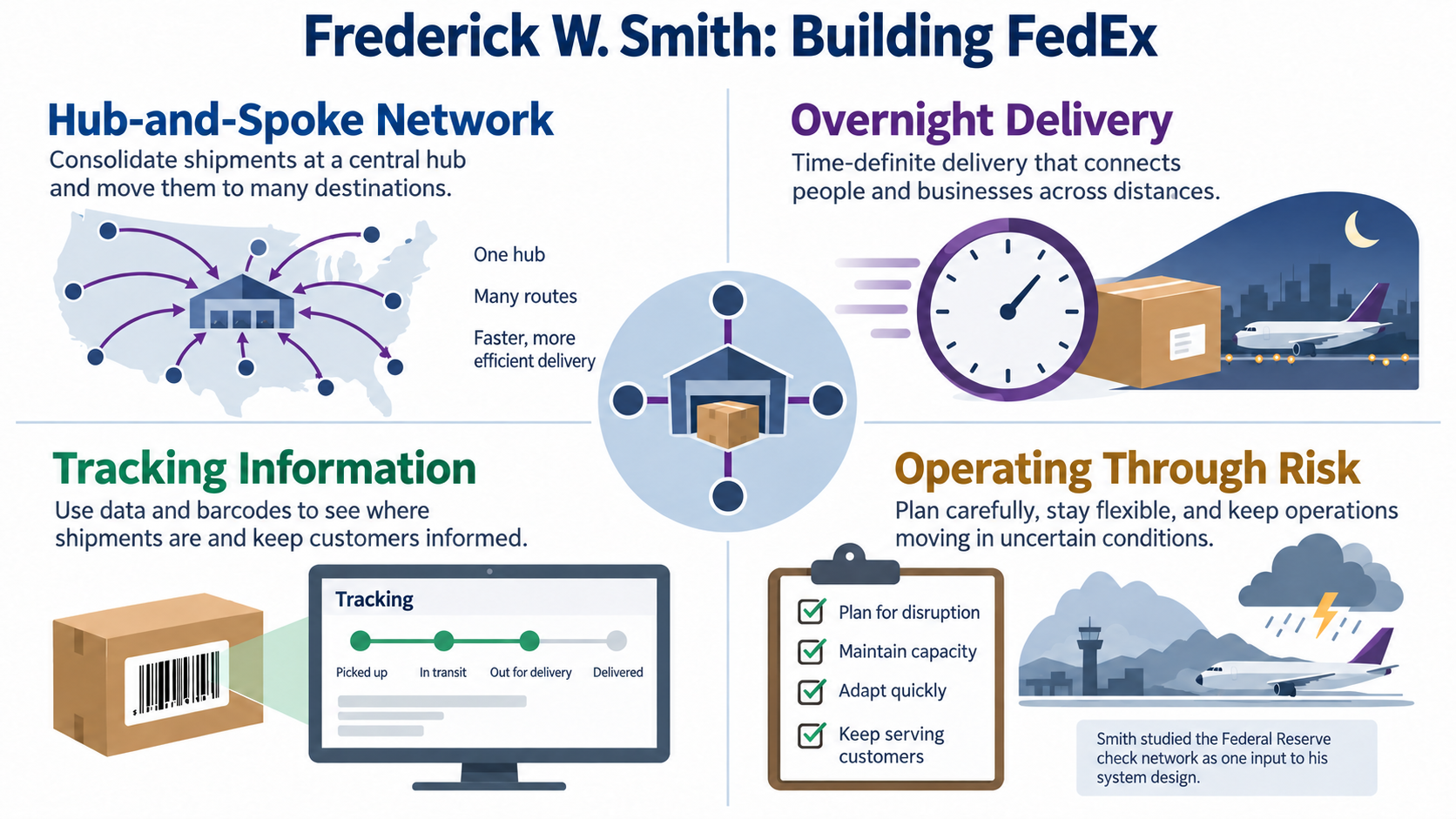
- Borrowing network topology: Smith said he applied the central-hub logic of banks and telecommunications networks to the movement of goods. — Talks at GS — Smith interview.
- Combining air and ground: Smith recalled that integrating aircraft with pickup and delivery trucks looked unconventional to established transportation companies. — Fortune Small Business — How I Delivered the Goods.
- Designing for the whole network: Smith argued that a central hub adds a stop to an individual shipment but sharply reduces the number of connections required across the whole network. — Fortune Small Business — How I Delivered the Goods.
- High-value parts shaped the market: Smith said that flying urgent computer parts as a student showed him how automation could create demand for rapid, reliable delivery. — Talks at GS — Smith interview.
- Study an adjacent network: Smith studied the Federal Reserve’s paper-check network and adapted its single-hub logic to moving goods. That study helped shape the Federal Express name; it was not a failed FedEx check-delivery venture. — Goldman Sachs — Fred Smith Interview.
Part 2: Lessons from the Marine Corps
- Marine leadership in FedEx: Smith said Marine Corps leadership lessons were embedded in FedEx employee relations and management training. — USNI Proceedings — Smith on Marine leadership.
- Using the SMEAC framework: Smith said he still organized strategic issues through the Marine Corps SMEAC method: situation, mission, execution, administration, coordination and communication. — Marine Corps Association — Smith interview.
- Taking care of the front line: Smith said FedEx senior management should facilitate the employees who deal directly with customers, and support those employees even when doing so costs money. — Talks at GS — Smith interview.
- Setting a personal example: In his signed Marine Corps essay, Smith said FedEx teaches managers to model the conduct they expect and recalled not cutting ahead of employees in the cafeteria. — USNI Proceedings — Smith on Marine leadership.
- Relying on first-level managers: Smith explicitly compared FedEx first-level managers to Marine noncommissioned officers and called their role central to execution. — USNI Proceedings — Smith on Marine leadership.
- Learning from military logistics limits: Smith said the military’s inventory-heavy supply-push system helped him see why an automated economy needed a different, demand-responsive distribution design. — Academy of Achievement — Smith interview.
- Praise publicly, counsel privately: In a direct interview, Smith said FedEx used the Marine-derived practice of public praise and private counseling, alongside Bravo Zulu recognition. — Marine Corps Association — Smith interview.
Part 3: The People-Service-Profit Philosophy
- People-Service-Profit: Smith described FedEx’s People-Service-Profit philosophy as treating employees fairly, enabling strong service, and sharing the resulting gains. — Academy of Achievement — Smith interview.
- Creating conditions for judgment: Smith said employees cannot simply be ordered to make good service decisions; leaders must empower them and build a culture that allows it. — Academy of Achievement — Smith interview.
- Showing why work matters: Smith said FedEx told employees that time-sensitive shipments could include medical treatments, aircraft parts and legal briefs, making the importance of each role concrete. — Fortune Small Business — How I Delivered the Goods.
- Explaining change before it happens: Smith described speaking with field teams for two years before combining air and ground operations, to explain the change and its employee implications. — Talks at GS — Smith interview.
- Listening through complaint procedures: Smith included employee complaint procedures, promotion and profit sharing among the concrete ways FedEx sought to treat its people fairly. — Academy of Achievement — Smith interview.
Part 4: Managing Risk and Survival
- The Vegas cash reprieve: In a 1981 interview, Smith recalled winning about $26,000 after taking $200 to Las Vegas and using the money to help payroll; later retellings give different figures. — Washington Post — 1981 Smith interview.
- Taking a swing despite failure: Smith described Zapmail as an expensive miss but said a company facing commoditization must take some risks and learn. — Fortune Small Business — How I Delivered the Goods.
- Plan conservatively despite ambition: Despite FedEx’s large upfront bet, Smith advised detailed, achievable plans with room for contingencies such as fuel-price increases. — Fortune Small Business — How I Delivered the Goods.
- Financing a full network: Smith said FedEx had to finance a broad network before winning large customers and used his own capital, market studies and rising traffic to raise outside funding. — Fortune Small Business — How I Delivered the Goods.
- Watching fundamentals through a cash crisis: Smith said FedEx ran short of money and lacked regulatory approvals, but daily traffic growth reinforced his conviction in the underlying service. — Academy of Achievement — Smith interview.
- Responsibility to the team: Smith said he kept fighting through the early crisis partly because he did not want to let down the people who had joined him. — Academy of Achievement — Smith interview.
Part 5: Innovation and Information Technology
- Package information matters: FedEx records Smith’s 1978 point that information about a package is as important as the package itself; the company then invested in tracking systems. — FedEx — 40 years of innovation.
- Centralizing operational data with COSMOS: FedEx dates COSMOS, its centralized system for managing packages, people, vehicles and weather information, to 1979. — FedEx — 40 years of innovation.
- Change before commoditization: Smith urged continual change to keep a business from becoming a commodity and offered the failed Zapmail experiment as one costly lesson. — Fortune Small Business — How I Delivered the Goods.
- Technology as operating capability: Smith said FedEx needed technological talent beyond his own skills and credited Jim Barksdale and colleagues with creating in-motion tracking capability. — Talks at GS — Smith interview.
- From handheld scans to Web tracking: FedEx introduced its hand-held SuperTracker barcode scanner in 1986 and customer package-status tracking on fedex.com in 1994. — FedEx — 40 years of innovation.
- Adapting to online commerce: Smith said FedEx built electronic customer interfaces before the Web and then adapted them for Internet commerce as customer behavior changed. — Academy of Achievement — Smith interview.
- Visibility supports the service promise: Smith said time-critical customers needed to know where shipments were; FedEx’s tracking investments made that visibility possible. — Academy of Achievement — Smith interview.
Part 6: Execution and Operational Discipline
- Measuring misses absolutely: Smith said FedEx measured service complaints in absolute numbers rather than accepting a high delivery percentage that still left customers unserved. — Academy of Achievement — Smith interview.
- Separating a CEO’s three jobs: Smith divided the CEO role into strategy, management and leadership and emphasized a viable strategy developed with directors and senior managers. — Chief Executive — Smith interview.
- Learning from history: Smith told the Academy interviewers he read history extensively and continued to do so as a business leader. — Academy of Achievement — Smith interview.
- Benchmarking while scaling: Smith said managers of a growing company should benchmark, study historical examples and then apply those lessons with discipline. — Chief Executive — Smith interview.
- Clear expectations and feedback: Smith said workers want to know what is expected, how they are doing and how good performance will be rewarded. — Fortune Small Business — How I Delivered the Goods.
- A timed overnight sort: A contemporary Washington Post reporter observed the Memphis hub’s timed overnight sort, showing how the network coordinated inbound aircraft, sorting and outbound flights. — Washington Post — 1981 Smith interview.
- Keeping vital cargo moving in 2020: In March 2020, Smith said FedEx was moving hospital and diagnostic supplies despite passenger-flight disruption and had changed facility and signature practices. — CBS Face the Nation — Smith transcript.
Part 7: Customer Centricity and The Purple Promise
- The Purple Promise: Smith described FedEx’s Purple Promise as the employee commitment to make every FedEx experience outstanding. — FedEx — the Purple Promise.
- Use criticism to improve service: Smith said a customer complaint can show FedEx what went wrong and create an opportunity to improve the service. — Academy of Achievement — Smith interview.
- Making reliability accountable: Smith said the overnight guarantee mattered inside FedEx because failure to deliver meant the company would not be paid. — Academy of Achievement — Smith interview.
- Customers depend on the outcome: Smith linked reliable next-morning delivery to customers who needed urgent medicines, repair parts or time-sensitive documents, not to the elegance of the hub design. — Academy of Achievement — Smith interview.
- Making low inventories possible: Smith said reliable express delivery let manufacturers and service teams rely less on local inventories of replacement parts. — Academy of Achievement — Smith interview.
Part 8: Markets, Regulation, and Strategy
- Advocating air-cargo deregulation: Smith said FedEx lobbied for air-cargo deregulation in the mid-1970s; the 1977 change allowed larger aircraft and helped the network grow. — Smith — Creating a More Accessible World.
- Following customers across borders: Smith said FedEx expanded internationally as high-tech manufacturing and customers shifted toward Asian production centers. — Talks at GS — Smith interview.
- E-commerce extends the market: In a 2018 speech, Smith said global e-commerce was increasing the value of transportation links for consumers, exporters and small businesses. — Smith — Creating a More Accessible World.
- Shipment data as economic visibility: Smith said FedEx’s flow of goods gives it a granular view of changing demand across sectors; he did not claim shipment volume alone predicts a recession. — Talks at GS — Smith interview.
- Arguing for open trade: Smith publicly argued that Open Skies and lower trade barriers expanded market access, while acknowledging some unfair practices and protected sectors. — Smith — Creating a More Accessible World.
- Scale a defensible network: Smith explained that FedEx needed a broad network from the start and that high fixed costs became more manageable once traffic passed break-even. — Fortune Small Business — How I Delivered the Goods.
- Unclog the supply chain: In a 2021 interview, Smith identified infrastructure gaps, labor shortages and the bullwhip effect as major constraints on moving goods; he said unclogging supply chains was important as prices rose. This was a diagnosis of that period, not a claim that logistics are inherently anti-inflationary. — CBS Face the Nation — Fred Smith interview.
- Good jobs as an outcome: Smith said one source of pride in FedEx’s growth was the chance to create good jobs for its employees, not only a larger shipping network. — Academy of Achievement — Smith interview.