Garry Tan is the CEO of Y Combinator, co-founder of Initialized Capital, and a former early designer and engineer at Palantir and Posterous. He is known for highlighting the link between technical execution and human psychology, arguing that a company's fate is tied directly to the founder's personal development. This profile tracks his specific lessons on navigating the seed stage and building software people actually use.
Part 1: The Psychology of the Founder
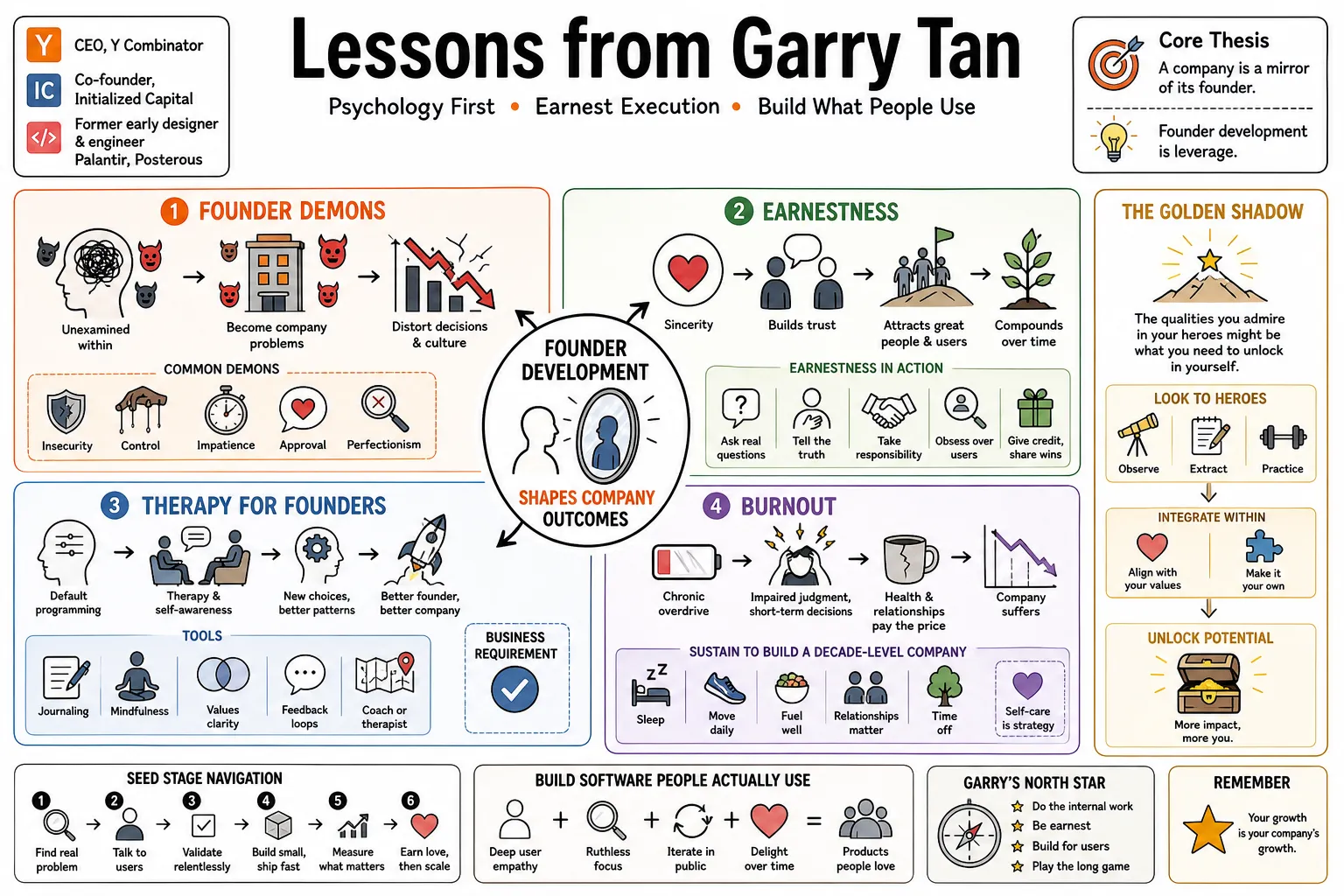
- On Founder Demons: "Startups end up taking on the personality of their founders. If you have unexamined demons inside of you, they will become your company's problems." — Source: [Garry Tan on YouTube]
- On Earnestness: "The number one characteristic of a successful founder isn't the flashiest resume; it's earnestness and extreme sincerity." — Source: [FS Blog]
- On the Golden Shadow: "The qualities you most admire in your heroes might exactly be what you need to unlock in yourself." — Source: [Garry Tan on YouTube]
- On Therapy for Founders: "If you're not aware of your internal default programming, then it will rule you. Doing the internal work is a business requirement." — Source: [Garry Tan on YouTube]
- On Burnout: "Be as dogged in your self-care as you are in your work ethic. You cannot build a decade-long company running on adrenaline alone." — Source: [Garry Tan on YouTube]
- On Self-Belief: "The biggest risk for ambitious misfits is that someone talks them out of their own potential before they even start." — Source: [Y Combinator]
- On Default States: "When under pressure, founders revert to their deepest insecurities. Knowing what yours are is the only way to catch yourself before you break the company." — Source: [Garry Tan on YouTube]
- On Imposter Syndrome: "Everyone is guessing. The only difference between you and the people you admire is that they started executing while they were still unsure." — Source: [Twitter]
- On Motivation: "Don't aspire to glory. Aspire to be useful. The market rewards utility, not ego." — Source: [Garry Tan on YouTube]
- On Emotional Resilience: "Startups rarely die from market wounds; they implode under fractures in the founder's psyche." — Source: [Garry Tan on YouTube]
Part 2: Design and Human Connection
- On the Startup Advantage: "When you're starting something new, your whole advantage over the incumbents is that you're a real human being. Be small. Be human." — Source: [Garry Tan on YouTube]
- On Customer Support: "Being small means you can have extreme, fanatical customer support. Tell users, 'I'm the CEO, what do you need?' That builds unshakeable loyalty." — Source: [Garry Tan on YouTube]
- On Product Design: "Design is not merely how it looks, it is actually also how it works and how it feels to the person using it." — Source: [Y Combinator Library]
- On the Party Framework: "Think about starting a startup like throwing an amazing party. You greet them at the door, take their coat, and introduce them to friends. Software should feel like that." — Source: [Garry Tan on YouTube]
- On User Personas: "You need to know exactly who you are building for. At Posterous, we built for 'David the Dad' so we knew exactly what to simplify." — Source: [Y Combinator Library]
- On the Meaning of Logos: "A great logo mixes meaning and aesthetics. At Palantir, the logo represented both the infinite book of knowledge and a tool for seeing hidden truths." — Source: [Garry Tan on YouTube]
- On Friction: "If a user has to think about how to use your product, you've already lost them to someone who made the same action thoughtless." — Source: [Twitter]
- On Design as Culture: "Design isn't just about the product interface; it's about putting together a culture and translating a mission into something tangible." — Source: [Medium]
- On the Infinite Book: "The computer is the infinite book. Our job as designers is to help humans interface with this infinite data to understand the world fundamentally." — Source: [Garry Tan on YouTube]
Part 3: Engineering and Building Products
- On Building Instead of Consulting: "Don't sell your time. Go make products. Time is finite, but if you make software, it keeps making money for you while you sleep." — Source: [Garry Tan on YouTube]
- On Code as Scale: "Writing code is the highest impact activity you can engage in. It scales infinitely at near-zero marginal cost." — Source: [Twitter]
- On the Golden Age of Building: "We are in the first pitch of the first inning of what AI will enable. We are in a golden age of building." — Source: [Podcast Notes]
- On Human Agency in AI: "Current AI systems are incredibly smart toasters with no agency. That means the human element and human direction are more important than ever." — Source: [Garry Tan on YouTube]
- On Technical Co-founders: "If you are building a tech company, you need someone in-house who can build the technology. Outsourcing your core competency is a death sentence." — Source: [Y Combinator Library]
- On Shipping Quickly: "If you aren't embarrassed by the first version of your product, you launched too late. Get it out and let the market tell you what's wrong." — Source: [Twitter]
- On Solving Hard Problems: "The best startups look like new elements on the periodic table. They require deep, physicist-like understanding from the engineers building them." — Source: [Medium]
- On Software as Magic: "Software is the closest thing we have to magic. You type words into a screen, and it changes the physical world." — Source: [Twitter]
- On Engineers Selling: "We take mostly technical people with big ideas and teach them how to sell. You can teach a great engineer to sell, but teaching a salesperson to engineer is much harder." — Source: [Y Combinator]
Part 4: Early-Stage Survival and Pivots
- On the Three Startup Killers: "Companies die for three reasons: co-founder conflict, failing to pivot when the market demands it, and losing belief." — Source: [Inc. Magazine]
- On Starting Small: "Founders are constantly told to think big, but it is just as important to start small. Solve one specific problem for one specific group perfectly." — Source: [Initialized Capital]
- On Losing Belief: "Once the belief is gone from the founders, the employees, or the customers, it’s already too late. Protecting morale is protecting the company." — Source: [Inc. Magazine]
- On the Posterous Mistake: "When asked if we were a platform or a network, we said 'both.' Being both is a dead end. You have to pick a lane to win." — Source: [Posthaven]
- On Pivoting: "Persistence sometimes leads you down bad roads. This is why we actively encourage founders to pivot when the data shows the current path isn't working." — Source: [Quora]
- On Retention: "A 10 percent difference in user retention is the difference between a startup that's flatlining and one that's a massive success." — Source: [Garry Tan on YouTube]
- On Product-Market Fit: "You feel product-market fit. It feels like the market is pulling the product out of your hands faster than you can build it." — Source: [Y Combinator Library]
- On Bridge Technologies: "Sometimes you build a bridge technology, like posting by email. You have to realize when the market shifts to a new paradigm, like mobile apps, and adapt immediately." — Source: [Medium]
- On Staying Alive: "In the early days, your only job is to not die long enough to get lucky." — Source: [Twitter]
Part 5: Leadership and Decision Making
- On the Co-CEO Model: "Don't let your startup die because you can't decide. Shared command between co-CEOs inevitably leads to frustration, chaos, and delay." — Source: [Garry Tan on YouTube]
- On Focus: "A startup ultimately lives or dies by its focus. The actual secret of productivity is to hyperfocus, and focus simply means saying no." — Source: [Y Combinator]
- On Founder Mode: "Big companies lack 'founder mode' because they have too many people. Founder mode is having your hands in the dirt and touching all parts of the company." — Source: [Podcast Notes]
- On Co-founder Conflict: "Disagreements and mismatches between founders are the most common cause of early death for a startup. Choose your partners as carefully as a spouse." — Source: [Inc. Magazine]
- On Making Fast Decisions: "Speed is your primary weapon. A wrong decision made quickly can be corrected, but a delayed decision kills momentum entirely." — Source: [Twitter]
- On Utility: "Calculate your impact with Elon Musk’s formula: Utility multiplied by the number of people. Your success is the area under that curve." — Source: [Garry Tan on YouTube]
- On Delegation: "You have to do things that don't scale first, but eventually, you have to hire people who are better than you at those exact things." — Source: [Twitter]
- On Authenticity in Leadership: "People will not follow a polished corporate robot through the hardest times of a startup. They will follow an authentic human being who cares." — Source: [Garry Tan on YouTube]
- On Managing Psychology: "The hardest part of being a CEO isn't the strategy; it's managing your own psychology and the psychology of your executive team." — Source: [Twitter]
- On Clear Communication: "If the team doesn't understand the goal, that is a failure of the CEO's communication, not the team's comprehension." — Source: [Garry Tan on YouTube]
Part 6: Venture Capital and the Seed Stage
- On the Why Now Framework: "The most powerful startups emerge when three factors converge: new technologies, changes in human behavior, and shifts in regulation. You need to answer 'Why now?'" — Source: [Unicorn Growth]
- On Earned Secrets: "The best startups are founded by people who have 'earned secrets' through direct, painful experience in a specific industry." — Source: [Unicorn Growth]
- On the Role of an Investor: "Even more important than writing the check, we help founders tell the story, recruit the first engineers, and get the next round of capital." — Source: [Crunchbase]
- On the Spray and Pray Model: "We rejected the spray and pray model at Initialized. The right trade-off is working with a smaller number of companies and spending massive time with them." — Source: [Crunchbase]
- On the Canonical Startup: "A canonical startup mixes a wildly smart business idea with hard technology. When we see that, we convince the founders to quit their jobs immediately." — Source: [Crunchbase]
- On Evaluating Pitch Decks: "I look for clarity above all else. If you can't explain what you do in one sentence, you haven't thought about it hard enough." — Source: [Twitter]
- On Board Seats: "At the seed stage, you don't need a formal board. You need advisors who roll up their sleeves and act like an extension of your founding team." — Source: [Initialized Capital]
- On Valuation: "Don't optimize for the highest valuation at the seed stage. Optimize for the partners who will actually help you survive to Series A." — Source: [Twitter]
- On Picking Winners: "We don't pick winners. We fund relentless problem solvers and help them build environments where winning becomes the default." — Source: [Initialized Capital]
- On Market Size: "A small market today that is growing exponentially is infinitely better than a massive, stagnant market. Invest in the derivative, not the current value." — Source: [Twitter]
Part 7: The Y Combinator Philosophy
- On YC's Mission: "Taking the top job at YC was a 'one in 10 billion lifetimes' opportunity to protect and grow the fountain of prosperity for innovation and venture." — Source: [Forbes]
- On Funding People: "Most accelerators fund ideas. Y Combinator funds founders and transforms them." — Source: [FS Blog]
- On YC's Engineering Roots: "My goal in returning to YC was to bring it back to its engineering-first roots, focusing on the builders." — Source: [Forbes]
- On the YC Network: "The true power of Y Combinator isn't the capital; it's the network of thousands of founders who will answer your email at 2 AM." — Source: [Y Combinator]
- On Batch Dynamics: "Putting hundreds of ambitious people in the same batch creates a positive peer pressure that forces everyone to move faster than they thought possible." — Source: [Y Combinator]
- On Office Hours: "The best YC office hours are the ones where a founder walks in with a complex problem, and walks out with a painfully simple, uncomfortable solution." — Source: [Y Combinator Library]
- On Demo Day: "Demo Day isn't the finish line; it's the starting gun for the next decade of your life." — Source: [Twitter]
- On Ambitious Misfits: "YC is designed to be the home for ambitious misfits who don't fit into traditional corporate structures but have the drive to build the future." — Source: [Garry Tan on YouTube]
- On Making Something People Want: "It's the simplest motto in the world, yet founders spend years building things nobody wants because they refuse to talk to users." — Source: [Y Combinator]
Part 8: Wealth, Career, and Scale
- On the Two Hundred Million Dollar Mistake: "Once you find a rocket ship with product-market fit, don't step off the gas. Leaving early or losing focus can cost you hundreds of millions in lost equity." — Source: [Garry Tan on YouTube]
- On Asymmetric Risk: "Startups offer asymmetric risk. The downside is limited to your time and early capital, but the upside is literally uncapped." — Source: [Twitter]
- On Attention: "Every business today is a meme. If you don't control the narrative and capture attention, your competitors will." — Source: [Y Combinator]
- On Wealth Creation: "True wealth isn't created by a high salary. It is created by owning equity in a system that scales without your constant manual input." — Source: [Garry Tan on YouTube]
- On Career Moats: "Build a career moat by combining two disparate skills. Being top ten percent in engineering and top ten percent in design makes you entirely unique." — Source: [Twitter]
- On Choosing Where to Work: "In your twenties, optimize entirely for learning and network, not salary. Join a company that is growing so fast it feels chaotic." — Source: [Twitter]
- On Building an Audience: "Attention is the currency of the modern internet. If you can build an audience, you can launch any product into a warm market." — Source: [Garry Tan on YouTube]
- On Optimism: "Cynicism is cheap and easy. Unyielding, calculated optimism is the only framework that allows you to build something massive." — Source: [Twitter]
- On Playing the Long Game: "The people who win in Silicon Valley are the ones who stay in the game for decades. Reputation compounds faster than capital." — Source: [Garry Tan on YouTube]