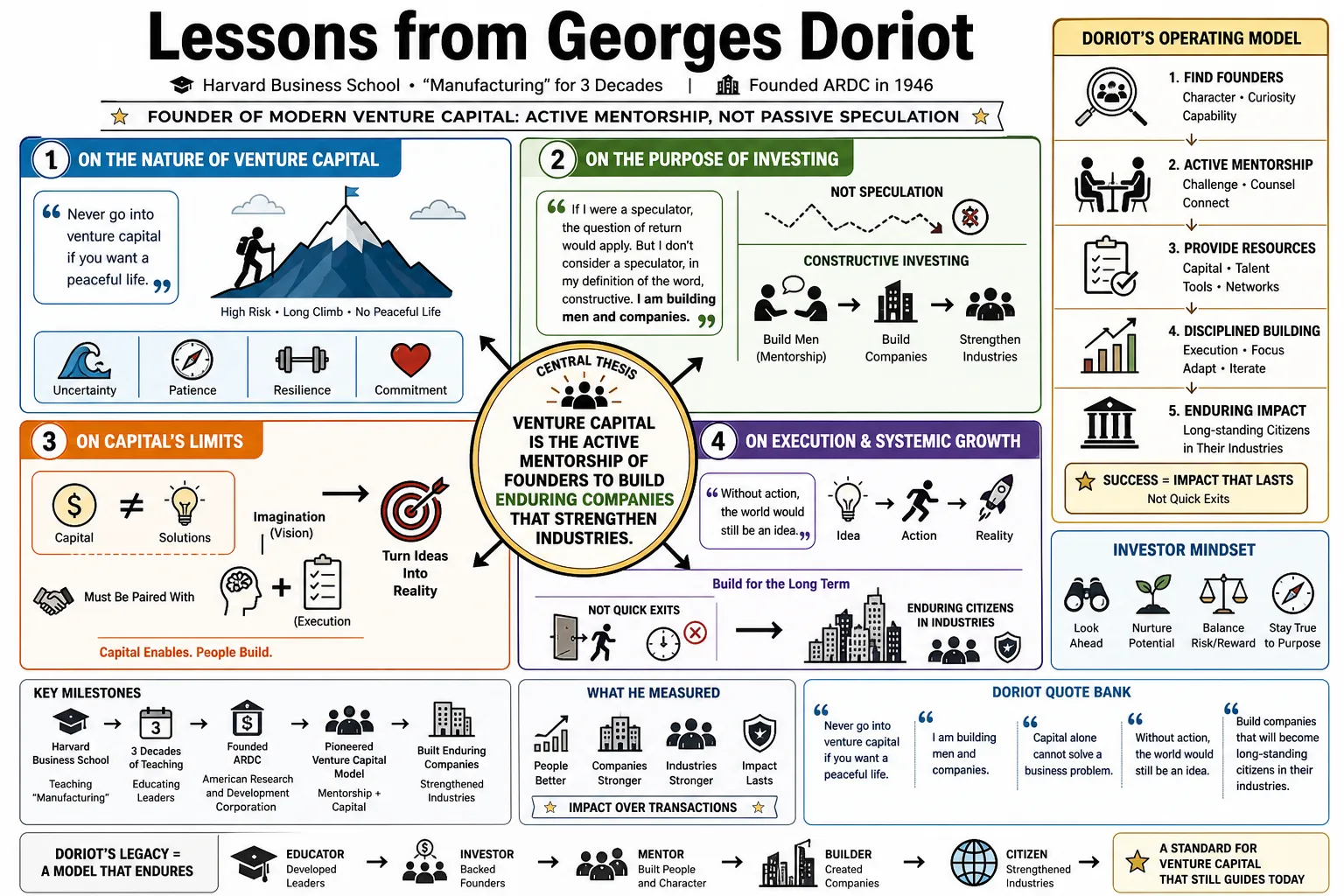
Lessons from Georges Doriot
Georges Doriot taught manufacturing and industrial management at Harvard Business School and led American Research and Development, an early institutional venture-capital firm. His work paired financing of new technology with practical help for the people building companies. — Baker Library — ARD.
Part 1: The Foundations of Venture Capital
- Be Present Through Difficult Years: Venture backing meant remaining engaged when young companies encountered trouble, not simply supplying a cheque and waiting for a return. — Baker Library — ARD.
- Build People and Companies: Doriot described his approach as constructive company-building rather than speculation focused only on near-term return. — Baker Library — Financing New Ideas.
- Pair Capital with Imagination: In ARD’s annual-report language, creating products and industries depended on creative people, imagination and initiative as well as money. — Baker Library — ARD.
- Stay with Companies Through Trouble: ARD’s approach was to remain involved with young businesses through challenging periods instead of treating an early difficulty as a reason for a quick exit. — Baker Library — ARD.
- Back Unproven Technology Selectively: ARD financed small technology ventures that conventional investors often overlooked, but it chose only a small fraction of the proposals it received. — Baker Library — ARD.
- Treat Enterprise as a Civic Responsibility: Doriot told Manufacturing students that business leadership carried responsibilities as both businesspeople and citizens. — Baker Library — Educating Leaders.
- Make Ideas Constructive: Doriot urged creative people to turn ideas into processes and products, backed by practical help as well as capital. — Baker Library — ARD.
- Expect an Uneven Start: ARD initially recorded losses before later gains; its stated purpose was to support companies during launching and insecure growth. — Harvard Archives — Doriot Papers.
- Finance Useful New Industries: ARD backed technologies such as instruments, medical devices and water purification; Doriot framed creative capital as a way to foster new products and industries. — Baker Library — ARD.
Part 2: Evaluating Founders and Ideas
- Prioritize Creative Founders: Doriot wrote that creating new industries depended on people more than money and urged investors to seek creative people with vision and initiative. — Baker Library — ARD.
- Combine Inventors with Practical Support: ARD paired technically inventive founders with financial and managerial backing, as its early portfolio and support of young ventures show. — Baker Library — ARD.
- Consider New Technical Fields: Doriot backed small technical ventures at a time when many investors avoided new fields; DEC was a conspicuous example. — Baker Library — DEC.
- Take Family Life Seriously: Doriot historically advised his all-male students that a healthy family life mattered to a business leader’s success. This is his period-specific view, not a universal rule for evaluating founders. — HBS — Georges Doriot.
- Seek People Who Can Create: Doriot urged investors to find imaginative people with a vision of work still to be done, then help them develop the idea. — Baker Library — ARD.
- Choose Training for the Work You Want: Doriot planned to study at MIT, but after telling Harvard president A. Lawrence Lowell that he wanted to run a factory, he followed advice to attend HBS. — Baker Library — Early Years at HBS.
Part 3: The Role of the Investor
- Offer More Than Money: Doriot’s ARD combined finance with ongoing managerial support and founder encouragement. — Baker Library — ARD.
- Give Young Companies Time: ARD warned investors not to expect profits for several years and supplied capital during companies’ launching and insecure growth. — Harvard Archives — Doriot Papers.
- Build a Personal Working Relationship: The Harvard archival account describes ARD’s unusually personal relationships with investees and Doriot’s habit of calling them his children. — Harvard Archives — Doriot Papers.
- Encourage Founders in a Rut: Tracerlab founder William Barbour recalled Doriot providing encouragement and appreciation when the young company became mired in day-to-day detail. — Baker Library — ARD.
Part 4: Management and Operations
- Inspire People: Harvard preserves Doriot’s advice to students that a leader will not get far without inspiring people. — HBS — Doriot Papers.
- Keep Professional Advisers Independent: A contemporaneous profile preserved by PBS attributes to Doriot the warning to be friendly but not overly close with lawyers. — PBS — Georges Doriot.
- Do Not Repeat Yourself in Meetings: PBS recounts Doriot keeping a stopwatch to time how long someone took to tell him the same thing three times. — PBS — Georges Doriot.
- Respect Manufacturing as Core Work: Doriot’s course treated production and administrative control as central business problems, not as an afterthought. — Baker Library — Early Years at HBS.
- Test Ideas in Real Operations: Doriot designed his Manufacturing course around fieldwork with actual companies, asking students to grapple with live operating problems. — Baker Library — Educating Leaders.
Part 5: Strategy and Competition
- Watch for Obsolescence: Harvard preserves Doriot’s warning that another company may be developing a product that renders yours obsolete. — HBS — Doriot Papers.
- Find an Advantage in Specialized Know-How: Doriot argued that patents and technical know-how could help a small company compete with a much larger one. — Baker Library — Financing New Ideas.
- Look Several Years Ahead: Doriot asked students to research what an industry might look like years later, making future-oriented thinking part of practical business education. — HBS — Georges Doriot.
- Learn from ARD’s Structural Constraints: ARD’s closed-end fund structure limited employee compensation options, while newer venture firms increased competition; those pressures helped drive its later merger. — Baker Library — Financing New Ideas.
- Do Not Ignore an Unfashionable Technology: Many investors showed little interest in computers when ARD backed Digital Equipment Corporation in 1957. — Baker Library — DEC.
Part 6: Leadership and Character
- Practice Courage Without an Audience: Harvard preserves Doriot’s classroom aphorism that courage matters when no one is watching. — HBS — Doriot Papers.
- Accept Responsibility Beyond Profit: Doriot told graduates that their business education carried responsibilities to the wider community as citizens. — Baker Library — Educating Leaders.
- Set Demanding Standards: Doriot held his Manufacturing students to demanding standards and treated the course as a formative experience, according to HBS accounts and former students. — HBS — Georges Doriot.
- Examine Your Own Strengths and Limits: Doriot urged students to observe carefully and make the most of their own assets and liabilities. — Baker Library — Educating Leaders.
- Develop Your Own Operating Philosophy: Doriot’s teaching assistant explained that the Manufacturing course aimed to help students develop their own philosophy and pattern of action. — Baker Library — Educating Leaders.
Part 7: Education and Pedagogy
- Learn from Live Business Problems: Doriot favored fieldwork with operating companies over relying entirely on historical cases. — Baker Library — Educating Leaders.
- Make Learning Demanding: HBS colleagues and alumni recall Doriot’s Manufacturing course as unusually demanding, with high expectations for student work. — HBS — Georges Doriot.
- Require Original Thinking: Doriot’s students described him as pushing them toward original, constructive thinking on difficult problems. — Baker Library — Early Years at HBS.
- Use Deliberate Provocation to Teach: Harvard’s historical account describes Doriot’s theatrical and provocative lecture style, including a technique of challenging students into more inventive responses. — Baker Library — Educating Leaders.
- Ask for Forward-Looking Reports: Doriot required student teams to produce topic reports on technologies and industries years ahead; some became published studies. — Baker Library — Educating Leaders.
- Study Emerging Products and Research: The official Manufacturing course description called for studying products, new ideas, new developments and research questions. — Baker Library — Early Years at HBS.
Part 8: The Long-Term Horizon
- Resist a Premature Exit: DEC founder Ken Olsen recalled that ARD refused early acquisition offers and that Doriot preached staying with a promising company. — Baker Library — DEC.
- Fund the Insecure Growth Period: ARD told shareholders not to expect immediate profits and defined its mission around providing capital while young companies launched and grew insecurely. — Harvard Archives — Doriot Papers.