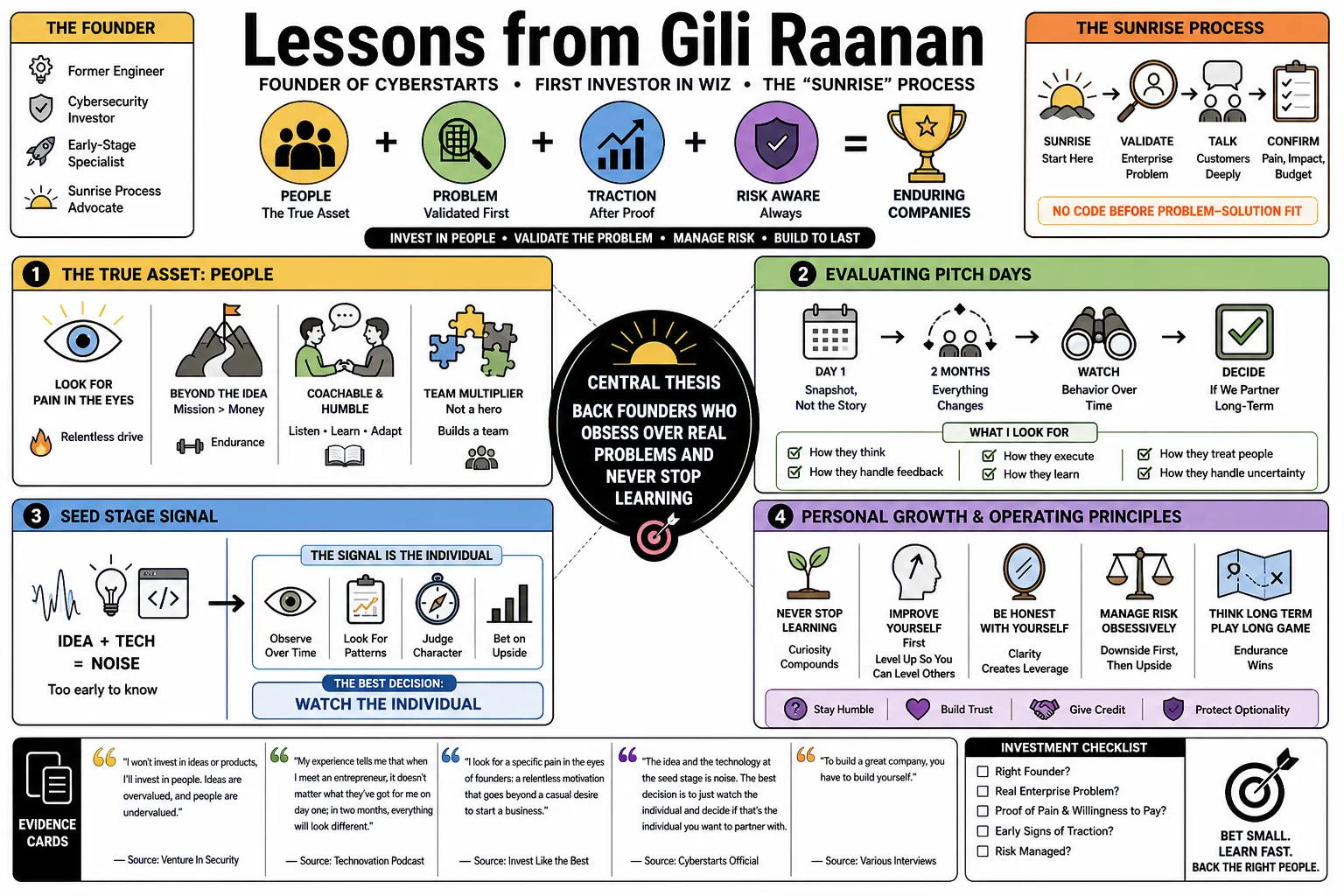
Lessons from Gili Raanan
Gili Raanan is the founder of Cyberstarts. Its Sunrise approach asks new teams to identify urgent cybersecurity pain points through a validation loop involving more than 60 CISO conversations before building a product. — Cyberstarts — Sunrise Approach.
Part 1: The Founder
- People before seed-stage ideas: Raanan says he selects seed-stage partners primarily by the people, since the initial market and product can change within weeks. — 20VC — Gili Raanan (2024).
- Look beyond the first pitch: He deliberately spends early founder meetings learning a person’s history rather than assessing a polished market thesis or product deck. — 20VC — Gili Raanan (2024).
- Look for intrinsic drive: He listens for a founder’s enthusiasm and energy about the problem, not simply whether the founder has an insider résumé. — 20VC — Gili Raanan (2024).
- Understand the person deeply: He asks why founders made consequential life choices, using the answers to understand motivation and how they may behave under pressure. — 20VC — Gili Raanan (2024).
- Test resilience before the code: Raanan looks for founders who have faced serious adversity and still excelled, treating that experience as one signal of resilience; it is his investing judgment, not a general predictor proved here. — Cyberstarts — Gili Raanan.
- Choose a real partner: At the seed stage he wants an open, transparent relationship before a company exists, comparing the investor relationship to an additional cofounder. — 20VC — Gili Raanan (2024).
- Ask why the founder chose this path: He says understanding what drives a founder helps him partner with the person better than reviewing a list of accomplishments. — 20VC — Gili Raanan (2024).
- Prioritize fit over sheer speed: For a young cybersecurity company, Raanan says discovering the pain point and a repeatable sales process matters more than simply being first to market. — 20VC — Gili Raanan (2024).
Part 2: The Sunrise Process and Validation
- Start Sunrise with buyer problems: Cyberstarts begins Sunrise with conversations with enterprise security leaders about important pain points before committing to a product. — 20VC — Gili Raanan (2024).
- Bring hard objections forward: Sunrise tests incumbent alternatives, pricing, channels and technical evaluation before the first line of code rather than waiting for sales objections later. — 20VC — Gili Raanan (2024).
- Return with a solution thesis: After the first pain-discovery round, Raanan describes a second set of 60–70 buyer conversations testing a proposed solution before building it. — 20VC — Gili Raanan (2024).
- Find pain with current budget: He asks prospective CISOs which single problem they would fund now, seeking present urgency rather than polite approval of a startup idea. — 20VC — Gili Raanan (2024).
- Review customer conversations together: Raanan says the founders run Sunrise interviews while Cyberstarts follows up, scores meetings and reviews learning weekly. — 20VC — Gili Raanan (2024).
- Move faster by resolving objections early: He attributes several portfolio companies’ early revenue to confronting buying and evaluation hurdles during Sunrise, a reported association rather than a guaranteed outcome. — 20VC — Gili Raanan (2024).
- Test the incumbent alternative: Before writing code, ask a prospective buyer why they would choose a new entrant instead of an established vendor such as Palo Alto Networks or Wiz. — 20VC — Gili Raanan (2024).
- Give founders direct buyer access: The Cyberstarts process connects new teams to dozens of enterprise CISOs for direct problem and solution feedback; that access is a process advantage, not proof of neutral purchasing. — Cyberstarts — Sunrise Approach.
- Disqualify weak ideas early: Raanan says Sunrise surfaces reasons prospects would not buy, allowing founders to reconsider ideas before committing years to a product. — 20VC — Gili Raanan (2024).
- Early revenue follows validation in his examples: Raanan points to several portfolio companies reaching significant ARR within their first 12–24 months after Sunrise; this is his account of selected companies, not a general promise. — 20VC — Gili Raanan (2024).
Part 3: Cybersecurity Fundamentals
- Cyber protection as a necessity: At a 2024 industry panel Raanan said he did not believe cybersecurity was a bubble, arguing that organizations needed protection amid real attacks. — CTech — Cybersecurity Panel.
- Geopolitics intensifies cyber risk: Raanan linked geopolitical conflict and recent attacks to rising demand for cybersecurity innovation; that is his market assessment, not a measured forecast. — CTech — Cybersecurity Panel.
- AI adds a second threat driver: In a 2025 interview he described global conflict and AI together as a “perfect storm” that could change the scale and sophistication of attacks. — Invest Like the Best — Cybersecurity Investment Playbook.
- New technologies create new security needs: He describes cybersecurity as following new technologies: cloud, mobile, IoT and AI each create distinct areas that need protection. — Invest Like the Best — Cybersecurity Investment Playbook.
- Changing threats leave room for entrants: Raanan expects evolving cyber risks to keep producing new opportunities, but emphasizes finding a real customer problem rather than assuming a feature will sell. — Invest Like the Best — Cybersecurity Investment Playbook.
- AI changes offense as well as defense: He argues that attackers can use the same AI advances as defenders, requiring security teams to reconsider how they respond at machine speed. — Invest Like the Best — Cybersecurity Investment Playbook.
- Sector focus is a deliberate bet: Raanan founded Cyberstarts in 2018 as an early-stage fund focused on cybersecurity, concentrating its work in that sector. — Cyberstarts — Gili Raanan.
Part 4: Sales and Go-To-Market
- Map four roles in a sale: Raanan separates the person with the problem, the budget owner, the decision-maker and the person who actually uses the product. — Invest Like the Best — Cybersecurity Investment Playbook.
- Prefer fewer buyer handoffs: In Wiz’s case, he says the CISO combined pain, budget, authority and ability to deploy, making early enterprise adoption easier. — Invest Like the Best — Cybersecurity Investment Playbook.
- Design distribution with the product: Raanan argues that category-defining startups think about user experience, sales and distribution from the first lines of code, not after building a technically good product. — Gili Raanan — The Long Game of Building Global Companies.
- Price against buyer value: Sunrise asks prospective customers how they would price and evaluate a proposed solution before code exists, tying the commercial model to the problem solved. — 20VC — Gili Raanan (2024).
- Test the buyer’s competitive choice: Sunrise asks why a buyer needs the startup rather than a familiar incumbent, which is a stronger test than simply hearing that the idea sounds good. — 20VC — Gili Raanan (2024).
- Generate demand, not just positioning: In 2024 Raanan said he had shifted his preferred first marketing hire from product marketing to demand generation because young software companies need more qualified opportunities. — 20VC — Gili Raanan (2024).
Part 5: Scale and Operations
- Control the operating pace: He warns that uncontrolled hiring or expansion can create managerial and technological complexity, so durable companies know when to slow down. — Gili Raanan — The Long Game of Building Global Companies.
- Defer margins, do not dismiss them: Raanan says healthy gross margins matter for a mature cybersecurity business, but he rarely makes them an immediate discussion with the youngest portfolio companies. — 20VC — Gili Raanan (2026).
- Hire engineers who love the craft: Discussing Wiz, he credits a highly motivated engineering team whose members enjoy writing code, while treating the productivity comparison as his own observation. — Invest Like the Best — Cybersecurity Investment Playbook.
- Brand can compound access: Raanan says a strong venture brand can attract founders, executives and follow-on investors, improving a firm’s ability to help its companies. — 20VC — Gili Raanan (2024).
- Concentrate on the chosen domain: He says Cyberstarts is a seed investor focused on cybersecurity teams and spends almost all its operating time on portfolio companies rather than broad market-thesis work. — 20VC — Gili Raanan (2024).
- Make the first user experience valuable: Raanan uses Wiz’s fast cloud integration and immediate insight during onboarding as an example of product design that also supports adoption. — Gili Raanan — The Long Game of Building Global Companies.
Part 6: Risk and Venture Strategy
- Underwrite rare venture outcomes: Raanan describes cyber venture returns as concentrated among a few winners rather than evenly distributed; this is his investing assessment. — 20VC — Gili Raanan (2026).
- Accept uncertainty at seed stage: He says early investors know little about a company’s ultimate market or product, so they must make judgments amid uncertainty. — 20VC — Gili Raanan (2026).
- Price and ownership matter to the investor: Raanan describes early-stage investing as a search for enough upside, calling investor greed and selfishness useful in that narrow context; he does not prescribe them as general founder behavior. — 20VC — Gili Raanan (2026).
- Size the seed round for the work: For early enterprise security software, he estimates roughly $5–6 million may be needed for a team, working product and a small go-to-market effort before Series A. — 20VC — Gili Raanan (2024).
- Use judgment without false certainty: In a discussion of changing venture benchmarks, he advises investors to learn from older frameworks but ultimately use their own judgment. — 20VC — Gili Raanan (2026).
- Spend attention on portfolio teams: Raanan says he devotes nearly all his work time to the companies Cyberstarts already backs rather than trying to win every possible cyber investment. — 20VC — Gili Raanan (2024).
- Back teams before metrics exist: He describes investing when founders may not yet have a company or product, judging the people and then helping them find a meaningful problem. — 20VC — Gili Raanan (2024).
- Treat seed price as a tradeoff: In 2026 Raanan said he had become more skeptical of inflated seed valuations, while still weighing price alongside the team and other factors. — 20VC — Gili Raanan (2026).
Part 7: Technology and Engineering
- Operator experience informs investing: Cyberstarts describes Raanan’s Unit 8200 service, CAPTCHA and early web-application-firewall work, two acquired software companies, and later venture career. — Cyberstarts — Gili Raanan.
- A useful invention still needs a business model: Raanan recounts building an early CAPTCHA prototype but failing to find its commercial model, which led him toward a customer-problem-first approach. — Invest Like the Best — Cybersecurity Investment Playbook.
- Sequence complex software work: Reflecting on The Mythical Man-Month and a large Unit 8200 migration, Raanan highlights team sizing, communication overhead and sequencing rather than an unsupported aphorism about architecture. — Gili Raanan — Myth of Product Version 1.0.
- AI security requires architectural change: In the 2025 interview he says defending against autonomous AI attacks is not merely an add-on feature; security products may need re-architecting. — Invest Like the Best — Cybersecurity Investment Playbook.
- Make hard technology usable: Raanan says Sunrise should lead to a solution ordinary customers can use, not just an ingenious technical invention lacking adoption. — Invest Like the Best — Cybersecurity Investment Playbook.
- Cloud adoption reset a security problem: He recalls customer conversations steering the Adallom team from on-premise Microsoft application security toward cloud security; market change redirected the product. — 20VC — Gili Raanan (2024).
- Technical invention needs customer value: His CAPTCHA story shows that widely used technology can still lack a viable business model; he argues for starting with a funded problem. — Invest Like the Best — Cybersecurity Investment Playbook.
- Balance feedback with product vision: Raanan warns that a single large client’s requests can turn a startup into bespoke consulting; listen to buyers while protecting a scalable product vision. — Gili Raanan — The Long Game of Building Global Companies.
Part 8: Lessons from Hypergrowth
- Wiz illustrates a people-first bet: Raanan backed the founders’ earlier Adallom team and later Wiz, citing the team’s experience alongside urgent customer pain and product-market fit. — Invest Like the Best — Cybersecurity Investment Playbook.
- Experienced teams can move decisively: He attributes part of Wiz’s execution to a founding team that had already built and scaled a cloud-security business at Microsoft before starting Wiz. — Invest Like the Best — Cybersecurity Investment Playbook.
- Wiz is a large historical outcome, not a formula: In his signed essay, Raanan describes Google’s $32 billion Wiz acquisition as a benchmark for building a company that can shape a global market, not a formula guaranteeing similar results. — Gili Raanan — The Long Game of Building Global Companies.
- Show real value in the buyer environment: Raanan says Wiz could demonstrate cloud-security findings in a prospect’s own environment early in the sales process, helping the product’s value become tangible. — Invest Like the Best — Cybersecurity Investment Playbook.
- Capital supports expensive enterprise building: He argues that an enterprise security company needs meaningful seed capital for product, team and initial go-to-market work, and later financing for scale. — 20VC — Gili Raanan (2024).
- Be a first-call board partner: Raanan says a strong early board member should be someone the CEO calls for important decisions, not merely a passive investor. — 20VC — Gili Raanan (2024).
- Target systemic problems, not narrow features: In his signed essay, Raanan argues that category-defining companies address a broad architectural problem, rather than becoming a feature or bespoke client project. — Gili Raanan — The Long Game of Building Global Companies.