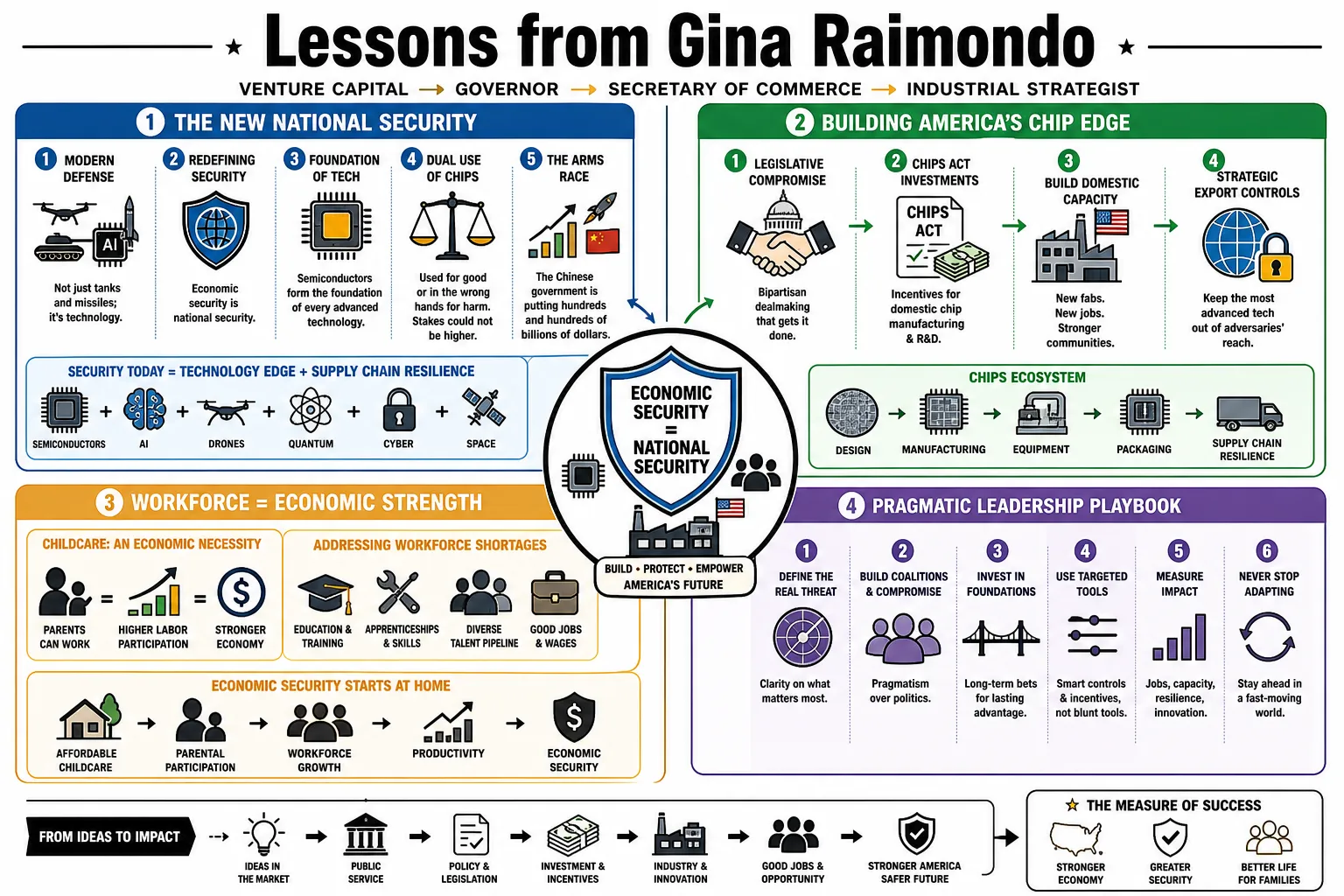
Lessons from Gina Raimondo
As U.S. Secretary of Commerce, Gina Raimondo linked semiconductor production and targeted export controls to national security. She also argued that a larger skilled workforce, including better access to childcare, was needed to expand U.S. chipmaking. — 60 Minutes Interview.
Part 1: The New National Security
- Modern defense includes technology: In a 2024 interview, Raimondo argued that national security now includes semiconductors, AI and drones as well as traditional weapons. — 60 Minutes Interview.
- Economic capability is a security issue: Raimondo connected domestic technological and industrial capacity to national security; in 2026 she said investment in U.S. capability was more consequential than restricting China alone. — CFR U.S.–China Panel.
- Chips underpin advanced technology: Her CHIPS vision describes semiconductors as an enabling foundation for AI, defense systems and other advanced technologies. — Commerce CHIPS Vision Speech.
- Chips have civilian and military uses: She argues that the same advanced computing capabilities can support civilian applications or military development, which is why some chips warrant export controls. — 60 Minutes Interview.
- Compete with China by building at home: Raimondo treated U.S. semiconductor investment as the primary competitive response to China, while reserving restrictions for the most sensitive technology. — NPR All Things Considered Interview.
- Keep national-security lines firm: She distinguishes ordinary trade with China from controls on advanced technology intended for military use, where she says national security is non-negotiable. — CNN State of the Union Interview.
- Protect the most advanced AI chips: Raimondo said the U.S. would continue ordinary semiconductor trade with China but not sell its most powerful AI chips for military use. — CNN State of the Union Interview.
- Invest in the foundations of competitiveness: Her 2021 White House remarks linked U.S. competitiveness to infrastructure, research, worker training and domestic manufacturing. — White House Press Briefing.
- Security can outweigh chip-company revenue: Raimondo said denying unique advanced technology can be warranted despite lost U.S. company sales, while cautioning that controls must target genuine security threats. — CFR U.S.–China Panel.
- Prepare workers for AI disruption: At RAISE US she said AI may create new jobs over time but the transition is already disruptive and existing training and support systems are not ready. — RAISE US Launch Statement.
Part 2: American Manufacturing and Supply Chains
- The zero-chip figure was historical: Raimondo said that when she entered office the United States made no leading-edge AI chips domestically; in 2026 she described new Arizona production, so the earlier figure is not a current statistic. — CFR U.S.–China Panel.
- Build R&D and high-volume capacity: Her 2023 goal was for every leading-edge chipmaker to have significant research, development and high-volume manufacturing in the United States, not merely any U.S. presence. — Commerce CHIPS Vision Speech.
- Reconnect chip research and fabrication: Raimondo argued that proximity between chip design, research and fabrication enables rapid iteration and strengthens technological leadership. — Commerce CHIPS Vision Speech.
- Use CHIPS to catalyze investment: She framed the CHIPS Act as a public investment intended to draw in private semiconductor manufacturing and research, not as a guarantee of any specific outcome. — CFR U.S.–China Panel.
- Preserve the innovation engine: Raimondo argued that maintaining U.S. leadership requires continued research and private-sector innovation alongside manufacturing subsidies. — CFR U.S.–China Panel.
- Childcare affects labor supply: Raimondo linked shortages of affordable childcare to women’s ability to return to work and to employers’ difficulty filling jobs. — Michigan Ford School Interview.
- Middle-mile links lower access costs: In Senate testimony, Raimondo described a $1 billion middle-mile program to build the high-speed backbone and reduce the cost of serving communities. — Senate Broadband Testimony.
- Broadband is essential infrastructure: She argued that affordable high-speed internet is needed for education, jobs and healthcare, yet remained inaccessible to many households. — White House Press Briefing.
- Design broadband for different communities: Raimondo said broadband programs need state-specific flexibility: some communities lack physical networks, while others chiefly face affordability barriers. — Senate Broadband Testimony.
Part 3: The Economics of Childcare
- Childcare plans are workforce plans: Raimondo defended CHIPS childcare planning as a labor-market response to the need for more workers, particularly women, in new fabs. — Harvard IOP Conversation.
- Care shortages kept women out of work: In the pandemic recovery, Raimondo argued that unavailable care prevented many women from returning to jobs; this was a 2021 labor-market assessment, not a current headcount. — White House Press Briefing.
- Care availability affects productivity: Her 2021 remarks treated dependable care for children and relatives as a precondition for many workers to participate in the economy. — White House Press Briefing.
- Require a childcare plan, not provision: Applicants seeking major CHIPS funding had to explain how they would address workforce and childcare needs; Raimondo explicitly said the program did not mandate that firms provide childcare themselves. — 60 Minutes Interview.
- Do not overlook women in chipmaking: Raimondo said semiconductor expansion would be hard to staff without bringing more women into construction and fab roles. — Michigan Ford School Interview.
- Build a broader semiconductor workforce: She described workforce pipelines spanning technicians, engineers and construction trades, with women needed to fill the industry’s planned expansion. — CSIS CHIPS Implementation Transcript.
- Value care workers as workers: Raimondo noted that many care workers, disproportionately women of color, worked full time while living in poverty and argued for better-supported, dignified jobs. — White House Press Briefing.
- Defend childcare as economic policy: Responding to criticism of CHIPS childcare planning, she said the aim was to make large semiconductor investments viable by expanding the available workforce. — Harvard IOP Conversation.
- Expose students to computer science early: Raimondo’s CS4RI initiative sought high-quality computer-science learning from kindergarten onward and wider participation by historically marginalized students; the program overview does not establish a later career-outcome effect. — CS4RI Official Overview.
- Draw on the full talent pool: Her workforce rationale was that semiconductor expansion cannot rely on historical hiring patterns while leaving capable women outside technical and construction roles. — Michigan Ford School Interview.
Part 4: Education, Training, and the Future Workforce
- Make apprenticeships employer-linked: Raimondo argued that effective training needs employer commitment and intentional apprenticeships tied to actual work. — Michigan Ford School Interview.
- Scale practical training: She urged scaling applied training because technological change can displace workers faster than isolated programs can help them transition. — Michigan Ford School Interview.
- Measure jobs and earnings, not just credentials: RAISE US proposes judging workforce programs by employment and earnings outcomes while still using relevant short-term credentials where they serve employer demand. — RAISE US Launch Statement.
- Build training around employers: Raimondo advocated demand-driven, affordable training connected to the skills employers need, rather than assuming a credential alone ensures a job. — White House Press Briefing.
- Upskill for technology transitions: She described employer-linked reskilling as a response to AI and other technological disruptions, without promising it would eliminate every displacement. — Michigan Ford School Interview.
- Update unready support systems: At RAISE US she argued existing worker-training and transition systems are not ready for the pace of AI-driven change. — RAISE US Launch Statement.
- Pair AI leadership with a people strategy: Raimondo said technological leadership requires an explicit people strategy for workers affected by AI. — RAISE US Launch Statement.
- Prefer wages and meaningful work to UBI: Raimondo said she personally opposed universal basic income and favored preparing people for decently paid work; she expressly distinguished this from President Biden’s position. — Michigan Ford School Interview.
- Use community colleges in the pipeline: She identified community colleges and technical schools as practical partners for training semiconductor technicians and other needed workers. — CSIS CHIPS Implementation Transcript.
Part 5: Global Competition and Export Policy
- Use precise export controls: Raimondo advocated controls around technologies with genuine national-security significance, while allowing ordinary trade and avoiding controls as a tool for commercial advantage. — CNN State of the Union Interview.
- Adjust controls as technology changes: She said the cutoff for restricted technology must be revisited as designs and capabilities change, acknowledging that export controls are difficult to calibrate. — CFR U.S.–China Panel.
- Compete while keeping channels open: Raimondo supports trade with China where it follows fair rules, while confronting technology theft and military-use risks through targeted measures. — NPR All Things Considered Interview.
Part 6: Navigating the Politics of Pension Reform
- Confront an underfunded pension system: As Rhode Island treasurer, Raimondo described the pension system she inherited as severely underfunded and argued that delaying reform would threaten future benefits and public services. — Freakonomics Radio Interview.
- Act despite political warnings: Raimondo recalled that close friends and advisers urged her to avoid pension reform because it was politically difficult; the source does not say every Democrat or legislator warned her. — Bloomberg / PBN Interview.
- Fiscal repair can protect future investment: She argued that politically difficult pension changes were needed so Rhode Island could fund future priorities; the reform was contested by unions. — Bloomberg / PBN Interview.
- Explain the pension arithmetic plainly: At a public town hall, Raimondo said it would be easier to deny the problem but insisted the pension gap was about arithmetic rather than partisan positioning. — TIME Town-Hall Report.
- Build a broad legislative coalition: Raimondo said Rhode Island’s pension reform passed by large margins in both chambers, illustrating that compromise was possible on a difficult issue. — LEADERS Interview.
- Challenge insider politics: In a direct interview, she said she wanted Rhode Island politics to treat people equally rather than favor those with connections. — Brown Political Review Interview.
- Speak plainly in a public-health crisis: Brown University later recalled Raimondo’s memorable “knock it off” admonition during the early pandemic; the lesson is her blunt public message, not proof that bluntness changed behavior. — Brown University Commencement Report.
- Make government deliver: Raimondo’s governing approach emphasized practical delivery, transparency and public-private cooperation rather than defending procedures for their own sake. — LEADERS Interview.
- Question inherited practices: She said leaders should not accept practices merely because they have long been done that way, while also warning against harming people during reform. — Harvard IOP Conversation.
Part 7: From Venture Capital to Government
- Move from law to team-building: Raimondo said she disliked the fine-detail combat of legal work and preferred assembling teams to accomplish concrete goals, which led her into venture capital. — CFR Career Interview.
- Use private-sector skills in government: She said venture work taught financial, operational and coalition-building skills useful in public service; this does not establish that government grants should be evaluated exactly like a VC fund. — CFR Career Interview.
- Use Commerce to widen opportunity: In her own 2021 remarks, Raimondo framed the department’s work around decent jobs, worker training, industrial capacity and competitive businesses. — White House Press Briefing.
- A service-cut warning prompted her run: A contemporaneous interview reports that threatened library and bus-service cuts led Raimondo, then a venture investor, to seek public office. — Bloomberg / PBN Interview.
- Ask operational questions in policy: Raimondo says her venture background made her attend to execution, finances and coalition building when moving into government. — CFR Career Interview.
- Listen to business without surrendering policy: She said private-sector experience helped her listen to and work with companies, while public officials still had to make decisions in the public interest. — CFR Career Interview.
- Pair public investment with execution: Raimondo emphasized careful implementation and using taxpayer funds to catalyze private investment; that is not identical to maximizing a private fund’s return. — CFR U.S.–China Panel.
Part 8: Pragmatism and Negotiation
- Negotiate concrete differences: During debate over the 2021 jobs package, Raimondo urged business opponents to state what they could support and work through compromise rather than simply reject the plan. — CNN Quest Means Business Interview.
- Prize workable cross-party outcomes: Her pension-reform account stresses coalition building and tangible government results despite a politically difficult issue. — Freakonomics Radio Interview.
- Keep candid diplomatic channels open: Raimondo argued that communicating directly with Chinese counterparts can prevent misunderstanding and escalation without relaxing national-security controls. — CNN State of the Union Interview.
- Help small broadband providers compete: In a recorded NTCA fireside chat reported by the event organizer, Raimondo urged community-based providers to apply for BEAD grants and said the agency would help them navigate the process. — NTCA RTIME Interview Report.
- Change procedures that no longer work: Raimondo urged reconsidering ineffective government practices, paired with her caution that reforms must not hurt people in the process. — Harvard IOP Conversation.
- Use public money to catalyze innovation: She described public investment as a catalyst for private capital and research in strategically important technologies, while acknowledging that execution choices can be improved. — CFR U.S.–China Panel.
- Make industrial policy serve workers: Raimondo framed infrastructure, manufacturing and training investments as ways to create decent jobs and strengthen American competitiveness. — White House Press Briefing.