Lessons from Hamdi Ulukaya
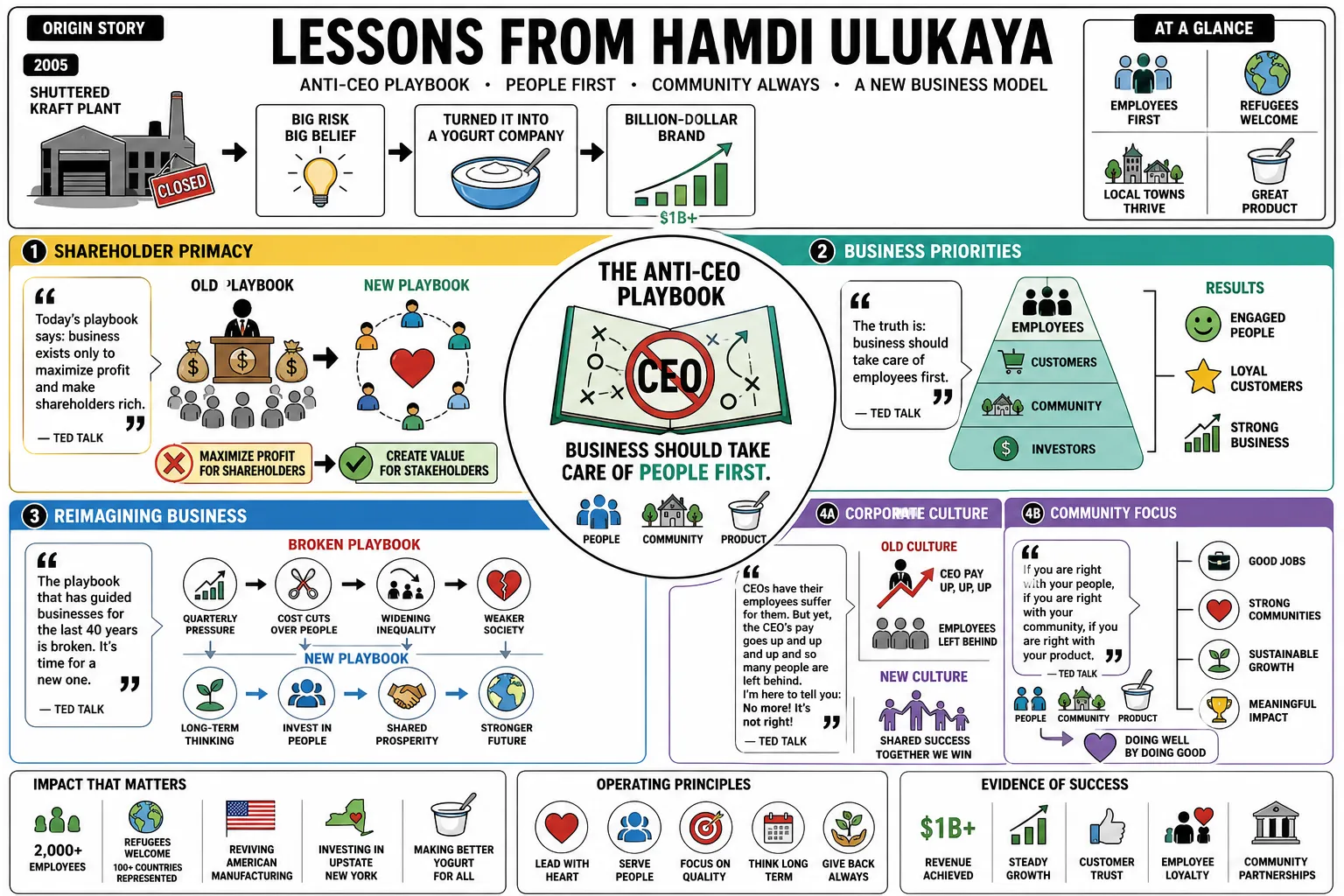
Hamdi Ulukaya founded Chobani after buying a shuttered Kraft yogurt plant in upstate New York in 2005. He built a mass-market yogurt business while emphasizing factory workers, local communities and practical employment opportunities for refugees. He calls this people-centered approach an anti-CEO playbook. — HBR On Leadership.
Part 1: The Anti-CEO Playbook
- Reject Shareholder-Only Thinking: Ulukaya argues that a business should not treat maximizing shareholder returns as its only purpose; employees and communities also matter. — The Anti-CEO Playbook.
- Put Employees First: His anti-CEO approach puts employees near the center of business decisions rather than treating them only as a cost. — The Anti-CEO Playbook.
- Rewrite the Business Playbook: Ulukaya calls for a different CEO playbook that gives people and communities weight alongside profit. — The Anti-CEO Playbook.
- Question CEO–Worker Priorities: Ulukaya criticizes leadership models that reward executives while workers bear the costs; his proposed alternative emphasizes employees. — The Anti-CEO Playbook.
- Link Business and Community: Ulukaya describes workers, communities and product quality as part of a company's success, not mere externalities. — TED ReThinking — Hamdi Ulukaya.
- Look Beyond the Spreadsheet: Seeing the old plant close led Ulukaya to consider its former workers and town, not merely the equipment's financial value. — TED ReThinking — Hamdi Ulukaya.
- Measure More Than Profit: In his anti-CEO argument, Ulukaya distinguishes financial profit from the wider value a business can create for people and communities. — The Anti-CEO Playbook.
- Build Community Through Business: Ulukaya says Chobani's early factory revival became a collective story involving former workers, local farmers and the town. — TED ReThinking — Hamdi Ulukaya.
- Stay Close to the Factory: Ulukaya said he stayed at the factory for years while learning to make and sell the product, keeping himself close to the work. — TED ReThinking — Hamdi Ulukaya.
Part 2: Community and Manufacturing
- Notice What a Closure Does to People: Ulukaya recalled the shut plant feeling like a cemetery and described how its closure affected workers and the town. — TED ReThinking — Hamdi Ulukaya.
- A Factory Closure Reaches Beyond Jobs: In Ulukaya's account, the shutdown signaled to workers that their work and town were being written off; reopening it restored a collective sense of possibility. — TED ReThinking — Hamdi Ulukaya.
- Commit to Making Things: Ulukaya spent years at the former Kraft plant developing Chobani rather than treating its purchase as a quick exit. — TED ReThinking — Hamdi Ulukaya.
- See the Community Around the Company: Ulukaya ties Chobani's purpose to the people and places around its factories; he describes community investment as compatible with a profitable business. — TED ReThinking — Hamdi Ulukaya.
- Choose a Place for Supply, Skills and Community: Chobani said it selected Twin Falls for its milk supply, skilled labor force and tight-knit local community. — Chobani — Twin Falls Announcement.
- Give Manufacturing Time: Ulukaya said he remained closely involved at the plant for about five years while the team developed Chobani and its market. — TED ReThinking — Hamdi Ulukaya.
- Recognize the People Who Make the Product: At Twin Falls, Ulukaya credited Chobani's growth to the hands of the people making its products. — Chobani — Twin Falls Grand Opening.
- Respect the Workers Who Keep a Plant Going: Ulukaya described the quiet courage of former plant workers during closure and recruited some of them for Chobani's restart. — TED ReThinking — Hamdi Ulukaya.
Part 3: Refugees and The Tent Partnership
- A Job Can Change a Refugee's Life: Ulukaya says employment helps refugees regain agency and begin integrating into a new community. — Tent — Hamdi Ulukaya.
- Bring Businesses into Refugee Integration: Ulukaya founded Tent to mobilize employers to hire and prepare refugees for work, not merely to rely on government or charitable aid. — Tent — Hamdi Ulukaya.
- See Refugees as Capable Workers: Ulukaya urged employers to recognize the resourcefulness and experience refugees bring, and described benefits to Chobani as well as workers. — TED ReThinking — Hamdi Ulukaya.
- Work Side by Side: Ulukaya described Chobani employees from many nationalities working alongside one another in the same plant. — TED ReThinking — Hamdi Ulukaya.
- Mobilize Employers Through Tent: After seeing Chobani's refugee hires integrate at work, Ulukaya founded Tent to encourage other businesses to hire and train displaced people. — Tent — Hamdi Ulukaya.
- A Diverse Workforce Can Change Company Culture: Ulukaya said refugee coworkers' experiences influenced others at Chobani while the company also gained from their work. — TED ReThinking — Hamdi Ulukaya.
- Reduce Fear Through Shared Work: Ulukaya recounted coworkers from different backgrounds working shoulder to shoulder, challenging assumptions about unfamiliar people. — TED ReThinking — Hamdi Ulukaya.
- Give Hope Through Opportunity: In his Giving Pledge letter, Ulukaya wrote that those blessed with opportunity should give hope to others. — Hamdi Ulukaya — Giving Pledge Letter.
- Make Hiring Practical: At Chobani, Ulukaya addressed barriers to refugee hiring by arranging transport, translators and training through the plant. — TED ReThinking — Hamdi Ulukaya.
- Let Personal Experience Inform Inclusion: Ulukaya's own experience arriving in America with little English shaped his attention to the safety and opportunity that work can offer newcomers. — TED ReThinking — Hamdi Ulukaya.
Part 4: Entrepreneurship and Risk
- Act Before Every Detail Is Settled: Ulukaya bought the old yogurt plant with an SBA-backed loan despite having no settled playbook for scaling it; he wanted freedom to make consequential founder decisions quickly. — HBR On Leadership.
- Survival Builds Resourcefulness: His earlier small cheese business nearly failed. He says surviving it trained him to be resilient, find solutions and approach the later yogurt opportunity with more confidence. — Masters of Scale.
- The Cheese Business Was Hard: Before Chobani, Ulukaya struggled to keep his small cheese plant afloat and at points could barely pay for milk or employees; he later described this as training in resilience. — Masters of Scale.
- Take a Calculated Leap: He bought the shuttered Kraft yogurt plant in 2005 for about $700,000 through an SBA loan and local-agency help, then worked with four former plant employees on the recipe before launch. — HBR On Leadership.
- Use Lessons from a Small Business: Operating a small cheese factory gave Ulukaya enough dairy experience to believe he could revive a larger yogurt plant, even though he had no detailed plan for doing so. — Masters of Scale.
- Adapt as the Company Changes: Ulukaya says a startup, a national distributor and a multi-plant company require different capabilities. He sees organizational flexibility and people who can solve new problems as central to scaling. — HBR On Leadership.
- Trust Product Judgment, Then Test It: Without formal business training, Ulukaya backed a belief that more natural, nutritious yogurt could sell in ordinary supermarkets; the product's early reception helped validate that bet. — HBR On Leadership.
- Demand Creates a New Bottleneck: After a local supermarket rapidly sold through Chobani yogurt, Ulukaya concluded the challenge had shifted from finding buyers to producing enough, and stayed close to the factory through the next growth phase. — Masters of Scale.
- See What Incumbents Overlooked: Ulukaya thought mainstream American yogurt was too sugary and saw room for a more natural, nutritious product at an accessible price; he made that bet even though the large incumbent had exited the plant. — HBR On Leadership.
Part 5: Leadership and Culture
- Keep the Shepherd's Perspective: Ulukaya traces Chobani's name and his way of thinking about shared responsibility to his Kurdish pastoral upbringing; while leading the company, he says he still considers himself a factory worker. — HBR On Leadership.
- Stay Close to the Factory: Ulukaya says he remained at the original factory from 2007 to 2012 and later moved to Idaho to help fix difficulties at the new plant, although he also learned that founder-led management alone does not scale indefinitely. — Masters of Scale.
- Share the Company's Success: Ulukaya says people who built Chobani should receive financial recognition, not just praise. He describes distributing 10% of the company among employees through Chobani Shares. — HBR On Leadership.
- Let Trusted Colleagues Warn You: Without a conventional business network or board in Chobani's early years, Ulukaya relied on factory colleagues and the local community for support and asked them to warn him when he was going in the wrong direction. — HBR On Leadership.
- Lead from Your Own Background: Ulukaya connects Chobani's mission and worker-first commitments to his Kurdish rural upbringing and the experience of seeing a factory closure affect an upstate New York community. — HBR On Leadership.
- Benefits Are Part of Being Employee-First: Ulukaya says factory employees need pay that reflects local living costs, health coverage comparable to his own and parental leave, before a company can credibly call itself employee-first. — HBR On Leadership.
- Know When the Company Must Change: Ulukaya says leaders can become too attached to the people and structure that served a startup. As Chobani grew, he had to recognize when different capabilities and organizational changes were needed. — HBR On Leadership.
- Keep Workers at the Center: Ulukaya says he tries to remain a factory worker in outlook even as CEO, and that the people making Chobani's products must be recognized financially as well as personally. — HBR On Leadership.
- Give Frontline Teams a Stake: Ulukaya credits Chobani's early factory workers with finding ways to make the old plant productive, and he links their commitment to recognizing them as central to the company. — HBR On Leadership.
Part 6: Product and Quality
- Keep Ingredients Simple: Ulukaya says he wanted yogurt he would serve to his own family; he criticized complicated ingredient lists and pursued simple, nutritious food that more people could access. — Washington Post Live.
- Notice the Mainstream Product Gap: Ulukaya says the yogurt available near his upstate New York home was too sugary and unlike the simple yogurt he knew; this gap motivated Chobani's product. — Masters of Scale.
- Bring Tradition into a New Market: Ulukaya drew on his Kurdish family's generations of cheese and yogurt making, then adapted that background to create a product intended for American supermarkets. — HBR On Leadership.
- Design the Cup as Part of the Launch: Ulukaya says he developed the yogurt, chose the Chobani name and designed the cup with his small early team before the 2007 launch. — Washington Post Live.
- Make Good Yogurt Accessible: Ulukaya says he wanted a simple, high-quality cup of yogurt to be available regardless of shoppers' location or income, rather than confined to specialty stores. — Washington Post Live.
- Scale Without Abandoning Quality: Ulukaya describes scaling natural, nutritious food as harder than producing cheap food; he says Chobani had to adjust people, systems and operations as distribution and factory capacity grew. — HBR On Leadership.
- Evolve Products Without Losing the Mission: Ulukaya says Chobani expanded into new formats and products while trying to preserve its original commitment to quality, nutrition and accessibility. — Washington Post Live.
- Let Repeat Demand Test the Product: When the first local supermarket quickly sold through Chobani yogurt, Ulukaya took that response as evidence that demand existed and shifted attention to making enough. — Masters of Scale.
Part 7: Wealth, Equity, and Success
- Let Employees Participate in Growth: Ulukaya says Chobani Shares distributed an ownership stake among employees so their contribution to building the company could be recognized financially. — HBR On Leadership.
- Give Wealth a Wider Purpose: In his Giving Pledge letter, Ulukaya committed a majority of his personal wealth to helping refugees and described using his opportunity to give hope to others. — Giving Pledge Letter.
- Resist Premature Investor Pressure: Ulukaya says he avoided outside investors early so he could make product and factory decisions quickly without pressure to sell the company before its model was proven. — HBR On Leadership.
- Use Entrepreneurship for Community Impact: Ulukaya's signed pledge letter links Chobani's success to the ability to help others and commits a majority of his personal wealth to refugee assistance. — Giving Pledge Letter.
- Measure More Than Financial Returns: Ulukaya says he wanted Chobani's employees and surrounding communities to benefit from its success, and he treated financial recognition for workers as part of that commitment. — HBR On Leadership.
- Pay and Benefits Are Leadership Decisions: Ulukaya argues that minimum wage was insufficient for his factory communities and describes offering stronger pay, healthcare and parental leave. The old numerical CEO-pay comparison is not supported by this source. — HBR On Leadership.
- Protect Founder Freedom Until the Model Works: Ulukaya says delaying outside equity let Chobani remain independent while he made risky but important decisions; he later welcomed investors after he believed the company had passed its early proof points. — HBR On Leadership.
Part 8: Philosophy and Origins
- Childhood in a Kurdish Nomadic Family: Ulukaya describes summers in the mountains with his Kurdish shepherd family, helping make cheese and yogurt, and learning to value trust and social reputation alongside possessions. — Masters of Scale.
- Adapt to Changing Conditions: Ulukaya links his nomadic upbringing to a practical way of facing uncertainty, then describes applying that resourcefulness when moving from a small cheese plant to a larger yogurt factory. — Masters of Scale.
- An Immigrant Can Build Local Roots: Ulukaya says he arrived in the United States in 1994, learned English, and found strong friendships and support in the upstate New York community where he built Chobani. — Washington Post Live.
- Find Similarities in a New Community: Ulukaya says he looked for similarities between the place where he grew up and the New York town where he settled, which helped him build relationships across their differences. — Washington Post Live.
- The Cheese Venture Came First: Before Chobani, Ulukaya founded Euphrates, a small feta-cheese business, after his father brought cheese from Turkey and the idea of importing it proved impractical. — Masters of Scale.
- Value the People Who Stayed: Ulukaya says factory workers were part of his early support system, giving practical help and honest warnings when he had few experienced business advisers around him. — HBR On Leadership.
- Early Near-Failure Built Resilience: Ulukaya says the cheese business came close to bankruptcy and that surviving it helped him face later uncertainty at Chobani. — Masters of Scale.
- Show That Business Can Help People: Ulukaya presents the anti-CEO approach as putting workers and communities at the center of business, and his own pledge directs personal wealth toward helping refugees. — TED Talk.
- Change Business Through Concrete Choices: Ulukaya's anti-CEO message points to concrete decisions—worker ownership, improved benefits and refugee hiring—as ways a business can serve more than shareholders. — HBR On Leadership.