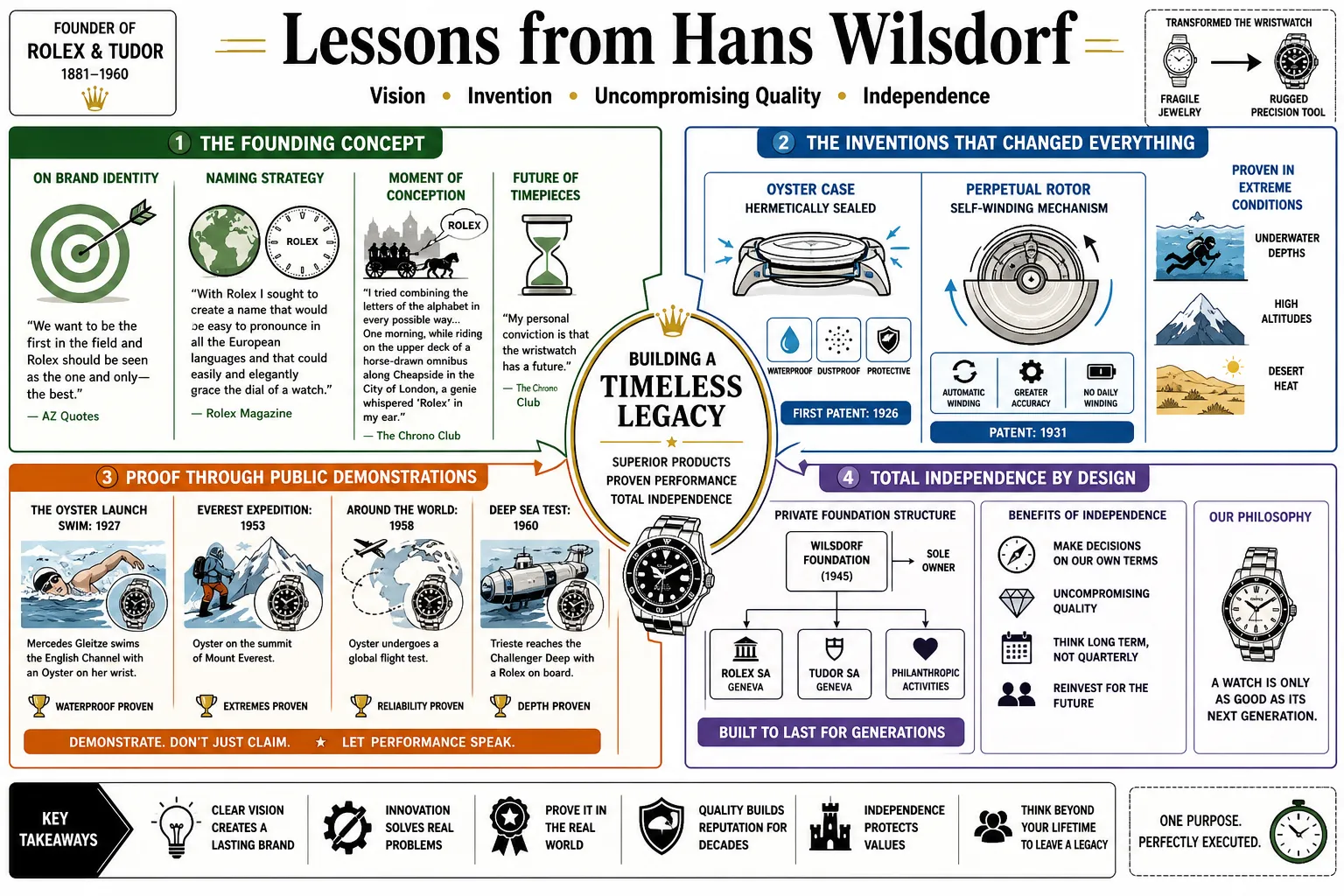
Hans Wilsdorf founded Rolex and later established the Tudor Watch Company. Under his leadership, Rolex introduced the waterproof Oyster in 1926 and its Perpetual rotor in 1931, advancing his aim of a precise, reliable wristwatch for everyday use. — Oyster Story.
Part 1: The Founding Concept
- Build a Distinct Brand: He wanted Rolex to be regarded as the leading wristwatch brand: in the company's own history, he calls for Rolex to be seen as 'the one and only – the best.' — Rolex Oyster History.
- Choose a Name That Travels: In his own account, Wilsdorf said the name Rolex was short enough for a watch dial, easy to remember, pleasant sounding, and pronounced consistently across European languages. — Wilsdorf’s Step by Step.
- Make the Name Memorable: Wilsdorf recalled testing many letter combinations before the name Rolex came to him while riding a horse-drawn omnibus in London. — Rolex History.
- Back the Wristwatch: Wilsdorf anticipated that wristwatches could displace pocket watches and sought to make the smaller format accurate enough for everyday use. — Rolex History.
- Think Differently: Wilsdorf urged Rolex to think and act differently from other watchmakers; Rolex still uses that 1951 statement to introduce its current improvement programme. — Rolex Oyster Story.
- Prove the Wristwatch: When wristwatches were regarded as imprecise, Wilsdorf pursued small, accurate Swiss movements to demonstrate that a watch worn on the wrist could be reliable. — Rolex History.
- Put Rolex on the Dial: Wilsdorf wanted the Rolex name visible on the dial at a time when retailers preferred to display their own names. — Wilsdorf’s Step by Step.
- Win Retailers Gradually: He introduced Rolex-branded dials gradually: first on one watch in six, then on two, then three, as retailers became more willing to sell them. — Wilsdorf’s Step by Step.
- Build on Past Progress: Looking back on Rolex's early achievements, Wilsdorf wrote that the progress already made strengthened his confidence in the company's future. — Rolex and Partners.
Part 2: The Pursuit of Precision
- Put Accuracy First: Wilsdorf first focused on making wristwatches precise and reliable, using small Swiss-made movements to challenge the belief that a wrist-worn watch could not keep accurate time. — Rolex History.
- Prove Accuracy in Bienne: In 1910, a Rolex wristwatch received the Swiss Certificate of Chronometric Precision from the official rating centre in Bienne—the first wristwatch to earn that certificate. — Rolex History.
- Meet the Kew Standard: A Rolex wristwatch earned a Class A precision certificate from Britain's Kew Observatory in 1914, a distinction previously reserved for marine chronometers. — Rolex History.
- Work with a Movement Specialist: Wilsdorf sourced small, precise movements from a Bienne watchmaker rather than treating a retail brand alone as proof of technical quality. — Rolex History.
- Test In-House and Externally: Rolex tested its watches in-house to its own requirements while also seeking neutral, independent certification against wider precision criteria. — Rolex Certification.
- Answer Skepticism with Tests: Because wristwatches were widely doubted as precision instruments, Wilsdorf sought independent certificates that could substantiate the performance of Rolex watches. — Rolex Certification.
- Make Certification Visible: In the late 1930s, Rolex changed its dial wording from 'Chronometer' to 'Officially Certified Chronometer' to distinguish watches whose precision it had submitted for independent certification. — Swiss Watch Industry Federation.
- Use Independent Certification: Rolex did not rely only on its own performance claims: it also submitted watches to neutral authorities using external precision criteria. — Rolex Certification.
- Refine the Waterproof Design: Rolex's first Submarine design in 1922 required opening an outer case to reach the crown; the 1926 Oyster replaced that impractical approach with a sealed case whose bezel, back and crown screwed down. — Rolex Oyster Case.
- Keep Later Standards Distinct: Wilsdorf's early pursuit of independently demonstrated accuracy set a lasting Rolex priority. In 2026, the company's evolving Superlative Chronometer programme added new testing criteria. — Rolex Oyster Story.
Part 3: The Oyster and Waterproofing
- Persist Through Technical Skepticism: Looking back in 1945, Wilsdorf said many watchmakers had regarded a waterproof wristwatch as impractical or without a future. He nevertheless pursued a sealed case. — Rolex Oyster Press Kit.
- Name the Design for Its Function: Wilsdorf said the Oyster name came from the watch's ability, like its namesake, to remain underwater without damage to its parts. — Rolex Oyster Press Kit.
- Protect Precision with a Seal: Wilsdorf pressed his technical team for a case that would shield the movement from dust, perspiration, water, heat and cold, because environmental intrusion threatened accuracy. — Rolex Certification.
- Keep Contaminants Out: The sealed Oyster case was intended to prevent dust and water from reaching the movement and degrading its long-term timekeeping. — Rolex Oyster Press Kit.
- Recognize the Oyster Breakthrough: At the Oyster's launch, Wilsdorf described it as the most important recent invention in watchmaking, reflecting how central waterproofing was to his wristwatch strategy. — Rolex Oyster Press Kit.
- Stand Behind the Product: In 1927, Wilsdorf publicly declared that Rolex made the best wristwatch in the world, expressing his confidence in the Oyster at its launch. — Rolex Oyster Story.
- Design for Everyday Exposure: Wilsdorf argued that a sealed watch should remain on the wrist while its wearer washed, bathed, worked in dust or perspired; practicality was part of the Oyster proposition. — Rolex Oyster Case.
Part 4: Demonstrations and Marketing
- Build a Testimonee Story: Rolex traces its own Testimonee concept to its 1927 publicity around Mercedes Gleitze and the Oyster: a demanding real-world test became a product testimonial. — Rolex History.
- Put Waterproofing to a Public Test: During Mercedes Gleitze's 1927 cross-Channel swim, an Oyster spent more than ten hours in cold water and remained working; Rolex then made the demonstration central to its publicity. — Rolex History.
- Show the Watch Underwater: A 1930s Rolex advertisement placed an Oyster inside a goldfish tank to make its waterproof claim visible rather than abstract. — Rolex Oyster History.
- Equip Real-World Pioneers: Rolex later entrusted Oyster watches to explorers, scientists, athletes, pilots, seafarers, mountaineers and divers, whose experience tested the product beyond a showroom. — Rolex Oyster Story.
- Turn a Test into a Story: After the 1927 Channel demonstration, Rolex placed a full-page Daily Mail advertisement about the working Oyster, connecting an engineering result to a memorable public narrative. — Rolex History.
- Test with Record-Setters: Rolex supplied watches for the 1933 Everest overflight and documented Sir Malcolm Campbell wearing one for his 1935 land-speed record—specific examples of its living-laboratory approach. — Rolex History.
- Reduce Crown Openings: The 1931 Perpetual rotor let an Oyster wind while worn, reducing the need to unscrew its crown and thus helping preserve the case's resistance to moisture and impurities. — Rolex Perpetual Rotor.
- Adopt a Useful Bracelet: In his memoir, Wilsdorf said an expanding bracelet created by another jewelry firm appealed to British buyers and helped early Rolex sales across Empire markets. — Wilsdorf’s Step by Step.
Part 5: Expanding the Market with Tudor
- Offer Dependability at a Lower Price: Wilsdorf said he wanted agents to sell a watch at a more modest price than Rolex while retaining the dependability for which Rolex was known. — Tudor — The Origins.
- Give Tudor Its Own Company: Wilsdorf established Montres TUDOR S.A. in March 1946 to market the Tudor watch as a separate company and brand. — Tudor — The Origins.
- Develop a Distinct Identity: Tudor's own history says that after the war Wilsdorf wanted the brand to have an identity of its own, even as Rolex initially backed its technical and service standards. — Tudor — The Origins.
- Share Proven Watchmaking Features: Early Tudor watches used a waterproof Oyster case and an Oyster-type crown, showing how the related brand drew on Rolex-associated watchmaking features. — Tudor — The Origins.
- Back the Watch After Sale: At Tudor's 1946 launch, Rolex guaranteed technical, aesthetic and functional characteristics as well as distribution and after-sales service, backing the lower-priced brand with an explicit support structure. — Tudor — The Origins.
Part 6: Hardship and Self-Reliance
- Learn Self-Reliance Early: In his 1946 account, Wilsdorf said his uncles encouraged him to become self-reliant after his parents died. He connected the habit of caring for his possessions with part of his later success. — Wilsdorf’s Step by Step.
- Prepare for Work Through Education: Orphaned at twelve, Wilsdorf later credited boarding-school education and early work in a pearl-export business with skills he found valuable throughout his career. — Wilsdorf’s Step by Step.
Part 7: Independence and Legacy
- Establish a Lasting Foundation: In 1945, Wilsdorf created the Fondation Hans Wilsdorf, which today owns the Rolex group. — Fondation Hans Wilsdorf.
- Separate Ownership from a Personal Estate: The Fondation Hans Wilsdorf is a private shareholder foundation funded by dividends from the Rolex group and directed toward public-interest objectives. — Fondation Hans Wilsdorf.
- Fund Public-Interest Work: The foundation uses dividend-derived income for public-interest work spanning social and health needs, education, culture, humanitarian causes, and animals and ecosystems. — Fondation Hans Wilsdorf.
- State a Purpose Beyond the Founder: The foundation's charter records Wilsdorf's instruction, six months before his death, that future foundation income should serve his lifetime aim of helping humanity. — Foundation Charter.
Part 8: The Philosophy of Quality
- Compete on Product Quality: Rolex's early programme concentrated on improving movement quality and demonstrating precision through official tests. The 1910 Bienne certificate was a visible result of that priority. — Rolex History.
- Make the Object Support the Claim: Rolex paired the Oyster's sealed technical design with public demonstrations such as Gleitze's swim. The campaign relied on an operating watch, not just an advertising assertion. — Rolex Oyster Press Kit.
- Keep Improving the Watch: Rolex describes the Oyster as an ongoing programme of improvement rather than a fixed 1926 design, with later engineering revisions building on Wilsdorf's original aim. — Rolex Oyster Story.
- Solve Concrete Failure Modes: Rolex moved from the impractical 1922 Submarine case to the sealed Oyster, then used the 1931 free rotor to reduce repeated crown opening—two specific ways it addressed vulnerabilities. — Rolex Oyster Press Kit.
- Write Down the Early History: Wilsdorf's 1946 Rolex Jubilee Vade Mecum includes his first-person account of the company's first decades and the steps that led to Rolex's early products. — Wilsdorf’s Step by Step.
- Turn a Delicate Format into a Tool: Wilsdorf pursued a wristwatch that would keep accurate time while resisting water and dust, moving beyond the era's view of wristwatches as vulnerable jewellery. — Rolex Oyster Story.
- Use Field Experience to Improve: Rolex says feedback from explorers and other demanding users helped its engineers improve the Oyster after those watches were tested in real conditions. — Rolex Oyster Story.
- Make a Practical Promise: Wilsdorf told customers they could keep an Oyster on through everyday exposure to water and dust, an assurance grounded in its sealed case. — Rolex Oyster Case.