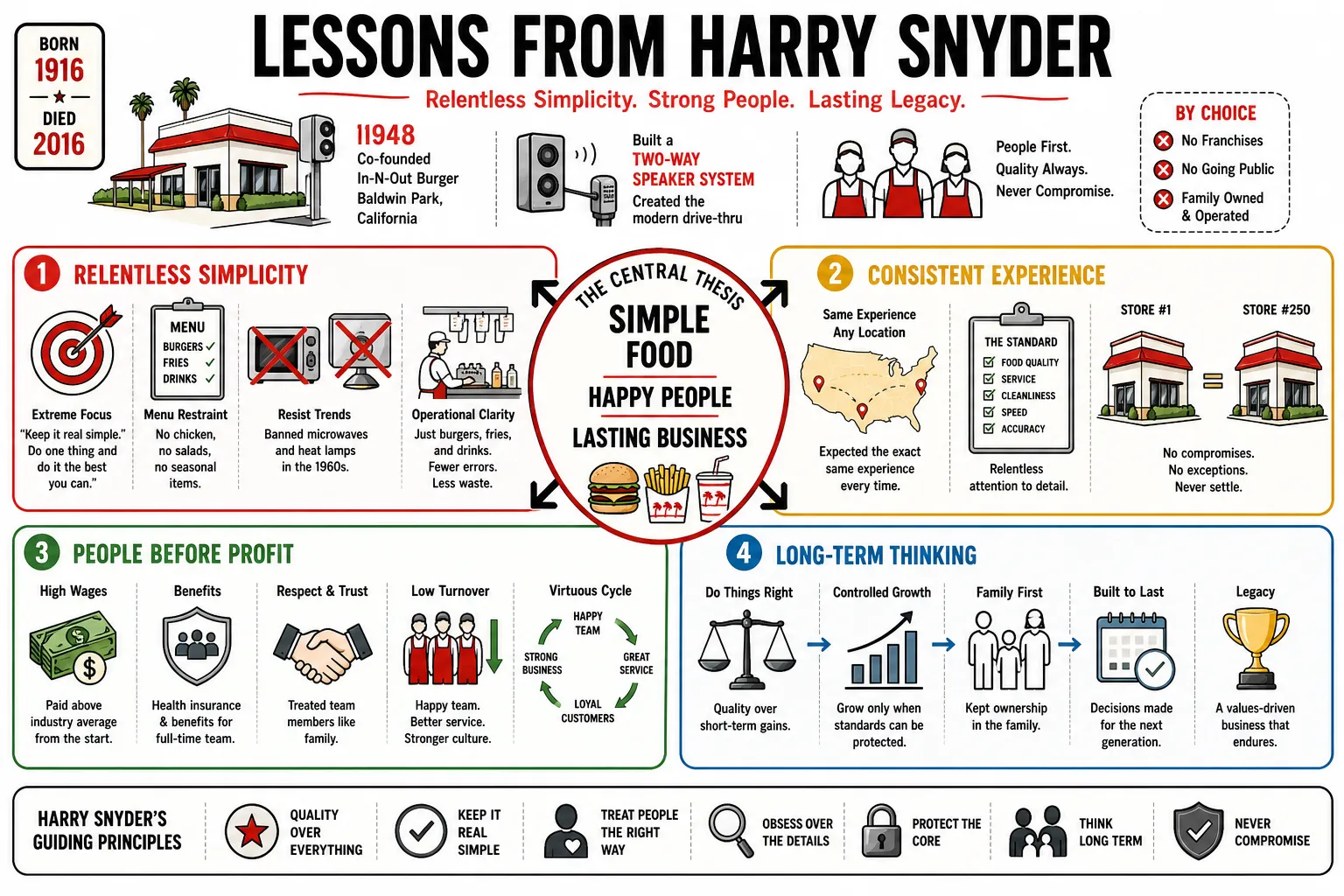
Lessons from Harry Snyder
Harry and Esther Snyder opened In-N-Out Burger in Baldwin Park, California, in 1948. Harry sourced fresh ingredients and built a two-way speaker box so customers could order from their cars, while Esther kept the books. Their early emphasis on food quality, friendly service and cleanliness shaped the family-owned company. — In-N-Out History.
Part 1: Relentless Simplicity
- On Doing One Thing Well: Harry and Esther Snyder built In-N-Out around a deliberately limited burger menu and close attention to food quality, rather than matching larger chains item for item. — Stacy Perman on In-N-Out.
- On Menu Restraint: Harry kept the original menu simple; the company's later growth largely preserved its focus on burgers, fries and drinks rather than continual new categories. — Stacy Perman on In-N-Out.
- On Consistent Standards: The founding standard joined fresh, high-quality food with friendly service and clean surroundings; In-N-Out still identifies those as Harry's core operating principles. — In-N-Out's Founding Philosophy.
- On a Clean Environment: Clean surroundings were part of Harry and Esther's founding service standard, alongside fresh food and friendly treatment of customers. — In-N-Out's Founding Philosophy.
Part 2: Uncompromising Quality
- On Early-Morning Sourcing: Harry went to local meat and produce markets before dawn to choose fresh ingredients for the first In-N-Out stand. — In-N-Out History.
- On Patty Preparation: In-N-Out's early patties were formed by Esther until a central facility opened in 1963; the family's direct control of preparation supported its freshness standard. — In-N-Out History.
- On Fresh-Cut Fries: A surviving 1976 In-N-Out lap mat says the fries were peeled and diced from fresh potatoes in stores, not cooked from frozen fries. — Smithsonian 1976 In-N-Out Lap Mat.
- On a Fresh-Food Standard: The company says it still supplies never-frozen ingredients; that current practice continues the founders' stated commitment to fresh, high-quality food, without proving Harry personally specified every later logistics rule. — In-N-Out: Founding Quality Standard.
- On Real Ice-Cream Shakes: In 1975, during Harry's lifetime, In-N-Out added shakes made with real ice cream to its menu. — In-N-Out History.
- On a Consistent Bun Supplier: The chain's bun supplier relationship began in 1954, during Harry and Esther Snyder's founding era, and was still in place more than four decades later. The available record does not establish that Harry personally formulated the sponge-dough recipe. — Los Angeles Times — Esther Snyder Interview.
- On Making the Work Visible: The historic Baldwin Park stand had an open kitchen visible through large glass windows, with the grill at an open window. The design let customers see part of the preparation rather than hiding it behind a wall. — Perman’s In-N-Out Burger.
Part 3: Empowering the Associates
- On Treating Associates as Family: The company remembers Harry's care for Associates as part of the founding culture; Lynsi Snyder separately credits Esther with making sure Associates were treated like family. The record does not establish that Harry coined the term or banned other words. — In-N-Out History.
- On Early Pay: Harry and Esther paid above the minimum wage from the chain's early years, according to reporting based on Esther's direct interview and early employee accounts. — Los Angeles Times: Family-Owned In-N-Out.
- On Paying for Retention: Esther said Harry believed that paying people well would encourage both good work and a desire to stay; early staff benefits and long tenure make that belief concrete. — Los Angeles Times: Family-Owned In-N-Out.
- On Internal Opportunity: Chuck Papez recalled Harry offering him a job and a career in 1954; Papez began in the kitchen and became a manager within five years. — Los Angeles Times: Family-Owned In-N-Out.
- On Early Team Loyalty: Early employee Chuck Papez recalled that Harry offered him a long-term career in 1954 and that the first stand felt like a family; his account illustrates the founders' durable relationships with staff. — Los Angeles Times: Early Associates.
- On Sharing Success: The founding Snyders began sharing profits with workers early in the chain's history; contemporary reporting also records Harry's annual savings-bond gifts to staff. — Los Angeles Times: Family-Owned In-N-Out.
- On a Visible Team Standard: In-N-Out's store uniforms were predominantly white until red aprons replaced them in 1974, during Harry's lifetime; the record supports the uniform tradition but not the claimed personal grooming theory. — In-N-Out History.
Part 4: Steady, Deliberate Growth
- On Staying Independent: Harry and Esther grew In-N-Out as a company-owned chain rather than franchising; the family's later leaders continued that approach to protect food and service quality. — In-N-Out: Company-Owned Growth.
- On Patient Growth: When Harry died in 1976, In-N-Out had 18 restaurants. Its measured expansion during his lifetime contrasts with the rapid franchised growth of larger chains. — In-N-Out History.
- On Using Every Part of a Site: Perman reports that In-N-Out sometimes leased unused space at its properties, including room for a pet shop beside Store No. 1. The example shows how the young company put a small site to additional use. — Perman’s In-N-Out Burger.
Part 5: Customer-Centric Innovation
- On the Drive-Thru Speaker: An amateur electronics enthusiast, Harry built a two-way speaker box in his garage so customers could order from their cars at the original Baldwin Park stand. — In-N-Out History.
- On Friendly Service: The founders' operating standard joined fresh food with friendly customer service and a clean environment; the speaker box did not replace that service principle. — In-N-Out: Founding Service Standard.
- On Eating in the Car: Harry devised paper lap mats to make it easier for customers to eat burgers in their cars without making a mess. — In-N-Out History.
- On Customer Requests: Animal Style appeared in 1961 in response to customers asking for a different burger preparation; it became an enduring menu customization. — In-N-Out History.
- On Staying Open Late: Harry and Esther chose late operating hours; In-N-Out's history coordinator says the decision helped make the restaurants community gathering places. — Foothills Paper: In-N-Out History.
- On the Crossed Palms: Harry began planting crossed palm trees at stores in 1972, inspired by the hidden-treasure image in a favorite film—not as a highway wayfinding device. — In-N-Out History.
Part 6: Hands-On Leadership
- On Inspecting the Inputs: Esther recalled that Harry visited the meat supplier and watched the cutting to ensure he received the beef he had ordered; his quality checks began before cooking. — Los Angeles Times: Esther Snyder Interview.
- On Working in the Stand: In the company's early years, Harry made burgers himself while Esther managed the books; his hands-on food work preceded the later chain. — Stacy Perman on In-N-Out.
- On Checking Stores at Night: Esther said Harry went around at night to check In-N-Out locations; the specific parking-lot audit ritual in the existing lesson is not established. — Los Angeles Times: Esther Snyder Interview.
- On Doing the Work Himself: Lynsi Snyder remembers Harry as an exceptionally hard worker who personally selected meat, cheese and produce for his customers. The company's history also describes his predawn market visits and nights building the drive-through speaker box. — In-N-Out History.
- On Partnership With Esther: Harry sourced and prepared food while Esther handled the bookkeeping for their first stand; the company began as a working partnership. — In-N-Out History.
Part 7: Financial Independence
- On Paying More to Preserve Quality: At the Irwindale Raceway snack bars, Harry paid experienced In-N-Out staff a premium after a separate crew fell short on food quality and service. — Lynsi Snyder: Irwindale Raceway Excerpt.
- On Word of Mouth: In-N-Out used little advertising in its early years; Stacy Perman's original interview describes how the food and customers' recommendations helped spread its reputation. — Fast Company: Stacy Perman Q&A.
Part 8: Enduring Legacy and Culture
- On a Continuing Standard: In-N-Out still names the founders' emphasis on fresh food, friendly service and cleanliness as guiding principles, though later generations changed and expanded its operations. — In-N-Out Media Kit.
- On Founder-Made Brand Details: Harry designed the company's first cartoon-fryman T-shirt in 1975, a concrete contribution to the brand's visual identity beyond the crossed palms. — In-N-Out History.
- On Early Community Events: During Harry's lifetime, In-N-Out launched cookout events at a Covina school and at Pasadena's Rose Parade; the later charitable foundation was formed by Esther and Rich in 1984. — In-N-Out History.
- On Teaching the Operating Basics: Harry taught managers practical basics ranging from customer and employee treatment to bun preparation and daily reports. Lynsi Snyder says many of those fundamentals remain in use, though formal In-N-Out University was built later under Rich Snyder. — Lynsi Snyder Interview.
- On Family Ownership: The family still owns and operates In-N-Out. That continuity preserves the founders' independent-company model, though later generations made their own management decisions. — In-N-Out: Family Ownership.