Herb Kelleher co-founded Southwest Airlines and built it into the most consistently profitable airline in the United States by stubbornly prioritizing his employees over customers and shareholders. He proved that an organization could operate with ruthless financial discipline and efficiency without sacrificing its sense of humor or its humanity. His approach to leadership—treating culture as a hard competitive advantage rather than a soft metric—offers a practical blueprint for running a business at scale.
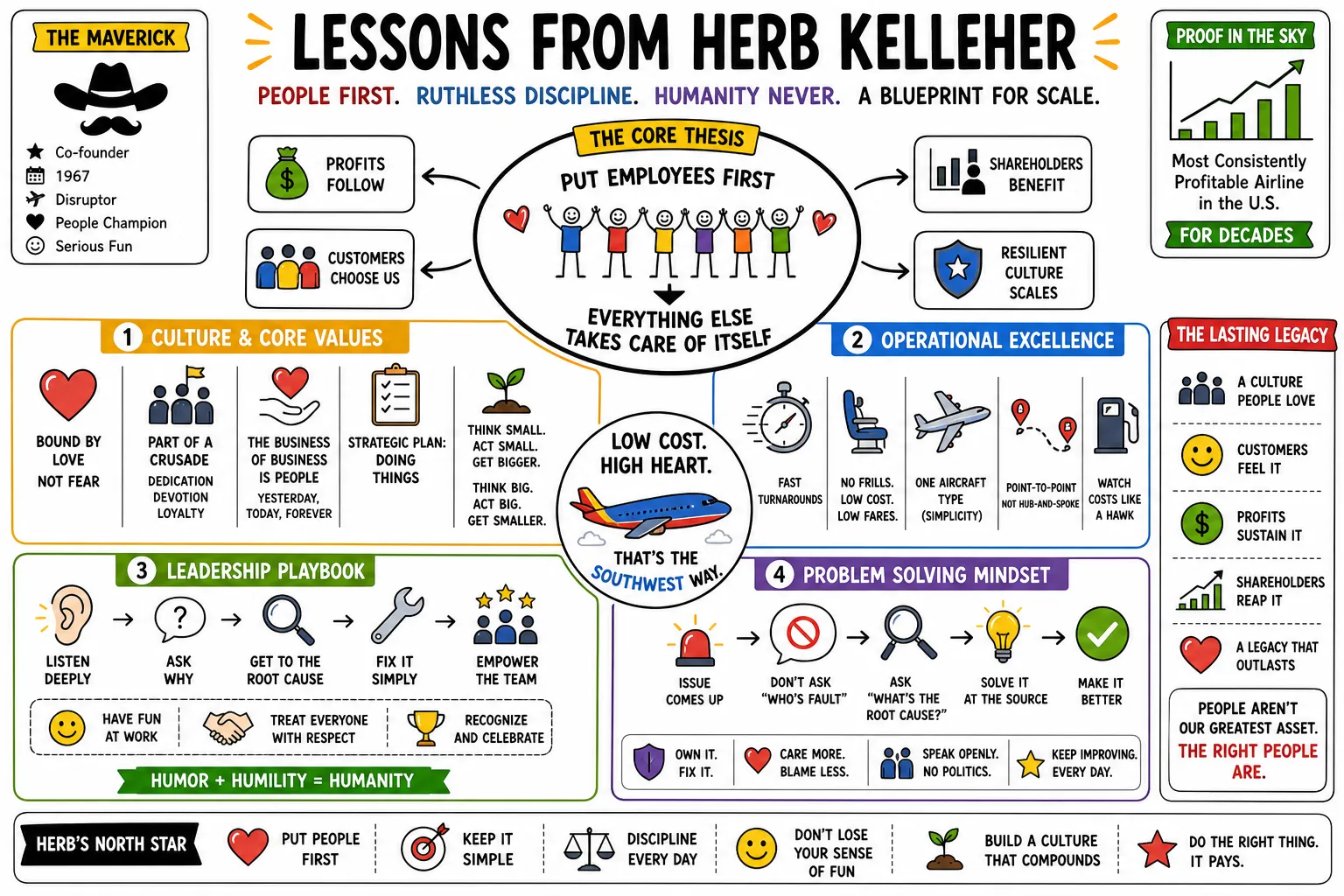
Part 1: Culture & Core Values
- On company culture: "A company is stronger if it is bound by love rather than by fear." — Source: [US Chamber of Commerce]
- On intangibles: "They can buy all the physical things. The things you can't buy are dedication, devotion, loyalty — the feeling that you are participating in a crusade." — Source: [Aviation Quotations]
- On the heart of the business: "The business of business is people. Yesterday, today and forever." — Source: [Barry-Wehmiller]
- On strategic simplicity: "We have a strategic plan. It's called 'doing things'." — Source: [Inc. Magazine]
- On scaling up: "Think small and act small, and we'll get bigger. Think big and act big, and we'll get smaller." — Source: [GuyEwood.com]
- On problem solving: "When an issue comes up, we don't say we're going to study it for two and a half years. We just say, 'Southwest Airlines doesn't do that. Maybe somebody else does, but we don't.'" — Source: [Skip Prichard]
- On managing for the bad times: "You must exercise financial discipline and efficiency during prosperous periods to ensure the company can withstand economic downturns and industry crashes." — Source: [Stanford Graduate School of Business]
- On competitive advantage: "Culture is not a soft asset; it is a sustainable competitive advantage because it is the one thing competitors cannot easily imitate or buy." — Source: [Fearless Culture]
- On bureaucratic bloat: "Bureaucracy is a threat to the corporate spirit, and leadership must actively fight everyday processes that slow down decision-making." — Source: [Corporate Rebels]
Part 2: The Employee-First Philosophy
- On the true hierarchy: "Your employees come first. And if you treat your employees right, guess what? Your customers come back, and that makes your shareholders happy. Start with employees and the rest follows from that." — Source: [Addicted2Success]
- On reciprocity: "Treat your people well and they'll treat you well." — Source: [John Millen]
- On internal service: "Treat your employees like customers." — Source: [Inc. Magazine]
- On individual autonomy: "If you create an environment where the people truly participate, you don't need control. They know what needs to be done and they do it." — Source: [AZQuotes]
- On honoring the total person: "A company must respond to employees' personal life events—whether celebrating joys or supporting them in grief—to demonstrate they are valued as whole people, not just workers." — Source: [Barry-Wehmiller]
- On rejecting corporate molds: "Employees should not be forced to act like lead soldiers stamped from a mold; giving them the license to be themselves leads to better performance." — Source: [Medium]
- On backing the team: "If a passenger is abusive to an employee, the company should side with the employee and fire the customer without hesitation." — Source: [Forbes]
- On egalitarianism: "Titles do not make anyone inherently better than anyone else; every role is equally necessary to the operational success of the business." — Source: [Tom McCallum]
- On organized labor: "Treating unions as active partners rather than corporate adversaries is essential for maintaining operational harmony and mutual trust." — Source: [NetSuite]
Part 3: Hiring, Firing & People
- On the core hiring rule: "You don't hire for skills, you hire for attitude. You can always teach skills." — Source: [Modern Servant Leader]
- On immutable traits: "We will hire someone with less experience, less education, and less expertise, than someone who has more of those things and has a rotten attitude. Because we can train people... But we can't change their DNA." — Source: [US Chamber of Commerce]
- On filtering candidates: "Treat the interview as starting the moment a candidate walks through the door; rudeness to a receptionist immediately disqualifies an applicant." — Source: [Fearless Culture]
- On cultural fit: "Seek out candidates who take their work incredibly seriously, but refuse to take themselves too seriously." — Source: [Stanford Graduate School of Business]
- On industry baggage: "Some of the most effective employees are hired from completely outside the industry, as they haven't learned the conventional, broken ways of operating." — Source: [Inc. Magazine]
- On protecting the team: "It is far better to leave a necessary position unfilled than to hire someone with a toxic attitude who will poison the existing team dynamic." — Source: [Medium]
- On peer involvement: "Involving frontline peers in the interview and hiring process ensures new recruits will naturally mesh with the teams they are joining." — Source: [Corporate Rebels]
- On looking for altruism: "The ideal job applicant possesses a natural servant's heart and an innate desire to help others succeed." — Source: [University of Texas]
- On swift corrections: "While hiring should be a careful, deliberate process, the company must be quick to fire anyone who routinely violates core values or disrespects coworkers." — Source: [Forbes]
Part 4: The Reality of Leadership
- On the soul of a company: "Leading an organization is as much about soul as it is about systems. Effective leadership finds its source in understanding." — Source: [Addicted2Success]
- On the nature of power: "Power should be reserved for weightlifting and boats, and leadership really involves responsibility." — Source: [GuyEwood.com]
- On the definition of leadership: "Leadership is fundamentally about being a devoted, hard-working servant to the people you lead and sharing in their everyday struggles and victories." — Source: [Modern Servant Leader]
- On swift decision making: "I've always been able to make erroneous decisions very quickly." — Source: [Skip Prichard]
- On passion and purpose: "If you're crazy enough to do what you love for a living, then you're bound to create a life that matters." — Source: [AZQuotes]
- On showing gratitude: "Effective leaders make a deliberate habit of drowning their employees in gratitude and recognizing their hard work as publicly as possible." — Source: [University of Texas]
- On executive visibility: "A CEO cannot effectively lead an operation from a corner office; leadership requires being out on the ramp, inside the planes, and mingling in the break rooms." — Source: [Forbes]
- On authentic vulnerability: "Openly admitting when you are wrong and displaying your flaws builds far more organizational trust than attempting to project an image of executive perfection." — Source: [Deeply Driven Podcast]
- On bearing the burden: "The true job of a leader is to absorb systemic stress and pressure, rather than passing that anxiety down the chain of command to frontline workers." — Source: [John Millen]
- On leading by serving: "True authority is not granted by a title on an organization chart; it is earned by continually removing obstacles for your team." — Source: [Medium]
Part 5: Cost Control & Operational Discipline
- On evaluating ideas: "When someone comes to me with a cost saving idea, I don't immediately jump up and say yes. I ask: 'what's the effect on the customer?'" — Source: [Skip Prichard]
- On absolute frugality: "If the Wright brothers were alive today Wilbur would have to fire Orville to reduce costs." — Source: [Aviation Quotations]
- On legal hurdles: "The Wright Amendment is a pain in the ass, but not every pain in the ass is a constitutional infringement." — Source: [Aviation Quotations]
- On the value of low debt: "Maintaining low corporate debt provides the freedom and flexibility to maneuver when inevitable industry crises wipe out over-leveraged competitors." — Source: [Stanford Graduate School of Business]
- On asset utilization: "An airplane only generates revenue when it is in the air; therefore, rapid turnaround times at the gate are the lifeblood of the financial model." — Source: [Inc. Magazine]
- On fleet simplicity: "Operating a single type of aircraft goes beyond maintenance savings; it radically simplifies crew scheduling, pilot training, and daily operations." — Source: [NetSuite]
- On stripping frills: "Removing unnecessary perks and amenities is the only way to reliably offer the lower fares that customers fundamentally value most." — Source: [Forbes]
- On smart frugality: "True frugality means spending money aggressively where it impacts the customer, while cutting costs that don't add value." — Source: [Tom McCallum]
- On consistent margins: "Profitability is not an accident of good times; it is the direct result of maintaining strict operational discipline even when cash is abundant." — Source: [US Chamber of Commerce]
Part 6: Competition & Strategy
- On institutional paranoia: "It takes nerves of steel to stay neurotic." — Source: [Aviation Quotations]
- On defining the market: "The company was never just competing with other airlines; the true strategy was to compete with the automobile by making flying cheap and accessible." — Source: [Inc. Magazine]
- On the underdog mentality: "Embracing the role of the scrappy underdog keeps a workforce hungry, alert, and firmly united against larger industry adversaries." — Source: [Forbes]
- On ignoring industry norms: "Conventional wisdom often dictates complex solutions; defying those norms by eliminating seat assignments and hub-and-spoke models creates an unassailable advantage." — Source: [Medium]
- On defending the model: "A business must be prepared to fight in the courts and legislatures just as aggressively as it fights in the free market to ensure its right to operate." — Source: [US Chamber of Commerce]
- On competitor distractions: "Never allow legacy competitors to dictate your strategy; focus entirely on executing your core competencies better than anyone else." — Source: [Addicted2Success]
- On maintaining nimbleness: "As an organization grows larger and more complex, leadership must work exponentially harder to retain the agility of a startup." — Source: [Corporate Rebels]
- On surviving price wars: "When massive competitors attempt to price a disruptor out of the market, a foundation of low operating costs and fierce customer loyalty serves as a reliable defense." — Source: [NetSuite]
- On strategic discipline: "True strategy is defined just as much by the lucrative opportunities you choose to ignore as by the ones you pursue." — Source: [John Millen]
Part 7: Customer Service & Hospitality
- On authentic service: "Genuine hospitality cannot be mandated in a script; it organically arises from hiring empathetic people and giving them the freedom to be themselves." — Source: [Fearless Culture]
- On resolving issues quickly: "Frontline employees must be fully empowered to solve customer problems immediately, without the friction of asking a supervisor for permission." — Source: [Medium]
- On the passenger experience: "Air travel should be approached as an inherently enjoyable human experience, rather than a sterile, stress-inducing logistical ordeal." — Source: [Tom McCallum]
- On structural equality: "Eliminating first-class seating sends a clear operational and cultural message that every single passenger deserves to be treated as a first-class citizen." — Source: [Inc. Magazine]
- On the foundation of service: "Friendly interactions and jokes mean absolutely nothing if the fundamentals fail; the planes must arrive on time and the bags must not be lost." — Source: [Forbes]
- On owning mistakes: "When service inevitably falls short, the only correct response is to own the mistake immediately, apologize sincerely, and fix it without offering corporate excuses." — Source: [John Millen]
- On exceeding expectations: "The objective of customer service is not mere satisfaction; it is to delight passengers so thoroughly that they naturally become vocal evangelists for the brand." — Source: [US Chamber of Commerce]
- On direct feedback: "Reading raw letters directly from customers provides unfiltered intelligence on exactly where the company is succeeding and where operational cracks are forming." — Source: [Stanford Graduate School of Business]
- On human connection: "A simple smile or a well-timed joke costs the company absolutely nothing to produce, yet it can completely salvage a stressed traveler's day." — Source: [Barry-Wehmiller]
- On building true loyalty: "Enduring customer loyalty is never truly bought with frequent flyer miles; it is hard-earned through years of consistent, caring, and highly reliable service." — Source: [NetSuite]
Part 8: Fun, Humor & Authenticity
- On the role of humor: "Humor is not a distraction from work; it is a practical tool used to build empathy, foster resilience, and diffuse tension during difficult operational periods." — Source: [Fearless Culture]
- On professional balance: "A healthy culture requires employees who take their daily responsibilities extremely seriously, while staunchly refusing to take themselves seriously." — Source: [Inc. Magazine]
- On authentic presence: "People consistently perform at their highest levels when they are not forced to wear a rigid professional mask and can bring their true personalities to work." — Source: [Medium]
- On unconventional solutions: "If settling a trademark dispute with a public arm-wrestling match saves thousands in legal fees and generates immense goodwill, it is simply a brilliant business decision." — Source: [Forbes]
- On corporate rigidity: "The stiff, emotionless corporate environment is an artificial construct; business is fundamentally a human endeavor and should actively reflect human joy." — Source: [Corporate Rebels]
- On celebrating success: "A vibrant company does not wait for the end of the fiscal year to celebrate; it actively finds reasons to throw parties and recognize small victories continuously." — Source: [Tom McCallum]
- On the power of play: "Integrating playfulness into the daily workflow stimulates creativity and helps break down the rigid, formal hierarchies that typically stifle corporate innovation." — Source: [Deeply Driven Podcast]
- On leading by example: "A chief executive who is willing to dress up in a ridiculous costume or perform a silly skit sends an immediate, clear message that absolutely no one is above having fun." — Source: [John Millen]
- On surviving industry crises: "When the broader economy faces a severe downturn, a deeply ingrained sense of humor acts as the shock absorber that keeps employee morale high and panic low." — Source: [Stanford Graduate School of Business]
- On a life well lived: "Achieving massive commercial success means very little in the end if you didn't genuinely enjoy the journey and leave the people around you smiling." — Source: [Southwest Airlines]