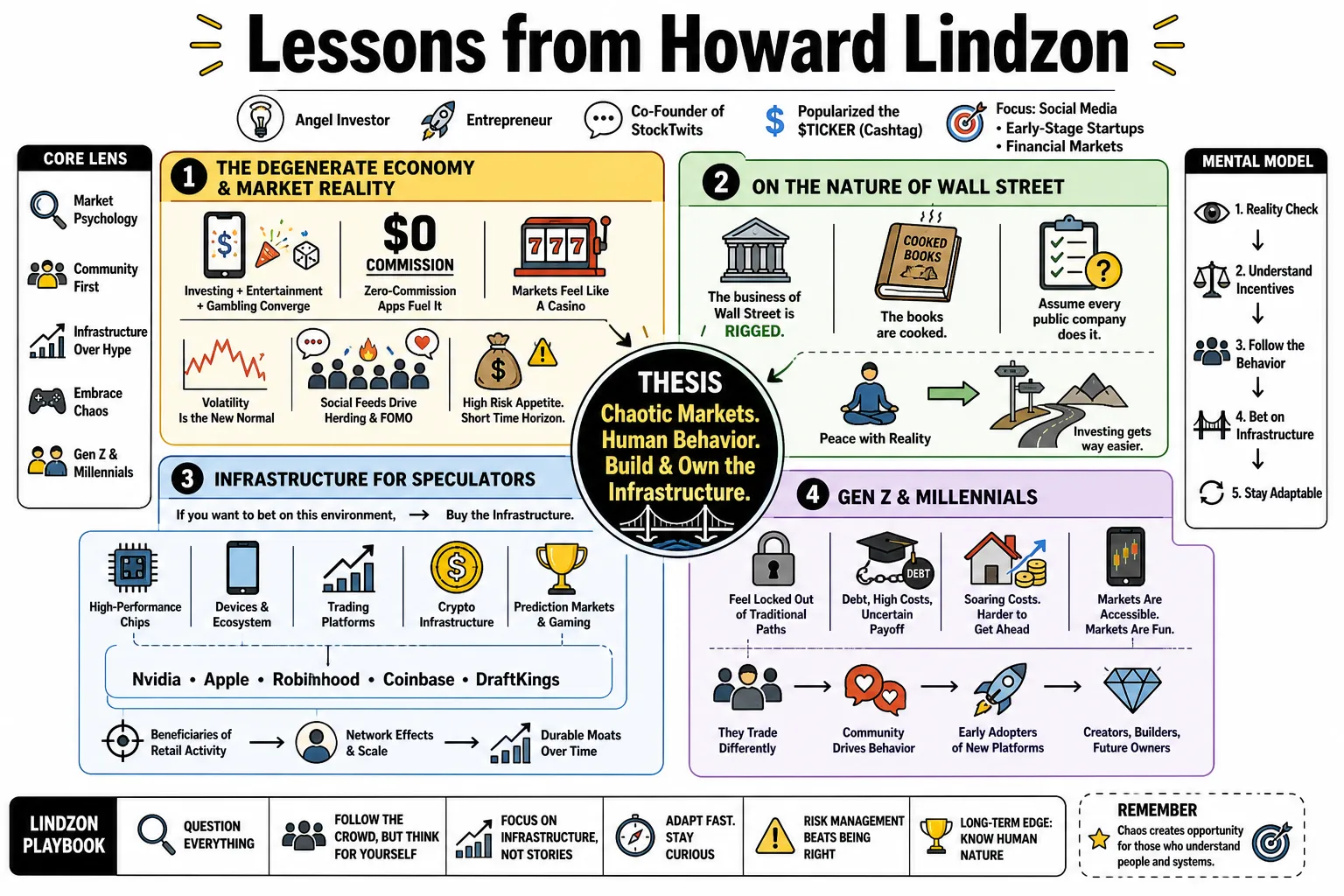
Lessons from Howard Lindzon
Howard Lindzon is an angel investor, entrepreneur, and the co-founder of StockTwits. Best known for popularizing the financial cashtag ($TICKER) and documenting the mechanics of the "degenerate economy," he focuses on the intersection of social media, early-stage startups, and financial markets. His candid insights on market psychology and community-driven trading offer a practical guide for navigating chaotic markets.
Part 1: The Degenerate Economy & Market Reality
- On the nature of Wall Street: "The business of Wall Street is rigged. The books are cooked. Assume every public company does it. Investing gets way easier once you are at peace with that." — Source: [Howard Lindzon Blog]
- On the shift in trading behavior: "We are witnessing the rise of the 'degenerate economy,' where investing, entertainment, and gambling completely converge through zero-commission apps." — Source: [Masters in Business]
- On infrastructure for speculators: "If you want to bet on this chaotic retail environment, you buy the infrastructure of the degenerate economy—companies like Nvidia, Apple, Robinhood, Coinbase, and DraftKings." — Source: [Howard Lindzon Blog]
- On Gen Z and Millennials: "Younger generations feel locked out of traditional paths to wealth, so they naturally turn to high-velocity, high-risk levers like crypto and prediction markets." — Source: [Panic with Friends]
- On market sentiment: "Prediction markets and social media algorithms are systematically making investors more bearish forever, rewarding engagement driven by fear." — Source: [Beehiiv]
- On media narratives: "The financial media exists to spread unnecessary fear; their job is to keep you watching, not to make you money." — Source: [Beehiiv]
- On surviving market shifts: "The market is the ultimate game. You must understand the actual playing field—not the one you wish existed—if you want to survive." — Source: [YouTube]
- On price screens: "If you sit in the barber shop long enough, you're going to get a haircut. Staring at price screens all day inevitably leads to overtrading." — Source: [YouTube]
- On being the last to know: "Retail investors are almost always the last to know the real news. You have to invest with that specific humility." — Source: [Howard Lindzon Blog]
- On permanent fixtures: "Meme stocks and high-risk crypto trading aren't temporary fads; they are permanent fixtures of modern market behavior." — Source: [Masters in Business]
Part 2: Startup Investing & Social Capital
- On his core metric: "I bet on people. I do not live in spreadsheets, I live on the street and on the stream." — Source: [YouTube]
- On missing big deals: "Passing on the early Twitter seed round because I was over-analyzing the valuation remains one of my greatest lessons in ignoring price for potential." — Source: [Masters in Business]
- On early-stage focus: "The best returns come from backing seed-stage founders who are solving real problems in Fintech, Software, and Consumer industries." — Source: [Accelerate Shares]
- On public vs. private markets: "Having deep experience in the public markets inherently makes you a more disciplined early-stage investor." — Source: [Masters in Business]
- On the concept of social capital: "Financial debt can blow up your portfolio; your network, reputation, and goodwill can compound for decades." — Source: [Zurb]
- On losing your reputation: "You can absolutely destroy that social capital if you lose your integrity along the way." — Source: [Masters in Business]
- On the '8 & 80' rule: "I look for '8 to 80 brands'—products used by an eight-year-old and an eighty-year-old. That massive demographic span creates an incredible moat." — Source: [YouTube]
- On consumer brands: "A true consumer brand doesn't just sell a product; it creates a daily habit that the user can't imagine living without." — Source: [Howard Lindzon Blog]
- On over-optimization: "Spreadsheet-based decisions kill great consumer startups before they even get off the ground." — Source: [Howard Lindzon Blog]
- On discovering talent: "The smartest people in the world are the people you have absolutely never heard of. You have to go find them." — Source: [YouTube]
Part 3: Psychology & The "12 Rules"
- On cutting losses: "It’s okay for an investment to become a trade, but never let a trade become an investment just to avoid admitting you were wrong." — Source: [Business Insider]
- On knowing yourself: "Personality comes first. The markets will ruthlessly exploit your specific psychological weaknesses." — Source: [Business Insider]
- On independence: "Develop your own approach to the market. Blindly following others is a guaranteed way to lose your capital." — Source: [Business Insider]
- On adaptability: "You will be wrong often. The key is to be flexible and ready to pivot before the damage is permanent." — Source: [Business Insider]
- On seeking guidance: "Find mentors today, but expect absolutely nothing in return from them." — Source: [Business Insider]
- On getting started: "Start today. Use dollar-cost averaging to get skin in the game immediately rather than waiting for the perfect moment." — Source: [Business Insider]
- On managing expenses: "Keep your costs down. Excessive fees will quietly eat your long-term returns." — Source: [Business Insider]
- On self-improvement: "Focus on your strengths, but invest the profits from those strengths into fixing your weaknesses." — Source: [Business Insider]
- On taking it seriously: "Don't practice with 'Vegas money.' Treat investing as a serious business with a strict daily routine." — Source: [Business Insider]
- On taking profits: "Selling is mystical. Don't feel shame in leaving money on the table; just learn to do it consistently." — Source: [Business Insider]
Part 4: Managing Information & The "AttentionFi" Era
- On filtering data: "There’s no such thing as information overload, only filter failure." — Source: [Accelerate Shares]
- On the AI shift: "Generative AI tools like Claude and OpenAI represent the biggest workflow shift we've seen in generations." — Source: [Howard Lindzon Blog]
- On the 'half-person' company: "AI now allows companies to operate with significantly fewer people. Founders should thank AI for the massive productivity gains." — Source: [Howard Lindzon Blog]
- On Attention Finance: "We are entering a wave of 'AttentionFi,' where tipping, micro-transactions, and financial engagement are seamlessly integrated into our digital lives." — Source: [Howard Lindzon Blog]
- On market terminology: "You don't learn Spanish in one day, and you're not going to learn how to invest in stocks in one day. Immerse yourself in the language." — Source: [YouTube]
- On tracking logic: "Write it down. Keep an investment journal to track your logic so you don't rewrite history when a trade goes wrong." — Source: [Business Insider]
- On the speed of news: "The internet didn't just democratize information; it accelerated the velocity at which a narrative can alter a stock's price." — Source: [Panic with Friends]
- On avoiding noise: "You have to curate your feed aggressively. If you follow panic, you will inevitably trade on panic." — Source: [Panic with Friends]
- On the modern workflow: "The integration of AI and prediction markets is becoming central to the modern trading workflow, fundamentally changing how risk is assessed." — Source: [Howard Lindzon Blog]
Part 5: Identifying Catalysts & Niche Trends
- On finding ideas: "Keep your eyes and ears open in everyday life for 'catalysts'—they show up in malls, on the street, and in the behavior of your friends." — Source: [Howard Lindzon Blog]
- On the power of the crowd: "The collective intelligence of a highly engaged niche community will consistently outperform a solitary analyst." — Source: [YouTube]
- On tracking momentum: "I look for sectors where the financial momentum aligns perfectly with a massive shift in consumer attention." — Source: [Panic with Friends]
- On software eating the world: "The crash in certain software margins is a natural cycle, but the underlying utility of software continuing to eat finance remains absolute." — Source: [Howard Lindzon Blog]
- On fintech evolution: "The best fintech products don't just move money; they change the user's emotional relationship with their wealth." — Source: [Accelerate Shares]
- On retail dominance: "Retail investors are no longer just the 'dumb money' at the end of the line; they are a unified catalyst that can force the hand of institutions." — Source: [YouTube]
- On macro trends: "You don't need to predict the exact path of interest rates to know that the digitization of the economy is a one-way street." — Source: [Beehiiv]
- On spotting winners early: "If teenagers are organically obsessing over an app and building their identities around it, you need to pay attention." — Source: [Panic with Friends]
- On product stickiness: "The ultimate catalyst for a startup is when the users start explaining the product to each other without your marketing team." — Source: [Accelerate Shares]
Part 6: StockTwits & The Power of Community
- On inventing the cashtag: "The invention of the cashtag ($TICKER) was simply about creating a functional filing cabinet for financial conversations on the internet." — Source: [YouTube]
- On Twitter adopting the cashtag: "It’s interesting that Twitter has hijacked our creation. But you can hijack a plane; it does not mean you know how to fly it." — Source: [YouTube]
- On building platforms: "We built StockTwits because we realized that the stream of financial consciousness was moving faster than any traditional terminal could track." — Source: [YouTube]
- On community value: "A community is more than an audience; it is a real-time feedback loop that stress-tests your investment thesis daily." — Source: [Panic with Friends]
- On the democratization of finance: "By organizing the conversation, we gave the individual investor a seat at the exact same table as the hedge fund manager." — Source: [Panic with Friends]
- On handling trolls: "In any open financial network, the noise will try to drown out the signal. Your moderation tools are as important as your discovery tools." — Source: [Howard Lindzon Blog]
- On shared experience: "Trading is inherently lonely. StockTwits worked because it allowed people to share the anxiety and the euphoria of the market together." — Source: [YouTube]
- On user behavior: "You learn more about a market by watching what traders say when they are losing money than when they are winning." — Source: [YouTube]
- On the evolution of social finance: "Social finance started as a place to share ideas; it has evolved into the actual venue where the market is made." — Source: [Howard Lindzon Blog]
Part 7: Portfolio Strategy & Execution
- On 'unpicking' stocks: "Instead of trying to pick the next winner, try 'unpicking' the losers. Take a broad index and simply remove the companies you believe are structurally weak." — Source: [Howard Lindzon Blog]
- On indexing: "Direct indexing allows you to avoid the pitfalls of active rebalancing while excising the scumbags from your portfolio." — Source: [Howard Lindzon Blog]
- On the pain of selling early: "Selling a great company too early—like my mistake with Buddy Media—is a specific kind of psychological pain that teaches you the value of holding winners." — Source: [Howard Lindzon Blog]
- On borrowed money: "Borrowed money is a tactic, not a strategy. If you rely on it to make your thesis work, you are gambling." — Source: [Business Insider]
- On holding periods: "If the original thesis for buying a stock remains completely intact, the day-to-day price action is irrelevant." — Source: [YouTube]
- On portfolio construction: "You build wealth through concentration, but you keep that wealth through diversification." — Source: [Panic with Friends]
- On market timing: "Attempting to perfectly time the top or bottom of a market is a fool's errand that only enriches brokers." — Source: [Beehiiv]
- On position sizing: "Never take a position so large that a single bad earnings report forces you to change your lifestyle." — Source: [Business Insider]
- On reacting to news: "The market's reaction to the news is far more important than the actual news itself." — Source: [Howard Lindzon Blog]
Part 8: Founders, Grit, and the Long Game
- On the 10-Year Rule: "Founders need to commit at least 10 to 12 years to their business. Even massive hits like Robinhood and StockTwits took a decade to reach true scale." — Source: [Accelerate Shares]
- On startup chaos: "I actively look for founders who show grit and an innate ability to navigate extreme chaos without losing their vision." — Source: [Howard Lindzon Blog]
- On early execution: "In the seed stage, the idea is cheap. The execution and the relentless energy of the founder are what I am actually buying." — Source: [Accelerate Shares]
- On pivoting: "A great founder knows the exact difference between a stubborn persistence to a failed idea and the necessary grit to push through a hard market." — Source: [YouTube]
- On capital efficiency: "The best companies are often built during capital constraints. Too much early money makes a startup lazy." — Source: [Panic with Friends]
- On hiring: "You can teach a smart employee a new skill, but you cannot teach them urgency." — Source: [Accelerate Shares]
- On enduring bear markets: "Bear markets are brutal on the portfolio but beautiful for the ecosystem; they clear out the tourists and leave only the dedicated builders." — Source: [Howard Lindzon Blog]
- On resilience: "You only fail in the startup world when you stop trying to solve the problem for the customer." — Source: [Accelerate Shares]
- On defining success: "Ultimately, success in investing and startups depends on surviving long enough to let compounding do the heavy lifting." — Source: [Masters in Business]