Lessons from Isadore Sharp
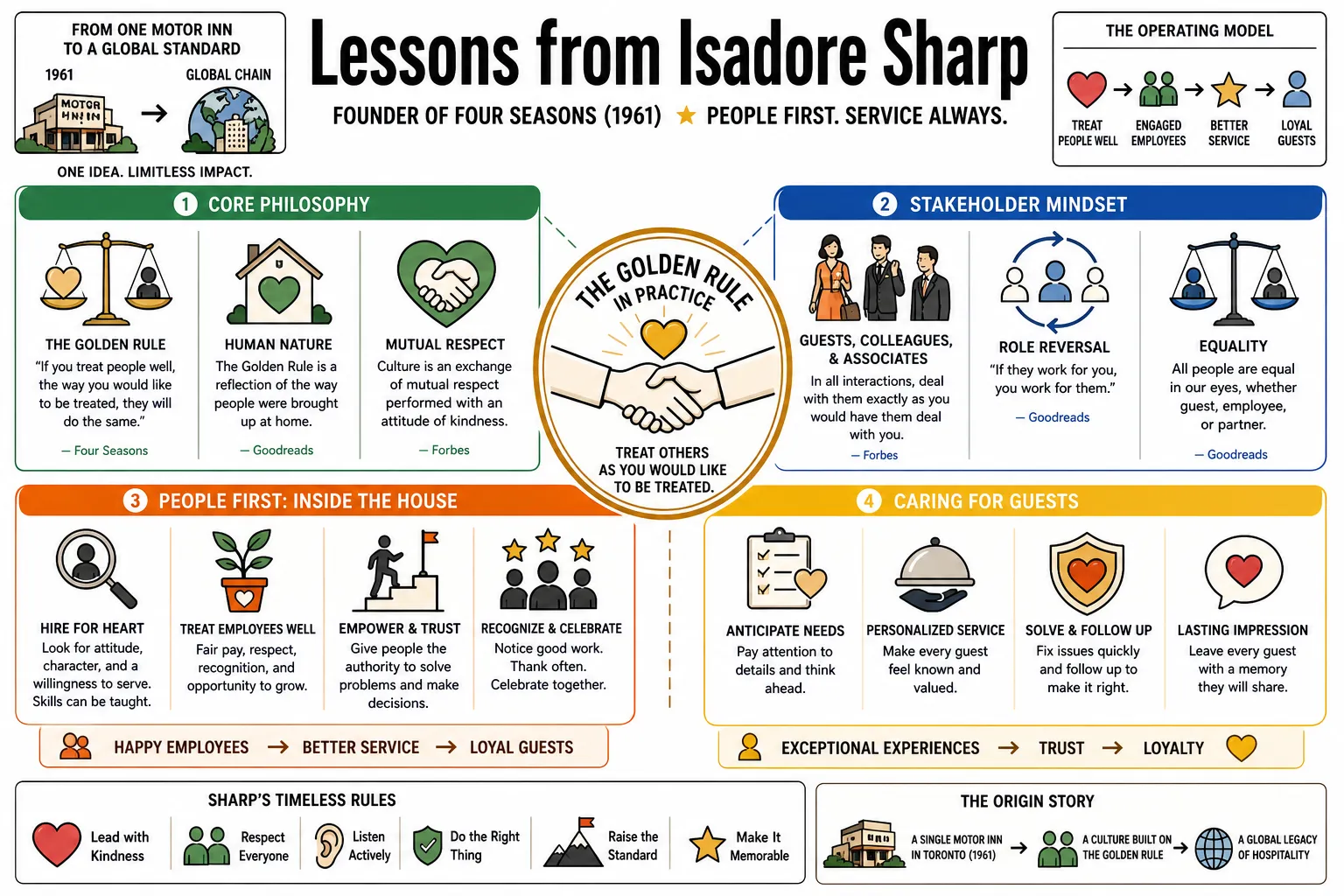
Isadore Sharp founded Four Seasons in 1961, turning a single Toronto motor inn into a global hotel chain. He built his operating model around the Golden Rule, proving that treating employees well directly improves customer service. This profile collects his specific rules for hiring, management, and taking care of guests.
Part 1: The Golden Rule in Practice
- On writing the credo: Sharp said "I sat down with our communications experts and wrote down the fundamentals of our culture, which is based on the Golden Rule – to treat others as you wish to be treated." — Four Seasons: Isadore Sharp, founder and chairman emeritus.
- On how values are inherited: Of his parents Sharp said "your principles and values that you inherit aren't what parents tell you. It's how they are. It's like osmosis. You learn by example of how they are treating people and how they treat you." — Big Shot with Harley Finkelstein and David Segal: How Issy Sharp built the Four Seasons, parts 1 and 2 (2022).
- On mutual respect: Sharp said "One way to characterize Four Seasons service would be to call it an exchange of mutual respect performed with an attitude of kindness." — Four Seasons: Isadore Sharp, founder and chairman emeritus.
- On dealing with everyone as you would want to be dealt with: Forbes quotes the company framework Sharp built: "In all our interactions with our guests, customers, business associates and colleagues, we seek to deal with others as we would have them deal with us." — Forbes: Four Seasons leader Isadore Sharp, treat employees right so they treat customers right (August 2015).
- On working for those who work for you: Sharp wrote "An old Japanese proverb put our managers' role in a nutshell: 'If they work for you, you work for them.'" — The Globe and Mail: Four Seasons, the Golden Rule, excerpt by Isadore Sharp (April 2009).
- On treating everyone as a guest: Recalling the first hotel manager he hired, Sharp said "I don't want to judge people by what they wear and who they are," and "They're our guests and treat them as we are the host." — Big Shot with Harley Finkelstein and David Segal: How Issy Sharp built the Four Seasons, parts 1 and 2 (2022).
- On enforcing the credo: Describing the Golden Rule credo, Sharp told Stanford "What was new... was we enforced it." — Stanford GSB Insights: Isadore Sharp, we hire for attitude (February 2010).
- On living up to values: Sharp wrote "Better to not profess any values than to not live up to them." — The Globe and Mail: Four Seasons, the Golden Rule, excerpt by Isadore Sharp (April 2009).
- On a principle that travels: Sharp said "It comes down to one single principle that transcends time and geography, religion and culture. It's the Golden Rule." — Four Seasons: Isadore Sharp, founder and chairman emeritus.
Part 2: Hiring and Talent
- On hiring for attitude: Sharp said "Competence we can teach; attitude is ingrained." — Stanford GSB Insights: Isadore Sharp, we hire for attitude (February 2010).
- On people who like people: He said "We want people who like other people, and are therefore more motivated to serve them." — Stanford GSB Insights: Isadore Sharp, we hire for attitude (February 2010).
- On what we believe about people: Sharp wrote "What we believe about people, positive or negative, is self-fulfilling, and it's fundamental to workforce attitude and motivation." — The Globe and Mail: Four Seasons, the Golden Rule, excerpt by Isadore Sharp (April 2009).
- On hiring people who believe: Sharp said "the people that, finally, I did hire, understood and believed and say, 'Yeah, I'd buy into it,'" and that he set out to talk about the credo "rather than to put a memo out." — Big Shot with Harley Finkelstein and David Segal: How Issy Sharp built the Four Seasons, parts 1 and 2 (2022).
- On walking the talk: Sharp said the question was whether leaders would "walk the talk," with "their actions... speak louder, than their words." — Big Shot with Harley Finkelstein and David Segal: How Issy Sharp built the Four Seasons, parts 1 and 2 (2022).
- On ego: On the confidence he credits to his parents, Sharp said "You don't have an ego. It's not like you're doing this, because, 'Hey, look how good I am.'" — Big Shot with Harley Finkelstein and David Segal: How Issy Sharp built the Four Seasons, parts 1 and 2 (2022).
- On the frontline being the product: Sharp said "These front-line staff represent our product to our customers. In the most realistic sense, they are the product." — Stanford GSB Insights: Isadore Sharp, we hire for attitude (February 2010).
- On forfeiting trust: He said "If we're seen showing greater concern for power, prestige, and costs than for the customer and the values we profess, then we forfeit belief and trust along with our goal of trying to be the best." — Stanford GSB Insights: Isadore Sharp, we hire for attitude (February 2010).
- On empowering the frontline: Sharp said "When our employees are trusted to use their common sense, they can and do turn mishaps into new service opportunities. Then, what the customer remembers is not the complaint, but the outcome." — Stanford GSB Insights: Isadore Sharp, we hire for attitude (February 2010).
- On treating employees as guests: Sharp told his team "we should be treating employees the way we expect them to treat our customers." — The Globe and Mail: Four Seasons, the Golden Rule, excerpt by Isadore Sharp (April 2009).
Part 3: The Customer Experience and Service
- On selling value, not products: Of McDonald's, Sharp wrote "They didn't just sell hamburgers; they sold value." — The Globe and Mail: Four Seasons, the Golden Rule, excerpt by Isadore Sharp (April 2009).
- On welcoming guests like a host: Sharp said of hotel service "You welcome them. You want to make sure they're having a good evening." — Big Shot with Harley Finkelstein and David Segal: How Issy Sharp built the Four Seasons, parts 1 and 2 (2022).
- On attracting customers: Sharp told a MaRS audience "Quality of service has always been our competitive advantage," adding "It's the 101 of business: if you can't attract a customer, you don't have a business." — MaRS: Isadore Sharp on building exceptional customer service (October 2015).
- On time as luxury: Sharp said "When we looked closely, it became clear that the greatest luxury for our customers was time." — Stanford GSB Insights: Isadore Sharp, we hire for attitude (February 2010).
- On helping guests use their time: He continued "And service could help them make the most of that, giving them greater productivity, greater enjoyment." — Stanford GSB Insights: Isadore Sharp, we hire for attitude (February 2010).
- On building from the guest's perspective: The MaRS report says Sharp "went on to describe how all of his hotels were built from the customer perspective." — MaRS: Isadore Sharp on building exceptional customer service (October 2015).
- On aiming for zero mistakes: Sharp wrote "So we ordered them to aim high: zero mistakes." — The Globe and Mail: Four Seasons, the Golden Rule, excerpt by Isadore Sharp (April 2009).
- On small details: Sharp said "We were the first company to put shampoo in the bathroom," explaining "Because I grew up with three sisters, I knew that girls never wash their hair with soap." — Dolce Magazine: Isadore Sharp and Shahid Khan, double vision.
- On credibility: Sharp wrote "the fastest way for management to destroy its credibility is to say employees come first and be seen putting them last." — The Globe and Mail: Four Seasons, the Golden Rule, excerpt by Isadore Sharp (April 2009).
Part 4: Leadership and Organizational Culture
- On what we do: Sharp wrote that he came up with the expression "We are only what we do, not what we say we are." — The Globe and Mail: Four Seasons, the Golden Rule, excerpt by Isadore Sharp (April 2009).
- On belief in yourself: Sharp said "you have a subliminal belief in yourself, that when you believe with what you're doing, it will work. Even though, there's skeptics all around you." — Big Shot with Harley Finkelstein and David Segal: How Issy Sharp built the Four Seasons, parts 1 and 2 (2022).
- On culture growing from within: In a passage from his book read on the Deeply Driven podcast: "a culture cannot be mandated as a policy. It must grow from within based on the actions of the company's people over a long period of time." — Deeply Driven podcast: Isadore Sharp, the work you don't see that built Four Seasons (February 2026).
- On cuts at the top: Sharp wrote "I had to make cuts at the very top: hotel general managers and head office senior executives. Some were competent technically, but we protected our values above all else." — The Globe and Mail: Four Seasons, the Golden Rule, excerpt by Isadore Sharp (April 2009).
- On legacy and succession: Nicola Wealth's summary of a 2025 conversation says Sharp and John Nicola discussed "succession, leadership, and philanthropy with intention." — Nicola Wealth: Architects of Legacy, in conversation with Isadore Sharp and John Nicola (October 2025).
- On keeping your word: Of his parents' debts and his own deals, Sharp said "You make a commitment, you live up to it," and "Your word is your bond." — Big Shot with Harley Finkelstein and David Segal: How Issy Sharp built the Four Seasons, parts 1 and 2 (2022).
Part 5: Defining True Luxury
- On quality and expectations: Sharp told his team "Quality doesn't necessarily mean luxury. It means giving customers what they expect, meeting customers' expectations every time." — The Globe and Mail: Four Seasons, the Golden Rule, excerpt by Isadore Sharp (April 2009).
- On what luxury meant: The Stanford report says Sharp said market research found "customers value luxury, but that didn't necessarily mean elegant surroundings or gourmet meals." — Stanford GSB Insights: Isadore Sharp, we hire for attitude (February 2010).
- On medium-sized hotels: Four Seasons' biography of Sharp lists among its key decisions "a focus on managing only medium-sized hotels of exceptional quality." — Four Seasons: Isadore Sharp, founder and chairman emeritus.
- On service over grand buildings: Of the London hotel Sharp said "we were a modern building. Nothing impressive, compared to them, but our people, the service changed how people were treated in London." — Big Shot with Harley Finkelstein and David Segal: How Issy Sharp built the Four Seasons, parts 1 and 2 (2022).
Part 6: Brand, Growth, and Strategy
- On there being no grand dream: Sharp said "There was no vision, there was no grand dream," reflecting on the first modest motor hotel. — Four Seasons: Isadore Sharp, founder and chairman emeritus.
- On the consistent thread: He said "there has always been a consistent thread and it propels us forward today, as we continue to grow globally, and that's service." — Four Seasons: Isadore Sharp, founder and chairman emeritus.
- On four key decisions: Four Seasons' biography says that besides culture, key decisions were to manage only medium-sized hotels of exceptional quality, to manage rather than own them, and to make service the brand's distinguishing edge. — Four Seasons: Isadore Sharp, founder and chairman emeritus.
- On persevering: Sharp said "It took five years to find all of the investors. When you have a passion, a belief about something, it allows you to persevere." — My Business Magazine: Isadore Sharp on leadership, luxury and legendary service.
- On specializing: Sharp wrote "If we were going to specialize and operate only one class of hotel, we should surely be better than companies that didn't." — The Globe and Mail: Four Seasons, the Golden Rule, excerpt by Isadore Sharp (April 2009).
- On what the brand stands for: Sharp said "Four Seasons today is a brand that people equate with exceptional experiences and the lifelong memories that come with them." — Four Seasons: Isadore Sharp, founder and chairman emeritus.
- On managing, not owning: After Vancouver's costs outran him, Sharp said "I decided we can no longer own the real estate of hotel," and the company became a management company. — Big Shot with Harley Finkelstein and David Segal: How Issy Sharp built the Four Seasons, parts 1 and 2 (2022).
- On the business model in downturns: Sharp said "the business model is what has got us through all these economic downturns." — Big Shot with Harley Finkelstein and David Segal: How Issy Sharp built the Four Seasons, parts 1 and 2 (2022).
Part 7: Beginnings, Evolution, and Innovation
- On not planning a hotel company: Sharp said "I wasn't intending to go into the hotel business; I hired people to run it, and then expected I'd sell it." — My Business Magazine: Isadore Sharp on leadership, luxury and legendary service.
- On cheap land: He explained the Jarvis Street site: "I needed a lot of land, and that seedy area was the only part of town I could buy a lot of land that was quite cheap." — My Business Magazine: Isadore Sharp on leadership, luxury and legendary service.
- On new amenities: The profile says Four Seasons "pioneered the idea of shampoo in the shower, 24-hour room service, bathrobes, same day cleaning and pressing." — My Business Magazine: Isadore Sharp on leadership, luxury and legendary service.
- On getting better or falling behind: Sharp wrote "We'd either keep getting better or fall behind." — The Globe and Mail: Four Seasons, the Golden Rule, excerpt by Isadore Sharp (April 2009).
- On being laughed at: Of his decision to make Four Seasons the world's best hotel company, Sharp wrote "No wonder they laughed behind my back." — The Globe and Mail: Four Seasons, the Golden Rule, excerpt by Isadore Sharp (April 2009).
- On building a second hotel: Sharp said "I decided that this worked so well, I'd build a second." — My Business Magazine: Isadore Sharp on leadership, luxury and legendary service.
Part 8: Legacy and Life Philosophy
- On the Terry Fox Run: Four Seasons' biography says Sharp "initiated the corporate sponsorship program supporting the Terry Fox Marathon of Hope" and is "Founder of the annual Terry Fox Run program." — Four Seasons: Isadore Sharp, founder and chairman emeritus.
- On people before profit: In a passage from his book read on the Deeply Driven podcast: "I never made the mistake of putting profit ahead of people, and I believe part of Four Seasons worldwide acclaim is built primarily on strong relationships." — Deeply Driven podcast: Isadore Sharp, the work you don't see that built Four Seasons (February 2026).
- On people who taught him: Of his first general manager, Sharp said "he taught me the hotel business." — Big Shot with Harley Finkelstein and David Segal: How Issy Sharp built the Four Seasons, parts 1 and 2 (2022).
- On parents and work ethic: Sharp said of his parents "They never complained," and "When you grow up in that type of atmosphere it develops who you are." — Dolce Magazine: Isadore Sharp and Shahid Khan, double vision.
- On living up to promises when it was hard: On the Vancouver hotel, Sharp said "I lived up to the promise of what I said I could do for them," and the landlords rewrote the deal. — Big Shot with Harley Finkelstein and David Segal: How Issy Sharp built the Four Seasons, parts 1 and 2 (2022).