Lessons from James J. Hill
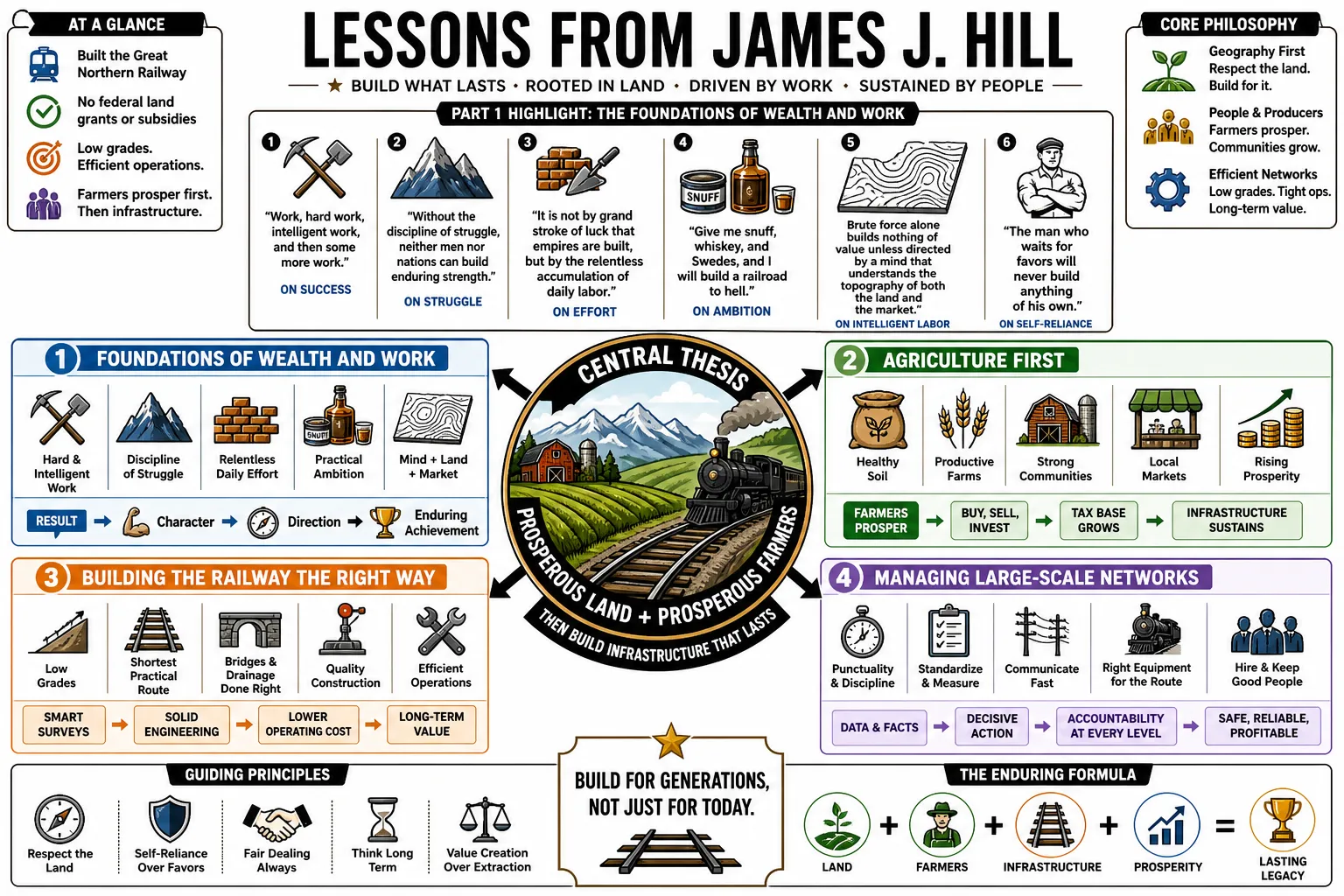
James J. Hill built the Great Northern Railway without federal land grants or subsidies, focusing strictly on low grades and efficient operations. He maintained that infrastructure only succeeds if the underlying geography and local farmers prosper first. This profile collects his specific views on capital, agriculture, and managing large-scale physical networks.
Part 1: The Foundations of Wealth and Work
- On the secret of success: "Work, hard work, intelligent work, and then some more work." — Source: [The Life of James J. Hill]
- On the necessity of struggle: "Without the discipline of struggle, neither men nor nations can build enduring strength; the easy path breeds weakness and eventual collapse." — Source: [Highways of Progress]
- On the value of effort: "It is not by grand stroke of luck that empires are built, but by the relentless, unglamorous accumulation of daily labor applied to a single purpose." — Source: [The Life of James J. Hill]
- On practical ambition: "Give me snuff, whiskey, and Swedes, and I will build a railroad to hell." — Source: [The Life of James J. Hill]
- On intelligent labor: "Brute force alone builds nothing of value unless directed by a mind that understands the topography of both the land and the market." — Source: [Highways of Progress]
- On self-reliance: "The man who looks to the government to secure his livelihood has already surrendered his most valuable asset: his individual initiative." — Source: [Highways of Progress]
- On continuous effort: "There is no point at which a man can safely say his work is done; the maintenance of what has been built requires as much vigor as the building itself." — Source: [The Life of James J. Hill]
- On the dignity of labor: "Wealth is merely the stored up labor of the past; to despise the labor is to misunderstand the very nature of wealth." — Source: [Highways of Progress]
- On focus: "A man must know his business from the ground up, in every detail, or he is bound to be at the mercy of those who do." — Source: [The Life of James J. Hill]
Part 2: The Art of Saving and Capital
- On the infallible test of success: "The test is simple and it is infallible: Are you able to save money? If not, drop out. You will lose. You may think not, but you will lose as sure as you live." — Source: [The Life of James J. Hill]
- On capital accumulation: "Capital is not a mysterious force; it is simply the portion of a man's labor that he refrains from consuming today so that he may deploy it tomorrow." — Source: [Highways of Progress]
- On the danger of debt: "Borrowed money is a tool for the builder but a trap for the consumer; when debt funds comfort rather than production, ruin is inevitable." — Source: [Highways of Progress]
- On financial discipline: "The man who cannot control his expenses will eventually find his expenses controlling his destiny and dictating his compromises." — Source: [The Life of James J. Hill]
- On economic stability: "True national wealth is measured not by the fortunes of the few, but by the accumulated savings of the millions who work and produce." — Source: [Highways of Progress]
- On the misuse of credit: "Credit should be extended only to that which creates new wealth, never to cover the deficits of inefficient management or personal extravagance." — Source: [Highways of Progress]
- On thrift: "Frugality is not about depriving oneself of necessities, but about refusing to trade future independence for immediate, fleeting gratification." — Source: [The Life of James J. Hill]
- On the predator classes: "The wealth of the country, its capital, its credit, must be saved from the predatory poor as well as the predatory rich, but above all from the predatory politician." — Source: [Highways of Progress]
- On the reality of markets: "No amount of financial engineering can substitute for the fundamental law that value must first be created before it can be distributed." — Source: [Highways of Progress]
Part 3: Railroads and Infrastructure
- On the purpose of railroads: "A railroad is not a speculative enterprise meant to enrich promoters; it is a permanent highway of commerce that must serve the territory it traverses." — Source: [The Life of James J. Hill]
- On grades and curves: "The secret to profitable railroading lies in the engineering: low grades and wide curves reduce the cost of hauling every ton of freight for the lifetime of the road." — Source: [The Life of James J. Hill]
- On operating costs: "The dividend is earned not by charging the highest possible rate, but by hauling the heaviest possible load at the lowest possible cost per mile." — Source: [Highways of Progress]
- On passenger trains: "The passenger train is like the male teat: neither useful nor ornamental." — Source: [The Life of James J. Hill]
- On mutual prosperity: "A railroad cannot prosper unless the farmers and industries along its line prosper first; our success is entirely dependent on theirs." — Source: [Highways of Progress]
- On empty cars: "The most expensive thing in the railroad business is moving empty air; every car must carry a paying load in both directions if the road is to survive." — Source: [The Life of James J. Hill]
- On pioneering: "We did not build our lines to where the people were; we built them to where the resources were, knowing the people would inevitably follow the tracks." — Source: [The Life of James J. Hill]
- On maintenance: "To defer maintenance on a track or a locomotive is to borrow from tomorrow at an exorbitant rate of interest; keeping the physical plant in perfect order is the highest economy." — Source: [Highways of Progress]
- On competition: "The best defense against competition is not a monopoly charter, but the ability to do the work cheaper and better than any rival could attempt." — Source: [The Life of James J. Hill]
- On geographical reality: "You cannot fight the geography of a continent; you must study the rivers, the mountains, and the natural trade routes, and lay your steel in harmony with them." — Source: [The Life of James J. Hill]
Part 4: Agriculture as the Bedrock
- On the source of wealth: "All wealth eventually traces back to the soil; a nation that neglects its agriculture is building its entire economic structure on sand." — Source: [Highways of Progress]
- On scientific farming: "The era of simply mining the soil for its nutrients is over; the modern farmer must act as a chemist and a scientist to maintain the land's fertility." — Source: [Highways of Progress]
- On crop rotation: "Growing wheat year after year on the same plot is agricultural suicide; diversification and the rotation of crops are the only guarantees of permanent prosperity." — Source: [Highways of Progress]
- On the Montana soil: "The natural wealth of the soil of Montana is greater than the wealth of all the mines within her borders." — Source: [James J. Hill Papers]
- On farm size: "A man will do better on a smaller plot of land that he tends intensely and intelligently than on a massive acreage that he neglects through lack of capital and labor." — Source: [Highways of Progress]
- On livestock: "Purebred livestock is not a luxury for the wealthy farmer; it is the most efficient machine available for converting raw crops into high value products." — Source: [Highways of Progress]
- On population and food: "As our population multiplies, the primary crisis of the future will not be industrial capacity, but whether our acres can produce enough bread to feed our people." — Source: [Highways of Progress]
- On agricultural education: "Sending agricultural experts directly into the fields to teach farmers by demonstration is vastly more effective than printing ten thousand government bulletins." — Source: [The Life of James J. Hill]
- On rural vs. urban life: "The drift of the youth from the farms to the cities is an economic tragedy; the true strength of the nation lies in the independence of the rural homestead." — Source: [Highways of Progress]
- On the farmer's independence: "A farmer out of debt, with good land and a knowledge of how to work it, is the most independent man in the world, immune to the panics of Wall Street." — Source: [Highways of Progress]
Part 5: Conservation and the Future
- On natural resources: "We are living like spendthrifts, drawing upon the capital of our natural resources rather than living on the interest; this cannot continue indefinitely." — Source: [Highways of Progress]
- On timber: "The wholesale destruction of our forests without replanting is a crime against future generations, inviting soil erosion and the disruption of our waterways." — Source: [Highways of Progress]
- On coal and iron: "Our mineral wealth, once extracted, is gone forever; we must price it and utilize it with the understanding that it is an exhaustible reserve." — Source: [Highways of Progress]
- On the obligation to posterity: "The measure of a civilization is not how much it can extract from the earth in a single generation, but what condition it leaves the earth in for the next." — Source: [Highways of Progress]
- On efficiency as conservation: "Eliminating waste in industrial processes is the highest form of conservation; every ton of coal saved through better engineering extends the life of the nation." — Source: [Highways of Progress]
- On land speculation: "Land should be held by those who intend to work it and improve it, not by speculators who merely sit and wait for the labor of others to increase its value." — Source: [The Life of James J. Hill]
- On water resources: "The careful management of our rivers and streams for irrigation and navigation is essential; letting water run to the sea unused is a squandering of nature's power." — Source: [Highways of Progress]
- On national decline: "History is a graveyard of nations that exhausted their soil and their forests, mistaking the temporary flush of resource extraction for permanent economic health." — Source: [Highways of Progress]
- On true prosperity: "Prosperity is an illusion if it is purchased by the depletion of the natural endowment upon which all future production must rely." — Source: [Highways of Progress]
Part 6: Leadership and Management
- On knowing the details: "You cannot run a railroad from an office in New York; you must be out on the line, seeing the grades, feeling the track, and knowing the men who do the work." — Source: [The Life of James J. Hill]
- On hiring: "I do not want men who wait for instructions; I want men who can see what needs to be done and have the courage to take the responsibility of doing it." — Source: [The Life of James J. Hill]
- On facts vs. theories: "When faced with an engineering or business problem, discard all theories and opinions until you have gathered every available, undeniable fact." — Source: [The Life of James J. Hill]
- On accountability: "A manager who blames his subordinates for a failure has missed the point of leadership; the final responsibility for the outcome always rests at the top." — Source: [The Life of James J. Hill]
- On leading by example: "You cannot expect loyalty and hard work from your men if they do not see you working harder and longer than any of them." — Source: [The Life of James J. Hill]
- On clear communication: "Give orders that are impossible to misunderstand. Ambiguity in command leads inevitably to disaster in execution." — Source: [The Life of James J. Hill]
- On paying for performance: "High wages are the cheapest wages if they secure the most efficient and intelligent labor; cheap labor that bungles the job is disastrously expensive." — Source: [Highways of Progress]
- On confronting reality: "Never try to hide a bad situation with optimistic reports. The sooner the ugly truth is known, the sooner the remedy can be applied." — Source: [The Life of James J. Hill]
- On vision: "The manager focuses on how to move today's freight; the leader focuses on where the freight of ten years from now will come from, and builds toward it." — Source: [The Life of James J. Hill]
Part 7: Expanding Global Trade
- On the Orient market: "The greatest untapped market in the world lies across the Pacific; if we can lay down American flour and cotton in Asia cheaper than anyone else, the trade is ours." — Source: [Highways of Progress]
- On trade balance: "Trade is an exchange, not a one-way street. We cannot expect to sell our goods to the Orient unless we are willing to buy their products to fill our returning ships." — Source: [Highways of Progress]
- On shipping economics: "A ship is exactly like a railroad car; it only makes money when it is full. We must secure return cargo from Asia, even if we carry it at cost, to make the outbound trip profitable." — Source: [The Life of James J. Hill]
- On artificial barriers: "Tariffs that protect inefficient domestic industries do nothing but raise the cost of living and invite retaliation against our agricultural exports." — Source: [Highways of Progress]
- On global competition: "The American farmer does not solely compete with his neighbor; he competes in the global market against the wheat fields of Argentina and Russia." — Source: [Highways of Progress]
- On integrated logistics: "To dominate trade, we must control the entire supply chain, from the grain elevator in Dakota to the dock in Seattle, and onto the steamship to Yokohama." — Source: [The Life of James J. Hill]
- On finding new buyers: "If the populations of Asia can be taught to consume wheat instead of rice, the demand for American agriculture will outstrip anything we have ever seen." — Source: [Highways of Progress]
- On port infrastructure: "A railroad is choked if its terminals are congested; investing in massive, efficient port facilities on the Pacific coast is the key to unlocking international commerce." — Source: [The Life of James J. Hill]
- On the scale of commerce: "Small efforts yield no international advantage; only ships of immense capacity, running in coordination with transcontinental rails, can alter the flow of world trade." — Source: [Highways of Progress]
Part 8: Legacy and National Progress
- On permanent works: Hill liked to say that long after he and everyone around him were gone, the sun would keep shining, the rain would keep falling, and his railroad would keep running just the same. — Source: [Minnesota Historical Society]
- On the opening of the Northwest: "It was like opening the vaults of a treasury and bidding each man help himself." — Source: [Highways of Progress]
- On true pioneers: "The pioneers of our Northwest were Hennepin, Marquette and La Salle. The least of their ambitions was to conquer an empire for their king." — Source: [Highways of Progress]
- On national duty: "The highest patriotism is not found in military conquest, but in the quiet, unrelenting effort to increase the productive capacity and self-sufficiency of the nation." — Source: [Highways of Progress]
- On the nature of empires: "An empire built on military force requires constant force to maintain; an empire built on efficient trade and prosperous agriculture sustains itself indefinitely." — Source: [The Life of James J. Hill]
- On leaving things better: "The only true measure of a man's life is whether he took the resources he was given and left the world richer, more organized, and more capable than he found it." — Source: [The Life of James J. Hill]
- On trusting the future: "I have always bet on the long term growth of this country, despite panics and depressions, because the underlying fundamentals of our land and our people are sound." — Source: [The Life of James J. Hill]
- On civic responsibility: "The man who has benefited greatly from the growth of his region has an absolute moral obligation to reinvest his capital and his expertise back into that same region." — Source: [Highways of Progress]
- On time as the judge: "Contemporaries will judge you by your personality and your politics; history will judge you solely by the utility and permanence of the things you built." — Source: [The Life of James J. Hill]
- On the endless frontier: "There is no final frontier of progress; as long as human ingenuity is applied to the earth's resources, there will always be new wealth to create and new efficiencies to discover." — Source: [Highways of Progress]