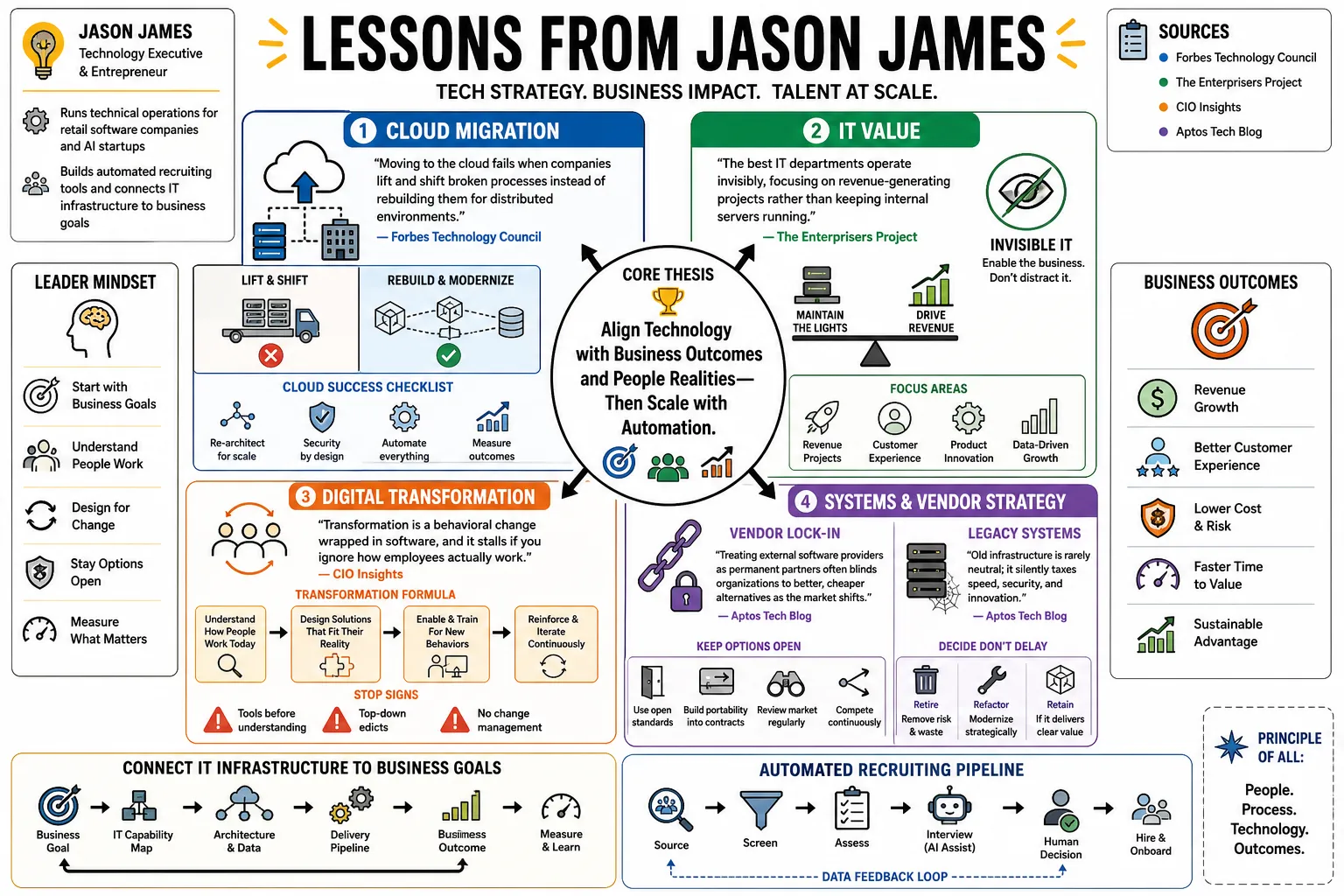
Lessons from Jason James
Technology executive and entrepreneur Jason James has run technical operations for retail software companies and AI startups. He focuses on building automated recruiting tools and connecting IT infrastructure directly to business goals. This profile gathers his perspectives on tech strategy and talent acquisition from his articles and podcast appearances.
Part 1: Technology Strategy and Transformation
- On Cloud Migration: "Moving to the cloud fails when companies lift and shift broken processes instead of rebuilding them for distributed environments." — Source: Forbes Technology Council
- On IT Value: "The best IT departments operate invisibly, focusing on revenue-generating projects rather than keeping internal servers running." — Source: The Enterprisers Project
- On Digital Transformation: "Transformation is a behavioral change wrapped in software, and it stalls if you ignore how employees actually work." — Source: CIO Insights
- On Vendor Lock-in: "Treating external software providers as permanent partners often blinds organizations to better, cheaper alternatives as the market shifts." — Source: Aptos Tech Blog
- On Legacy Systems: "Old infrastructure is rarely replaced because it is slow; it is replaced when it prevents the company from launching new products." — Source: Forbes Technology Council
- On Tech Debt: "Technical debt is like a credit card balance. Paying the minimum lets you survive today, but it consumes your budget tomorrow." — Source: The Enterprisers Project
- On Data Silos: "Information locked in specific departments creates conflicting reports and forces executives to guess rather than decide." — Source: Aptos Tech Blog
- On Infrastructure Scaling: "Build architecture for the traffic you expect in two years, because rewriting databases during a traffic spike is impossible." — Source: Forbes Technology Council
- On Automation: "Automating a flawed process just means you produce errors at a much faster rate." — Source: Brave New Normal Podcast
- On Software Purchasing: "Buying software without consulting the end users guarantees low adoption and wasted budgets." — Source: CIO Insights
Part 2: Leadership and Organizational Culture
- On Executive Alignment: "When the engineering and sales teams disagree on goals, the entire company moves backward." — Source: 20VC Podcast
- On Remote Work: James describes Tezi culture as committed to calm and built for a team of adults, which puts more weight on judgment and output than managerial surveillance. — Source: HR Heretics
- On Micromanagement: "Telling smart people exactly how to do their jobs is the fastest way to make them quit." — Source: Brave New Normal Podcast
- On Transparency: "Hiding bad news from the board only delays the inevitable and destroys trust when the truth finally comes out." — Source: The Enterprisers Project
- On Company Culture: "Culture is defined by who gets promoted and who gets fired, not by the values printed on the breakroom wall." — Source: Forbes Technology Council
- On Meeting Efficiency: "If a meeting has no agenda and no required outcome, cancel it and send an email instead." — Source: Tezi Blog
- On Decision Making: "Waiting for perfect information before making a choice means you will always act too late." — Source: CIO Insights
- On Mentorship: "Effective leaders spend more time removing obstacles for their team than they do assigning new tasks." — Source: Brave New Normal Podcast
- On Accountability: "When a project fails, blame the system first and the individuals second to find the actual root cause." — Source: The Enterprisers Project
Part 3: Artificial Intelligence in Practice
- On AI Adoption: "Companies treating AI as a magical solution often end up with expensive chat interfaces that solve no real business problems." — Source: Tezi Blog
- On Recruiting AI: James frames AI recruiting around screening thousands of applicants quickly while keeping humans in the loop for final judgment. — Source: HR Heretics
- On Data Quality: "An AI model trained on biased historical data will simply automate and scale your past mistakes." — Source: Forbes Technology Council
- On Job Displacement: "Artificial intelligence will replace tasks, leaving humans to adapt to new toolsets." — Source: 20VC Podcast
- On Algorithmic Bias: "Testing algorithms for unfair advantages requires human oversight and constant auditing, rather than a single initial review." — Source: Tezi Blog
- On AI Integration: "The most successful AI tools operate in the background, assisting users without requiring them to change their entire workflow." — Source: Aptos Tech Blog
- On Predictive Analytics: "Forecasting models are useful, but they cannot predict black swan events or sudden market crashes." — Source: CIO Insights
- On Chatbots: "Customer service bots that trap users in endless loops cause more brand damage than having no support at all." — Source: Forbes Technology Council
- On Machine Learning Costs: "Training models from scratch is rarely necessary when fine-tuning existing foundational models costs a fraction of the price." — Source: Tezi Blog
- On Generative Tech: "Using text generation for legal or medical advice without human review invites catastrophic liability." — Source: Brave New Normal Podcast
Part 4: Cybersecurity and Risk Management
- On Security Culture: "A firewall cannot protect a company if employees willingly hand over their passwords to phishing emails." — Source: The Enterprisers Project
- On Zero Trust: "Assuming the internal network is safe is a dangerous outdated concept; verify every user and every device constantly." — Source: Forbes Technology Council
- On Data Breaches: "It is no longer a question of if a breach will happen, but how quickly you can detect and contain it." — Source: CIO Insights
- On Compliance: "Meeting regulatory checklists does not equal actual security, it merely keeps the auditors satisfied." — Source: Aptos Tech Blog
- On Ransomware: "Paying a ransom funds future attacks and offers zero guarantee that your files will actually be restored." — Source: The Enterprisers Project
- On Password Policies: "Forcing users to change passwords every thirty days just leads to people adding a number to the end of their old password." — Source: Forbes Technology Council
- On Incident Response: "Practicing your response plan during a calm afternoon is the only way it will work during an actual crisis." — Source: CIO Insights
- On Third-Party Risk: "Your security is only as strong as the weakest vendor who has access to your sensitive customer data." — Source: Aptos Tech Blog
- On Security Budgets: "Executives usually approve security funding only after a major incident, which is the most expensive time to buy." — Source: Brave New Normal Podcast
Part 5: Product Design and User Experience
- On User Interfaces: "If a user requires a manual to figure out your software dashboard, your design team has failed." — Source: Tezi Blog
- On Feature Bloat: "Adding every requested button makes the product unusable for the majority of your normal customers." — Source: 20VC Podcast
- On Customer Feedback: "Listen to what customers complain about, but do not blindly build exactly what they tell you to build." — Source: Tezi Blog
- On Prototyping: James treats top-of-funnel AI interviews as an operating experiment: test what works with candidates and hiring teams before assuming the workflow should scale. — Source: HR Heretics
- On Accessibility: "Designing for color blindness and screen readers should be the starting point, not an afterthought." — Source: Tezi Blog
- On Performance: "A beautiful application that takes ten seconds to load will be abandoned immediately." — Source: Aptos Tech Blog
- On Design Consistency: "Using different button styles across the same application confuses users and destroys trust in the brand." — Source: 20VC Podcast
- On Onboarding: "The first five minutes a user spends in your app determine if they will ever open it again." — Source: Tezi Blog
- On Iteration: James argues that standing out in a crowded AI recruiting market depends on practical workflow impact, not merely launching another AI-branded tool. — Source: HR Heretics
Part 6: Talent Acquisition and Team Building
- On Hiring Engineers: James warns that impressive resumes can reflect riding the elevator up at hypergrowth companies, so hiring teams need to separate real contributors from pedigree riders. — Source: HR Heretics
- On Retention: "Employees leave bad managers, not bad companies, so fix your management layer before increasing salaries." — Source: The Enterprisers Project
- On Diverse Teams: "Hiring people who all think alike creates a comfortable environment that fails to notice obvious market threats." — Source: Forbes Technology Council
- On Interviewing: "Ask candidates about their biggest failures; if they blame others, they will do the same when they join your team." — Source: Tezi Blog
- On Onboarding Engineers: "A new developer should be able to push a minor code change to production on their first day." — Source: CIO Insights
- On Compensation: James sees the tough new-grad market as a chance to find overlooked talent when other companies are pulling back from early-career hiring. — Source: HR Heretics
- On Junior Talent: "Companies that refuse to hire junior developers eventually run out of senior developers to hire." — Source: The Enterprisers Project
- On Team Size: "Adding more people to a delayed software project only slows it down further due to communication overhead." — Source: Forbes Technology Council
- On Performance Reviews: "Annual reviews are useless; feedback must be immediate and specific to change actual behavior." — Source: Brave New Normal Podcast
- On Contractor Use: "Outsourcing core intellectual property is a short-term cost saving that destroys long-term company value." — Source: Aptos Tech Blog
Part 7: Navigating Industry Shifts
- On Tech Trends: "Chasing every new technology framework leads to a fragmented codebase that nobody knows how to maintain." — Source: Forbes Technology Council
- On Economic Downturns: "When budgets shrink, companies discover which software subscriptions they actually need and which were just nice to have." — Source: The Enterprisers Project
- On Innovation: "True innovation often looks like a toy at first, causing established companies to ignore it until it is too late." — Source: Brave New Normal Podcast
- On Competition: "Obsessing over competitors blinds you to what your actual customers are asking for." — Source: Tezi Blog
- On Startups vs Enterprise: "Startups move fast because they lack compliance processes; enterprises move slow because they have too many." — Source: 20VC Podcast
- On E-commerce: "Retail survival depends on merging physical store inventory with online data to create a single view of the customer." — Source: Aptos Tech Blog
- On Mobile Adoption: "If a workflow cannot be completed on a smartphone, your sales team simply will not use it." — Source: CIO Insights
- On Open Source: "Relying on open source software requires contributing back to the community, or you risk the project dying." — Source: Forbes Technology Council
- On Market Timing: "Being five years early to a market is financially identical to being wrong." — Source: 20VC Podcast
Part 8: Professional Growth and Resilience
- On Continuous Learning: "The coding languages you learn today will be obsolete in a decade, so focus on learning how to solve problems." — Source: The Enterprisers Project
- On Burnout: James discusses the 100-hour-week and 9-9-6 debate in contrast with Tezi's calmer operating culture, treating sustained output as more important than performative hours. — Source: HR Heretics
- On Public Speaking: "Audiences do not remember your slides; they remember the stories you tell and how those stories made them feel." — Source: Brave New Normal Podcast
- On Networking: "Building relationships when you do not need a job is the only way to have options when you do." — Source: Forbes Technology Council
- On Handling Failure: "A failed project is only wasted money if you hide the results instead of sharing what you learned." — Source: Tezi Blog
- On Career Transitions: "Moving from engineering to management requires abandoning the idea that writing code is your primary value." — Source: CIO Insights
- On Imposter Syndrome: "Everyone feels unqualified when taking on a larger role; success comes from acting despite that feeling." — Source: Brave New Normal Podcast
- On Reading: "Reading outside your industry provides solutions that your competitors will never think to apply." — Source: The Enterprisers Project
- On Legacy: "The best mark a leader can leave is a team that continues to succeed long after they have resigned." — Source: Forbes Technology Council