Lessons from Jay Hoag
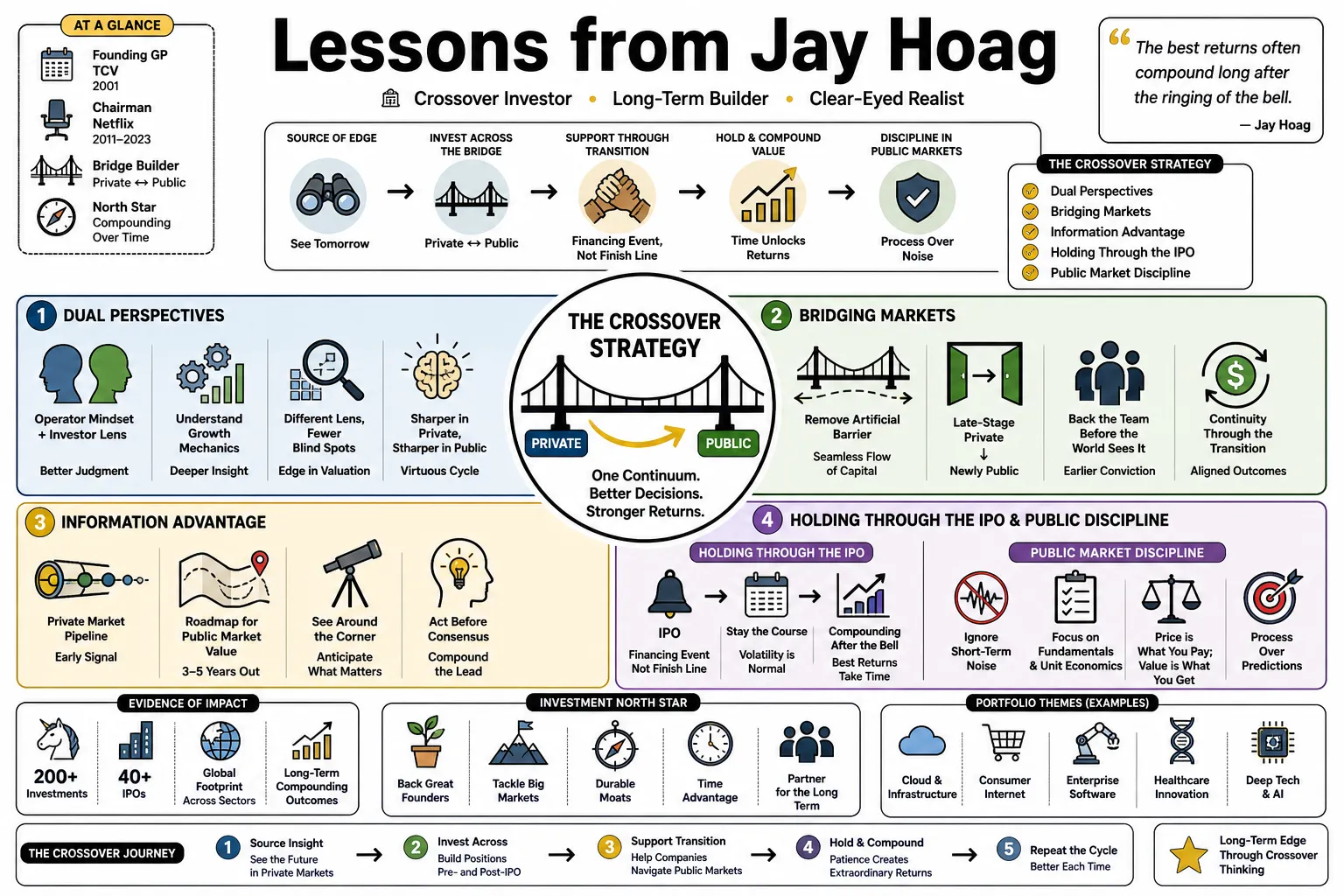
Jay Hoag is a co-founder of Technology Crossover Ventures (TCV), founded in 1995 as the first firm to invest in both public and private companies from the same fund. His investments include Netflix, Spotify, Zillow, Expedia, Facebook and Airbnb. — Acquired: Netflix's Journey, Building TCV, and Investing Through Downturns, with TCV co-founder Jay Hoag (November 2022).
Part 1: The Crossover Strategy
- On staying with winners: Hoag said "Their growth prospects don't end when they become public so maybe you should be patient and be long-term partners with those companies." — Acquired: Netflix's Journey, Building TCV, and Investing Through Downturns, with TCV co-founder Jay Hoag (November 2022).
- On the online advantage: Hoag said "The advantage of the online model was you don't have physical stores, so you don't have the burden." — Acquired: Netflix's Journey, Building TCV, and Investing Through Downturns, with TCV co-founder Jay Hoag (November 2022)
- On Public Market Discipline: Hoag treats public-market pressure as useful when it forces companies to focus on funding, product value, customer delight, and the durability of the business rather than on short-term headlines. — Reference: Acquired interview with Jay Hoag
- On holding through the IPO: Hoag said "We will hold our private investments as they go public, the best ones for a long period of time." — Invest Like the Best, episode 429: Jay Hoag, Keys to Successful Growth Investing (June 2025).
Part 2: Contrarian Investing (Avoiding the Herd)
- On momentum investing: Hoag said "money chases momentum or follows perceived momentum at the risk of insult. Possibly like seven-year-olds playing soccer, the ball goes over there and everybody goes over there." — Invest Like the Best, episode 429: Jay Hoag, Keys to Successful Growth Investing (June 2025).
- On Being Misunderstood: Hoag says investors buying under severe public pressure must be willing to look wrong for a while, but only when conviction is grounded in the team, product, customer delight, moats, and execution. — Reference: Acquired interview with Jay Hoag
- On out-of-favor sectors: Hoag said "I just have a hard time believing there are not going to be any new consumer Internet. businesses founded and built over the next 10 or 20 years." — Invest Like the Best, episode 429: Jay Hoag, Keys to Successful Growth Investing (June 2025).
- On every great company struggling: Hoag said "I can't think of a single great technology company that didn't struggle at some point." — Acquired: Netflix's Journey, Building TCV, and Investing Through Downturns, with TCV co-founder Jay Hoag (November 2022).
- On ignoring headlines: Hoag said "the ability to be balanced in one's view, which often can mean contrarian not consensus, and ignore conventional wisdom or ignore the headlines." — Acquired: Netflix's Journey, Building TCV, and Investing Through Downturns, with TCV co-founder Jay Hoag (November 2022).
- On Blockbuster's north star: Of Blockbuster, Hoag said "Their north star was not delighting the customer including the late fees." — Acquired: Netflix's Journey, Building TCV, and Investing Through Downturns, with TCV co-founder Jay Hoag (November 2022)
- On Patience: Hoag frames contrarian investing as the discipline to reassess a company dispassionately during market dislocations instead of letting temporary headlines replace the underlying business analysis. — Reference: Acquired interview with Jay Hoag
Part 3: Founders & Leadership
- On what makes great founders: Hoag said "That to me is what makes great founding entrepreneurs CEOs. They envision a day when they would be not shipping DVDs." — Acquired: Netflix's Journey, Building TCV, and Investing Through Downturns, with TCV co-founder Jay Hoag (November 2022).
- On luck: Hoag said "It's really important to be lucky early on and then just keep following great entrepreneurs around." — Acquired: Netflix's Journey, Building TCV, and Investing Through Downturns, with TCV co-founder Jay Hoag (November 2022)
- On his first piece of luck: Hoag said "the first luck was I grew up in a middle class midwestern family, and for whatever reason I had a good work ethic." — Acquired: Netflix's Journey, Building TCV, and Investing Through Downturns, with TCV co-founder Jay Hoag (November 2022)
- On the CEO and the team: Hoag said "It starts with the CEO and the team. I think particularly public markets swing wildly from genius to idiot. Folks, it's the same team." — Acquired: Netflix's Journey, Building TCV, and Investing Through Downturns, with TCV co-founder Jay Hoag (November 2022).
- On Leadership Development: Hoag emphasizes that the CEO and team often determine whether TCV doubles down in stressed situations, because exceptional execution can separate companies with similar opportunities. — Reference: Acquired interview with Jay Hoag
- On Honesty: Hoag advises leaders in pressured public companies to focus on the business, stay passionate about the roadmap, and keep delivering value to consumers rather than letting stock-price narratives dictate decisions. — Reference: Acquired interview with Jay Hoag
Part 4: Long-Term Horizon (The Long Game)
- On compounding: Hoag said "the best companies over time, like on Netflix, Spotify, et cetera, compounded high rates for a long period of time. So we're being hopefully economically selfish by retaining our stake." — Invest Like the Best, episode 429: Jay Hoag, Keys to Successful Growth Investing (June 2025).
- On staying at streaming: Hoag said "Streaming was a pretty limited content offering, but they stayed at it and it was free." — Acquired: Netflix's Journey, Building TCV, and Investing Through Downturns, with TCV co-founder Jay Hoag (November 2022)
- On long-term partnership: Hoag said "all that work can lead in periods of dislocation to an opportunity where you might deploy capital publicly via pipe, or just taking a stake, or taking a stake and becoming an active board member." — Acquired: Netflix's Journey, Building TCV, and Investing Through Downturns, with TCV co-founder Jay Hoag (November 2022).
- On volatility: Of Netflix after it went public in 2002, Hoag said "Market melted down. It went down 60% twice. That was not very fun." — Invest Like the Best, episode 429: Jay Hoag, Keys to Successful Growth Investing (June 2025).
- On losing subscribers: Hoag said "from a business standpoint, I think 22 million subs went to 19 million." — Acquired: Netflix's Journey, Building TCV, and Investing Through Downturns, with TCV co-founder Jay Hoag (November 2022)
- On Relationship Building: Hoag's Netflix story shows the value of following exceptional entrepreneurs over many years, from Reed Hastings's earlier Pure Software experience through Netflix's later crises and reinventions. — Reference: Acquired interview with Jay Hoag
Part 5: Rigorous Diligence & Valuation
- On Valuation Discipline: Hoag says difficult investments require repeatedly reassessing the CEO, team, product, customer delight, competitive moats, and execution rather than relying on market narratives alone. — Reference: Acquired interview with Jay Hoag
Part 6: Navigating Cycles & Downturns
- On how short dislocations are: Hoag said "when you look back at market dislocating events like the global financial crisis or the Netflix history in 2011 as an example, when you look back at them, they're actually pretty short." — Acquired: Netflix's Journey, Building TCV, and Investing Through Downturns, with TCV co-founder Jay Hoag (November 2022).
- On sideways markets: Hoag said "One of my old bosses said his biggest professional accomplishment was keeping his job between 1974 and 1982 because generally the markets moved sideways." — Acquired: Netflix's Journey, Building TCV, and Investing Through Downturns, with TCV co-founder Jay Hoag (November 2022)
- On the pandemic: Hoag said "The pandemic, there's no playbook on how to invest during a pandemic. That was a first." — Acquired: Netflix's Journey, Building TCV, and Investing Through Downturns, with TCV co-founder Jay Hoag (November 2022).
- On staying the course: Hoag said "Just focus on the business. Ignore the press." — Acquired: Netflix's Journey, Building TCV, and Investing Through Downturns, with TCV co-founder Jay Hoag (November 2022).
- On not taking it personally: Hoag said "I'd say don't take it personally." — Acquired: Netflix's Journey, Building TCV, and Investing Through Downturns, with TCV co-founder Jay Hoag (November 2022)
- On Panic: Hoag tells operators whose stocks are down sharply to avoid taking the market move personally, assume the business must still be well funded, and concentrate on the roadmap and consumer value. — Reference: Acquired interview with Jay Hoag
- On Resilience: Hoag points out that great technology companies often pass through moments of severe stress, from Netflix and Expedia to Airbnb, Zillow, and Facebook, and that survival through those periods can define the outcome. — Reference: Acquired interview with Jay Hoag
Part 7: Board Governance & Partnership
- On Managing Egos: Hoag's governance posture is less about public visibility than patient judgment: he describes TCV's role as long-term partnership through volatile public and private market conditions. — Reference: Acquired interview with Jay Hoag
Part 8: Market Opportunity & Category Definers
- On TAM Expansion: Hoag describes Netflix's international opportunity as a case where investors could not simply extrapolate current data but could still reason from the product's broader consumer value proposition. — Reference: Acquired interview with Jay Hoag
- On extrapolating from limited data: Hoag said "You couldn't extrapolate data points because we weren't in Europe or various parts of Asia Pacific, but you could envision this value prop being applicable there." — Acquired: Netflix's Journey, Building TCV, and Investing Through Downturns, with TCV co-founder Jay Hoag (November 2022)
- On Enduring Value: Hoag keeps returning to basic business quality: the team, product, customer delight, competitive moats, funding, and execution matter more than the market story around a company at any given moment. — Reference: Acquired interview with Jay Hoag