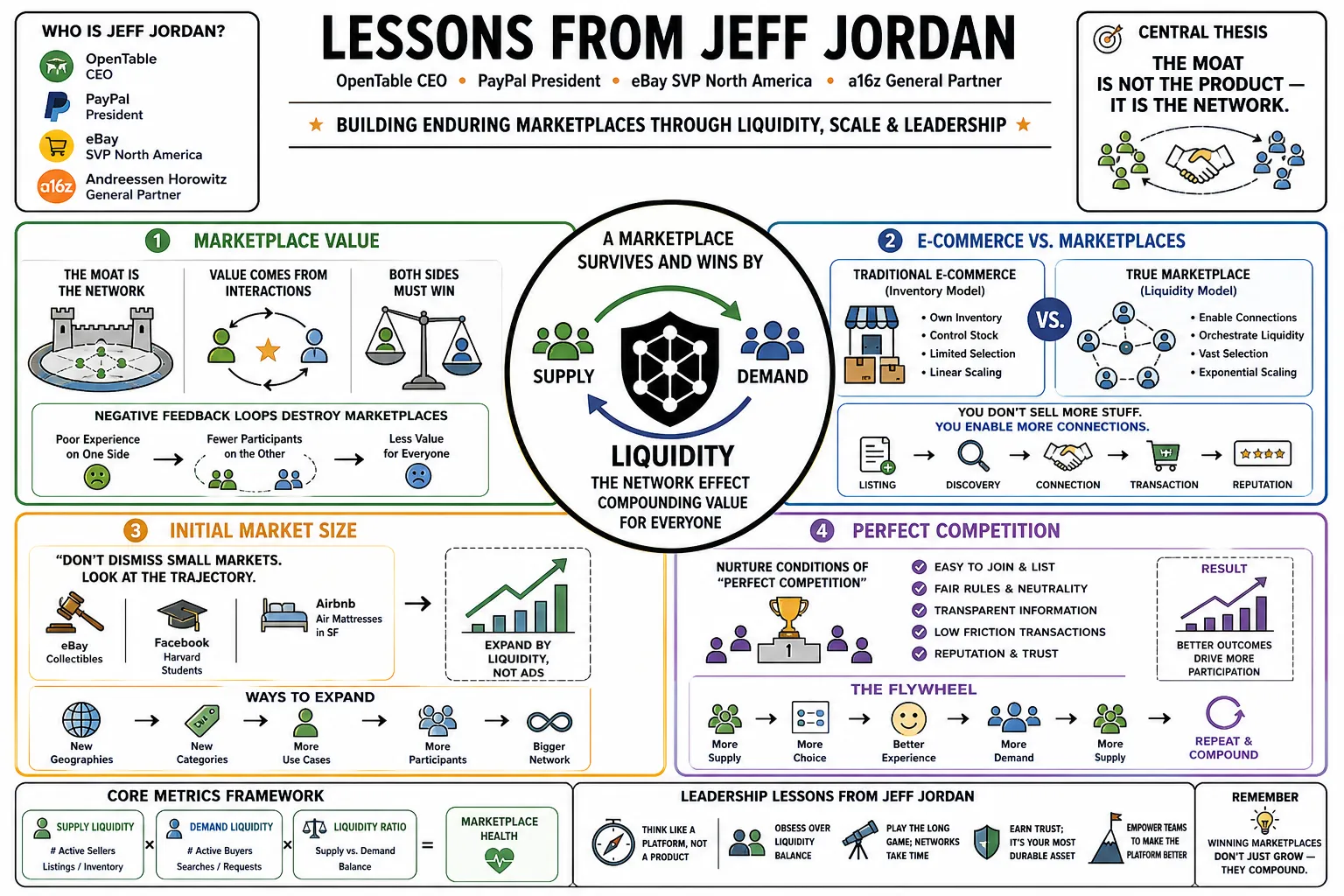
Lessons from Jeff Jordan
Before joining Andreessen Horowitz as a General Partner, Jeff Jordan served as CEO of OpenTable, President of PayPal, and SVP of North America at eBay. He defined the core metrics for two-sided marketplaces, showing exactly how platforms must balance supply and demand to stay alive. This profile outlines his frameworks on liquidity, scale, and leadership for anyone building a network business.
Part 1: The Core of Marketplaces
- On Marketplace Value: "The moat is not the product — it is the network." — Source: [a16z]
- On E-commerce vs. Marketplaces: "Traditional e-commerce is about managing inventory; a true marketplace is about managing liquidity and connections." — Source: [Invest Like the Best]
- On the Defensibility of Networks: "Once a marketplace establishes liquidity, it becomes incredibly difficult to displace because the value for both buyers and sellers is locked in the network." — Source: [a16z Marketplace 100]
- On Initial Market Size: "Do not dismiss a startup just because its initial market looks tiny. Look at eBay, Facebook, and Airbnb—they all started in seemingly niche markets before expanding." — Source: [Business Insider]
- On Perfect Competition: "Founders must nurture and manage conditions of 'perfect competition' to keep the ecosystem healthy and prevent any single participant from dominating." — Source: [Andrew Chen's Blog]
- On Economic Empowerment: "The secret to successful platforms is economic empowerment—creating a system where your supply side fundamentally earns more money because you exist." — Source: [A.Team]
- On The Chicken-and-Egg Problem: "You cannot build a two-sided marketplace symmetrically; you usually have to aggressively constrain or hack one side to give the other side a reason to show up." — Source: [The Twenty Minute VC]
- On Horizontal vs. Vertical: "Vertical marketplaces often outcompete horizontal ones because they solve the paradox of choice and offer a much deeper, tailored user experience." — Source: [Starting Line VC]
- On the eBay Flywheel: "eBay scaled because it created a self-reinforcing cycle: we had all the buyers, so the sellers came, which brought even more buyers in return." — Source: [Sloan Sports Conference]
- On Recognizing Disruption: "Seeing Airbnb for the first time was a true déjà vu experience—it had the exact same disruptive, category-defining energy as eBay did in 1999." — Source: [Medium]
Part 2: Growth and Network Effects
- On The Gravity of Scale: "Growth faces an inevitable gravity; as you scale, triple-digit year-over-year growth will naturally slow to 50 percent, and then to 25 percent." — Source: [a16z Podcast]
- On Local vs. Global Networks: "Global network effects scale infinitely, while local network effects must be rebuilt city by city, radically changing a company's capital requirements." — Source: [Andrew Chen's Blog]
- On Growth Phases: "Early-stage companies must prioritize aggressive user acquisition, but large, mature businesses must shift their entire focus to retention and minimizing churn." — Source: [a16z Podcast]
- On True Growth: "You cannot 'hack' true user engagement; growth tactics only work if the underlying product fundamentally delivers value that makes people want to stay." — Source: [Substack]
- On Virality: "The best marketing for a marketplace isn't paid acquisition, but the organic word-of-mouth that happens when a buyer or seller has an unexpectedly great outcome." — Source: [The Twenty Minute VC]
- On Hacking Supply: "Sometimes you have to manually do the unscalable work on the supply side just to create enough inventory for the demand side to care." — Source: [Invest Like the Best]
- On New Marketing Channels: "The rise of new acquisition channels, like short-form video, fundamentally changes how early-stage marketplaces should approach their initial growth strategies." — Source: [a16z Podcast]
- On Paid Marketing Traps: "Relying entirely on paid acquisition to fuel network effects is a dangerous game if the organic retention isn't already there to support the spend." — Source: [Future]
- On Retention Over Acquisition: "If you have a leaky bucket, it does not matter how much water you pour in; you must fix retention before you scale acquisition." — Source: [Future]
- On Growth Degradation: "You have to deeply understand cohort degradation. As the network gets more valuable, newer cohorts should ideally behave better, or at least stabilize predictably." — Source: [Invest Like the Best]
Part 3: Liquidity and Match Rates
- On the Definition of Liquidity: "Liquidity isn't just having users; it is the specific percentage of interactions that result in a successful transaction." — Source: [13 Metrics for Marketplace Companies]
- On Failed Interactions: "Track your 'zeros'—every time a user searches for something and fails to find it, you have identified the exact friction killing your marketplace." — Source: [13 Metrics for Marketplace Companies]
- On Match Rates: "Match rate is the ultimate vital sign of a marketplace; if buyers can't reliably and quickly find what they need, the platform dies." — Source: [a16z.com]
- On Seller Utilization: "If your supply side isn't seeing enough utilization or generating enough revenue, they will inevitably churn to a platform where they can." — Source: [13 Metrics for Marketplace Companies]
- On Liquidity Failure: "Low liquidity is the primary and most common cause of marketplace failure—without transactions, a marketplace is just an empty room." — Source: [The Marketplace Guide]
- On Search Friction: "A search query with zero results is a direct failure of the marketplace to fulfill its core promise to the demand side." — Source: [13 Metrics for Marketplace Companies]
- On Time-to-Match: "The speed at which supply meets demand is a massive competitive advantage; faster liquidity equals a better user experience." — Source: [The Twenty Minute VC]
- On Liquidity Quality: "Not all liquidity is equal; you need high-quality matches that result in positive reviews, not just raw transaction volume." — Source: [a16z Podcast]
- On Measuring Liquidity: "Liquidity cannot be measured by a single metric; it requires looking at search success, time to fill, and overall transaction density simultaneously." — Source: [13 Metrics for Marketplace Companies]
Part 4: Supply, Demand, and Fragmentation
- On Fragmented Supply: "Marketplaces are infinitely more valuable and defensible when the supply side is highly fragmented, preventing any one seller from dictating terms." — Source: [a16z.com]
- On Fragmented Demand: "Just as supply must be fragmented, a fragmented demand side ensures the marketplace isn't overly reliant on a few whale buyers." — Source: [a16z Marketplace 100]
- On Aggregating the Unorganized: "The greatest marketplace opportunities lie in aggregating supply that was historically unorganized or entirely inaccessible to the average consumer." — Source: [The Twenty Minute VC]
- On Supply Side Power: "If a small group of suppliers controls the majority of your inventory, they don't need your marketplace—they are your marketplace." — Source: [Invest Like the Best]
- On The Paradox of Choice: "Too much supply without curation overwhelms the buyer; the platform must curate and surface the best options to reduce friction." — Source: [Starting Line VC]
- On Multi-Tenant Supply: "Watch out for suppliers who use multiple platforms simultaneously; true defensibility comes when they prefer to use you exclusively." — Source: [13 Metrics for Marketplace Companies]
- On Subsidizing Supply: "In the early days, you often have to financially subsidize the supply side to ensure there is enough inventory to attract the first real buyers." — Source: [a16z.com]
- On Managing Participant Tension: "A successful marketplace must constantly manage the inherent tensions between buyers wanting low prices and sellers wanting high margins." — Source: [ServiceChannel]
- On Supply Side Professionalization: "As a marketplace matures, its early amateur supply side often professionalizes, which changes the dynamics of how you must serve them." — Source: [Invest Like the Best]
Part 5: Metrics and Unit Economics
- On Cohort Curves: "The best models are built off cohort curves; using cohorts gives you a real sense of network effects and long-term user retention." — Source: [Invest Like the Best]
- On Misleading Cohorts: "Founders often make the mistake of presenting cohort data without accounting for episodic usage, which paints an artificially rosy picture of retention." — Source: [a16z Podcast]
- On Blended CAC: "Avoid 'blended' Customer Acquisition Cost numbers at all costs; they mask the true health and efficiency of your paid versus organic marketing channels." — Source: [a16z.com]
- On the LTV/CAC Ratio: "While LTV to CAC is a standard metric, in a marketplace, you must measure it separately for both the supply and demand sides." — Source: [13 Metrics for Marketplace Companies]
- On Projecting Profitability: "Investors look for the mental plasticity in a founder to project a business toward future profitability, even when current unit economics look challenging." — Source: [The Twenty Minute VC]
- On Cross-Side Network Effects: "A true metric of health is whether the addition of a new buyer demonstrably improves the conversion rate or retention of the sellers." — Source: [13 Metrics for Marketplace Companies]
- On GMV vs. Net Revenue: "Gross Merchandise Value is a vanity metric if your take rate is zero; the real measure of a business is net revenue." — Source: [13 Metrics for Marketplace Companies]
- On Frequency of Use: "High-frequency marketplaces have fundamentally different, and usually superior, economics compared to low-frequency, high-ticket marketplaces." — Source: [a16z Podcast]
- On Marginal Costs: "Software businesses scale beautifully because the marginal cost of adding a new user is practically zero, which is the magic of the model." — Source: [Invest Like the Best]
- On True Retention: "A truly retained user isn't just someone who hasn't deleted their account; it's someone who transacts at a predictable, repeating cadence." — Source: [a16z Podcast]
Part 6: Leadership and The Founder's Journey
- On The Hardest Part of Scaling: "The hardest part of scaling a company is that the founder's own leadership skills must evolve continuously alongside the growing business." — Source: [a16z.com]
- On Taking the 'Shit Stuff': "Your job as a leader is to do the shit stuff so that everyone else in the company can remain highly productive and happy." — Source: [a16z.com]
- On Founder Perseverance: "The most critical skill for a founder is simply courage or perseverance, especially when facing the inevitable, massive hurdles of scaling." — Source: [Business Insider]
- On Near-Death Experiences: "Almost every wildly successful company faced distinct moments in their early history where it looked entirely possible that they might fail." — Source: [Business Insider]
- On Executive Transitions: "The shift from being a hands-on operator to a leader requires you to stop doing the work and start managing the people doing the work." — Source: [a16z.com]
- On First-Time Founders: "It is perfectly acceptable that most founders have never run a company before; success comes from learning incredibly fast from the mistakes you make." — Source: [Business Insider]
- On Distinguishing Panic: "A critical CEO skill is learning to distinguish between everyday problems and existential threats that actually require you to panic." — Source: [a16z Podcast]
- On Leaving It All on the Field: "Building a startup requires an all-consuming dedication where you must literally leave everything you have on the field every single day." — Source: [a16z.com]
- On Building Culture: "Culture is not what you write on the wall; it is the specific behaviors you tolerate and the people you choose to promote." — Source: [Invest Like the Best]
Part 7: Boards, Investing, and Decision Making
- On Board Honesty: "Board members must be honest partners; avoiding hard feedback is one of the single biggest misalignments between VCs and their founders." — Source: [The Twenty Minute VC]
- On Delivering Feedback: "The best board members figure out the most effective, constructive way to deliver difficult feedback without destroying the founder's confidence." — Source: [The Twenty Minute VC]
- On Decision Hygiene: "Leaders must cultivate 'decision hygiene'—creating rigorous processes to make choices under extreme uncertainty while actively neutralizing cognitive biases." — Source: [a16z Podcast]
- On the Curse of Experience: "Experience can sometimes be a double-edged sword if it causes an investor or operator to incorrectly map a past framework onto a novel problem." — Source: [a16z Podcast]
- On the Operator-Investor Transition: "Moving from an operator to an investor requires shifting from making the final decisions yourself to advising the person who has to make them." — Source: [Invest Like the Best]
- On Evaluating Markets: "When investing, do not just look at the current size of a market; evaluate whether the proposed product can fundamentally expand that market's boundaries." — Source: [Business Insider]
- On Board Dynamics: "A highly functional board acts as a sounding board and a support system, not just a group of bosses grading the CEO's homework." — Source: [The Twenty Minute VC]
- On Pattern Matching: "Good venture capital relies heavily on pattern matching from past successes, but the best venture capital requires knowing when to ignore the pattern." — Source: [Invest Like the Best]
- On Betting on People: "Ultimately, at the early stage, you are not just underwriting a business model; you are underwriting the founder's capacity to evolve." — Source: [The Twenty Minute VC]
Part 8: Navigating Crises and Scaling Realities
- On Launching in a Downturn: "Taking OpenTable public during the 2009 recession proved that if the underlying business economics are sound, you can navigate even the worst external markets." — Source: [a16z.com]
- On Managing Relationships: "During economic crises, the most important thing a CEO can do is over-communicate and meticulously manage relationships with employees, investors, and customers." — Source: [a16z.com]
- On the Reality of IPOs: "An IPO is not the finish line; it is merely a financing event that marks the beginning of operating under intense public scrutiny." — Source: [a16z.com]
- On Long-Term Thinking: "You cannot control macroeconomic meltdowns, but you can control your execution; founders must maintain a long-term view despite short-term financial chaos." — Source: [Business Insider]
- On Organizational Debt: "Fast-growing companies accumulate organizational debt just like technical debt; eventually, you have to slow down and restructure your management layers." — Source: [a16z.com]
- On Adapting to Scale: "The processes that got your company to a hundred employees will absolutely break when you try to use them to reach a thousand employees." — Source: [Invest Like the Best]
- On Executive Hiring: "When hiring executives during hyper-growth, look for people who have seen the movie before and know what the next phase of scale looks like." — Source: [a16z.com]
- On Surviving the Valley of Death: "Startups often enter a phase where hype fades before revenue fully scales; surviving this period requires ruthless prioritization and capital efficiency." — Source: [The Twenty Minute VC]
- On Uncontrollable Factors: "There will always be external shocks—competitors, regulations, or market crashes. Your job is to build a business resilient enough to absorb them." — Source: [a16z.com]