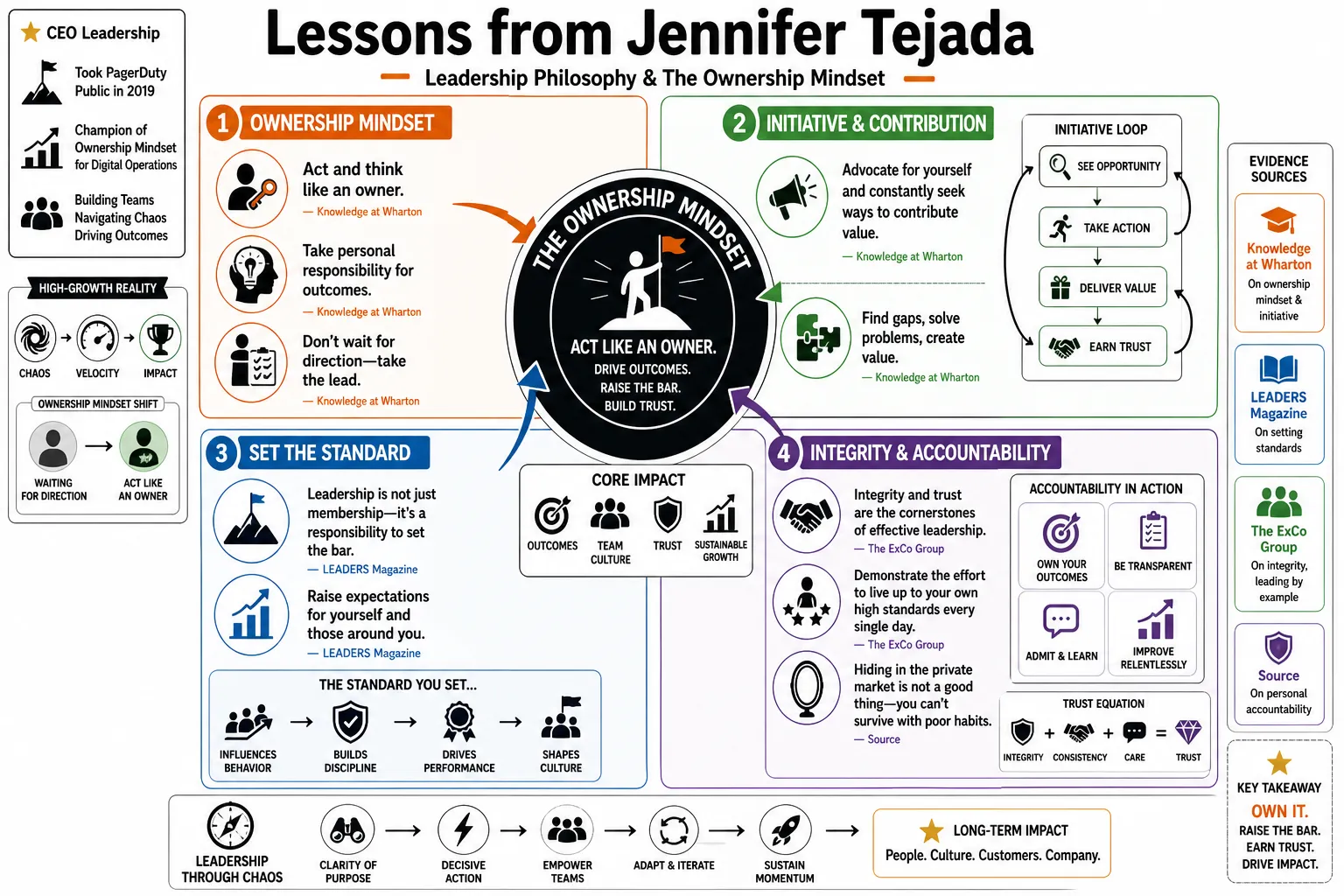
Lessons from Jennifer Tejada
As CEO of PagerDuty, Jennifer Tejada took the company public in 2019 and championed an "ownership mindset" for digital operations. This collection covers her approach to building teams and handling the chaos of high-growth tech companies.
Part 1: Leadership Philosophy and The Ownership Mindset
- On the ownership mindset: "Act and think like an owner. Take personal responsibility for outcomes rather than waiting for direction." — Source: Knowledge at Wharton
- On taking initiative: "Advocate for yourself and constantly seek ways to contribute value to the organization." — Source: Knowledge at Wharton
- On setting standards: "Leadership is not just membership—it’s a responsibility to set the bar for those around you." — Source: LEADERS Magazine
- On organizational integrity: "Integrity and trust are the cornerstones of effective leadership; without them, everything else is fragile." — Source: The ExCo Group
- On leading by example: "Demonstrate the effort to live up to your own high standards every single day." — Source: The ExCo Group
- On personal accountability: "Hiding away in the private market is not a good thing because you can't survive with poor habits." — Source: Knowledge at Wharton
- On continuous learning: "Maintain a sense of wanderlust in your career; be willing to learn entirely new skills." — Source: University of Michigan Alumni
- On authentic leadership: "Bring your whole self to work. There is no time to put on airs or act in an artificial way." — Source: Medium
- On modeling vulnerability: "Own and call out your own failures to encourage a culture of fast learning and psychological safety." — Source: Medium
- On long-term motivation: "Have the right motives: a genuine desire to grow people and help them achieve things they previously thought were impossible." — Source: SaaStr
Part 2: Building Trust and Culture
- On defining culture: "Culture is defined by the lowest level of behavior you’re willing to tolerate." — Source: Bessemer Venture Partners
- On hiring criteria: "Actively avoid hiring brilliant jerks. Prioritize emotional intelligence alongside technical aptitude." — Source: Bessemer Venture Partners
- On scaling trust: "Scaling trust requires showing employees that you are invested in their personal career and life goals, not just company wins." — Source: The ExCo Group
- On consistency: "Trust is built through consistency. It is about doing what you say you will do over a long period." — Source: The ExCo Group
- On culture as a multiplier: In Cloud Giants, Tejada said culture became a force multiplier for PagerDuty because it helped the company build more inclusive leadership and compete more effectively for talent, supporting a clearer lesson that culture compounds business performance when it changes who joins, stays, and leads. — Reference: Cloud Giants interview with Jennifer Tejada
- On early influences: "My father, a hospital administrator, knew his staff by name. That taught me that trust is built through consistent, personal effort." — Source: The ExCo Group
- On maintaining standards: "When you tolerate bad behavior from high performers, you signal to the rest of the company that your values are negotiable." — Source: Bessemer Venture Partners
- On emotional intelligence: "EQ is just as critical as IQ when evaluating candidates for leadership roles." — Source: Bessemer Venture Partners
- On psychological safety: "Employees need to know that their ideas will be heard and that they won't be punished for taking calculated risks." — Source: Medium
- On shared values: "Aligning the team around a shared set of core values is the most effective way to navigate rapid organizational change." — Source: SaaStr
Part 3: Empathy and Emotional Intelligence
- On empathy as a strategy: "Empathy is my weapon of choice when battling giants in the industry." — Source: Unusual Ventures
- On understanding others: "Building a supportive, inclusive culture is not just soft skill-building, but a critical component of high-performing teams." — Source: LEADERS Magazine
- On customer empathy: In BrainStation, Tejada said selling enterprise software starts with really getting to know the customer and understanding their biggest pain points, then identifying solutions that address those issues in a palpable, quantifiable way, supporting a stronger lesson about customer empathy as an operating discipline. — Reference: BrainStation interview with Jennifer Tejada
- On the always-on world: "Building customer loyalty requires an empathetic understanding of the stress caused by digital operations in an always-on environment." — Source: Nash Squared
- On active listening: "True empathy involves listening without immediately trying to formulate your response or solve the problem." — Source: Unusual Ventures
- On empathetic leadership during crises: "When things go wrong, the first response should be to support the people fixing the problem, not to assign blame." — Source: PagerDuty Keynote
- On internal operations: "Apply the same empathy you have for your customers to your internal engineering and support teams." — Source: Nash Squared
- On reading the room: "A leader must be able to sense the emotional state of their organization and adjust their communication accordingly." — Source: The ExCo Group
- On compassion as a differentiator: "In a highly competitive market, treating people with dignity and compassion can be your greatest competitive advantage." — Source: LEADERS Magazine
Part 4: Performing in Ambiguity and High-Growth
- On managing chaos: "Perform in ambiguity by staying focused on long-term values and overarching goals." — Source: The ExCo Group
- On the startup mindset: "In early-stage innovation, you won't see the skid marks when we go off the cliff. It is high risk and incredibly fast-paced." — Source: Medium
- On sustainable growth: "Predictable is manageable. You need a balance between the chaos of high-growth tech and stable operational rhythms." — Source: Medium
- On decision making: "You often have to make decisions with incomplete data; waiting for perfect information means you are already too late." — Source: SaaStr
- On resilience: "The ability to lead through complex and uncertain environments is a critical skill for modern executives." — Source: The ExCo Group
- On continuous evolution: "You cannot be stagnant. I sometimes change 20-25% of my leadership team annually to ensure we have the cutting-edge skills required for the future." — Source: Bessemer Venture Partners
- On preparing for AI-era change: At Wharton, Tejada said leaders have to anticipate the next leg of the journey earlier as companies get bigger, while LEADERS framed lateral moves and unexpected challenges as preparation for leading in an era shaped by AI and constant change, supporting a more grounded lesson that organizations have to prepare people ahead of fast-moving technology shifts. — Reference: Knowledge at Wharton interview with Jennifer Tejada
- On managing growth pains: "Growth breaks things. Your job isn't to prevent things from breaking, but to build systems that recover quickly." — Source: SaaStr
- On focus during turbulence: "When the market gets noisy, double down on the fundamental value you deliver to your core customers." — Source: Knowledge at Wharton
Part 5: Diversity, Inclusion, and Team Building
- On operationalizing diversity: "Diversity and inclusion must be operationalized from the top down; they are not just ethical imperatives but business drivers." — Source: BrainStation
- On innovation and background: "The best ideas and innovations come from teams with diverse backgrounds and experiences." — Source: LEADERS Magazine
- On equitable recruiting: "Implement structured, equitable recruiting processes to ensure employees can see themselves mirrored in the leadership team." — Source: Bessemer Venture Partners
- On diverse ecosystems: "A homogenous team will build a product that only serves a homogenous user base." — Source: All American Speakers
- On inclusion as a practice: "Hiring for diversity is only the first step; inclusion is the daily practice of making sure those voices are actually heard." — Source: Medium
- On challenging biases: "Leaders must actively examine their own networks and biases when sourcing executive talent." — Source: BrainStation
- On broad perspectives: "We need people who think differently than we do to catch the blind spots we inevitably have." — Source: LEADERS Magazine
- On representing the customer: "Your workforce should look like the global customer base you are trying to serve." — Source: Bessemer Venture Partners
- On intersectionality: "Understand that employees bring multiple identities to work, and those intersecting identities shape their professional experience." — Source: Medium
Part 6: Customer-Centricity and Product Vision
- On true product fit: "Prioritize solution-to-problem fit over product-to-market fit. Ensure the team remains focused on the customer’s primary needs." — Source: Women Who Code
- On avoiding distractions: "Do not become too focused on snazzy new features at the expense of the core problem the product is meant to solve." — Source: Women Who Code
- On foundational marketing: "My early career at Procter & Gamble provided foundational lessons in consumer marketing that apply just as much to enterprise software." — Source: Fast Company
- On digital operations: "Compress costs and accelerate productivity by giving engineering teams the tools to manage digital operations seamlessly." — Source: PagerDuty Keynote
- On AI integration: "Generative AI should be used to help customers maintain high reliability standards and reduce toil, not just for the sake of having AI." — Source: AWS re:Invent
- On customer feedback: "Listen to the customers who are struggling with your product; they will tell you exactly where your roadmap needs to go." — Source: SaaStr
- On the consumerization of IT: "Enterprise software users now expect the same frictionless, intuitive experiences they get from their consumer applications." — Source: Fast Company
- On proactive problem solving: "The best digital operations platforms fix issues before the end-user even notices a degradation in service." — Source: PagerDuty Keynote
- On building for scale: "Architect your product to handle the worst-case scenario for your largest customer." — Source: AWS re:Invent
Part 7: Career Navigation, Mentorship, and Networking
- On mentorship vs. sponsorship: "Mentors provide advice, but sponsors advocate for your career opportunities when you aren't in the room." — Source: BrainStation
- On building support systems: "Build strong, diverse support systems early in your career and choose your partners wisely." — Source: Unusual Ventures
- On learning to network: "I initially sucked at networking, but I learned that being an active giver in professional ecosystems is crucial for success." — Source: Fast Company
- On taking risks: "Volunteer for the messy, complicated projects that no one else wants to touch; that is where you prove your value." — Source: University of Michigan Alumni
- On lateral moves: "Don't be afraid to take a lateral move if it allows you to learn a new discipline or understand a different part of the business." — Source: University of Michigan Alumni
- On asking for help: "No one succeeds in a vacuum. Being willing to ask for help is a sign of confidence, not weakness." — Source: Women Who Code
- On self-advocacy: "You have to be your own best advocate. Do not assume your hard work will automatically be noticed and rewarded." — Source: Fast Company
- On continuous feedback: "Seek out feedback aggressively, especially from those who are likely to give you the unvarnished truth." — Source: Unusual Ventures
- On giving back: "As you move up, you have a responsibility to pull others up with you and expand their access to opportunity." — Source: BrainStation
- On embracing the journey: "Your career is not a straight line. The detours often provide the most valuable lessons." — Source: University of Michigan Alumni
Part 8: Scaling and Long-Term Value Creation
- On sustainable business models: "Focus on building long-term value for customers rather than chasing short-term valuation bumps." — Source: SaaStr
- On public market discipline: "Operating as a public company forces a level of operational rigor and transparency that makes the business fundamentally stronger." — Source: Knowledge at Wharton
- On scaling operations: "You cannot scale a company using the same manual processes that got you to your first ten million in revenue." — Source: SaaStr
- On resource allocation: "Be ruthless about where you allocate engineering resources; align them strictly with your strategic priorities." — Source: Nash Squared
- On strategic partnerships: "Utilize partnerships to extend your reach and capabilities, ensuring they bring mutual value to both parties' ecosystems." — Source: AWS re:Invent
- On global expansion: "Expanding globally requires respecting local cultures and business practices while maintaining your core company identity." — Source: LEADERS Magazine
- On capital efficiency: "In evolving economic landscapes, the companies that thrive are those that balance high growth with capital efficiency." — Source: SaaStr
- On legacy: "The ultimate measure of a CEO is not just the market capitalization they achieved, but the leaders they developed along the way." — Source: The ExCo Group
- On looking forward: "Always be designing the organization you will need three years from now, not the one you needed yesterday." — Source: Knowledge at Wharton