Jens Grede is a Swedish entrepreneur who co-founded SKIMS, Good American, and FRAME, helping to reshape how modern retail and marketing operate. He is known for integrating pop culture directly into brand strategy, operating as a behind-the-scenes strategist alongside high-profile partners like Kim Kardashian and Tom Brady. This profile compiles his frameworks on leveraging media, managing creative risk, and building sustainable consumer businesses.
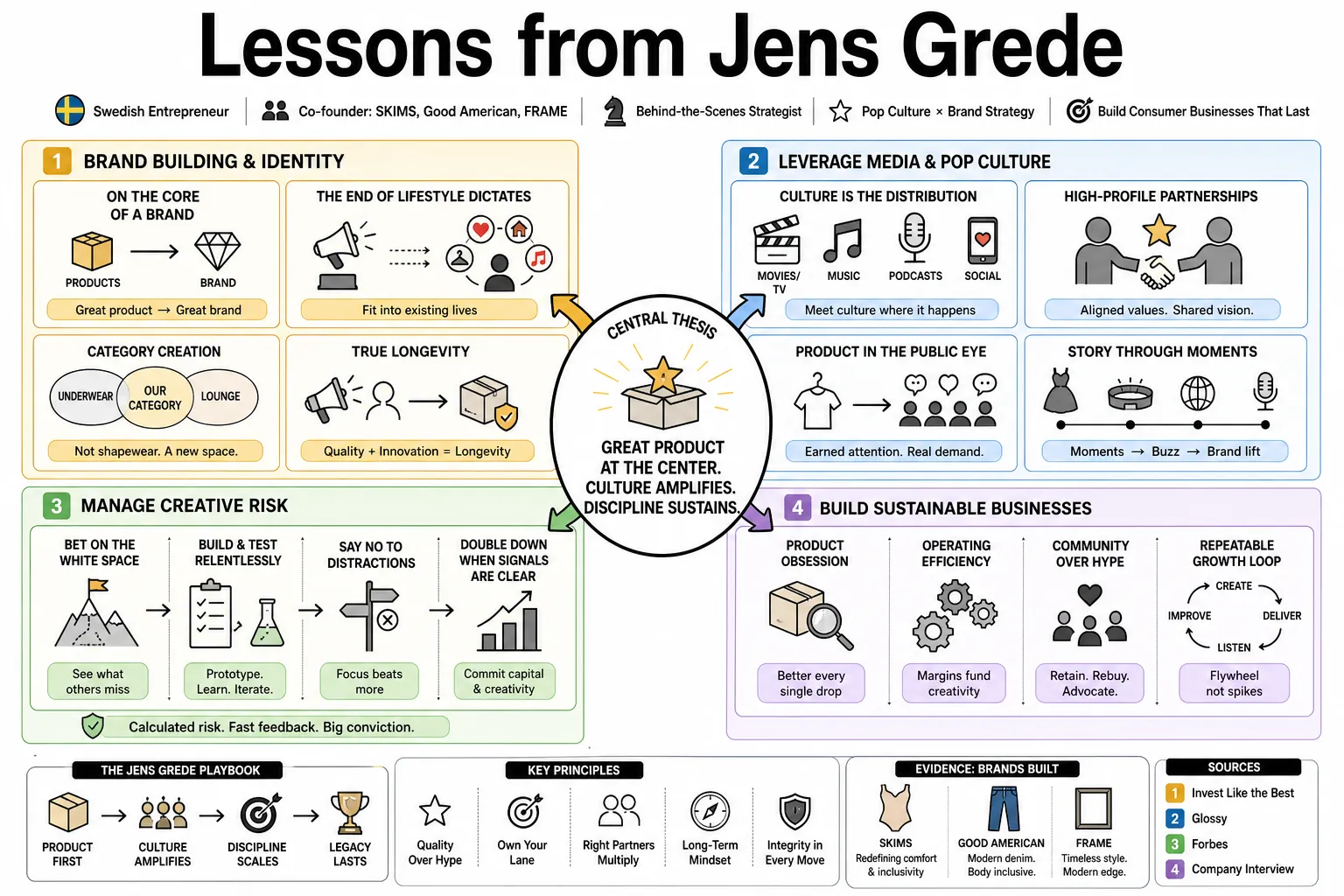
Part 1: Brand Building & Identity
- On the core of a brand: "Before a brand, there are products, and you can't build a great brand without a great product." — Source: Invest Like the Best
- On the end of lifestyle dictates: "The era of a brand dictating a lifestyle is over. Consumers want brands that fit into their existing lives." — Source: Glossy
- On category creation: "One of the misconceptions about SKIMS since launch is that we're a shapewear brand; we're our own category between underwear and lounge." — Source: Forbes
- On true longevity: "While marketing and celebrity will attract curious customers, only excellent product can build a brand and a business. The secret to longevity is simply in the quality and innovation of our product." — Source: Forbes
- On cultural alignment: Colossus frames Grede's SKIMS thesis around finding where a brand can live inside popular culture, not treating culture as decoration after the product is built. — Reference: Colossus episode page for Building SKIMS
- On distribution shifts: "Successful consumer brands are almost always born in the cracks of a major distribution change." — Source: The Business of Fashion
- On continuous experimentation: The Invest Like the Best episode notes emphasize continuous adaptation in enduring brands, so experimentation is part of the operating model rather than an occasional campaign tactic. — Reference: Apple Podcasts listing for Building SKIMS
- On authentic origins: "We wanted to make product we liked. We didn't think about a distribution strategy or a customer strategy at the very beginning of FRAME." — Source: Glossy
- On resisting narrow definitions: "Focusing on a broader ethos rather than putting ourselves in a box has allowed the brand to evolve its product offering naturally." — Source: Forbes
Part 2: Pop Culture & Commerce
- On mass attention: "Pop culture today is really the only hack to the consumer economy that we have." — Source: Invest Like the Best
- On reaching scale: "It's the only way today that you can reach a critical mass of US consumers... building a sense of knowing what the company stands for." — Source: Invest Like the Best
- On the individual voice: "In a world where we have distrust generally for authority... the voice of an individual has probably never been higher." — Source: Colossus
- On moving fast: Apple's episode notes describe the conversation as covering movement at the speed of culture instead of traditional corporate planning cycles, making fast cultural response a core brand capability. — Reference: Apple Podcasts listing for Building SKIMS
- On personal media consumption: "I love pop culture. If you looked at my media mix, I wake up in the morning, I read about four or five newspapers. But in the evening you'll find me watching Love Island and The Great British Bake Off." — Source: Forbes
- On mass fragmentation: "We no longer live in a cohesive mass culture. People are increasingly stuck in their own algorithms." — Source: Forbes
- On cutting through noise: "Because audiences are fragmented across a million different channels, pop culture events are the rare moments that cut across demographic and political lines." — Source: Forbes
- On the 'Popular Culture' holding company: "We named our company Popular Culture because it reflects our exact thesis: building businesses that sit squarely in the cultural zeitgeist." — Source: Puck News
- On relevance over tradition: "You cannot rely on the heritage of a name anymore; you have to earn your relevance every single day through culture." — Source: The Robin Report
- On avoiding trend traps: "You must be informed by pop culture and move with it, but you cannot be held hostage to it. The product must stand alone." — Source: The Robin Report
Part 3: Product Excellence
- On product supremacy: "You have to create a product so great that you will still get to the same place with or without marketing, just on the strength of the product alone." — Source: Invest Like the Best
- On operational difficulty: "I don't think customers truly know how hard it is to manufacture excellent product in a somewhat timely fashion at scale." — Source: Puck News
- On defining innovation: "All my thought process is around innovation... Innovation can be a fabric or innovation that just wasn't in the market." — Source: Wave
- On strategic collaborations: "We're combining high-performance innovation with sexy, style-forward design for all women who demand both." — Source: TMX
- On leveraging partner strengths: "The goal is to merge our partner's R&D—which is often the best in the world—with our own sensibility around culture and style." — Source: Forbes
- On community feedback: "A lot of founders are in love with their own product... rather than letting people tell them what they think. Out of the gate, we created a very strong feedback loop with our own community." — Source: The Robin Report
- On the customer's voice: "We try to avoid 'house taste' or founder bias. At the end of the day, the customer is always right." — Source: Invest Like the Best
- On design utility: "Great design in apparel isn't just about how something looks on a hanger; it is entirely about how it makes the wearer feel in their daily life." — Source: Fast Company
- On foundational staples: FRAME describes its own evolution from hand-crafted denim into ready-to-wear staples across denim, cotton, leather, and cashmere, keeping foundational materials close to the brand identity. — Reference: FRAME brand about page
Part 4: Entrepreneurial Mindset & Risk
- On the compulsion to build: "When you're an entrepreneur, it's not that you want to do something, it's that you cannot not do something." — Source: Invest Like the Best
- On defining the title: "I hesitate to call myself a classic entrepreneur. I see myself more as a coach whose job is to bring a vision to life and help the team win." — Source: Wave
- On taking chances: BoF presents Grede's career as a path from advertising into co-creating category-shaping fashion businesses, making entrepreneurial risk a pattern of building into new openings rather than waiting for certainty. — Reference: Business of Fashion podcast page with Jens Grede
- On non-linear paths: "I didn't have a linear plan and I never went to college. I built my career by creating the job I wanted rather than waiting for someone to give me permission." — Source: Wave
- On true ambition: "If you want to achieve significant results or financial success, you have to be totally honest with yourself about those desires, and accept the discomfort that comes with them." — Source: Moneywise
- On initial capital: "If you do not have financial money, you must have human capital. The smartest strategy is to become undeniably excellent at something." — Source: Repoding
- On the 'wouldn't it be cool' metric: The Colossus episode notes include real-time decision making and effective content creation in popular culture, supporting a bias toward culturally intuitive ideas that can be judged quickly. — Reference: Apple Podcasts listing for Building SKIMS
- On learning from agencies: "Working on the agency side early in my career gave me the marketing acumen to truly understand the consumer's point of view before I ever tried to sell them my own brand." — Source: The Impression
- On avoiding perfectionism: "As a founder, you don't need to be perfect. You just need to make a couple of really good decisions to be successful, even if you make bad choices along the way." — Source: Business Insider
- On starting small: Colossus places the SKIMS origin story before the later scale story, reinforcing that durable consumer companies often begin with a specific product and audience insight before the full platform is obvious. — Reference: Colossus episode page for Building SKIMS
Part 5: Navigating Dysfunction & Anxiety
- On useful chaos: "Dysfunction can actually be useful if you learn from it. A messy workplace is an opportunity to stop complaining and start outperforming." — Source: Wave
- On standing out: "If you work in an environment with some dysfunction... you'd be great. You will stand out simply by being the person who gets things done." — Source: Wave
- On anxiety as a tool: BoF quotes Grede saying he was scared of messing up the SKIMS opportunity, turning that fear into a useful form of vigilance around a rare brand-building moment. — Reference: Business of Fashion podcast page with Jens Grede
- On reading people: Apple's episode description says Grede knows consumers deeply and can translate creative-commercial judgment into plain frameworks, making customer reading a central leadership skill. — Reference: Apple Podcasts listing for Building SKIMS
- On embracing discomfort: BoF describes Grede as operating inside a high-stakes SKIMS moment he did not want to waste, a reminder that ambitious brand opportunities come with discomfort that leaders have to metabolize. — Reference: Business of Fashion podcast page with Jens Grede
- On making mistakes: Highsnobiety reports that Grede called the original Kimono name tone-deaf and treated the backlash as a mistake the company had to acknowledge and correct quickly. — Reference: Highsnobiety coverage of the Kimono naming controversy
- On listening to backlash: In Highsnobiety's account, Grede said SKIMS listened, apologized, changed the name, explained the mistake, and described a way forward after the Kimono backlash. — Reference: Highsnobiety coverage of the Kimono naming controversy
- On the illusion of control: "You quickly realize in retail that you control very little of the macroeconomic environment, so you must hyper-focus on the few inputs you can actually manage." — Source: The Robin Report
- On maintaining perspective: "When things go wrong, the most important thing a leader can do is absorb the panic so the team can focus on the solution." — Source: Repoding
Part 6: Leadership & Management
- On the role of the CEO: "I don't operate like a traditional corporate CEO. I see my job as removing obstacles so the creative and operational talent can actually do their best work." — Source: Repoding
- On swift decision making: "Make a decision and move on. The speed of the decision is often more important than getting it perfectly right the first time." — Source: Shopify
- On resolving partner disputes: "Emma and I have a simple rule for avoiding friction: whichever of us cares the most gets to decide." — Source: Business Insider
- On supporting your partners: "If one partner is deeply passionate about a decision and gets the final say, the other partner has to get behind it 110%, with no resentment." — Source: Business Insider
- On complementary skill sets: "My wife and I work well together precisely because our work styles are galaxies apart. You don't need a partner who thinks exactly like you do." — Source: Business Insider
- On scaling company culture: "As you grow, you have to formalize talent operations and organizational design, because intuition doesn't scale infinitely without structure." — Source: The Industry Fashion
- On hiring for excellence: "I look for people who are undeniably excellent at their specific craft, even if they lack a traditional corporate resume." — Source: Repoding
- On avoiding bureaucracy: The Invest Like the Best notes contrast movement at the speed of culture with traditional corporate planning cycles, pointing to lighter decision loops as a consumer-brand advantage. — Reference: Apple Podcasts listing for Building SKIMS
- On managing creatives: "You cannot manage highly creative people with spreadsheets. You have to manage them with shared vision and mutual respect." — Source: The Impression
Part 7: Creator Partnerships & Influence
- On the limits of celebrity: "A celebrity name gets you attention for the first launch. It does not buy you a second purchase. Only the product does that." — Source: Forbes
- On building a legacy: Forbes reports Grede comparing the long-term opportunity for SKIMS to the way Jordan Brand outgrew a narrow celebrity-brand definition, framing legacy as product and category expansion over time. — Reference: Forbes interview with Jens Grede on SKIMS
- On active co-founders: "Kim is incredibly hands-on. She is the creative director, the fitting model, and the ultimate arbiter of the brand's aesthetic." — Source: Reddit/Industry Interviews
- On mutual trust: "Successful creator partnerships require total trust. They bring the audience and the cultural intuition; we bring the operational execution." — Source: Observer
- On the creator economy shift: Fast Company's SKIMS profile frames the Kim Kardashian partnership through the Jordan Brand analogy, showing creator-led brands moving from endorsement into enduring business architecture. — Reference: Fast Company profile of Jens Grede and SKIMS
- On identifying the right talent: "We don't partner with people just because they are famous. We partner with people who have a distinct point of view and a genuine connection to the product category." — Source: Observer
- On authenticity: "Consumers have highly tuned radar for inauthenticity. If the creator doesn't actually wear or use the product in their daily life, the market will reject it." — Source: The Robin Report
- On shifting power dynamics: "The power has completely shifted from traditional retail gatekeepers to individuals with massive, highly engaged audiences." — Source: Colossus
- On amplifying influence: "Our job is not to change the creator's voice, but to build a commercial engine that amplifies their existing influence at a global scale." — Source: Puck News
- On the value of reach: "When your co-founder can reach hundreds of millions of people instantly, it fundamentally changes your customer acquisition cost and your entire marketing playbook." — Source: Invest Like the Best
Part 8: Consumer Strategy & Future
- On physical retail: "The era of a store serving merely as a billboard in an expensive location is over. Stores must justify their existence economically." — Source: Puck News
- On the purpose of stores: "At the end of the day, a physical store is the best venue in which to completely control your customer journey—from design to staffing to storytelling." — Source: Puck News
- On omnichannel realities: "Even in a highly digital world, physical retail remains the absolute best place to own your relationship with the consumer." — Source: Puck News
- On shifting consumer desires: Apple's episode notes say Grede describes today's cultural shift as consumers clamoring for comfort in uncertain times, tying demand to mood as much as category. — Reference: Apple Podcasts listing for Building SKIMS
- On closed networks: "Because algorithms are increasingly unpredictable, brands must focus on building direct, closed networks with their customers, like dedicated apps or loyal email lists." — Source: Wave
- On community as a moat: Highsnobiety's interview coverage has Grede describe community as starting with listening to the audience instead of trying to manage its opinion. — Reference: Highsnobiety coverage of SKIMS community and backlash
- On earning attention: "You are no longer competing against other brands in your category; you are competing against every other piece of entertainment on a consumer's phone." — Source: Global Player
- On continuous adaptation: "The brands that survive the next decade will be those that adapt their distribution strategies as fast as consumer habits shift." — Source: The Business of Fashion
- On long-term vision: "Fame provides the initial spark, but long-term success is always driven by boring things: supply chain discipline, operational expertise, and relentless execution." — Source: The Robin Report