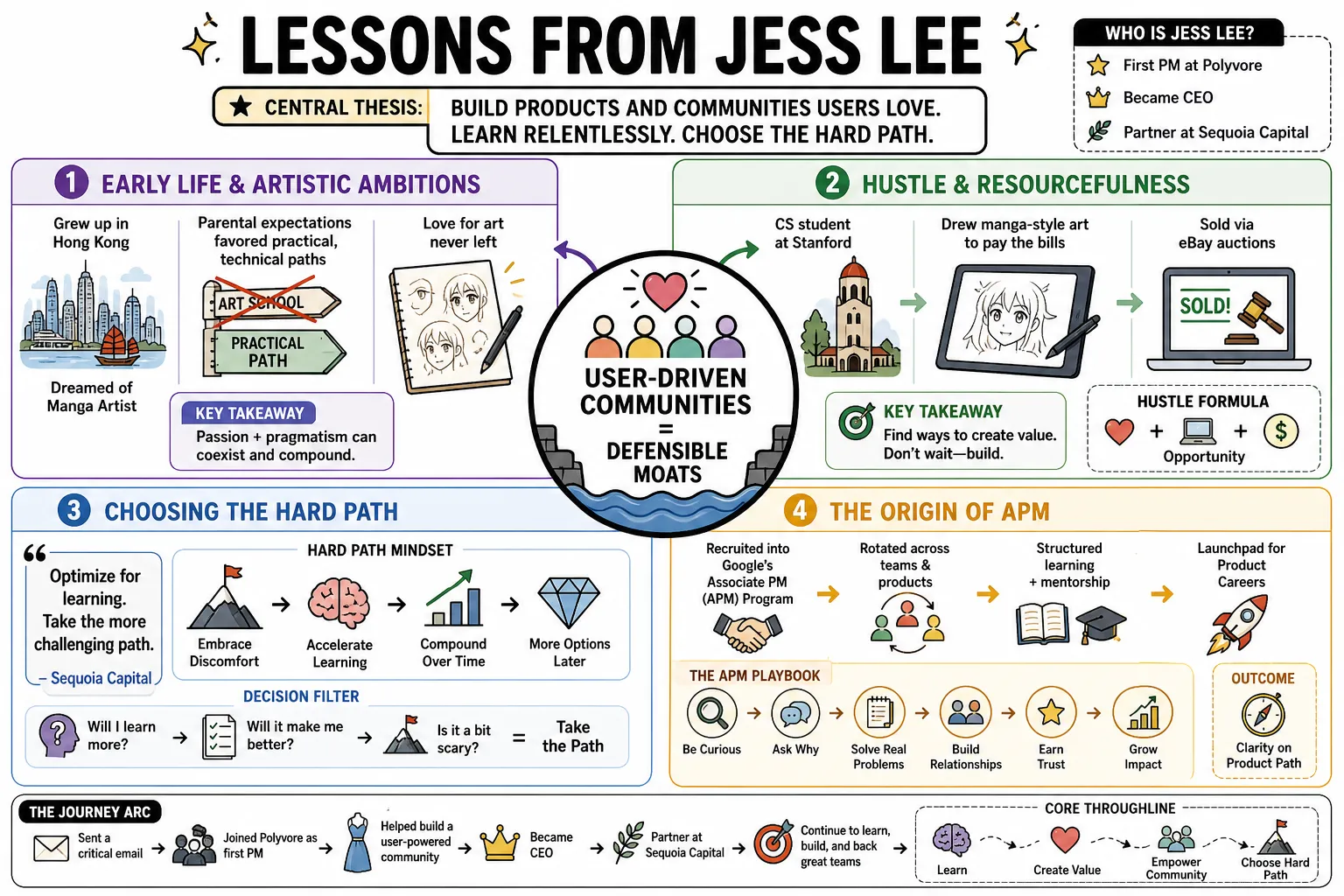
Lessons from Jess Lee
Jess Lee joined Polyvore as its first product manager after sending the founders a highly critical email, eventually taking over as CEO before joining Sequoia Capital as a partner. This profile collects her specific frameworks for evaluating talent and her argument that user-driven communities create the best defensible moats. She also shares tactical advice on scaling products and navigating the path from early employee to founder and investor.
Part 1: Early Life & Career Foundations
- On Artistic Ambitions: "Growing up in Hong Kong, I actually dreamed of becoming a manga artist before shifting my focus to computer science." — Source: Los Angeles Times
- On Practical Paths: "Parental expectations often discouraged art school in favor of more practical, technical paths." — Source: Los Angeles Times
- On Side Hustles: "Even while studying computer science at Stanford, I continued drawing manga-style art to help pay my bills through eBay auctions." — Source: The Hustle
- On choosing the hard path: Lee reframed career choices around growth rather than guaranteed success: optimize for learning, take the more challenging path, and move when learning plateaus. — Reference: Sequoia Seven Questions with Jess Lee
- On The Origin of APM: "Being recruited into Google's Associate Product Manager program right out of college exposed me to a masterclass in building for scale." — Source: Business Insider
- On Early Product Chops: "Working on Google Maps and helping create the 'My Maps' feature taught me how to put creation tools directly in the hands of the end-user." — Source: Wikipedia
- On Working at Google: "My time working under Marissa Mayer taught me the importance of building products that can handle massive, immediate consumer scale." — Source: Business Insider
- On Being a Power User: "I was actually an early user of Polyvore who wrote in to complain and got hired as the first PM." — Source: Medium
- On Recognizing Contribution: "I was retroactively made a cofounder by the other founders, who are 3 extremely generous dudes who felt I deserved it based on my contributions." — Source: Medium
- On Career Pivots: "When I look back on all my career decisions, I've been primarily motivated by growth and learning. Basically, if I feel like my learning is plateauing, then it's sort of time to do something different." — Source: Medium
Part 2: Evaluating Talent & Building Teams
- On The 4Q Framework: "When evaluating founders, I look beyond IQ and assess them across Emotional, Product, and Judgment Quotients." — Source: Delphi AI
- On founder IQ: Lee uses IQ as one part of founder evaluation: raw intellectual horsepower matters, but it has to be paired with people skill, judgment, and system awareness. — Reference: Library of Minds interview on the 4Q framework
- On founder EQ: In Lee’s 4Q framework, EQ is the one-on-one people skill that helps a founder understand, motivate, and work with others. — Reference: Library of Minds interview on EQ
- On founder PQ: Lee describes PQ as political quotient: the ability to navigate systems, group dynamics, and organizational context beyond one-on-one relationships. — Reference: Library of Minds interview on PQ
- On founder JQ: Lee adds JQ, judgment quotient, because brilliant founders can still make poor decisions if they lack practical judgment. — Reference: Library of Minds interview on JQ
- On personal spikes: Lee leans on the idea that you can move only a few points on a ten-point scale, so the highest leverage is turning existing strengths into exceptional strengths. — Reference: Sequoia article on focusing strengths
- On managing weaknesses: Lee says to know your weaknesses and manage around them by hiring people who are already strong where you are not. — Reference: Sequoia article on managing around weaknesses
- On team composition: Lee likes spiky people: extreme strengths can be powerful when the team is built so one person’s spike complements another person’s gap. — Reference: Library of Minds interview on spiky people
- On distance traveled: Lee pays attention to how far someone has come relative to their starting point, especially when underdogs show unusual pain tolerance and persistence. — Reference: Talks at Google transcript on distance traveled
- On People Problems: "Ultimately, you realize that all company scaling problems are fundamentally people problems." — Source: 25iq
Part 3: The Polyvore Community Engine
- On Democratizing Fashion: "Our goal was to democratize fashion by empowering everyday people to shape trends, rather than relying on top-down traditional institutions." — Source: OpenSource
- On User-Generated Content: "The core product was the 'set'—a digital collage that turned our community into an engine for shopping discovery and trend forecasting." — Source: Wikipedia
- On tools over directives: Lee’s Polyvore experience started from being a power user: the product worked when it let users create, complain, and pull the roadmap toward what the community actually needed. — Reference: Library of Minds interview on Polyvore user feedback
- On Cultivating Delight: "Growth wasn't about growth hacking; it was always about delighting the community so they'd want to tell their friends." — Source: CMX Hub
- On Listening to Users: "Actively incorporating user requests into the product development cycle is the most direct path to retention." — Source: Medium
- On Rewarding Super Users: "We made it a priority to spotlight top community members and send personalized gifts to acknowledge their contributions." — Source: CMX Hub
- On Integrating Community: "Community interaction wasn't a side project; we made it a central part of our company culture." — Source: CMX Hub
- On Seamless Sharing: "By making it frictionless for users to push their creations to Pinterest, Tumblr, and Twitter, our users became our distribution network." — Source: Wikipedia
- On Social Commerce: "Empowering users to mix and match items drove higher intent and deeper engagement than traditional e-commerce catalogs." — Source: The Hustle
- On Unstoppable Moats: "When you build cult-level community loyalty, you establish an unstoppable moat that competitors cannot easily copy." — Source: Medium
Part 4: Product Development Philosophy
- On The Value Hypothesis: "Before worrying about scale, a startup must first rigorously prove its value hypothesis by answering if the product actually solves a real problem." — Source: 25iq
- On The Growth Hypothesis: "Once you have proven value, the growth hypothesis focuses entirely on how to distribute that value efficiently." — Source: 25iq
- On Telemetry: "Startups have a massive advantage if they instrument their product early to capture event data, allowing decisions based on facts." — Source: 25iq
- On Data vs. Art: "You have to balance data-driven telemetry with the 'art' of product development—creating moments of pure user delight." — Source: 25iq
- On Cult-Like Movements: "Successful early-stage founders operate almost like cult leaders, gathering people and co-creating a shared vision." — Source: Note
- On Novel Insights: "A great idea isn't enough; I look for a compelling, novel insight into a problem where massive disruption is possible." — Source: Business Insider
- On Doing Less: "Do a few things well. Focus on what actually matters instead of spreading your product too thin." — Source: Medium
- On iteration speed: Lee treats velocity as a core founder signal: teams cannot control everything, but they can control how quickly they decide, ship, learn, and adjust. — Reference: Library of Minds interview on velocity
- On Storytelling as a Feature: "The ability to tell a compelling story is a critical founder superpower required to convince the best people to join." — Source: Note
Part 5: Leadership & The Startup Rollercoaster
- On embracing discomfort: Lee says founders have to get comfortable being uncomfortable, because both failure and rapid success keep forcing the company to change underneath them. — Reference: Sequoia article on startup discomfort
- On scaling pace: As a company grows, Lee warns that what worked at one stage keeps breaking at the next; the founder has to keep adapting instead of expecting stability. — Reference: Sequoia article on scaling and relearning the job
- On relearning your job: Lee describes startup leadership as repeated relearning: you figure out the job at one size, then the company doubles and the job changes again. — Reference: Sequoia article on relearning as the company scales
- On Stress Management: "Stop stressing over every little thing. The highs are never as high and the lows are never as low as they feel in the moment." — Source: Medium
- On authentic leadership: Lee could not simply pattern-match against the CEO archetypes around her; she had to find a leadership style that was true to her own strengths. — Reference: Library of Minds interview on authentic leadership
- On imposter syndrome: Lee’s move into the CEO role came with real nervousness and imposter syndrome, which she worked through by learning the job rather than pretending she already fit the mold. — Reference: Library of Minds interview on becoming CEO
- On Empathy and Standards: "The hardest part of building is balancing deep empathy for your team with the necessity of maintaining a relentlessly high performance bar." — Source: Delphi AI
- On Firing Fast: "When performance isn't met, you have to learn the difficult lesson of firing fast for the health of the broader organization." — Source: Delphi AI
- On Seeking Help: "Surround yourself with other founders who can help you; community is really important and trying to shoulder the entire burden alone is a mistake." — Source: Medium
Part 6: Investing in Consumer Startups
- On her natural habitat: Lee still identifies strongly with consumer products, especially companies that create new utilitarian, entertainment, media, gaming, or social behaviors. — Reference: Library of Minds interview on consumer categories
- On the role of a partner: Lee brings an operator’s memory to venture: she values founder support from people who have lived through the startup rollercoaster themselves. — Reference: Sequoia article on founder support from former operators
- On generational shifts: Lee studies changes in consumer behavior, future-of-work habits, and new forms of community because those shifts often reveal where the next consumer company can emerge. — Reference: Talks at Google transcript on consumer and future-of-work areas
- On the side-hustle economy: Lee’s consumer lens includes future-of-work behavior: changes in how people earn, organize time, and build communities can become product opportunities. — Reference: Talks at Google transcript on future-of-work and consumer focus
- On AI in consumer: Lee expects consumer AI to show up first in creative and entertainment formats: AI-generated videos, fanfic, short-form stories, and new kinds of participatory media. — Reference: Library of Minds interview on AI consumer media
- On evaluating velocity: Lee’s early-stage filter is velocity: how quickly the team makes decisions, runs the next turn, learns from the result, and keeps moving. — Reference: Library of Minds interview on founder velocity
- On Mission Orientation: "Founders who are deeply mission-oriented are the ones who can endure the inevitable crises of the startup journey." — Source: Lessie AI
- On Finding Disruptors: "The best consumer investments often look like toys early on before they reveal their potential to disrupt massive incumbent markets." — Source: Business Insider
- On Capital Efficiency: "Community-driven growth not only builds a moat, but it provides highly capital-efficient acquisition channels." — Source: The Hustle
Part 7: Championing Women & Diversity
- On Commanding Attention: "When facing skepticism in a room full of disinterested investors, sometimes you have to be bold and literally slam the data on the table." — Source: Business Insider
- On systemic change: Lee’s work around women in tech is not only individual advice; she wants communities and systems that help more female founders get support. — Reference: Talks at Google transcript on helping female founders
- On access to capital: Lee connects venture diversity to funding access: changing who sits at the table changes which founders get seen, understood, and financed. — Reference: Commonwealth Club event on women in venture capital and tech
- On Finding Champions: "Don't just look for mentors who will give advice; seek out champions who will actively put their political capital on the line for you." — Source: SheCanCode
- On Peer Networks: "A community of peers who are at your exact stage can often provide more tactical, relevant support than a senior executive." — Source: Women in Tech
- On defying archetypes: Lee’s own CEO lesson was that she did not need to imitate a standard archetype; authenticity became part of how she led. — Reference: Library of Minds interview on authentic leadership
- On Asking for Guidance: "Never hesitate to reach out to people who inspire you; the worst they can do is ignore the email." — Source: SheCanCode
- On Visible Role Models: "Having women in partner roles at top firms changes the equation for the next generation of female founders looking for someone who understands their market." — Source: Hustle Fund
- On building confidence: Lee builds confidence through learning: instead of asking whether she will succeed or fail, she asks whether the next step creates growth. — Reference: Talks at Google transcript on learning and confidence
Part 8: Strategic Thinking & Future Perspectives
- On the lifecycle of startups: Lee warns that every company stage breaks the last operating model; founders have to expect the job to change at each new scale. — Reference: Sequoia article on scaling stages
- On the next wave: Lee sees AI as a new consumer platform shift, with new formats emerging around entertainment, media, and creation rather than only productivity tools. — Reference: Library of Minds interview on AI-native consumer media
- On Defensibility: "In a world where software gets easier to write, the most defensible assets a company has are its network effects and its brand love." — Source: Medium
- On Consumer Expectations: "The bar for consumer software design continues to rise; what delighted users five years ago is now considered the bare minimum." — Source: 25iq
- On product-market fit: Lee treats product-market fit as a frameworked diagnosis: founders need to understand whether they are solving a hair-on-fire, hard-fact, or future-vision problem. — Reference: TechCrunch article on Lee’s product-market fit framework
- On strategic patience: Lee values velocity, but she also wants founders to understand the kind of market they are in so speed is aimed at the right problem. — Reference: TechCrunch article on PMF archetypes and velocity
- On Cross-Pollination: "Some of the best ideas come from looking at entirely different industries or regions and porting those mechanics to your own product." — Source: Hark Audio
- On designing for joy: Lee believes great consumer products need a kernel of delight: the product has to create enough emotional pull that people want to return and tell others. — Reference: Talks at Google transcript on consumer delight
- On the ultimate goal: Lee’s team-building philosophy is to put exceptional, spiky people in roles where their strengths matter and where complementary teammates cover the gaps. — Reference: Library of Minds interview on pairing spiky people