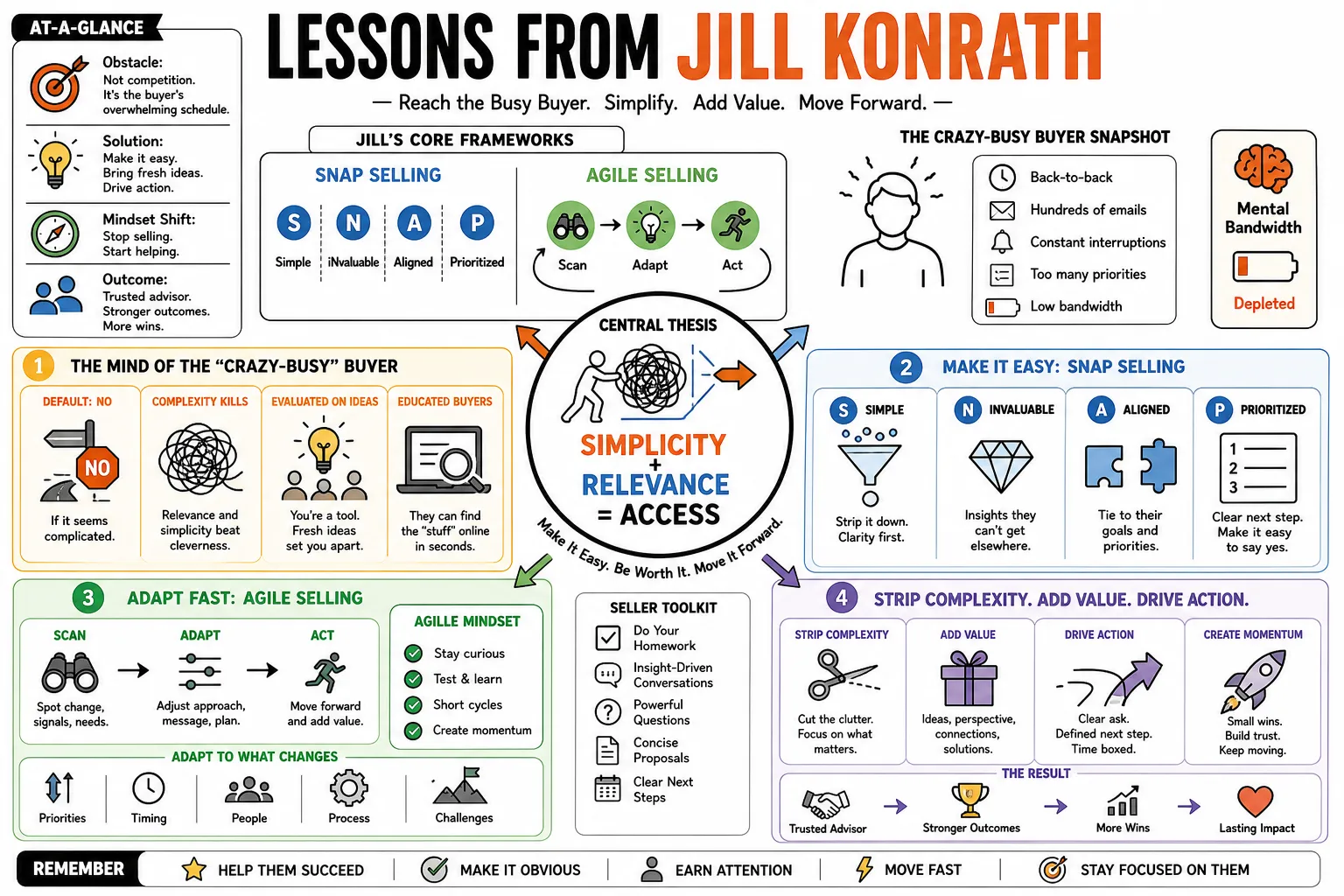
Lessons from Jill Konrath
Sales strategist Jill Konrath realized that the primary obstacle in B2B sales isn't the competition, but the buyer's overwhelming schedule. Through frameworks like SNAP Selling and Agile Selling, she taught reps how to reach distracted decision-makers by abandoning the traditional pitch and stripping away complexity. Her work forces sellers to adapt to how real people actually process information and make choices under pressure.
Part 1: The Mind of the "Crazy-Busy" Buyer
- On their default state: "Busy buyers default to 'no' if things seem complicated. You must make your message, proposals, and next steps easy to understand and execute." — Source: [WeFlow]
- On complexity: "In a world of crazy-busy buyers, relevance and simplicity beat cleverness. Stop selling and start helping your prospects manage their complexity." — Source: [Graham Mann]
- On evaluation: "Today's seller knows that their products, services, or solutions are simply tools. Buyers evaluate you based on your ability to bring fresh ideas." — Source: [Goodreads]
- On self-education: "Sellers who are successful today know that customers can go online and find out all that stuff in seconds. You are dealing with educated people who want conversations." — Source: [Goodreads]
- On the status quo: "Your prospects don't want to change how they're doing things. It takes time and energy they don't have." — Source: [Unbound Growth]
- On risk aversion: "The current sales environment is a 'perfect storm' where buyers are more informed, have less time, and are more risk-averse than ever." — Source: [Jonathan Stark]
- On being deleted: "The buyer decides in seconds whether to delete your email or take your call based entirely on whether you seem like a waste of time." — Source: [WeFlow]
- On relevance: "If you aren't talking about what they care about right now, you are irrelevant. Your solution must be perfectly synchronized with their current objectives." — Source: [Graham Mann]
- On collaboration: "You're dealing with educated people who want conversations and collaboration, not pitches of any sort." — Source: [Befreed]
Part 2: The SNAP Selling Methodology
- On the SNAP acronym: "The core of the methodology is the SNAP acronym, which represents the four rules you must follow to win over a busy prospect: Simple, iNvaluable, Align, Priorities." — Source: [WeFlow]
- On keeping it simple: "Eliminate jargon and provide only the essential information. Make the buying process as frictionless as possible." — Source: [WeFlow]
- On being invaluable: "You need to stand out as a subject matter expert rather than just another salesperson. Provide unique insights to become a resource they can’t afford to ignore." — Source: [WeFlow]
- On always aligning: "Your solution must be perfectly synchronized with the buyer’s current objectives and needs." — Source: [Graham Mann]
- On raising priorities: "You must link your offering to the buyer’s most urgent and critical issues. If it's a 'nice to have,' it gets pushed to the back burner indefinitely." — Source: [WeFlow]
- On Decision 1 (Allow Access): "To pass the first decision gate, be Simple and iNvaluable immediately to prove you aren't a waste of time." — Source: [WeFlow]
- On Decision 2 (Initiate Change): "The buyer decides if the status quo is painful enough to justify the effort of changing. Align with their goals to show why the problem is a high priority." — Source: [WeFlow]
- On Decision 3 (Select Resources): "The buyer decides which specific solution to choose. Focus on being the 'best fit' by maintaining SNAP principles through the evaluation." — Source: [WeFlow]
- On cognitive load: "The methodology focuses on reducing the buyer's cognitive load. Overwhelmed decision-makers protect their time fiercely." — Source: [WeFlow]
- On friction: "Success requires making your proposals and next steps incredibly easy to execute, eliminating all unnecessary friction from the interaction." — Source: [WeFlow]
Part 3: Value Propositions & Messaging
- On weak value propositions: "If you're struggling to get into big companies, you probably have a weak value proposition. Pure and simple." — Source: [Goodreads]
- On business results: "A true value proposition is a clear statement of the tangible, measurable business results a customer gets from your offering." — Source: [Jonathan Stark]
- On the financial language: "Your messaging must speak the language of executives. Focus on ROI, bottom-line impact, and risk mitigation." — Source: [Jonathan Stark]
- On USP vs Value: "Your Unique Selling Proposition defines why you are different from competitors, but your Value Proposition defines the financial result. The 'So What?' matters more." — Source: [Jonathan Stark]
- On elevator pitches: "An elevator speech merely defines who you help and what you do. It is not enough to break into a massive corporation." — Source: [Jonathan Stark]
- On the true differentiator: "What differentiates sellers today is their ability to bring fresh ideas. How we sell is more important than what we sell." — Source: [Goodreads]
- On focusing on pain: "Focus your messaging on business impact, like increased revenue or decreased costs, rather than leaning on product features or benefits." — Source: [Jonathan Stark]
- On quantifying impact: "Your value statement should ideally include numbers or percentages to make the potential outcome concrete and undeniable." — Source: [Jonathan Stark]
- On gatekeepers: "Rather than trying to get past gatekeepers, treat them as valuable sources of information. They know the executive's priorities." — Source: [Jonathan Stark]
- On provocative messaging: "Use a mix of provocative emails and voicemails that lead with pure value and insight, rather than immediately asking for a meeting." — Source: [Jonathan Stark]
Part 4: Agile Selling & Continuous Learning
- On learning agility: "Learning agility is a leading predictor of leadership success today. It is more reliable than IQ, EQ, or even leadership competencies." — Source: [Goodreads]
- On failure as a lab: "Success in modern sales requires treating every obstacle as a solvable challenge and every failure as a learning lab." — Source: [Befreed]
- On rejection: "Agile sellers refuse to see failure as personal. They use rejection as immediate feedback to refine their approach." — Source: [Befreed]
- On chunking information: "Break down complex information into small, digestible pieces to avoid cognitive overload while learning. Four pieces at a time is the maximum." — Source: [Befreed]
- On sequencing: "Learn the most critical information first, such as buyer personas and pain points, before diving into deep product technicalities." — Source: [Befreed]
- On the speed of change: "Rapid learning and the ability to adapt quickly serve as the ultimate competitive advantage in a constantly changing sales world." — Source: [Befreed]
- On developing agility: "Learning agility isn't innate but a skill that can be proactively developed and strengthened over time." — Source: [Befreed]
- On asking for help: "Eat your pride. Ask for help earlier rather than later to accelerate your learning curve." — Source: [Befreed]
- On reviewing material: "When you're deep in study mode, stop every thirty minutes to review what you've just learned. Repeat the information out loud to cement it in your brain." — Source: [Goodreads]
- On monotasking: "Eliminate multitasking to learn faster and think better. Focusing on one learning task at a time is essential for mastery." — Source: [Goodreads]
Part 5: Reclaiming Time & Productivity
- On the Time Master mindset: "Instead of being a victim of your schedule, act as if you are a Time Master by creating personal rules for how you handle your day." — Source: [SoBrief]
- On willpower depletion: "Recognize that every minor decision depletes your willpower. Save your best mental energy for high-leverage work like strategizing." — Source: [SoBrief]
- On time blocking: "Multitasking is a myth that reduces productivity. Dedicate specific blocks of time to one type of activity, like prospecting or research." — Source: [Peak Sales Recruiting]
- On the 52/17 rule: "Top performers often work intensely for 52 minutes and then take a 17-minute break to completely recharge their brains." — Source: [Peak Sales Recruiting]
- On email management: "Stop checking email thirty times a day. Schedule three to four specific blocks to process your inbox so it doesn't control your attention." — Source: [SoBrief]
- On front-loading the day: "Tackle your most challenging or ugliest task first thing in the morning before distractions and reactive work take over." — Source: [SoBrief]
- On turning off notifications: "Build a firewall around your focus. Turn off all desktop and phone notifications during a prospecting block to remain completely present." — Source: [SoBrief]
- On physical movement: "Take short walks when you hit a mental block. Physical activity actively boosts creativity and problem-solving." — Source: [SoBrief]
- On sleep: "Aim for eight hours of rest. Sleep is a fundamental performance-enhancement tool that restores your executive function for the next day." — Source: [SoBrief]
Part 6: Navigating Big Companies
- On targeting functional areas: "Instead of trying to sell to the company, target specific functional areas like HR or IT where your value proposition is most immediately relevant." — Source: [Jonathan Stark]
- On the account entry campaign: "Getting into a big company is not a single event. It is a systematic campaign requiring planning, research, and orchestrated outreach." — Source: [Jonathan Stark]
- On the pain of change: "In big companies, the pain of change often outweighs the pain of the problem. Decision-makers would rather stick with a mediocre situation than risk disruption." — Source: [Jonathan Stark]
- On the Rule of 7-10: "It often takes seven to ten distinct touches to even get a response from a busy corporate executive. Persistence must be paired with value." — Source: [Jonathan Stark]
- On avoiding the corporate door: "It is much easier to enter a large organization through a specific department experiencing a clear problem than trying to walk through the general corporate front door." — Source: [Selling Energy]
- On researching objectives: "Understand the company’s strategic objectives, recent news, and broader industry challenges before attempting to reach out." — Source: [Jonathan Stark]
- On providing value early: "You must position yourself as an expert who provides value before the sale by sharing white papers, insights, or trend analysis." — Source: [Selling Energy]
- On resource positioning: "To succeed with major accounts, you must completely shift your posture from being a product pusher to operating as a strategic business resource." — Source: [Selling Energy]
- On surgical outreach: "Mass outreach fails with large enterprises. The modern environment necessitates a highly surgical approach tailored to the specific account." — Source: [Jonathan Stark]
Part 7: Pipeline and Process Management
- On sales as an outcome: "Sales is an outcome, not a goal. It's a function of doing numerous things right, starting from the moment you target a potential prospect until you finalize the deal." — Source: [Goodreads]
- On deal stalling: "The longer a deal stays in your pipeline, the less likely you are to ever close it, even if your prospect claimed they desperately needed your offering." — Source: [Goodreads]
- On the buyer's journey: "Know your buyer's journey so you can seamlessly align your actions and expectations with it." — Source: [Goodreads]
- On insightful questions: "Insightful questions build credibility and deepen relationships far better than well-rehearsed pitches." — Source: [Befreed]
- On the ultimate competitor: "The truth is, the status quo is your biggest competitor. Most deals are lost to the prospect's desire to simply do nothing." — Source: [Unbound Growth]
- On preparing for the worst: "High-performing sellers prepare for everything that could go wrong. They use cheat sheets and role-play to ensure they can pivot smoothly during a meeting." — Source: [Befreed]
- On zombie leads: "Don't waste time on zombie leads that aren't going anywhere. Be ruthless about qualifying out prospects who are merely kicking tires." — Source: [SoBrief]
- On trigger events: "Look for specific changes in a prospect's world, like new funding or leadership changes, to reach out when they are most likely to need your help." — Source: [SoBrief]
- On the cost of nothing: "Your primary job during the sales process is to continually articulate the cost of staying the same to move them toward action." — Source: [Befreed]
Part 8: The Mindset of a Top Seller
- On the unique balance: "All the top sellers I know possess a unique balance of positivity and negativity. They're always optimistic about ultimate outcomes, but sometimes seem paranoid about everything that could go wrong." — Source: [Goodreads]
- On success as a decision: "Success is a decision. Dare to choose it." — Source: [Goodreads]
- On distracted environments: "Distractions consume an average of two hours per day. Top sellers fight aggressively to reclaim this lost time." — Source: [Goodreads]
- On shifting focus: "Shift your focus entirely from your product to the buyer's business objectives. Your mindset must be centered on how they measure success." — Source: [Befreed]
- On losing the pitch: "If you are pitching, you are losing. Successful sellers replace the monologue with targeted collaboration." — Source: [Befreed]
- On maintaining credibility: "To maintain credibility, you must ensure that every touchpoint adds undeniable value to the buyer's day." — Source: [Graham Mann]
- On letting go of pride: "Letting go of pride and ego allows you to view failure objectively. That objectivity is what allows agile sellers to adapt faster than their peers." — Source: [Befreed]
- On daily preparation: "Spend ten minutes at the end of every day planning the next day’s top priorities. Your brain will work on them while you sleep." — Source: [SoBrief]
- On embracing the storm: "The modern sales landscape is complex and chaotic. Those who succeed do not fight the chaos; they build systems to navigate it cleanly." — Source: [Jonathan Stark]