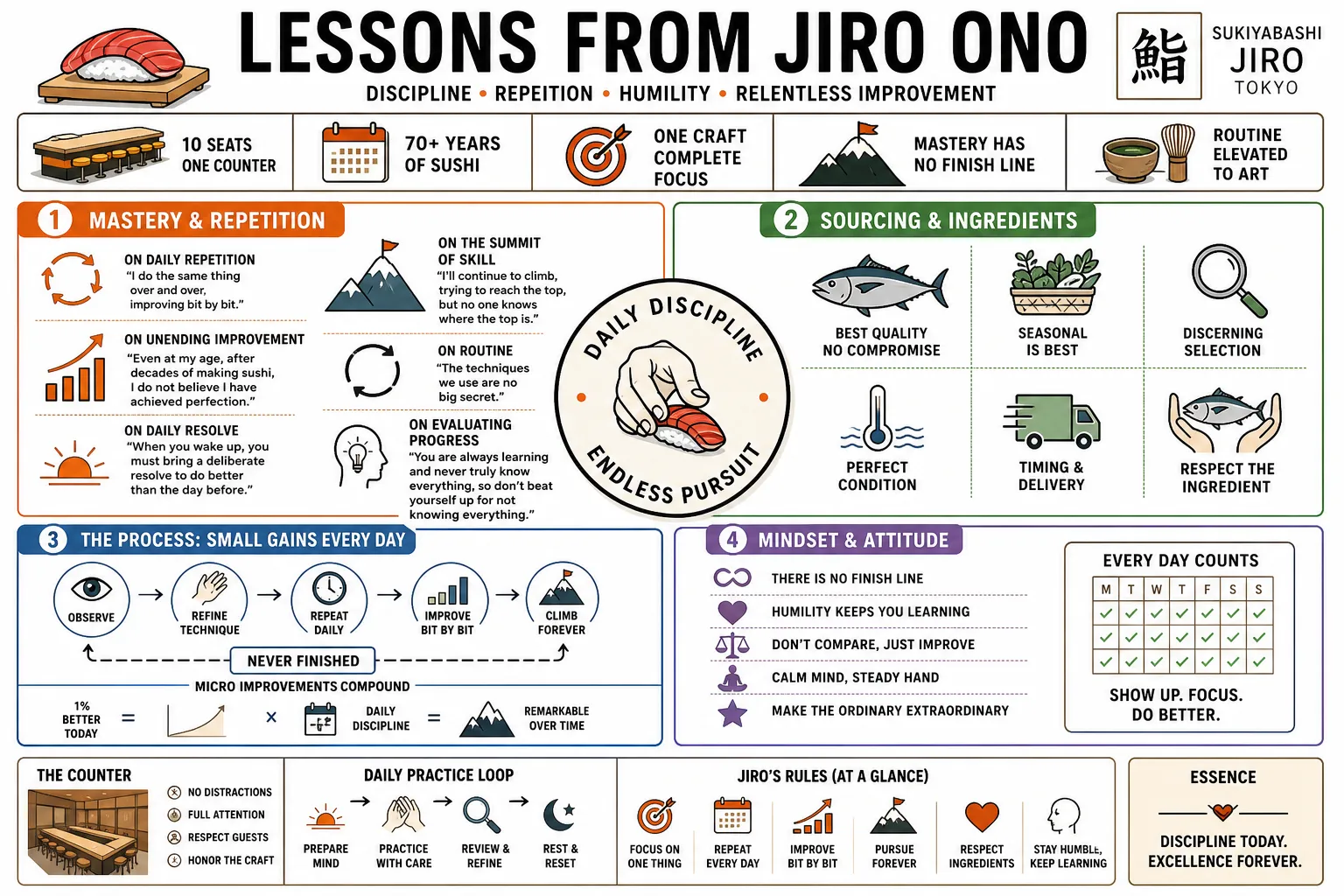
Lessons from Jiro Ono
Jiro Ono spent over seventy years making sushi at his ten-seat Tokyo restaurant, Sukiyabashi Jiro. His relentless focus on a single craft turned a daily routine into art. This profile collects his rules for discipline and sourcing ingredients, along with his belief that mastery has no finish line.
Part 1: Mastery and Repetition
- On daily repetition: "I do the same thing over and over, improving bit by bit. There is always a yearning to achieve more." — Source: [Jiro Dreams of Sushi]
- On the summit of skill: "I'll continue to climb, trying to reach the top, but no one knows where the top is." — Source: [Jiro Dreams of Sushi]
- On unending improvement: "Even at my age, after decades of making sushi, I do not believe I have achieved perfection." — Source: [Jiro Philosophy]
- On routine: "The techniques we use are no big secret. It's just about making an effort and repeating the same thing every day." — Source: [Yoshikazu Ono]
- On evaluating progress: "You are always learning and never truly know everything, so don't beat yourself up for not knowing everything." — Source: [Jiro Dreams of Sushi]
- On daily resolve: "When you wake up, you must bring a deliberate resolve to do better than the day before." — Source: [Jiro Philosophy]
- On the mundane: "The repetition of daily tasks is not mundane, it is the only path to perfection." — Source: [Sushi: Jiro Gastronomy]
- On muscle memory: "Your hands must know the rice and the fish better than your mind does. That only comes with decades of repetition." — Source: [MAD Symposium]
- On dissatisfaction: "There is always room for improvement. I am never completely satisfied with my work." — Source: [Jiro Dreams of Sushi]
- On gradual growth: "Mastery is not a sudden breakthrough, but a daily, nearly invisible refinement of technique." — Source: [Jiro Philosophy]
Part 2: Passion and Immersion
- On choosing an occupation: "Once you decide on your occupation, you must immerse yourself in your work." — Source: [Jiro Dreams of Sushi]
- On loving your work: "You have to fall in love with your work. Never complain about your job." — Source: [Jiro Dreams of Sushi]
- On the secret of success: "You must dedicate your life to mastering your skill. That’s the secret of success and is what makes you respected." — Source: [Jiro Dreams of Sushi]
- On daily joy: "I feel ecstasy every day. I love making sushi." — Source: [Jiro Dreams of Sushi]
- On working with heart: "Sushi is an art, and you have to put your heart into it." — Source: [Jiro Philosophy]
- On dreams: "I would make sushi in my dreams. I would jump out of bed at night with ideas." — Source: [Jiro Dreams of Sushi]
- On total commitment: "A shokunin does not work merely for a paycheck, but to fulfill a spiritual obligation to be one's best." — Source: [Sushi: Jiro Gastronomy]
- On complaining: "Complaining about your job is contrary to the path of success and honor. If you do not love it, leave it." — Source: [Jiro Philosophy]
- On defining existence: "Work is not just a means of survival, but the very definition of one’s existence." — Source: [Jiro Dreams of Sushi]
- On lifelong devotion: "There is no retirement from a craft you love. The craft is your life." — Source: [MAD Symposium]
Part 3: Standards and Perfection
- On personal standards: "Kodawari is the uncompromising adherence to high personal standards, striving for excellence not for external reward, but because you demand it of yourself." — Source: [Jiro Philosophy]
- On self-judgment: "I am my own harshest critic. No Michelin guide can judge my sushi more strictly than I judge it myself." — Source: [Jiro Dreams of Sushi]
- On maintaining quality: "I will not serve a piece of sushi if it does not meet my standard, even if the customer cannot tell the difference." — Source: [Sushi: Jiro Gastronomy]
- On consistency: "Consistency is not about being identical every day, but about adjusting to the variables of the day to produce the same perfect result." — Source: [Yoshikazu Ono]
- On the temperature of rice: "The rice must be served exactly at body temperature. Any colder, and the flavor of the fish is lost." — Source: [Sushi: Jiro Gastronomy]
- On pacing a meal: "An omakase meal is like a concerto. There is a specific rhythm, an ebb and flow of flavors that must be strictly maintained." — Source: [Jiro Dreams of Sushi]
- On the pressure of stars: "The Michelin stars did not change how I make sushi. They only changed the expectations of those who walk through the door." — Source: [Jiro Dreams of Sushi]
- On taking pride: "You must take absolute pride in your work. If you do not respect your own craft, no one else will." — Source: [Jiro Philosophy]
- On the illusion of perfection: "Perfection is a direction, not a destination. You walk toward it every single day." — Source: [MAD Symposium]
- On details: "The difference between good and great is an obsession with details that most people consider insignificant." — Source: [Masuhiro Yamamoto]
Part 4: Simplicity and Focus
- On simplicity: "Ultimate simplicity leads to purity." — Source: [Masuhiro Yamamoto]
- On eliminating distractions: "We have no appetizers and only ten seats. Stripping away distractions allows the quality of the sushi to be the sole focus." — Source: [Jiro Dreams of Sushi]
- On focus: "I do not want to build an empire. I only want to make sushi in this one small room." — Source: [Jiro Dreams of Sushi]
- On resisting expansion: "If we opened more locations, I could not watch the rice. And if I cannot watch the rice, I cannot serve it." — Source: [Jiro Philosophy]
- On the menu: "There is no need for a complex menu when you have dedicated your life to perfecting a few essential items." — Source: [Sushi: Jiro Gastronomy]
- On minimalism in craft: "The less you do to the fish, the better it must be. Simplicity offers no place to hide mistakes." — Source: [Masuhiro Yamamoto]
- On the restaurant environment: "The environment must be clean, quiet, and entirely focused on the plate in front of the guest." — Source: [Jiro Philosophy]
- On narrowing one's path: "To do one thing extremely well, you must be willing to say no to everything else." — Source: [MAD Symposium]
- On essence: "We remove what is unnecessary until only the pure essence of the ingredient remains." — Source: [Yoshikazu Ono]
Part 5: Quality and Ingredients
- On developing taste: "In order to make delicious food, you must eat delicious food." — Source: [Jiro Dreams of Sushi]
- On discerning quality: "The quality of ingredients is important, but one must develop a palate capable of discerning good and bad food. Without good taste, you can't make good food." — Source: [Jiro Dreams of Sushi]
- On trusting vendors: "Our vendors are specialists. The tuna dealer only buys tuna. The shrimp dealer only buys shrimp. We must trust their mastery as they trust ours." — Source: [Yoshikazu Ono]
- On the daily market: "Buying the best fish is not about spending the most money; it is about having the relationships and the eye to choose the exact right piece on that specific day." — Source: [Sushi: Jiro Gastronomy]
- On massaging octopus: "We used to massage the octopus for thirty minutes. Now we massage it for forty-five minutes to ensure the meat is incredibly soft." — Source: [Jiro Dreams of Sushi]
- On timing: "Every ingredient has a peak moment. The sushi must be consumed the very second it is placed in front of the guest." — Source: [Sushi: Jiro Gastronomy]
- On rice vinegar: "The balance of vinegar and salt in the rice must be bold enough to stand up to the richest fish, yet delicate enough not to overpower the leanest." — Source: [Jiro Philosophy]
- On preparing eel: "Eel must be roasted precisely so the fat renders and the flesh becomes as soft as cotton." — Source: [Sushi: Jiro Gastronomy]
- On adapting to seasons: "You do not force the fish to bend to your will; you adapt your technique to respect the season and the catch." — Source: [Yoshikazu Ono]
Part 6: Teaching and Apprenticeship
- On the length of apprenticeship: "An apprentice must work for ten years before they are allowed to cook the eggs." — Source: [Jiro Dreams of Sushi]
- On squeezing towels: "The first thing an apprentice learns is how to properly wring out a hot towel. If they cannot do that, they cannot touch the fish." — Source: [Jiro Dreams of Sushi]
- On harsh training: "The training is severe. Many leave after the first day. Only those who can endure the repetition will ever become chefs." — Source: [Yoshikazu Ono]
- On watching the master: "I do not explain every detail. An apprentice must learn by watching, observing, and absorbing the rhythm of the kitchen." — Source: [Jiro Philosophy]
- On earning approval: "When an apprentice finally makes tamago that meets my standard, they are no longer an apprentice. They are a shokunin." — Source: [Jiro Dreams of Sushi]
- On failure: "Mistakes in the kitchen are not failures if they teach you exactly what not to do tomorrow." — Source: [MAD Symposium]
- On patience: "It takes years of watching the rice before you are allowed to even touch it. Patience is the first ingredient." — Source: [Sushi: Jiro Gastronomy]
- On humility: "An apprentice must empty their cup completely. You cannot learn my way if you are holding onto your own ego." — Source: [Jiro Philosophy]
- On the legacy of students: "My greatest achievement is not my sushi, but the chefs who have survived this kitchen and carried the craft out into the world." — Source: [Masuhiro Yamamoto]
Part 7: Discipline and Work Ethic
- On parental coddling: "Nowadays parents say to their kids, 'If it gets too hard, you can come back.' When parents say stupid things like that, their kids will turn out to be failures." — Source: [Jiro Dreams of Sushi]
- On leaving home: "When I left home at age nine, I was told I had no home to return to. That meant I had to survive by working hard." — Source: [Jiro Dreams of Sushi]
- On vacations: "Holidays are just too long. After a day or two, I want to get back to work. I miss the restaurant." — Source: [Jiro Dreams of Sushi]
- On physical endurance: "Standing for fourteen hours a day requires not just physical strength, but an unyielding mental discipline." — Source: [Jiro Philosophy]
- On taking days off: "I only took days off for national holidays or funerals. Even then, my mind was on the rice." — Source: [Jiro Dreams of Sushi]
- On wearing gloves: "I wear gloves when I leave the restaurant to protect my hands. My hands are my tools; they must remain soft and undamaged." — Source: [Jiro Dreams of Sushi]
- On early mornings: "The discipline starts before sunrise at the fish market. If you are lazy in the morning, the sushi will suffer in the evening." — Source: [Yoshikazu Ono]
- On strict routines: "A strict routine eliminates the burden of decision-making. You do not decide to work hard; you simply follow the discipline you have built." — Source: [Jiro Philosophy]
- On surviving hardship: "Hardship is not an excuse to quit; it is the exact fire required to forge a master." — Source: [MAD Symposium]
Part 8: Legacy and Aging
- On passing the torch: "My son Yoshikazu has been working with me for decades. The restaurant will be in his hands, and it will be as good or better." — Source: [Jiro Dreams of Sushi]
- On working until the end: "I don’t want to retire. I want to keep making sushi until I die." — Source: [Jiro Dreams of Sushi]
- On living in the present: "I do not dwell on the past. I am only concerned with the sushi I am making today and how I can improve it tomorrow." — Source: [Jiro Philosophy]
- On the shadow of the father: "It is difficult to take over from a famous father. You have to be twice as good just to be considered equal." — Source: [Yoshikazu Ono]
- On changing ocean conditions: "The fish we used to catch easily are disappearing. We must face the reality that the ingredients for our craft are finite." — Source: [Jiro Dreams of Sushi]
- On adapting to age: "As I age, my stamina decreases, but my palate and my intuition only grow sharper." — Source: [MAD Symposium]
- On true legacy: "The legacy of a shokunin is not in awards or fame, but in the exact memory of the taste left with the customer." — Source: [Sushi: Jiro Gastronomy]
- On remaining a student: "Even in your nineties, you must view yourself as a student of your craft. The moment you believe you are a master, you begin to decline." — Source: [Jiro Philosophy]
- On the final plate: "If I could make one final piece of sushi, it would be the exact same piece I made today. Simple, focused, and made with total dedication." — Source: [Masuhiro Yamamoto]