Lessons from Joe Coulombe
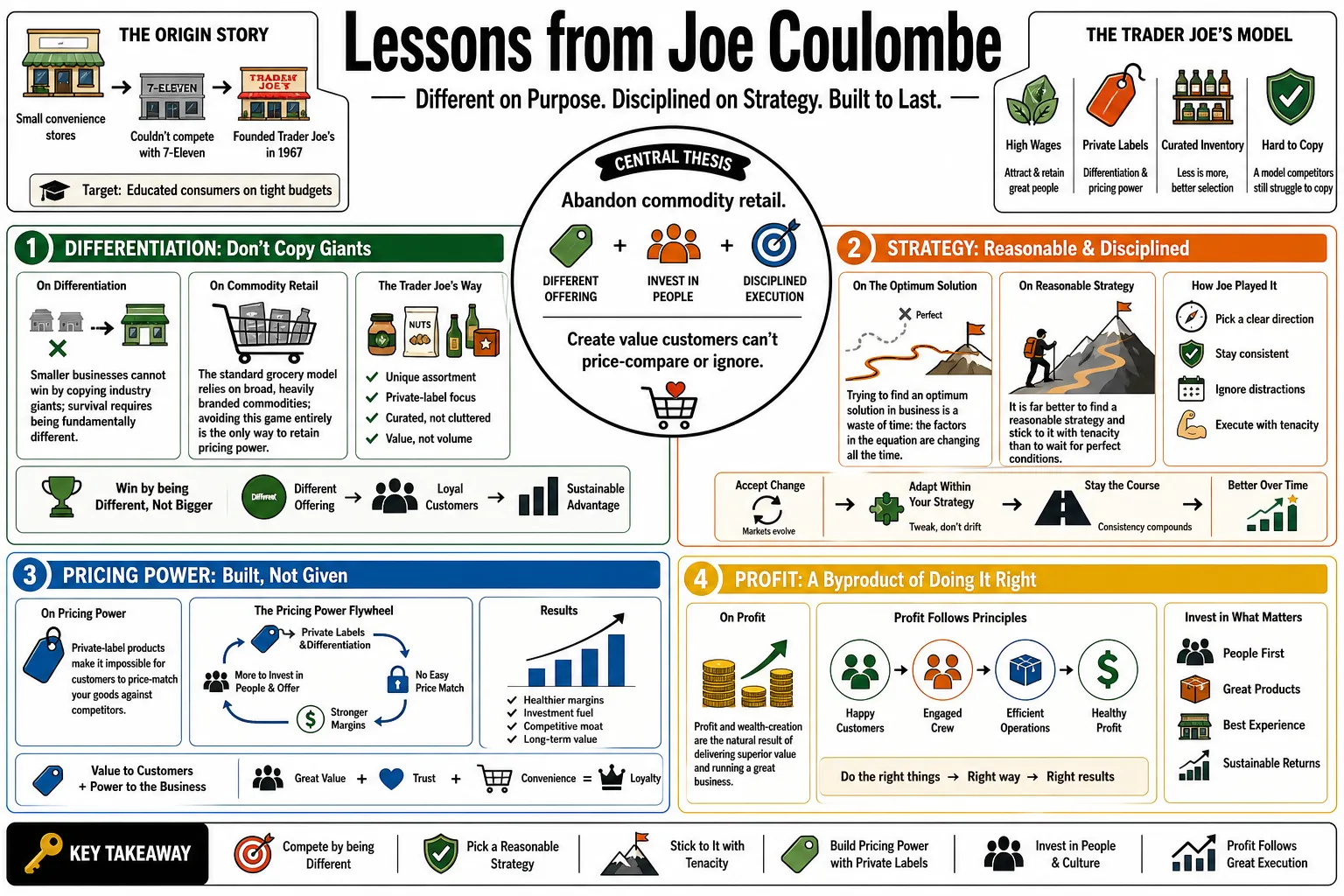
When Joe Coulombe realized his small convenience stores couldn't compete with 7-Eleven, he founded Trader Joe's in 1967 to court educated consumers on tight budgets. He abandoned standard supermarket economics in favor of high wages, private labels, and a curated inventory, building a retail model that competitors still struggle to copy.
Part 1: Strategy and Differentiation
- On Differentiation: "Smaller businesses cannot win by copying industry giants; survival requires being fundamentally different." — Source: [Becoming Trader Joe]
- On Commodity Retail: "The standard grocery model relies on broad, heavily branded commodities; avoiding this game entirely is the only way to retain pricing power." — Source: [Founders Podcast]
- On The Optimum Solution: "Trying to find an optimum solution in business is a waste of time: the factors in the equation are changing all the time." — Source: [Goodreads]
- On Reasonable Strategy: "It is far better to find a reasonable strategy and stick to it with tenacity than to wait for perfect conditions." — Source: [Becoming Trader Joe]
- On Pricing Power: "Private-label products make it impossible for customers to price-match your goods against competitors." — Source: [Macro-Ops]
- On Profit: "Profit and wealth-creation are inevitable by-products of doing other things well. Making money as an end in itself ranks low." — Source: [Goodreads]
- On Being Right: "It is better to be vaguely right than exactly wrong." — Source: [Goodreads]
- On The Non-Commodity Experience: "True differentiation comes from offering goods that mass-market convenience stores wouldn't dream of stocking." — Source: [Masters Invest]
- On Shelf Space: "Businesses should focus on increasing the value offered per cubic inch of shelf space rather than simply expanding square footage." — Source: [Los Angeles Times]
- On Product Discontinuity: "Embracing sudden changes in product availability builds a treasure-hunt atmosphere that cannot be replicated by predictable supermarkets." — Source: [Biography Nuts]
Part 2: Managing and Compensating Employees
- On High Wages: "This is the most important single business decision I ever made: to pay people well." — Source: [Biography Nuts]
- On Replication: "Competitors fail to replicate the store's model because they are fundamentally unwilling to pay the high wages required to attract top-tier talent." — Source: [Becoming Trader Joe]
- On Frontline Staff: "Happy, well-compensated frontline employees are the absolute foundation of a successful retail operation." — Source: [Biography Nuts]
- On Wage Targets: "The goal was to ensure the average full-time employee earned the median family income for California." — Source: [Los Angeles Times]
- On Store Managers: "Store captains should be treated and paid as high-level professionals, often earning more than desk-bound corporate executives." — Source: [Founders Podcast]
- On Compensation as an Investment: "High wages are an investment that guarantees lower turnover, higher productivity, and significantly reduced theft." — Source: [Masters Invest]
- On Building a Culture: "I have been known to say that there's no better business to run than a cult. Trader Joe's became a cult of sorts." — Source: [Goodreads]
- On Bureaucracy: "As a company grows, it must actively resist rigid procedures and allow local teams the latitude to serve their specific communities." — Source: [Biography Nuts]
- On Employee Insights: "The people working on the floor interacting with customers possess the most accurate insights for improving the business." — Source: [Founders Podcast]
- On Retail as a People Business: "Retail is not about managing products; it is fundamentally about managing people who happen to sell products." — Source: [Masters Invest]
Part 3: Understanding the Customer
- On Target Demographics: "The ideal customer base was the overeducated and underpaid, people who appreciated worldly goods but had limited budgets." — Source: [Los Angeles Times]
- On Respecting Intelligence: "Treat customers like adults; provide high-quality items without bombarding them with mass-market advertising or screaming discounts." — Source: [Becoming Trader Joe]
- On The Macaroni and Cheese Shopper: "A classical musician might have a refined palate but only enough money for basic staples, creating a market for affordable gourmet foods." — Source: [Founders Podcast]
- On Location Strategy: "Placing stores near universities, hospitals, and research centers guarantees a steady flow of intellectually curious shoppers." — Source: [Macro-Ops]
- On Negative Selling: "Never give an order to a customer; create an environment where the products are interesting enough to sell themselves." — Source: [Founders Podcast]
- On Losing Customers: "I believe in the wisdom that you gain customers one by one, but you lose them in droves." — Source: [Masters Invest]
- On Customer Loyalty: "Loyalty is not bought through promotions, but earned by consistently respecting the customer's intelligence." — Source: [Becoming Trader Joe]
- On Niche Demographics: "The breakup of mainstream consumption in America opened the door for niche demographics like health food enthusiasts and wine connoisseurs." — Source: [Goodreads]
- On Advertising: "Relying on traditional advertising implies your products cannot speak for themselves through sheer value and quality." — Source: [Biography Nuts]
Part 4: Product Selection and Curation
- On Curation: "Narrowing the assortment of goods prevents choice paralysis and builds trust that every item on the shelf has been vetted." — Source: [Macro-Ops]
- On Bulky Items: "Refuse to stock items that take up massive amounts of physical space but offer very low profit margins." — Source: [Los Angeles Times]
- On Product Testing: "Every product must possess high value per cubic inch, a fast rate of consumption, ease of handling, and a distinct reason to exist." — Source: [Founders Podcast]
- On Private Labels: "Shifting away from branded merchandise is the only way to control both product quality and consumer value." — Source: [Masters Invest]
- On Health Foods: "Let's define health foods as foods grown with as few chemicals as possible, processed with as few chemicals as possible, and packaged as ecologically as possible." — Source: [Goodreads]
- On Dropping Products: "A retailer must possess the willingness to stop carrying any product immediately if its value proposition drops." — Source: [Becoming Trader Joe]
- On Vendor Pricing: "If a vendor can no longer supply an item at the best price, pull it from the shelves entirely rather than compromising on cost." — Source: [Founders Podcast]
- On Categorization: "The goal is to find products that cannot be easily categorized or found in a standard supermarket aisle." — Source: [Biography Nuts]
- On Repeat Visits: "Focus on products that are consumed quickly and need frequent replenishment, driving repeat store visits." — Source: [Macro-Ops]
Part 5: Buying and Supply Chain Economics
- On Intensive Buying: "Skip the middlemen and work directly with manufacturers to intervene in product development and secure the best prices." — Source: [Macro-Ops]
- On Retail's Function: "The fundamental job of a retailer is buying goods in bulk, breaking them down, and selling the pieces to the final consumer." — Source: [Biography Nuts]
- On Virtual Distribution: "Efficiently managing the supply chain behind the scenes allows a small store to offer prices that rival massive conglomerates." — Source: [Becoming Trader Joe]
- On Vendor Relationships: "Cultivate direct relationships with suppliers to discover excess inventory or unique runs of high-quality goods." — Source: [Founders Podcast]
- On Creating Value: "True value is created through smart, aggressive sourcing rather than relying on broad, heavy promotions." — Source: [Masters Invest]
- On The 18th-Century Model: "Reject the outdated retail model that relies on selling heavily marketed, identical commodities at standard markups." — Source: [Founders Podcast]
- On Ease of Handling: "A product's ease of handling is just as critical to its profitability as its purchase price." — Source: [Macro-Ops]
- On Global Sourcing: "Looking outside domestic supply chains is essential to finding the interesting, worldly products the target demographic desires." — Source: [Los Angeles Times]
- On Price Anchoring: "By owning the supply chain for private labels, you prevent competitors from establishing a baseline price for your best items." — Source: [Becoming Trader Joe]
Part 6: Navigating Problems and Discontinuity
- On Business Problems: "All businesses have problems. It's the problems that create the opportunities. If a business is easy, every simple bastard would enter it." — Source: [Masters Invest]
- On Hairballs: "By hairballs, I mean those wholly unnecessary thorns that come unexpectedly. Their greatest danger is that they consume management stamina." — Source: [Goodreads]
- On Perfect Information: "If all the facts could be known, idiots could make the decisions." — Source: [Founders Podcast]
- On Flexibility: "A business model must remain agile enough to navigate shifting government regulations and sudden market changes." — Source: [Becoming Trader Joe]
- On Changing Landscapes: "The retail landscape is never static; surviving requires a constant readiness to pivot away from failing product lines." — Source: [Biography Nuts]
- On Tenacity: "Brilliance is secondary; the sheer tenacity to push through operational roadblocks is what ultimately builds a lasting company." — Source: [Founders Podcast]
- On Shifting Behaviors: "Recognizing structural changes in consumer behavior early is more valuable than any short-term tactical optimization." — Source: [Masters Invest]
- On Regulatory Fear: "Allowing fear of taxes or regulations to dictate your long-term ownership decisions is a mistake that leads to deep regrets." — Source: [Founders Podcast]
- On Executive Energy: "Reserve executive energy specifically for fundamental matrix issues, rather than getting bogged down by daily, expected friction." — Source: [Becoming Trader Joe]
Part 7: Retail Philosophy
- On The Buyer's Role: "Shift from giving customers whatever they ask for to empowering your buyers to curate a selection that surprises and delights." — Source: [Macro-Ops]
- On Store Footprints: "A smaller footprint forces strict discipline on inventory and prevents the accumulation of mediocre products." — Source: [Los Angeles Times]
- On The Mindset of Shopping: "Shopping for necessities shouldn't be a chore; injecting a sense of playfulness into the store environment changes the consumer's mindset." — Source: [Becoming Trader Joe]
- On Iteration: "Trader Joe's was not so much born as extruded through a continuous process of trial, error, and refinement." — Source: [Goodreads]
- On The Treasure Hunt: "When a product might disappear at any time, customers are incentivized to buy it immediately rather than waiting for a sale." — Source: [Founders Podcast]
- On Categories: "Deciding which product categories to completely ignore is just as important as deciding what to stock." — Source: [Masters Invest]
- On Fads vs Shifts: "Ignoring short-lived retail fads in favor of long-term demographic shifts ensures sustainable growth." — Source: [Becoming Trader Joe]
- On Reading Widely: "A retail leader must read widely and observe cultural shifts outside the grocery industry to anticipate what people will want." — Source: [Founders Podcast]
- On Expansion Limits: "Resist the urge to open stores faster than you can find and train the exceptional people needed to run them." — Source: [Biography Nuts]
- On Operational Simplicity: "Simplifying operations at the store level creates an experience that large, complex competitors find structurally impossible to copy." — Source: [Macro-Ops]
Part 8: Marketing and Brand Identity
- On Theming: "Adopting a cohesive, slightly absurd visual theme immediately breaks the corporate grocery atmosphere." — Source: [Los Angeles Times]
- On Authenticity: "A brand's identity must authentically reflect the quirks and convictions of its founders, not just market research." — Source: [Founders Podcast]
- On Content Marketing: "Use newsletters to tell detailed, humorous stories about the products rather than just printing coupons and price drops." — Source: [Becoming Trader Joe]
- On Word of Mouth: "When you deliver an exceptional, highly specific experience, your target demographic will do your marketing for you." — Source: [Masters Invest]
- On Information Asymmetry: "Educating the customer about where a product comes from and why it was chosen builds immense brand trust." — Source: [Macro-Ops]
- On Focus Groups: "Great retail concepts are developed through strong intuition and direct observation, not watered-down committee consensus." — Source: [Founders Podcast]
- On Humor: "Using intelligent, slightly irreverent humor in store signage signals to the customer that they are in on the joke." — Source: [Biography Nuts]
- On Packaging: "Ecological and minimalist packaging not only reduces costs but appeals directly to the values of the educated consumer." — Source: [Goodreads]
- On Legacy: "A retail brand's ultimate success is measured by its ability to maintain its soul and distinct culture long after the founder departs." — Source: [Becoming Trader Joe]