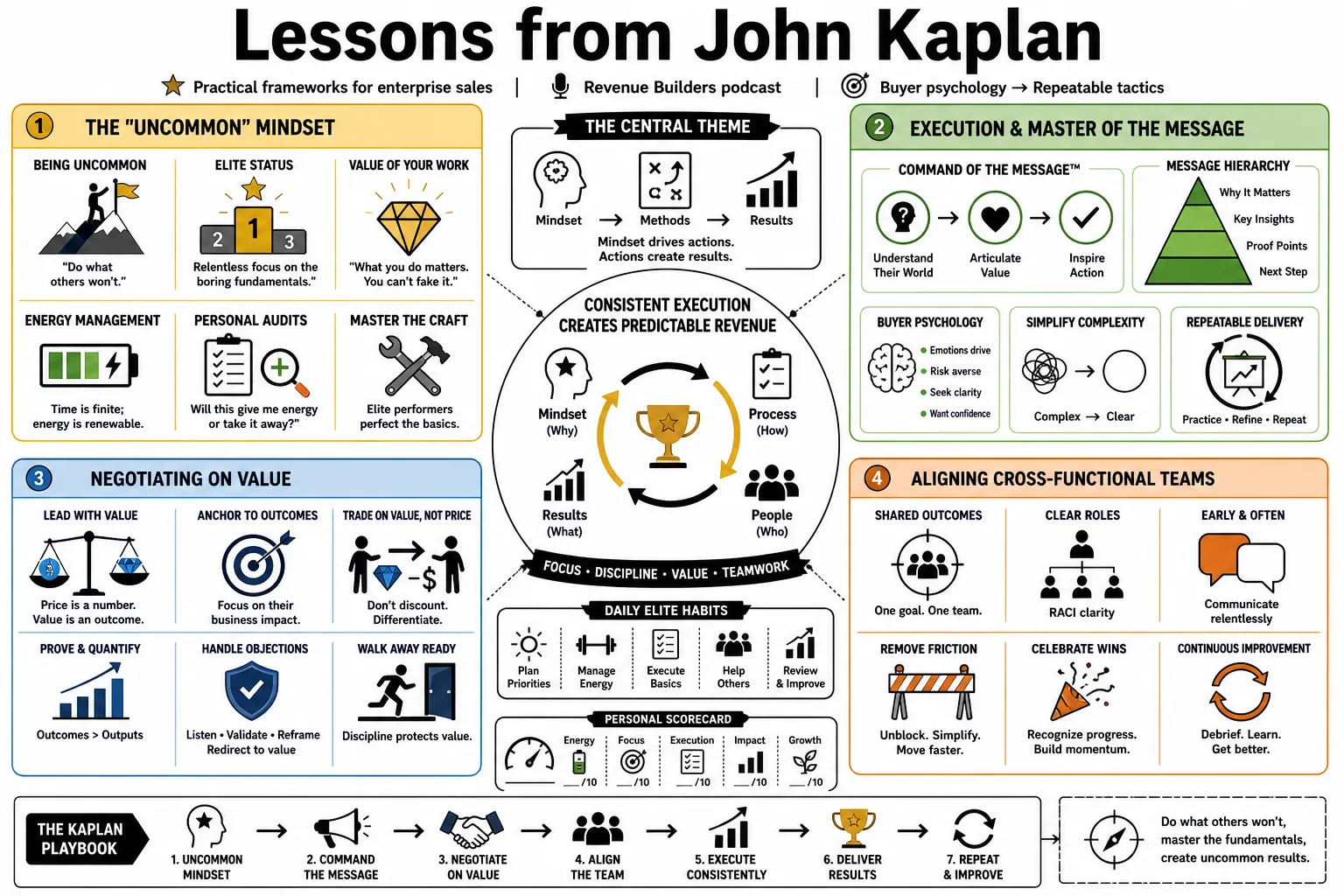
Lessons from John Kaplan
John Kaplan, co-founder of Force Management, builds practical frameworks for enterprise sales. Through methods like Command of the Message and the Revenue Builders podcast, he turns buyer psychology into repeatable tactics. The insights below cover his approach to consistent execution, negotiating on value, and aligning cross-functional teams.
Part 1: The "Uncommon" Mindset & Elite Performance
- On Being Uncommon: "To achieve results that others don't, you must be willing to do what others won't." — Source: [Force Management Blog]
- On Elite Status: "Being elite isn't an accident; it is the result of a relentless focus on the boring fundamentals that average performers skip." — Source: [The Audible-Ready Sales Podcast]
- On the Value of Your Work: "What you do matters. If you don’t believe what you do matters, you will falter. You can’t fake it for very long." — Source: [Force Management Insights]
- On Energy Management: "Time management is a fallacy. It’s not about time management; it’s about energy management. Time is finite; energy is renewable." — Source: [Revenue Builders Podcast]
- On Personal Audits: "Continuously ask yourself: 'Will this job, or this task, give me energy or take it away?'" — Source: [Revenue Builders Podcast]
- On Mastering the Craft: "Elite athletes and top-tier sales professionals share a common trait: they never stop practicing their craft, regardless of their tenure." — Source: [Force Management Blog]
- On Repetition: "Skills need to be done hundreds of times, if not thousands, to be performed flawlessly in the moment." — Source: [Revenue Builders Podcast]
- On Pressure vs. Stress: "The difference between stress and pressure is preparedness. Stress is bad. Pressure is good, kind of like an old friend or a heavy blanket." — Source: [The Audible-Ready Sales Podcast]
- On Gratitude: "Focusing on what is working and practicing gratitude is essential to maintaining the fire required for elite performance." — Source: [Force Management Blog]
- On Finding Flow: "Sustained high performance requires finding the 'zone' where your skills perfectly match the challenge at hand." — Source: [Force Management Insights]
Part 2: Command of the Message & Value Communication
- On Selling Change: "If you try to sell a product, you're going to fail. If you sell change, you are going to succeed." — Source: [Force Management Insights]
- On the Four Essential Questions: "Every organization must be aligned on four things: What problems do you solve? How do you solve them? How do you do it better? Where have you done it before?" — Source: [Force Management Insights]
- On Defining the Problem: "Your message must focus intimately on the buyer's 'Before' state before you ever introduce your solution." — Source: [The Audible-Ready Sales Podcast]
- On Required Capabilities: "Value is communicated by clearly linking the customer's specific business problem to the specific capabilities required to solve it." — Source: [Force Management Blog]
- On Differentiation: "You must be able to articulate how you solve the problem differently or better than the competition, or you will be commoditized." — Source: [Force Management Blog]
- On Proof Points: "Differentiation is meaningless without proof. You must be able to confidently answer, 'Where have you done this before?'" — Source: [Force Management Insights]
- On Seller Deficit Disorder: "The two biggest complaints buyers have are 'You don't understand my business' and 'You don't listen.' Avoid this deficit at all costs." — Source: [Force Management Blog]
- On Earning the Right: "By articulating the customer's challenges better than they can, you earn the right to propose a solution." — Source: [The Audible-Ready Sales Podcast]
- On Positive Business Outcomes: "Sellers must move beyond feature-dumping and focus on PBOs—the specific, measurable results the customer achieves after the problem is solved." — Source: [Force Management Blog]
- On Meaningful Conversations: "A great sales conversation helps the customer get to a place they simply cannot get to on their own." — Source: [Revenue Builders Podcast]
Part 3: The Art of Discovery & "So What?"
- On the Importance of Discovery: "Deals are ultimately won or lost in the discovery phase, not in the closing phase." — Source: [Force Management Insights]
- On the "So What?" Question: "When you find a problem, keep asking 'So what?' until you uncover the tangible negative consequences of leaving it unsolved." — Source: [The Audible-Ready Sales Podcast]
- On Uncovering Pain: "The 'So what?' framework leads you to the bad things that happen if the problem isn't fixed, such as lost revenue or increased risk." — Source: [Force Management Blog]
- On Guiding the Buyer: "The more you tell someone they have a problem, the more they will resist you. The more you ask great discovery questions, the more they will convince themselves." — Source: [Force Management Insights]
- On Standing in the Pain: "You have to use discovery questions that make the buyer stand in their moment of pain long enough to recognize the need for change." — Source: [The Audible-Ready Sales Podcast]
- On the Cost of Inaction: "Always establish how big the problem is and specifically ask, 'What happens if you do nothing?'" — Source: [Force Management Blog]
- On Active Listening: "Discovery is not an interrogation; it is a diagnostic process that requires intense listening and genuine curiosity." — Source: [The Audible-Ready Sales Podcast]
- On Recapping the Conversation: "The practice of 'The What We Hear'—playing back the discovery session to the customer—is a critical validation step." — Source: [Force Management Blog]
- On Diagnosis Before Prescription: "Prescribing a solution before thoroughly diagnosing the scope of the problem is professional malpractice in sales." — Source: [The Audible-Ready Sales Podcast]
- On Finding the Metric: "If a problem cannot be measured in time, money, or risk, it is likely not a problem worth solving for the executive buyer." — Source: [Force Management Insights]
Part 4: Process, Planning & The 3 Ps
- On Setting Objectives: "A goal without a plan is just a wish. This applies to everything from territory management to individual meeting execution." — Source: [Force Management Insights]
- On the Purpose: "Every single interaction with a customer must start with a clearly defined Purpose: Why are we here today?" — Source: [The Audible-Ready Sales Podcast]
- On the Process: "After establishing purpose, outline the Process: How exactly are we going to achieve the goal of this meeting?" — Source: [Force Management Blog]
- On the Payoff: "Conclude your meeting framework with the Payoff: What is the specific value the customer will get out of the time spent together?" — Source: [The Audible-Ready Sales Podcast]
- On First Impressions: "Openers are closers; the groundwork and structure you lay in the beginning determines your ultimate success." — Source: [Force Management Insights]
- On Controlling the Engagement: "Using the 3 Ps ensures you maintain control of the conversation while respecting the buyer's time." — Source: [The Audible-Ready Sales Podcast]
- On Predictability: "A rigorous process removes the reliance on individual heroics and creates predictable, scalable outcomes." — Source: [Force Management Blog]
- On Meeting Preparation: "Never walk into a client engagement without a written plan detailing your desired outcomes and potential objections." — Source: [Revenue Builders Podcast]
- On Execution Discipline: "The best strategies fail without disciplined, step-by-step execution at the field level." — Source: [Force Management Insights]
Part 5: Value Negotiation & Protecting Margins
- On the Definition of Negotiation: "Negotiation is a continuous process of value validation that begins at the first discovery call, not a late-stage event." — Source: [Force Management Insights]
- On the Give-Get Rule: "Never give a concession, like a discount, without getting something of equal or greater value in return." — Source: [The Audible-Ready Sales Podcast]
- On Discounting for Velocity: "Discount-for-yes deals churn two to three times faster and reduce expansion revenue years out. Never give for velocity alone." — Source: [Force Management Insights]
- On Trading Variables: "Trade for things that have strategic value to your company: term length, prepaid contracts, or public case studies." — Source: [The Audible-Ready Sales Podcast]
- On Procurement: "If you only start negotiating when the contract reaches procurement, you have already lost your leverage." — Source: [Force Management Blog]
- On Defending Value: "Your ability to defend your pricing is directly proportional to how well you quantified the customer's pain during discovery." — Source: [Revenue Builders Podcast]
- On Walking Away: "You must be willing to walk away from a bad deal. A disciplined 'no' is often more profitable than a desperate 'yes.'" — Source: [The Audible-Ready Sales Podcast]
- On Price Objections: "A price objection is usually a value objection in disguise. If they challenge the price, revisit the positive business outcomes." — Source: [Force Management Blog]
- On Mutual Agreement: "True negotiation results in a mutually beneficial outcome where both the buyer and the seller feel they received proportional value." — Source: [Force Management Insights]
Part 6: Leadership, Coaching & The Skill/Will Model
- On the Role of a Leader: "Effective leaders genuinely enjoy helping others succeed on their own terms." — Source: [Revenue Builders Podcast]
- On Trusting the Process: "Everybody is willing to be led, provided they believe that you and your process can get them to a place they cannot get to on their own." — Source: [Force Management Insights]
- On Playing vs. Coaching: "Being a great 'player' does not automatically make one a great 'coach.' Coaching requires a completely different skill set." — Source: [The Audible-Ready Sales Podcast]
- On the Skill/Will Model: "You must meet your people where they are. You cannot coach a 'low skill/high will' person the same way you coach a 'high skill/low will' person." — Source: [Force Management Blog]
- On Front-Line Managers: "Front-line managers are the lifeblood of the company, yet they are often the least trained. Prioritize their development." — Source: [Revenue Builders Podcast]
- On Accountability: "Rules without relationships equal rebellion. You must build trust before you can demand rigorous accountability." — Source: [Force Management Blog]
- On In-the-Trenches Leadership: "The best sales leaders don't just inspect the CRM; they get in the trenches and co-sell alongside their reps." — Source: [The Audible-Ready Sales Podcast]
- On Developing People: "Your ultimate metric as a leader is not just revenue, but how many of your team members get promoted and succeed." — Source: [Revenue Builders Podcast]
- On Servant Leadership: "Shift your focus from making your own number to serving your team; when they win, you win." — Source: [Force Management Insights]
Part 7: Hiring, Talent & Patriots vs. Mercenaries
- On the Cost of a Bad Hire: "A single bad hire in a key position can set a company back by years. Hire with extreme rigor." — Source: [Force Management Blog]
- On Success Profiles: "Don't hire on gut feel. Build a 'Success Profile'—a documented list of core competencies proven to succeed in your specific environment." — Source: [The Audible-Ready Sales Podcast]
- On Evidence-Based Interviewing: "Use a structured interview guide to find concrete evidence of desired behaviors, not just a candidate's ability to interview well." — Source: [Force Management Blog]
- On Patriots: "In building company culture, seek out 'Patriots'—those committed to the cause who will metaphorically melt down their furniture to make bullets." — Source: [Force Management Insights]
- On Mercenaries: "Avoid 'Mercenaries' at all costs. They might hit short-term numbers, but they will leave the moment the money stops or things get hard." — Source: [Revenue Builders Podcast]
- On Cultural Fit: "You can teach product knowledge and process, but you cannot easily teach grit, resilience, or core values." — Source: [The Audible-Ready Sales Podcast]
- On Onboarding: "Effective onboarding is not an HR checklist; it is an intensive enablement program designed to get reps to productivity faster." — Source: [Force Management Blog]
- On Continuous Assessment: "Regularly evaluate your talent against your Success Profile to identify coaching gaps before they become performance issues." — Source: [The Audible-Ready Sales Podcast]
- On Retention: "Top performers stay when they believe they are growing, learning, and led by someone who cares about their career trajectory." — Source: [Revenue Builders Podcast]
Part 8: Alignment, Culture & Career Growth
- On Operational Alignment: "Sales cannot operate in a silo. Cross-functional alignment between Sales, Marketing, and Product is non-negotiable for scale." — Source: [Force Management Blog]
- On Messaging Consistency: "If your marketing team says one thing and your sales team says another, the buyer is the one who pays the price in confusion." — Source: [The Audible-Ready Sales Podcast]
- On Facing Adversity: "All experiences can be good if we believe they are purposeful. Some of the biggest growth comes from the most difficult situations." — Source: [Force Management Insights]
- On Service: "Long-term career fulfillment comes from shifting the focus from 'making a sale' to genuinely 'serving the customer.'" — Source: [Revenue Builders Podcast]
- On Opportunity vs. Position: "Many people confuse a title or position with true opportunity. Always prioritize the quality of leadership and growth potential over the label." — Source: [Force Management Blog]
- On Continuous Learning: "The moment you think you have nothing left to learn is the moment your career begins its decline." — Source: [The Audible-Ready Sales Podcast]
- On Building Legacy: "A successful career is not measured solely by quota attainment, but by the impact you leave on the people you led and worked alongside." — Source: [Revenue Builders Podcast]
- On Embracing the Grind: "There is no shortcut to mastery. Embrace the boring, repetitive work required to be excellent when it matters most." — Source: [Force Management Blog]
- On Organizational Truth: "You cannot fix what you are unwilling to acknowledge. Honest, unfiltered alignment on your current state is the first step to hyper-growth." — Source: [The Audible-Ready Sales Podcast]