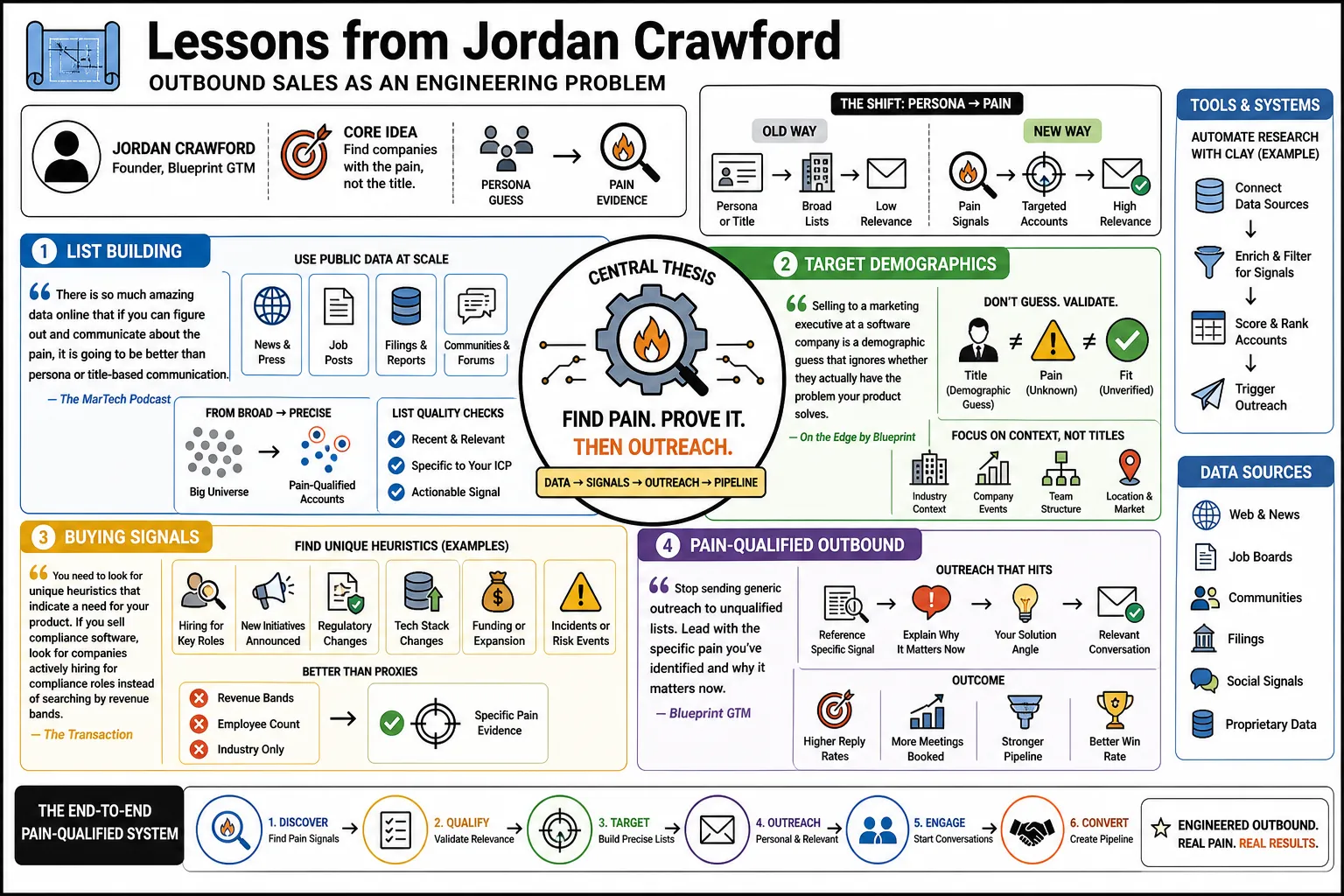
Lessons from Jordan Crawford
Jordan Crawford, founder of Blueprint GTM, treats B2B outbound sales as an engineering problem. He teaches teams to drop generic buyer personas and instead use public data to find companies experiencing specific pain points. This collection breaks down his methods for automating account research with tools like Clay to run highly targeted campaigns.
Part 1: The Shift from Persona to Pain
- On List Building: "The thing that people may not really get about good list building is there is so much amazing data online that if you can figure out and communicate about the pain, it is going to be better than persona or title-based communication." — Source: The MarTech Podcast
- On Target Demographics: "Selling to a marketing executive at a software company is a demographic guess that ignores whether they actually have the problem your product solves." — Source: On the Edge by Blueprint
- On Buying Signals: "You need to look for unique heuristics that indicate a need for your product. If you sell compliance software, look for companies actively hiring for compliance roles instead of searching by revenue bands." — Source: The Transaction
- On Pain-Qualified Outbound: "Stop assuming a job title means a pain exists. Let public data prove the pain exists before you ever send the first email." — Source: GTMnow
- On Wasted Effort: "Companies waste massive budgets marketing to people who fit an ideal customer profile on paper but have zero structural need for what they sell." — Source: RevOps FM
- On Job Descriptions as Data: "A company's active job descriptions are the most honest public ledger of their current operational pain. What they are hiring to fix is what they are willing to spend money on." — Source: Bootstrappers
- On Persona Obsession: "Personas are often a lazy substitute for doing the hard work of understanding actual business friction." — Source: The MarTech Podcast
- On Timing: "Pain-qualified data inherently solves for timing. If a company just installed a new CRM system, the pain of data migration is acute right now." — Source: Predictable Revenue
- On Irrelevant Pitching: "Every generic pitch sent to an executive is a tax on their attention. If you cannot point to a specific reason why you are reaching out, do not send the message." — Source: Pavilion
- On Finding the Signal: "The internet is overflowing with unstructured intent data, and the competitive advantage goes to whoever can filter that noise to find a verified buying signal." — Source: On the Edge by Blueprint
Part 2: Go-To-Market Engineering
- On Defining GTM Engineering: "GTM Engineering is about building new systems and data moats to acquire customers. It is fundamentally different from revenue operations, which focuses on maintaining existing reporting." — Source: GTM Shift
- On Technical Sales: "The next generation of great sales leaders will be highly technical. They will know how to write scripts, scrape websites, and connect APIs to find their buyers." — Source: The MarTech Podcast
- On Tool Proficiency: A GTM Live episode summary makes the same point: Crawford argues that operators who actually get into Claude Code and similar tools will build what older playbooks cannot imagine, while people who avoid the tools will be left defending methodologies buyers have moved past. — Reference: GTM Live episode summary on Jordan Crawford, Claude Code, and outdated GTM playbooks
- On System Building: "You should not be writing emails manually. You should be building the system that understands exactly when an email should be triggered based on a real-world event." — Source: Clay
- On Competitive Advantage: "Your outbound strategy is no longer safe if it relies solely on buying lists from major data vendors, because your competitors have those exact same lists." — Source: RevOps FM
- On Operations: "Most operations teams are drowning in CRM ticket requests. Engineers focus on top-of-funnel data architecture that actually generates net new pipeline." — Source: GTMnow
- On Automation Nuance: "The really great stuff does not scale immediately. Stop trying to scale it before you prove the logic actually works on ten specific accounts." — Source: Deezer
- On AI Mandates: The Topline episode page quotes Crawford criticizing top-down AI-first mandates from leaders who cannot explain what AI-first means or how teams should implement it. — Reference: Topline episode page quoting Crawford on vague AI-first executive mandates
- On Actionable Strategy: "I never write about strategies without providing the tactical tools required to implement them. Strategy without execution is just theory." — Source: On the Edge by Blueprint
- On Building Moats: "A data moat is created when you combine disparate, publicly available data sources into a proprietary insight that your competitors cannot easily replicate." — Source: Bootstrappers
Part 3: Programmatic Outbound and AI
- On Generative AI Limits: "AI and other marketing tools can be helpful, but they will only take you so far. You still need to be able to have real dialogues and use critical thinking." — Source: The Entrepreneur Ethos
- On Iteration Speed: The GTM Live episode summary frames Crawford’s operating lesson as speed of iteration: being wrong quickly and cheaply can outperform slower correctness, because extra attempts create the equivalent of getting two moves for every one move by a stronger opponent. — Reference: GTM Live episode summary on fast, cheap iteration and the grandmaster analogy
- On AI Personalization: "Using AI to write a generic opening line about a prospect's university is a party trick. Real personalization is using AI to map their company's structural pain." — Source: GTMnow
- On Autonomous Agents: In Pavilion’s AI and GTM interview, Crawford describes AI agents that can hunt leads more precisely than standard databases and use MCP-style access to internal and public data to identify specific account opportunities. — Reference: Pavilion interview with Crawford on AI agents, MCP, and account opportunity discovery
- On High-Volume Mediocrity: "Most companies use AI to send bad emails faster. You should use it to send fewer, highly relevant messages." — Source: The MarTech Podcast
- On Scraping Tools: "Tools like Clay allow you to pull in dozens of data providers to enrich a single account. Operating on a single enrichment source leaves you blind." — Source: Clay
- On Data Enrichment: "Enrichment is not just about getting a valid email address. It involves gathering context on what software they use and how their headcount is trending." — Source: Predictable Revenue
- On Prompting for Sales: "A good prompt for sales research asks the AI to analyze a financial report and extract strategic initiatives, rather than asking it to write a pitch." — Source: On the Edge by Blueprint
- On Programmatic SEO: "The principles of programmatic SEO apply to outbound. You want to create highly specific messaging variations based on the exact attributes of the target account." — Source: Growth Mentor
- On Testing: "If you are not running systematic tests on your data sources as well as your copy, you are leaving the most important variable to chance." — Source: RevOps FM
Part 4: Data Moats and Unique Heuristics
- On Uncovering Signals: "Identify specific, narrow segments by understanding unique heuristics that indicate a distinct need for your product." — Source: The Transaction
- On Job Board Scraping: "Scraping job boards is a highly effective activity. A new open role for a specific tool administrator tells you exactly what that company is investing in." — Source: Bootstrappers
- On Review Mining: "Customer reviews of your competitors are highly valuable. You can programmatically find companies complaining about missing features and target them with that exact solution." — Source: On the Edge by Blueprint
- On Technology Detection: "Knowing a company installed a specific technology last week provides far more value than knowing their industry category or employee count." — Source: The MarTech Podcast
- On Following the Money: "Look at what the press release says a company is using their funding for, as that dictates where their budget allocation is going." — Source: Pavilion
- On Regulatory Triggers: "Changes in compliance laws create immediate pain for specific types of businesses, making them perfect targeting heuristics." — Source: GTMnow
- On Pricing Data: "If a company has transparent pricing on their website, you can deduce their target market and profit margins to help position your own ROI." — Source: Predictable Revenue
- On the Value of Public Data: "The most actionable data is often sitting in plain sight on a company's careers page, entirely un-gated." — Source: RevOps FM
- On Narrow Segmentation: "A list of fifty companies that perfectly match a highly specific heuristic will consistently outperform a generic list of five thousand companies." — Source: Clay
Part 5: The Fallacy of More SDRs
- On Throwing Bodies at Problems: "B2B companies frequently fail because they try to solve a data and targeting problem by simply hiring more representatives to send more bad emails." — Source: The MarTech Podcast
- On SDR Inefficiency: "You cannot hand a fresh graduate a terrible list and expect them to out-maneuver an experienced finance executive." — Source: GTM Shift
- On Scaling Bad Processes: "If your outbound motion is broken, adding more headcount just scales the inefficiency and ruins your domain reputation." — Source: Predictable Revenue
- On Structural Flaws: "When outbound fails, leadership tends to blame the representatives. The reality is usually a structural failure in how the company identifies its market." — Source: RevOps FM
- On Cost of Acquisition: "The traditional outbound model is becoming expensive because companies are paying a premium for manual data entry and guesswork." — Source: Bootstrappers
- On Specialized Roles: "Instead of hiring ten general representatives, you should hire one engineer to build the targeting system and two senior representatives to handle the replies." — Source: On the Edge by Blueprint
- On Domain Burnout: "Sending thousands of irrelevant emails a day is a guaranteed way to ensure your entire company ends up in the spam folder." — Source: The MarTech Podcast
- On Compensation Alignment: "If you compensate representatives purely on meeting volume, they will book low-quality meetings. You have to align the incentive with revenue potential." — Source: Pavilion
- On Efficiency Metrics: "The goal is not to see how many activities a representative can log. The goal is to maximize the revenue generated per outreach attempt." — Source: GTMnow
Part 6: Frameworks for Revenue
- On the CATCAT Framework: "Simplify your prospecting with CATCAT: Companies, ABM, Titles, Channel, Approach, and Timing. If one is missing, the entire campaign fails." — Source: Predictable Revenue
- On the FIND Process: "Use the FIND workflow to structure campaigns: Focus on a tight segment, Investigate the data signals, Narrate the specific pain, and Deploy." — Source: GTMnow
- On Total Addressable Market: "Your addressable market is not every company that could theoretically buy your software. It is the companies actively experiencing the problem right now." — Source: Sell Better
- On Account Prioritization: "Tier your target accounts by the density of buying signals they are currently exhibiting rather than their total employee count." — Source: RevOps FM
- On Campaign Design: "A campaign should be designed backwards. Start with the exact pain the customer feels, find the data signal for that pain, and then write the email." — Source: On the Edge by Blueprint
- On Signal Stacking: "One buying signal is interesting. Three distinct buying signals overlapping on a single account means you need to prioritize that outreach immediately." — Source: The Transaction
- On Disqualification Metrics: "A functional framework must aggressively disqualify bad accounts. If your system flags every company as a good fit, the system is broken." — Source: Clay
- On Channel Selection: "Do not assume email is the only viable channel. If the data shows a prospect is highly active on social media, route your approach accordingly." — Source: The MarTech Podcast
- On Timing Triggers: "Timing acts as a multiplier for your approach. A brilliant message sent six months before a contract renewal is effectively worthless." — Source: Pavilion
Part 7: Messaging that Converts
- On True Salesmanship: "Great sales is not about being pushy. It is about asking the right questions, disqualifying the wrong customers, and asking the right customers to articulate their pain." — Source: Growth Mentor
- On the Pitch: "After they articulate their specific pain, you simply ask them if they want to solve it." — Source: Growth Mentor
- On Permissionless Value: "Reach out with something actually useful. Give them a piece of analysis they can use immediately without requiring a scheduled meeting." — Source: SaaS Group
- On Subject Lines: "Your subject line should read like an internal email from a colleague referencing a specific, ongoing project." — Source: Predictable Revenue
- On Brevity: "If they have to scroll on their phone to read your pitch, you have already lost their attention. Get to the pain point in the first two sentences." — Source: On the Edge by Blueprint
- On Avoidance of Jargon: "Executives do not care about your synergistic platform. They care about reducing their cloud computing bill by twenty percent." — Source: RevOps FM
- On Call to Actions: "Stop asking for fifteen minutes of their time. Ask a low-friction question that confirms the pain point actually exists." — Source: GTMnow
- On Authenticity: "The more your outreach looks like an automated marketing blast, the faster it will be deleted. Plain text generally wins." — Source: The MarTech Podcast
- On Providing Proof: "Do not just claim you can help. Show them exactly how you helped a competitor who had the exact same technology stack and hiring profile." — Source: Bootstrappers
Part 8: The Future of B2B Sales
- On the Shift in Power: "The technical marketers and the go-to-market engineers are going to replace traditional sales operations leaders entirely." — Source: GTM Shift
- On AI Capabilities: The Revenue Leadership Podcast recap presents Crawford’s view that generic outreach is losing power and that durable advantage comes from proprietary datasets that reveal genuine prospect needs and support highly relevant messaging. — Reference: Revenue Leadership Podcast recap on Crawford, proprietary datasets, and relevant AI-enabled messaging
- On Skill Acquisition: "If you are in sales today, you need to learn basic scripting, APIs, and data structuring because that is where the true advantage lies." — Source: The MarTech Podcast
- On Market Adaptation: "The companies that fail to adopt programmatic data strategies will soon find their customer acquisition costs are impossible to sustain." — Source: On the Edge by Blueprint
- On the Disappearance of Tiers: "The distinction between marketing, sales development, and operations is blurring. It is all becoming revenue engineering." — Source: RevOps FM
- On Agentic Workflows: "We are entering an era where AI agents will crawl the web, identify intent, and execute sequences autonomously." — Source: Clay
- On the Human Element: "Even as automation scales, the final step of securing trust and navigating enterprise procurement will require empathetic humans." — Source: Pavilion
- On Speed as a Moat: "The ability to launch a targeted campaign based on a new market event within one day is the ultimate competitive advantage." — Source: Predictable Revenue
- On the True Goal: "Ultimately, the point of all this engineering is to ensure that when you finally speak to a prospect, the conversation is actually worth their time." — Source: GTMnow